

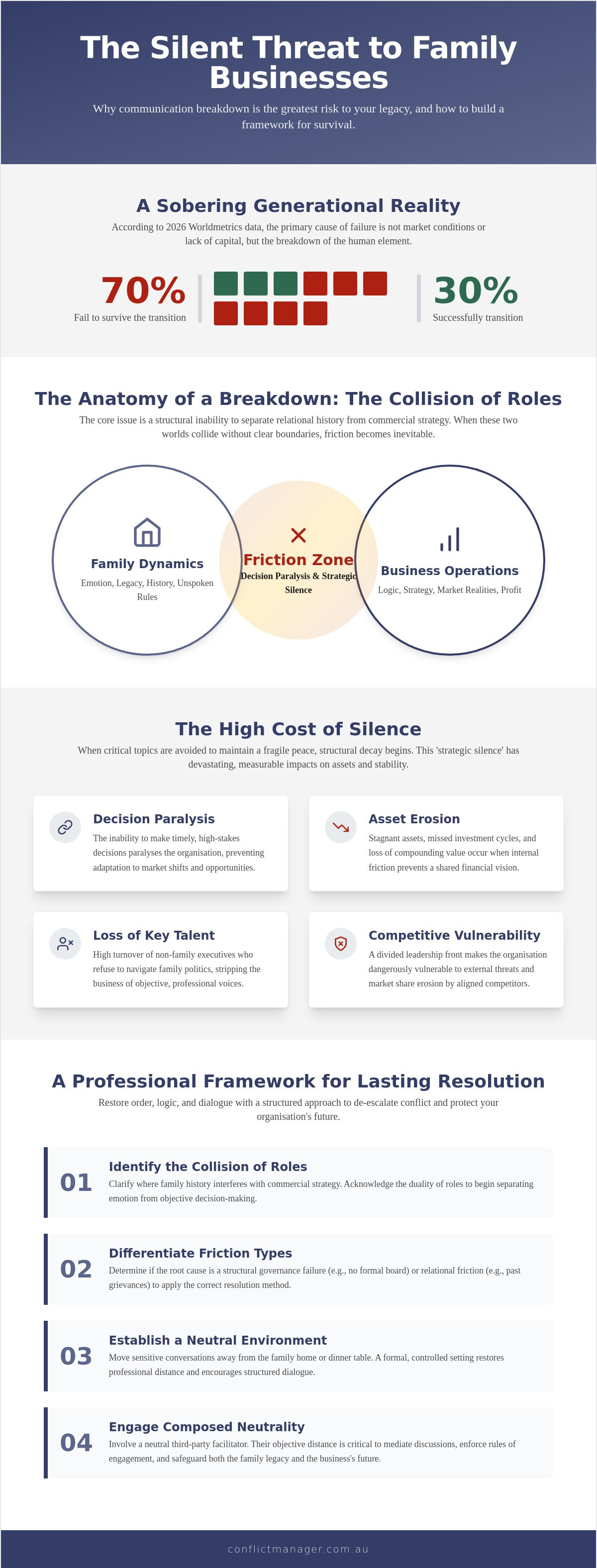
Statistics from Worldmetrics in 2026 reveal a sobering reality: only 30 per cent of family businesses survive the transition to the second generation. This failure isn't typically due to poor market conditions or a lack of capital. Instead, it's almost always a failure of the human element. Legacy. History. Friction. When the dinner table becomes an extension of the boardroom, a communication breakdown in family business becomes nearly inevitable. You've likely felt the weight of avoided conversations or the sting of generational resentment during a strategy meeting. It's a heavy burden to carry when the vision of your ancestors feels at odds with the logic of the modern market.
We understand that the blurring of boundaries creates a unique kind of friction that leads to decision-making paralysis. Order. Logic. Resolution. This article provides a professional framework for identifying, de-escalating, and resolving the complex communication failures that threaten your stability. We'll examine how to restore a sense of professional distance while protecting your family's hard-earned assets. By the end, you'll have the tools to establish a sustainable framework for future dialogue that ensures your organisation thrives for decades to come.
Key Takeaways
- Identify the "collision of roles" to clarify where family history interferes with commercial strategy and professional decision-making.
- Understand the financial risks of a communication breakdown in family business, specifically how silence leads to asset erosion and operational paralysis.
- Differentiate between structural governance failures and relational friction to apply the correct resolution method for each unique challenge.
- Establish a professional framework for dialogue by moving sensitive conversations away from the family home into a neutral, controlled environment.
- Discover how engaging a neutral third party can provide the objective distance required to safeguard both the family legacy and the business’s future.
The Anatomy of Communication Breakdown in Family Business
History. Identity. Friction. At its core, a communication breakdown in family business is rarely a simple failure of speech. It is a structural inability to separate relational history from commercial strategy. When the grievances of the past are allowed to dictate the decisions of the present, the organisation loses its capacity for objective movement. This breakdown often manifests as a "collision of roles" where individuals struggle to navigate the duality of being both a family member and a corporate stakeholder. This creates a unique set of challenges in family-owned companies that require more than just standard management theory to resolve.
Unaddressed friction eventually matures into a state of "strategic silence." In this environment, the leadership team avoids critical topics to maintain a fragile peace at home. While this silence may feel like stability, it is actually a form of internal rot that prevents the business from adapting to market shifts. These patterns are frequently cyclical. They are passed down through intergenerational wealth transfers, where the communication failures of the founders become the cultural inheritance of the successors.
The Blurring of Professional and Personal Boundaries
Maintaining an objective distance is notoriously difficult when the boardroom is also the family centre. When "kitchen table" decisions are made outside of formal governance structures, the integrity of the business is compromised. These informal agreements bypass accountability and leave non-family executives in a state of confusion. Role ambiguity inevitably leads to deep-seated resentment and stalled decision-making that paralyses the entire organisation.
The Psychology of Legacy and Expectation
The "founder’s vision" often carries a weight that can feel suffocating to subsequent generations. This legacy is not just a business plan; it's a moral imperative. When a communication breakdown in family business is driven by the fear of disappointing a patriarch or matriarch, the leadership team loses its ability to pivot. This fear leads to suppressed communication to avoid the perceived shame of failing the family name. These dynamics are often governed by "unspoken rules" that dictate how the family should behave, acting as invisible barriers to innovation and honest dialogue.
The High Cost of Silence: Impact on Asset Integrity and Stability
Silence in a family office is often mistaken for peace. It is, in reality, a form of structural decay. When a communication breakdown in family business occurs, the first casualty is the ability to make timely, high-stakes decisions. This paralysis prevents the organisation from responding to shifts in the market, such as the 6.75 per cent prime rate observed in July 2026. If stakeholders cannot reach a consensus on investment strategies, assets remain stagnant while the global economy moves forward. The cost of this inertia is rarely measured in a single day, but it accumulates with devastating speed.
Asset erosion is the inevitable result of this prolonged inactivity. Without a clear, shared vision for the future, long-term capital preservation becomes impossible. This isn't just about missing a single trade; it's about the gradual loss of compounding value and the missed opportunities for diversification. When internal friction consumes the leadership team's energy, the business becomes dangerously vulnerable to external threats. Competitors sense this lack of alignment and move to capture market share that was once secure. Your legacy deserves a more robust defence than a divided front can provide.
There is also a significant human cost beyond the family circle. Non-family executives, such as CEOs or CFOs, often find themselves caught in the crossfire of domestic disputes. This toxic environment leads to high turnover rates among top-tier talent who prioritise their professional reputation over navigating family politics. Losing these objective voices further insulates the family from reality, accelerating the downward spiral. Engaging in professional Stakeholder Facilitation can provide the necessary buffer to keep your executive team intact and your operations steady.
Threats to the Family Office Structure
Disputes that remain unresolved eventually reach a point of no return. This often results in the forced fragmentation of family trusts and the liquidation of shared assets to satisfy diverging interests. The legal and financial implications are vast, often resulting in tax inefficiencies and the loss of generational scale. Protecting the structural integrity of the office requires a neutral, objective approach that prioritises the health of the assets over the heat of the argument.
The Emotional Toll on Family Governance
The high-emotion environment that precedes a total breakdown is physically and mentally exhausting. Chronic stress doesn't just affect the balance sheet; it impacts the wellbeing of every stakeholder involved. Emotional entanglement clouds the discernment required for complex wealth management, turning objective financial decisions into personal battlegrounds. When feelings dictate the flow of capital, the legacy is already in jeopardy.
Structural vs. Relational Friction: Identifying the Root Cause
Origins. Systems. Conflict. To resolve a communication breakdown in family business, one must first diagnose the source of the heat. Friction typically falls into two distinct categories: relational and structural. Relational friction is the byproduct of personal history, rooted in sibling rivalries or unresolved childhood dynamics that have migrated into the office. Structural friction, conversely, is a failure of governance. It occurs when roles are ill-defined and authority is ambiguous. While a spreadsheet can solve a liquidity issue, it's a blunt instrument for a twenty-year-old grievance. Business logic cannot heal relational wounds. It only masks them until they erupt during a critical board meeting.
Many families attempt an "internal fix" over Sunday dinners or casual catch-ups. These settings lack the boundaries required for objective analysis. They often exacerbate the problem by bringing work stress into the family sanctuary. Professional facilitation provides a necessary barrier. Some stakeholders worry that external intervention feels too formal for a private family. In reality, this formality is a protective measure. It creates a safe, neutral space where difficult truths can be spoken without the fear of permanent relational damage. It's about moving from the heat of the moment to the cool logic of resolution.
Governance Gaps and Decision-Making Rights
A primary driver of structural conflict is the absence of clear decision-making rights. When everyone feels they have a say but no one knows who has the final vote, progress stalls. A Family Constitution serves as a vital tool here, formalising communication channels and clarifying expectations. Professional governance acts as a buffer. It ensures that business logic remains the priority during commercial discussions, preventing family emotion from derailing the organisation's strategic goals.
Intergenerational Vision Misalignment
Succession creates a natural point of friction. Founders often operate from a "Preservation" mindset, focused on protecting what they've built. Successors frequently lean toward "Innovation," seeking to adapt the business for a digital future. According to a 2026 Deloitte Private survey, 85 per cent of family business executives believe strategic succession planning is critical, yet only 23 per cent are actively implementing a plan. This gap is where communication fails. Facilitated dialogue helps align these disparate goals, ensuring the legacy is preserved while allowing the next generation to lead with confidence.
Restoring Dialogue: A Framework for Resolution
Order. Clarity. Movement. Moving from a state of volatility toward a vision of structured resolution requires a deliberate shift in both mindset and environment. A communication breakdown in family business cannot be mended in the same rooms where the friction was first ignited. Relocating the dialogue to a neutral centre, away from the family home or the primary office, strips away the domestic triggers that often fuel resentment. This physical distance is a prerequisite for establishing "rules of engagement" that prioritise the health of the organisation over individual grievances. In this space, the suspension of historical narratives is mandatory. Stakeholders must commit to active listening, a process that requires hearing the words spoken today rather than the echoes of arguments from decades past.
Establishing these boundaries allows the leadership team to transition from a reactive posture to a proactive strategy. It's about creating a container for difficult truths to be aired without the fear of permanent relational damage. When the environment is controlled and the rules are clear, the pulse of the room lowers. This calm is where real work begins. By focusing on the present commercial reality, the family can begin to untangle the emotional knots that have paralysed their decision-making for years.
The Role of Professional Facilitation
Volatile situations demand total objectivity. A neutral third party is essential because they possess no stake in the family’s personal history. When a communication breakdown in family business reaches a stalemate, an external perspective provides the necessary distance to view the situation without bias. Facilitators manage high-emotion business disputes with a composed authority, acting as a steady hand to guide stakeholders through necessary structural changes. This expert guidance brings clarity to clouded situations, allowing for a level of honesty that is often impossible within the family circle. If you are ready to move from friction to flow, our Family Conflict Resolution services provide the neutral ground required to protect your legacy.
Formalising Communication Channels
- Step 1: Audit informal habits. Identify where "kitchen table" decisions occur and how they bypass formal governance. This audit reveals the gaps where logic is often replaced by emotion.
- Step 2: Regular stakeholder meetings. Establish a cadence of professional meetings with clear agendas. These sessions must be treated with the same rigour as any other corporate board meeting.
- Step 3: Conflict management protocol. Implement a formal process for handling future disagreements. This protocol ensures that when friction arises, there is a pre-agreed path toward resolution.
- Step 4: Document everything. Decisions must be documented in writing to avoid future "assumption-based" conflict. This creates a definitive record; it ensures all parties are aligned on the same set of facts and expectations.
The Value of Composed Neutrality: Why External Mediation Works
Integrity. Perspective. Stability. When internal efforts to resolve a communication breakdown in family business reach their limit, the introduction of a neutral third party is not a surrender; it is a strategic recalibration. Conflict Manager operates as an authoritative expert in family office and organisational resolution, providing the objective distance required to view volatile situations with total clarity. A communication breakdown in family business often stems from deep-rooted patterns that require a specific, expert-led approach to break. By removing the emotional entanglement of personal history, we allow stakeholders to focus on the structural integrity of their enterprise. This process preserves both the high-value business assets and the vital family relationships that underpin them.
Sustainable outcomes are only possible when the dialogue is guided by a seasoned professional who understands the weight of responsibility. We don't just facilitate a conversation; we architect a framework for future stability. This intervention is an investment in the longevity of the family legacy, ensuring that the friction of today doesn't become the insolvency of tomorrow. When stakeholders are guided by a steady hand, the pulse of the organisation slows, and logic returns to the boardroom. Moving from complexity toward a vision of structured resolution becomes a methodical, inevitable progression.
A Reassuring Path Through High-Stakes Friction
The Conflict Manager approach is grounded, reassuring, and fundamentally objective. We provide a sense of order during periods of high stress, acting as a buffer between the heat of personal dispute and the necessity of commercial movement. Our firm brings extensive experience in navigating the complexities of high-net-worth families with sizable assets, where the stakes involve more than just operational profit. We understand that in these environments, a single misstep in communication can have cascading effects on trust structures and investment portfolios. This expertise allows us to guide families through transitions with a composed authority that minimises disruption and restores professional distance.
Securing the Future of the Family Business
It's vital to view mediation not as a sign of failure, but as a sophisticated leadership choice. Recognising when internal dynamics are no longer productive is a mark of executive maturity. Preserving a multi-generational legacy requires more than just hard work; it demands the clarity and stability that only a neutral facilitator can provide. By establishing a professional framework for resolution today, you are protecting the assets and the name for the generations that follow. If you are ready to restore order to your organisation, we invite you to Enquire about professional family business mediation to begin the journey toward a structured and sustainable future.
Securing Your Legacy Through Structured Dialogue
Legacy. Stability. Continuity. Protecting a multi-generational enterprise requires more than just commercial acumen. It demands the courage to address the human friction that stalls progress. We've examined how identifying the root cause of conflict, whether structural or relational, allows for a transition toward professional governance. By establishing formal communication channels and moving sensitive discussions to a neutral setting, you safeguard the assets and the reputation you've worked so hard to build.
A communication breakdown in family business isn't a sign of failure. It's a signal that your current systems are no longer sufficient for the complexity of your growth. Our seasoned experts specialise in high-net-worth family office mediation, providing a steady hand to manage high-emotion disputes with total objectivity. We focus on delivering sustainable outcomes that preserve the family legacy while ensuring the organisation remains agile. Restore clarity to your family business with expert mediation and lead your organisation into its next chapter with confidence. The path toward resolution is clear, and the future of your legacy is within reach.
Frequently Asked Questions
What are the most common signs of a communication breakdown in a family business?
Common indicators include decision-making paralysis, the emergence of "strategic silence," and the persistent blurring of boundaries between the dinner table and the boardroom. You'll often notice that critical commercial topics are avoided to maintain a fragile peace, or conversely, every strategy meeting devolves into a rehashing of personal history. These patterns are classic symptoms of a communication breakdown in family business that require immediate, objective attention.
How do we separate family issues from business decisions during a dispute?
The most effective method is to establish formal governance structures that create a clear buffer between relational history and commercial logic. This involves moving all business discussions away from the family home into a neutral centre and adhering to a strict, documented agenda. By formalising decision-making rights, you ensure that the organisation’s strategy is driven by market reality rather than shifting emotional tides within the family circle.
Can a family business survive a major communication failure between the founders and successors?
Survival is entirely possible if all parties commit to a professional framework for resolution that addresses the underlying friction. While 2026 data from Worldmetrics suggests only 30 per cent of family businesses survive the transition to the second generation, those that do often utilise external facilitation to align disparate visions. Success requires a willingness to prioritise the longevity of the legacy over the need to be "right" in a personal argument.
What is the difference between family mediation and standard business mediation?
Family mediation specifically addresses the complex intersection of personal history and professional responsibility, whereas standard mediation focuses on contractual or operational disputes. Resolving a communication breakdown in family business requires a deep understanding of psychological dynamics and the weight of intergenerational expectation. It's a bespoke process designed to heal the human element while simultaneously protecting the structural integrity of the business assets.
When is the right time to engage a neutral third-party mediator for our family office?
You should seek external intervention when internal efforts to resolve a dispute result in repetitive arguments or a total cessation of dialogue. If your leadership team is experiencing decision-making paralysis or if there is deep-seated resentment regarding the future vision of the company, a mediator provides the necessary distance. Engaging a professional before a "point of no return" is reached is a strategic choice that preserves both capital and relationships.
How can we prevent personal resentments from affecting our business’s asset integrity?
Implementing a formal conflict management protocol ensures that personal grievances don't dictate the flow of capital or investment strategy. When roles are clearly defined and governance is transparent, the business remains insulated from domestic friction. This structured approach acts as a safeguard, ensuring that the preservation of the family legacy remains the primary objective, even during periods of high interpersonal stress.
Will professional mediation make our family conflict public or more stressful?
Professional mediation is a strictly confidential process designed to lower the pulse of the room and reduce the overall stress of the stakeholders. Unlike legal proceedings, which can expose private matters to the public record, mediation occurs in a controlled and private environment. A seasoned expert brings a sense of order and composed authority to the situation, helping to de-escalate high-emotion disputes rather than inflaming them.
How long does the family business conflict resolution process typically take?
The timeline depends on the complexity of the organisational structure and the depth of the friction, but a clear path forward is typically established within several weeks. It's a methodical progression rather than a quick fix. The goal is to move the family from a state of volatility toward a sustainable framework for future dialogue, ensuring the long-term stability of the enterprise and its leadership team.


