

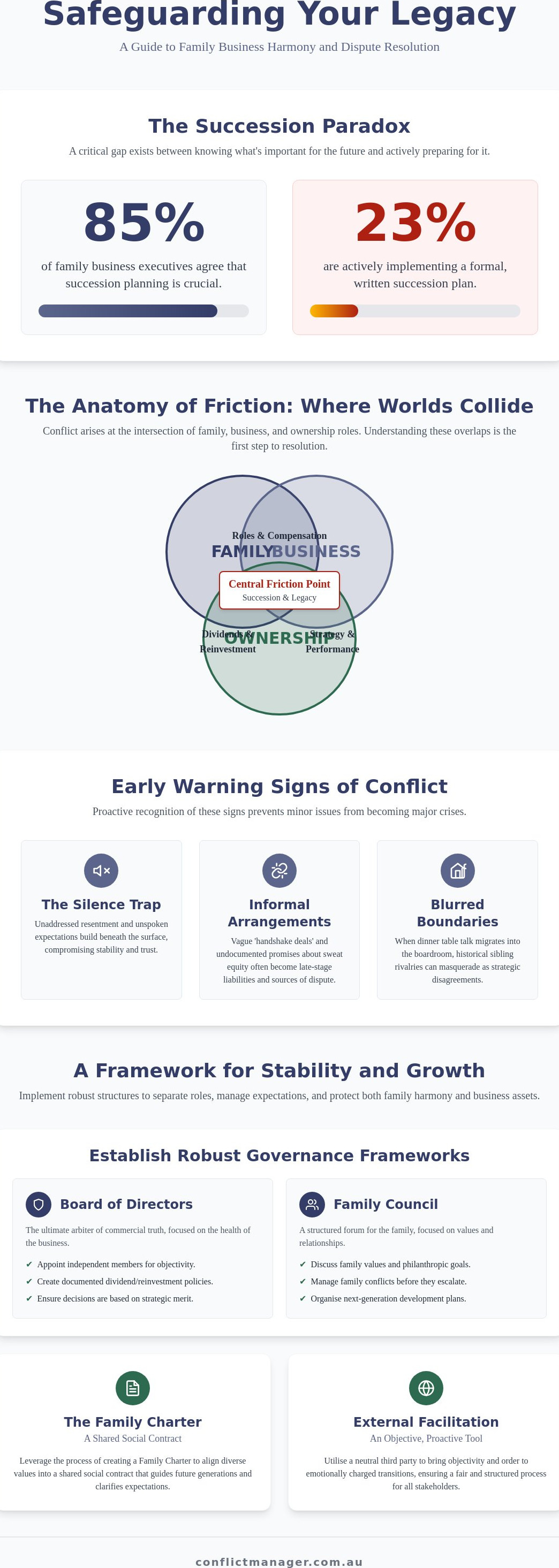
Did you know that while 85 per cent of family business executives agree that succession planning is crucial, only 23 per cent are actively implementing a plan? This succession paradox, documented in February 2026, highlights a sobering reality for founders who've poured their lives into building a legacy. It's often not market forces that dismantle these enterprises, but the internal friction that arises when family business dispute resolution is left to chance rather than strategy. You've likely felt the tension when a simple Sunday lunch turns into an unplanned board meeting, leaving everyone drained and anxious about the future of the firm.
Legacy. Stability. Continuity. These are the pillars of a lasting enterprise, yet they're often the first to crumble under the weight of unspoken expectations. We understand that the lines between the dinner table and the boardroom often blur; this creates a unique set of pressures that can threaten both your family harmony and your hard-earned wealth. This guide will show you how to safeguard your business through proactive facilitation and robust governance frameworks. We'll explore how to establish a clear separation of roles, creating a sustainable decision-making structure that preserves your assets for the long term.
Key Takeaways
- Understand how the Three-Circle Model helps identify structural friction points where family, business, and ownership interests intersect.
- Establish robust governance frameworks and independent boards to provide the "rules of engagement" necessary for effective family business dispute resolution.
- Leverage the process of creating a Family Charter to align diverse values into a shared social contract that guides future generations.
- Learn to spot early warning signs like the silence trap before unaddressed resentment compromises your business stability or family wealth.
- Utilise external stakeholder facilitation as a proactive tool to bring objectivity and order to emotionally charged transitions.
The Unique Anatomy of Friction in Family-Owned Businesses
Connection. History. Capital. Family enterprises represent a common model of economic organization that blends the intimacy of the home with the rigour of the marketplace. This intersection is where the unique anatomy of friction begins. Conflict in this environment isn't simply about profit margins or quarterly targets. It's about the decades of emotional history that precede every commercial decision. When these worlds collide, the result is often a complex knot of emotional equity that can either solidify a legacy or tear it apart.
Traditional corporate HR frameworks often struggle to untangle these knots. Standard mediation might address a breach of policy, but it rarely touches the deep-seated interpersonal dynamics that drive family friction. Most HR professionals are trained to manage employees, not relatives who share a surname and a dinner table. To understand where the pressure builds, we look to the Three-Circle Model. This framework maps the overlapping interests of the family, the business, and the ownership. Friction naturally occurs where these circles overlap. A family member who owns shares but doesn't work in the business will naturally view a capital reinvestment plan differently than a sibling who manages daily operations. Effective family business dispute resolution must acknowledge these distinct perspectives to find a path forward.
The Blurring of Professional and Personal Boundaries
The greatest risk to stability is the migration of table talk into the boardroom. Without structured filters, historical sibling rivalries can masquerade as strategic disagreements. An adult child might feel the psychological weight of a legacy they didn't choose, leading to resentment that manifests as professional obstruction. These aren't just business problems; they're family dynamics played out on a commercial stage. Investing in family business dispute resolution early prevents these personal echoes from drowning out commercial logic.
Why Informal Arrangements Create Future Risks
Early-stage informality is a common trap. Handshake deals and vague promises about sweat equity often feel like trust, but they eventually become late-stage liabilities. When expectations aren't documented, resentment grows as the business scales and roles become more complex. Transitioning from a family-first to a business-first mindset is essential for survival. It requires moving away from informal agreements toward a structure where roles are defined by capability rather than birthright. Without this shift, the business remains vulnerable to the changing whims of individual family members.
Establishing Robust Governance Frameworks for Prevention
Structure. Discipline. Foresight. These elements form the bedrock of a resilient enterprise. While the previous section explored the emotional anatomy of friction, we must now look at the structural solutions that contain it. Governance acts as the "rules of engagement," providing a neutral framework that protects the business from the inherent volatility of family life. By establishing formal boundaries, you ensure that decisions are made based on strategic merit rather than momentary sentiment. This is a primary pillar of effective family business dispute resolution.
A formal Board of Directors serves as the ultimate arbiter of commercial truth. Including independent members is vital; they provide the unruffled objectivity needed to navigate difficult transitions. They don't carry the baggage of childhood rivalries or the pressure of parental expectations. Alongside this, documented dividend and reinvestment policies are essential. They manage wealth expectations by clarifying exactly how profit is distributed versus how much is retained for growth. Without these rules, individual financial needs can quickly spark conflict and drain the company's liquidity.
While the Board focuses on the business, a Family Council focuses on the family. These structured meetings are distinct from board meetings; they provide a space to discuss family values, philanthropic goals, and the next generation's development. It's about managing family business conflicts through alignment before they escalate into commercial crises. If you find these conversations are becoming circular or stalled, seeking external stakeholder facilitation can help restore order and clarity.
The Power of the Shareholders’ Agreement
Clarity. Certainty. Protection. A robust Shareholders' Agreement is the ultimate defensive tool. It must define clear exit strategies, including buy-sell agreements and specific valuation formulas, to prevent disputes over share prices when a member wishes to leave. It's also critical to distinguish between economic interest and decision-making power. Just because a relative owns 20 per cent of the company doesn't mean they have the inherent right to veto strategic shifts. Finally, including mandatory mediation clauses ensures that any deadlock is addressed through professional family business dispute resolution before it reaches a courtroom.
Professionalising the Family Office
Asset management. Reporting. Merit. Professionalising the Family Office centralises wealth management, which reduces friction between individuals. It allows for the establishment of clear employment criteria. Roles should be earned through merit rather than birthright. By creating transparent reporting lines that mirror non-family corporate structures, you remove the ambiguity that often breeds resentment. This professional distance ensures the business remains a vehicle for wealth preservation rather than a source of interpersonal stress.
The Family Charter: Aligning Values and Expectations
Values. Purpose. Alignment. While legal documents like Shareholders' Agreements provide the skeleton of an enterprise, the Family Charter provides its heart. It's a non-binding but morally authoritative "social contract" that defines the family’s relationship with the business. Legal contracts focus on what must happen. The charter focuses on how the family wants to behave. This distinction is vital because it addresses the human element, specifically the subtle nuances of identity and legacy, that rigid legalistic frameworks often overlook.
The process of creating the charter is often as valuable as the final document itself. It forces difficult conversations into the light in a controlled, safe environment. By formalising these shared expectations, you create a preemptive layer of family business dispute resolution that prevents small misunderstandings from calcifying into permanent rifts. Integrating the charter into the broader business strategy ensures the family’s collective vision remains the compass for commercial growth. This approach aligns with The Three Components of Family Governance, which underscores the importance of a family constitution in managing the complex interface between relatives and the firm.
Core Components of an Effective Family Charter
A well-crafted charter begins with a Mission Statement. This defines the "why" behind the family’s continued business involvement, moving beyond simple profit toward a shared sense of purpose. It also includes Conflict Resolution Protocols. These are agreed behaviours that dictate how the family will interact when disagreements arise, ensuring that professional respect isn't lost during heated debates. Finally, the charter establishes guidelines for education and philanthropy. These ensure the next generation is prepared for stewardship, viewing their roles as a responsibility rather than a mere inheritance.
Facilitating the Charter Creation Process
Success depends on the environment. It's essential to hold these discussions on neutral ground, moving away from the home or the boardroom to neutralise old power dynamics. Every voice must be heard. If younger family members feel sidelined during this phase, they're more likely to sabotage the agreement later. A neutral facilitator plays a critical role here. They manage high-emotion contributions with a steady hand, ensuring the conversation remains focused on the future rather than litigating the past. This professional distance allows the family to reach a consensus that serves as a cornerstone for family business dispute resolution, ensuring the agreement feels both fair and sustainable.
Identifying Early Warning Signs of Family Business Friction
Resentment. Silence. Erosion. These are the quiet precursors to a corporate crisis. While many people associate conflict with heated arguments, the most dangerous stage of a dispute is often the quietest. This is the "slow burn" of unaddressed grievances. It begins when family members enter the "silence trap," choosing to stop discussing business matters altogether to avoid friction. While this may feel like peace, it's actually a sign of deep structural instability. When communication ceases, the path to family business dispute resolution becomes significantly more complex because the underlying issues have been allowed to calcify.
Triangulation is another critical warning sign. This occurs when family members talk about each other rather than to each other, often using a parent or a neutral sibling as a conduit for complaints. This behaviour erodes trust and bypasses the formal governance structures we've previously established. External stressors, such as the ongoing economic uncertainty and volatile interest rates currently affecting the Australian market, often act as a catalyst. These pressures don't create new problems; they simply expose the cracks that were already there. If you recognise these patterns in your own firm, it's time to consider professional family conflict resolution before the situation escalates.
Succession Anxiety and the "Founder’s Shadow"
Succession is rarely a single event. It's a transition that often triggers deep anxiety. You might see the "founder’s shadow" when a leader struggles to let go, creating a strategic bottleneck that stifles the next generation. This leads to the "waiting in the wings" syndrome, where successors grow resentful due to a lack of clear timelines or authority. Often, this friction is exacerbated by the "fair vs. equal" debate. Founders may want to be fair to all children, but treating them equally in terms of ownership transfer can sometimes cripple the business's operational agility.
Role Confusion and Performance Drift
Accountability. Merit. Transparency. When these vanish, performance drift begins. A common warning sign is when family members hold roles that exceed their current professional capabilities. This breakdown of accountability occurs when family status protects poor performance, leading to resentment among non-family staff and capable relatives alike. If shadow decision-making, where the real choices are made in private hallway chats rather than formal meetings, becomes the norm, your governance has failed. These shifts signal that the business is being run on sentiment rather than strategy, making family business dispute resolution an urgent priority.
The Strategic Case for External Facilitation and Mediation
Objectivity. Perspective. Equilibrium. These are the essential assets an external facilitator brings to a family enterprise. While we have discussed the structural tools of governance and the moral authority of a Family Charter, the presence of a neutral third party is often what allows these frameworks to function. External facilitation isn't merely a response to a crisis; it's a proactive maintenance tool for the family legacy. It provides the steady hand required to navigate high-emotion transitions, ensuring that family business dispute resolution becomes a process of growth rather than one of division.
There is a fundamental difference between legal mediation and family facilitation. Legal mediation is frequently adversarial, focusing on the division of assets and the definition of rights within a rigid framework. It's often the final step before the courtroom. Facilitation, however, is restorative. It seeks to align stakeholders through dialogue and shared purpose, addressing the emotional undercurrents that legal documents simply cannot reach. By guiding stakeholders through structural change with composure, a professional facilitator helps transform a period of volatility into a moment of strategic renewal. This restorative approach to family business dispute resolution ensures that the business remains a vehicle for wealth, not a source of pain.
Why Internal Resolution Efforts Often Struggle
Blind spots. Bias. History. These are the primary reasons internal efforts to resolve conflict often fail. Family members are typically too close to the situation to see the structural flaws that are driving the friction. Even when an internal peacemaker has the right answer, their perceived bias can destroy their effectiveness. A sibling or parent is never seen as truly neutral. A professional facilitator uses an elevated, objective register that naturally lowers the pulse of the room. This objective distance allows for the use of language that clarifies rather than inflames, making it possible to address deep-seated issues without triggering defensive reactions.
Achieving Sustainable Outcomes through Expert Guidance
Clarity. Resolution. Continuity. The goal of external intervention is to move the family from a state of disruption toward a vision of structured resolution. This isn't a temporary fix; it's the creation of a sustainable framework that protects both the balance sheet and the family bond. When decisions are made through a facilitated process, the outcomes are more likely to be honoured by all parties because the process itself was seen as fair and objective. If your business is currently navigating the complexities of transition or internal friction, the next logical step involves engaging Conflict Manager for a confidential consultation. Taking this step ensures that your legacy is protected by a steady, experienced hand during times of change.
Securing the Future of Your Family Legacy
Legacy. Resilience. Order. Transitioning from a state of internal friction to one of structural clarity requires more than just legal documents; it demands a fundamental shift in how the family views its collective responsibility. We've explored how robust governance frameworks and the creation of a Family Charter provide the necessary boundaries to protect both the firm and the family bond. By identifying early warning signs like the silence trap or succession anxiety, you can intervene before resentment compromises your stability.
Sustainable change depends on total objectivity. We provide specialised mediation for high-net-worth families and expert-led facilitation for complex organisational change, bringing a composed, objective approach to high-stakes disputes. This professional distance is essential for effective family business dispute resolution. It allows your family to move past historical friction toward a shared vision of prosperity. Your legacy deserves a structured path forward, ensuring that what you've built remains a source of pride for generations to come.
Secure your family legacy with expert facilitation from Conflict Manager
Frequently Asked Questions
Is a family charter legally binding in Australia?
A family charter is typically not legally binding in Australia; it serves as a morally authoritative social contract rather than a commercial deed. It defines the family’s shared vision and values to guide future generations. For legal enforceability, you must mirror the charter's core principles in a Shareholders' Agreement or the company constitution, which provide the necessary legal framework for enforcement.
How do we handle a family member who is underperforming in the business?
Address underperformance by shifting from birthright-based roles to merit-based accountability. You should establish clear job descriptions and performance metrics that apply to every staff member, regardless of their surname. If internal discussions become too personal, external facilitation can help implement these professional standards without damaging the underlying family relationships.
What is the difference between family mediation and traditional business mediation?
Family mediation focuses on restoring relationships and managing emotional history, whereas traditional business mediation is often a purely commercial transaction. Traditional methods often ignore the decades of personal dynamics that drive friction. Restorative family business dispute resolution seeks to align the family's emotional intent with the company's strategic requirements, ensuring long term harmony.
When is the best time to start succession planning to avoid a dispute?
The best time to start is at least five to ten years before an anticipated transition. With 78 per cent of family business executives expecting a CEO transition by 2036, waiting for a crisis is a high risk strategy. Early planning allows you to bridge the "succession paradox" by gradually preparing the next generation for their future responsibilities.
How do we involve independent directors without losing family control?
You can involve independent directors by appointing them to a minority of board seats or as non-voting advisors. This provides the unruffled objectivity needed for strategic growth while keeping ultimate decision making power with the family shareholders. It's about gaining expert perspective and structural integrity without surrendering the family's long term vision for the enterprise.
Can we prevent a dispute if the family members are already not speaking?
Disputes can still be prevented through a process of individual stakeholder facilitation. A neutral third party can meet with family members separately to identify common ground and establish new communication protocols. This "shuttle diplomacy" often creates the safe space needed to move from a state of disruption toward a structured return to the boardroom.
What should we do if a family member wants to exit the business and be bought out?
Refer to your existing Buy-Sell agreement and established valuation formulas to ensure a fair and predictable exit. Recent 2026 regulations, such as those following the Connelly v. United States ruling, may affect how life insurance proceeds impact company valuation for estate purposes. It's vital to review these agreements regularly to ensure they remain equitable and financially sustainable for the firm.
How does a neutral facilitator help with high-emotion family meetings?
A neutral facilitator manages the interpersonal dynamics that often derail high stakes meetings. They ensure every voice is heard and prevent any single individual from dominating the conversation through historical authority. By maintaining a composed and objective environment, they help the family focus on strategic family business dispute resolution rather than litigating historical grievances.


