

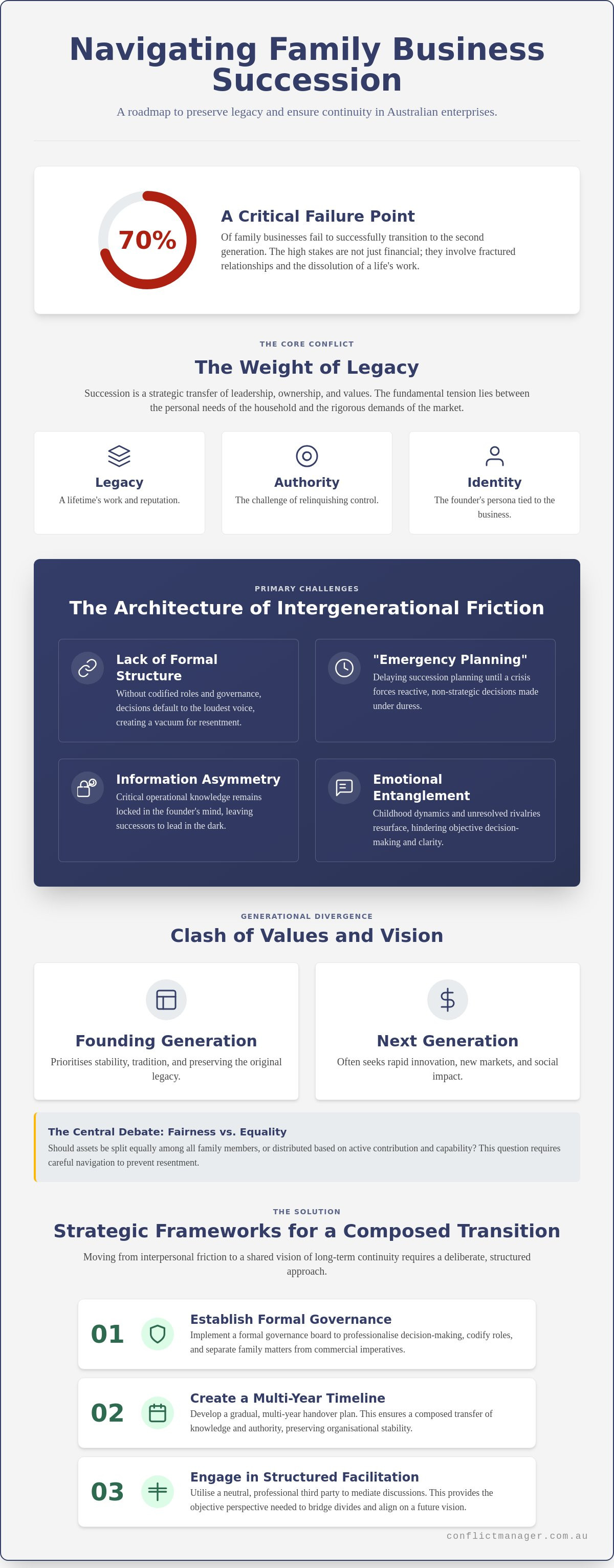
Legacy. Authority. Identity. These three pillars often crumble when a founder prepares to step away, leading to 70% of family businesses failing to reach the second generation. While the financial stakes are high, the true cost of family business succession disputes is often measured in fractured relationships and the slow dissolution of a life's work. You've likely spent decades building a name that stands for something, only to find that the transition of power feels more like a battlefield than a passing of the baton. It's a common struggle; the fear that your hard-earned stability might vanish under the weight of intergenerational friction is entirely valid.
This article provides a roadmap to manage these volatile transitions, showing you how to resolve the emotional and structural hurdles that put your continuity at risk. We'll examine the shift from informal family dynamics to professional governance, ensuring your leadership transition is both methodical and calm. By the end, you'll understand how to implement structures that protect your assets and, more importantly, your family's peace of mind for years to come.
Key Takeaways
- Recognise that true succession is a strategic transfer of values and leadership, necessitating a careful balance between family identity and commercial requirements.
- Identify the structural vulnerabilities and the risks of "emergency planning" that often trigger family business succession disputes during periods of transition.
- Learn why internal proximity and emotional entanglement can lead family members to self-censor, hindering the clarity needed for objective decision-making.
- Establish formal governance boards and multi-year transition timelines to ensure a composed, gradual handover of authority that preserves organisational stability.
- Discover how structured facilitation provides the neutral perspective required to move from interpersonal friction toward a vision of long-term continuity.
Understanding the Weight of Legacy: Why Succession Challenges Arise
Succession planning is the strategic transfer of leadership, ownership, and values. It is a deliberate architecture of continuity. In many Australian enterprises, the fundamental tension lies between family identity and commercial necessity. This friction often ignites family business succession disputes when the personal needs of the household clash with the rigorous demands of the market. As we approach 2026, Australia faces a critical juncture in intergenerational wealth transfer. Research suggests that billions of dollars in assets are poised to change hands, yet many firms remain unprepared for the structural shift. For many, this isn't just a transaction; it's the culmination of a lifetime's work.
The "Founder’s Shadow" looms large over this process. After decades of stewardship, the difficulty of relinquishing control can be profound. It's not merely about stepping down; it's about the perceived loss of a primary identity. When a founder struggles to let go, the vacuum of clear leadership often leads to organisational paralysis. This hesitation isn't a sign of weakness, but rather a reflection of the deep emotional investment required to build a legacy from the ground up.
The Interplay of Emotion and Asset Integrity
High-stakes assets often act as a catalyst for suppressed grievances. Property, shares, and intellectual property aren't just line items on a balance sheet; they are symbols of status, power, and history. We often see the risk of "succession by proclamation", where a founder dictates terms without consultation. This approach lacks the durability of collaborative facilitation. True structural integrity requires more than just legal documentation; it requires a shared understanding of family business dynamics to ensure the enterprise survives the emotional weight of the transition. Without a neutral party to facilitate these discussions, the risk of asset fragmentation increases.
Generational Divergence in Values and Vision
Vision. Risk. Modernity. The first generation often prioritises stability and tradition, while the second or third may seek rapid innovation or social impact. These differing risk appetites can destabilise even the most profitable companies if they aren't managed with care. The "fairness versus equality" debate remains a central theme in many family business succession disputes. Should assets be split equally among all children, or should they be distributed based on active contribution to the firm? Navigating these questions without professional guidance frequently results in long-term resentment. Clear governance is the only way to bridge the gap between yesterday's legacy and tomorrow's growth, ensuring the business remains a source of unity rather than a cause of division.
Primary Challenges: The Architecture of Intergenerational Friction
Structures. Roles. Expectations. These are the scaffolding of a healthy enterprise, yet they are frequently the first to erode under the pressure of transition. Without a formal framework for decision-making, family business succession disputes often arise from simple ambiguity. When power isn't codified, it defaults to the loudest voice or the oldest sibling. This lack of clear governance creates a vacuum where resentment can fester, turning a commercial transition into a personal crisis. Professional governance isn't a bureaucratic burden; it's the safeguard of both the balance sheet and the family bond.
Delay is a decision in itself. Many Australian firms fall into the "Emergency Planning" trap, avoiding the topic until a health crisis or market downturn forces their hand. Decisions made under duress are rarely strategic. They are reactive, often favouring immediate peace over long-term viability. This reactive state is compounded by information asymmetry, where the founder holds critical operational knowledge that hasn't been codified. When the "how" and "why" of a business remain locked in one person's mind, the successor is left to lead in the dark. For those struggling to bridge these gaps, engaging in stakeholder facilitation can provide the objective distance required for a stable handover.
The boardroom is rarely immune to the ghosts of the past. Childhood dynamics often resurface during high-stakes negotiations, where a dispute over capital expenditure might actually be the echo of an unresolved sibling rivalry. Managing the expectations of family members not active in the business is equally vital. Entitlement can clash with meritocracy, leading to friction when "bloodline" expectations meet the cold reality of "bottom line" requirements. Acknowledge these patterns early. It's the only way to prevent history from dictating the future.
Governance Gaps and Structural Misalignment
Boundary blurring is a significant risk in multi-generational offices. When the dinner table becomes a proxy for the boardroom, the lack of clear roles creates inevitable friction. A Family Constitution serves as a vital tool for clarity. It's not merely a legal hurdle, but a living document that defines how the family interacts with the business. By establishing clear boundaries, you ensure that personal grievances don't disrupt organisational momentum.
The Psychological Barriers to Handing Over the Reins
The founder's fear of losing their sense of purpose is a powerful deterrent to action. Post-succession life can feel like a void, leading many to subconsciously sabotage the transition to maintain their relevance. On the other side, the successor often carries an invisible weight of anxiety regarding their own competence and the preservation of the legacy. The Succession Paradox occurs when a founder's intense desire to protect their legacy leads to the avoidance of the very structural changes and difficult conversations necessary to secure it.
The Limitation of Internal Resolution: Why Proximity Hinders Clarity
Proximity. History. Intimacy. These are the strengths of a family unit, yet they are the very factors that cloud judgement during a transition of power. When leadership is viewed through the lens of a parent-child or sibling relationship, objective commercial logic often takes a back seat. This emotional entanglement means that internal efforts to resolve family business succession disputes frequently stall. History has a way of anchoring people to old roles, making it nearly impossible to evaluate a successor's readiness or a founder's departure with total impartiality. When you're too close to the flame, it's difficult to see the structure of the fireplace.
In many Australian family firms, a culture of self-censorship takes hold. Family members avoid the "thorny" issues to preserve the peace at Sunday lunch. While this might maintain a veneer of harmony, it leaves deep-seated structural issues unaddressed. "Sorting it out" internally often results in a series of temporary truces rather than a permanent resolution. In contrast, the structured logic of professional mediation introduces a steady, objective hand. A neutral third party doesn't carry the weight of decades of family baggage. This allows them to view volatile environments with the clarity that those inside simply cannot achieve. They act as a circuit breaker in a high-voltage situation.
The Cost of Unresolved Conflict
Disruption doesn't stay within the family. When disputes are left to simmer, they erode business value and market confidence. Non-family employees and external stakeholders quickly sense the friction, leading to a loss of talent and a decline in organisational momentum. A temporary truce might stop the shouting, but only professional resolution creates a sustainable outcome that survives the founder. The goal is to move from a state of complexity toward a vision of structured resolution, ensuring the business remains a viable entity rather than a casualty of domestic discord.
Mediation as a Safeguard for Asset Integrity
A facilitator provides a "safe harbour" for high-emotion conversations that would otherwise become explosive. This is the critical difference between legal arbitration, which focuses on rights and rules, and empathetic, professional facilitation, which focuses on interests and relationships. The most resilient family offices don't wait for a crisis to erupt. They engage external experts early, treating the process as a proactive safeguard for asset integrity. By addressing the friction of transition before it becomes a fire, you protect the commercial value and the family bond simultaneously.
Strategic Frameworks for a Composed Transition
Order. Governance. Clarity. These three elements form the essential foundation of a successful handover. Establishing a formal Governance Board that includes non-family, independent advisors is the first step toward professionalisation. These external voices provide an objective counterweight to internal biases, ensuring that decisions are made for the long-term health of the enterprise rather than the immediate comfort of the family unit. By involving neutral experts, you significantly reduce the likelihood of family business succession disputes escalating into structural failures that threaten the company's survival.
Codifying the "Family Vision" is equally critical. All stakeholders must align on the core purpose of the wealth and the business's role in the family's future. This alignment isn't achieved through a single decree but through a series of facilitated family meetings where transparent communication is prioritised. When everyone understands the collective purpose behind the wealth, the specific mechanics of leadership become much easier to navigate. To ensure these frameworks are implemented with precision, engaging in professional family conflict resolution provides the necessary structure to manage deep-seated tensions during this process.
A structured conflict management protocol acts as a circuit breaker for future disagreements. It provides a methodical path for resolving issues before they become entrenched. By establishing these rules of engagement early, you move from a state of reactive disruption toward a vision of structured resolution. This proactive approach ensures that when friction inevitably occurs, it is handled with the same professional rigour as any other commercial challenge.
Developing a Robust Succession Timeline
A five-to-ten-year horizon is the gold standard for complex Australian family businesses. This timeframe allows for a gradual phasing out of the founder’s operational role while carefully maintaining their consultative value as a mentor. It is a period of movement and structural integrity. During this window, the board must identify "readiness markers" for the incoming generation, ensuring they are measured against professional benchmarks rather than just their lineage. This slow, deliberate pace lowers the pulse of the organisation and builds trust through logical sequence.
Codifying Governance and Dispute Protocols
Order requires documentation that lives beyond the current leadership. Family trusts and shareholder agreements are vital, yet they must be supported by a "conflict escalation ladder". This protocol outlines exactly how issues are resolved, moving from internal discussion to facilitated mediation before they ever reach the point of litigation. A flexible governance structure ensures the business can evolve as the family grows, keeping the legacy intact through economic shifts and personal changes.
Preserving the Legacy: The Logic of Professional Mediation
Clarity. Continuity. Composure. These are the markers of a successful transition, yet they are often the first victims of internal friction. Conflict Manager serves as the steady hand for high-stakes family transitions, offering a neutral perspective when the weight of responsibility becomes too heavy for internal resolution. Our methodical approach is designed to move your organisation from a state of disruption toward a vision of structured resolution. By introducing total objectivity into high-emotion business disputes, we ensure that decisions are based on commercial logic and long-term stability rather than reactive sentiment.
Succession is rarely a straight line. It is a movement through complex human and structural dynamics that requires a seasoned professional to navigate. We invite stakeholders to seek clarity before friction becomes a crisis, as the cost of delay is often the very legacy you've spent a lifetime building. When family business succession disputes are handled with professional rigour, the transition becomes a moment of growth rather than a point of fracture. It's about creating a framework that survives the founder and supports the next generation with confidence.
The Conflict Manager Approach
Sustainable outcomes require more than just a signed agreement; they require the preservation of both assets and relationships. Our focus is on the nuances of multi-generational family office dynamics, where the needs of the individual must be balanced against the requirements of the enterprise. Through expert-led stakeholder facilitation, we employ techniques designed to lower the pulse of the room and build trust through a logical, sequential process. This ensures that every voice is heard without allowing emotional entanglement to derail the strategic objectives of the firm.
Securing the Future of Your Family Business
Acting with composure when the stakes are highest is the hallmark of effective leadership. It's the ability to step back and view a volatile situation with the help of a neutral party that often determines the survival of the business. Professional mediation is the bridge between legacy and future stability. For families ready to organise their succession strategy, the next step involves moving beyond informal discussions and into a structured, professional environment. By addressing the friction of transition now, you secure a future where the family remains united and the business remains resilient.
Securing Your Enterprise for the Next Generation
Transition. Governance. Continuity. These are the fundamental pillars that uphold a lasting legacy. We've explored how formal governance boards and multi-year timelines provide the necessary framework for a stable handover. You now understand that internal proximity often clouds the very judgement needed to navigate complex family business succession disputes effectively. By introducing an objective third party, you can move from reactive friction toward a methodical and lasting resolution that preserves your family's hard-earned harmony.
Conflict Manager provides expert-led mediation for high-net-worth family offices with comprehensive national coverage across Australia. We specialise in high-emotion business dispute resolution, offering the professional depth required to protect both your commercial assets and your interpersonal relationships. It's time to lead with the composure your legacy deserves. Discuss your family succession strategy with a neutral expert at Conflict Manager to ensure your transition is as stable as the business you've built. Your future continuity is within reach when you choose to prioritise structured, external clarity.
Frequently Asked Questions
What are the most common family business succession planning challenges in Australia?
The primary hurdles include intergenerational friction and the absence of formal governance structures. Many Australian firms struggle with the "Founder's Shadow", where the difficulty of relinquishing control leads to organisational paralysis. Statistically, 70% of family businesses don't survive the transition to the second generation, often due to unresolved internal tensions rather than commercial failure.
How can mediation help when family members disagree on the future of the business?
Mediation introduces a neutral third party capable of viewing volatile situations with total objectivity. It acts as a circuit breaker, allowing family members to separate deep-seated emotional grievances from the structural needs of the enterprise. By focusing on shared interests rather than entrenched positions, mediation helps resolve family business succession disputes before they erode the company's market value.
When is the right time to start succession planning for a family office?
Experts recommend commencing the process 5 to 10 years before the founder's planned departure. A successful transition is a methodical journey that typically takes between 3 and 7 years to complete. Starting early ensures that leadership changes are handled with composure rather than forced by an emergency or health crisis.
Can a family business survive without a documented succession plan?
While survival is possible, the risks are immense. Research indicates that businesses without a formal plan can lose 30-40% of their value during an unplanned transition. Currently, 66% of family businesses lack a formalised strategy, a gap that often leads to structural misalignment and the slow dissolution of the family legacy.
What is the role of an external mediator in family business disputes?
The mediator provides a steady hand and a structured framework for difficult conversations. They facilitate communication between stakeholders without becoming emotionally entangled in the family's history. Their objective is to move the group from a state of complexity toward a vision of structured resolution, ensuring that the business's integrity remains intact.
How do we manage the expectations of children who are not involved in the family business?
Transparency and early dialogue are essential for managing non-active family members. The "fairness versus equality" debate must be addressed through facilitated meetings that align all heirs with the core purpose of the family wealth. Clearly defining the boundaries between ownership rights and operational management helps prevent resentment from festering into a crisis.
Is professional conflict resolution different from legal representation?
Yes, the focus is fundamentally different. While legal representation prioritises rights, rules, and often adversarial outcomes, professional conflict resolution focuses on interests, relationships, and sustainable facilitation. It aims for a collaborative outcome that preserves the family bond, whereas litigation often results in a permanent fracture.
How do we ensure the founder feels respected during the transition of power?
Respect is maintained by phasing out operational duties while preserving the founder's consultative value. Acknowledge their decades of stewardship by involving them in high-level strategic conversations or mentorship roles. This gradual transfer of authority ensures the founder's identity remains tied to the business's ongoing success rather than a sudden loss of purpose.


