

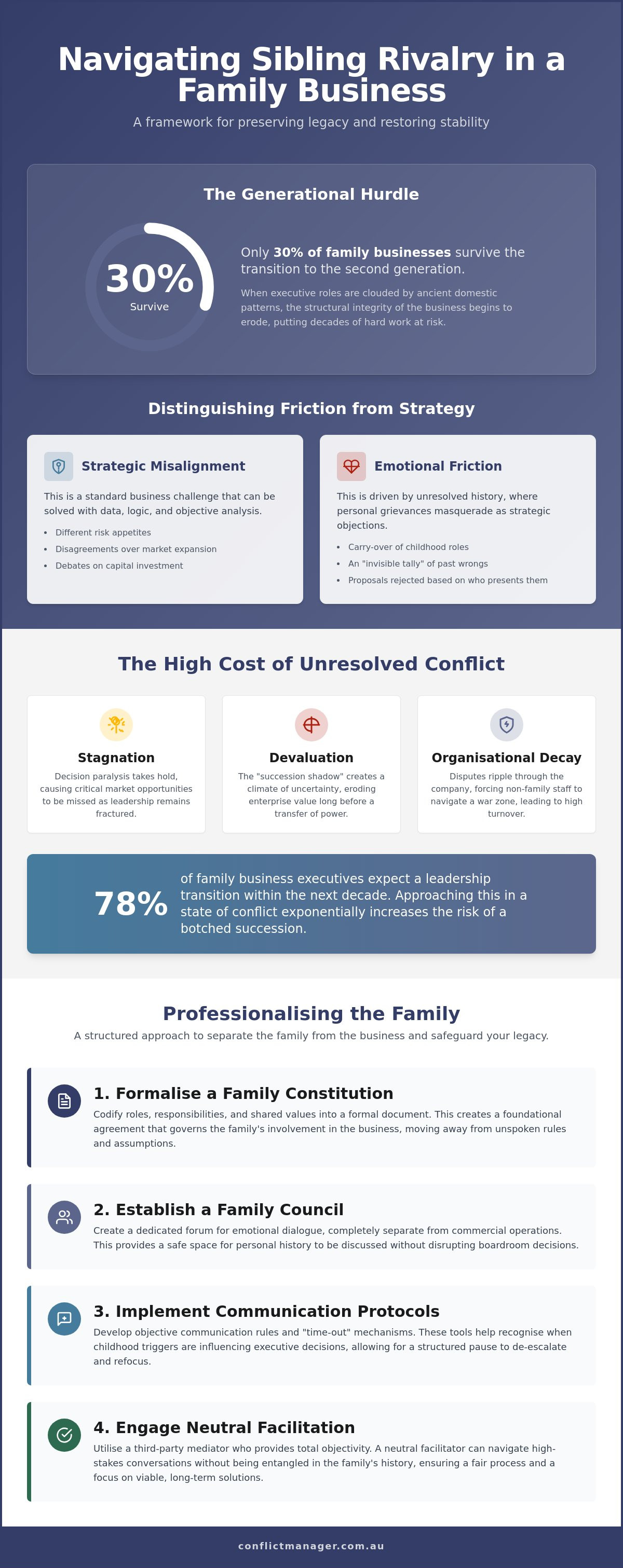
Only 30% of family businesses survive the transition to the second generation. This statistic from the Family Business Institute highlights a fragile reality where the boardroom often becomes an involuntary extension of the childhood dinner table. When managing sibling rivalry in a family business, the friction isn't usually about a lack of talent or shared vision; it's about the weight of history. Friction. History. Legacy. You likely feel the exhaustion of mediating between loved ones while trying to protect the wealth your family has built over decades. It's a heavy burden to carry when executive roles are clouded by ancient domestic patterns.
We understand that these tensions aren't personal failures but structural ones. This guide provides a professionalised framework to help you navigate these complex dynamics and safeguard your family's future. You'll discover how to implement robust governance, establish clear boundaries between the lounge room and the office, and restore the stability required for a successful succession. By moving toward a more formalised structure, you can ensure your legacy remains intact and your family bonds are preserved.
Key Takeaways
- Distinguish between strategic misalignment and emotional friction to prevent decision paralysis from eroding your organisational culture.
- Learn how managing sibling rivalry in a family business requires a formalised Family Constitution to codify roles, responsibilities, and shared values.
- Establish a Family Council as a dedicated forum for emotional dialogue, ensuring that personal history does not disrupt commercial operations.
- Implement objective communication protocols and "time-out" mechanisms to recognise when childhood triggers are influencing executive decisions.
- Understand the value of neutral facilitation in providing the total objectivity needed to navigate high-stakes transitions and safeguard your legacy.
The Anatomy of Sibling Rivalry: Why Friction Persists
Identity. Authority. Obligation. These three pillars often buckle under the weight of unresolved history when siblings share the helm of a commercial enterprise. Managing sibling rivalry in a family business is rarely about a simple disagreement over a balance sheet or a marketing campaign. Instead, it represents the collision of childhood patterns with adult fiduciary duties. It's a complex landscape where the boardroom table often feels like an extension of the family dinner table, complete with its old hierarchies and unspoken rules.
In the Australian business environment, where family-owned firms form the backbone of the economy, the pressure to maintain both profit and peace is immense. Many executives find themselves trapped by an "invisible tally" of parental attention or perceived fairness that dates back decades. This emotional accounting system often dictates current business decisions, making it difficult to achieve the objective clarity required for sustainable growth. When personal grievances masquerade as strategic objections, the structural integrity of the business begins to erode.
The Carry-over of Childhood Roles
Labels assigned in youth frequently persist into the executive suite, creating rigid boundaries that stifle professional development. When one sibling is perpetually cast as "the responsible one" while another is pigeonholed as "the creative one", it limits their ability to evolve as leaders. These roles often lead to siblings "playing to the gallery" of the founding generation, seeking validation rather than making sound commercial choices. You might find that a heated argument over a new office lease is actually a proxy for a thirty-year-old grievance. Recognising these carry-over roles is the first step toward professionalising your interactions and ensuring that childhood dynamics don't dictate your corporate future.
Strategic vs Emotional Conflict
It's vital to distinguish between a genuine strategic misalignment and pure emotional friction. A difference in risk appetite or a disagreement over market expansion is a standard business challenge that can be solved with data and logic. However, when a sibling rejects a proposal simply because of who presented it, you're dealing with emotional undercurrents that traditional business planning cannot fix. The Dassler brothers feud serves as a stark historical reminder of how these hidden dynamics can escalate, eventually splitting a single legacy into two competing global empires. We use a sense of composed authority to look past the "presenting issue" and identify the root cause. Without this objective diagnosis, internal efforts at resolution often fail because the mediators themselves are emotionally entangled in the family's history.
The Cost of Conflict: Risks to Legacy and Assets
Stagnation. Devaluation. Decay. These are the silent predators of a family legacy when internal friction remains unaddressed. While managing sibling rivalry in a family business is often framed as a personal matter, its true cost is reflected in the erosion of enterprise value. When leadership is fractured, decision paralysis takes hold. Critical opportunities are missed because consensus is impossible; the strategic direction of the firm becomes secondary to interpersonal point-scoring. This succession shadow creates a climate of uncertainty that can devalue a business long before a formal transfer of power even occurs.
The 2026 Deloitte research indicates that 78% of family business executives expect a leadership transition within the next decade. If this transition is approached while siblings are in active conflict, the risk of a botched succession increases exponentially. It's not just the family name at stake. It's the structural integrity of the entire organisation. Implementing strategies for overcoming sibling rivalry is therefore a fiduciary necessity rather than a mere lifestyle choice. Engaging in structured stakeholder facilitation allows families to address these risks before they manifest as irrevocable financial losses.
Erosion of Organisational Stability
Sibling disputes rarely stay confined to the boardroom. They create a ripple effect that permeates every level of the company. Non-family executives and staff are often the first to feel the impact, finding themselves forced to navigate an internal war zone where loyalty is tested daily. According to Acas data, nearly half a million employees resign each year due to workplace conflict. In a family firm, this loss of top-tier talent is particularly damaging. High-performing managers will not stay in an environment where their professional growth is capped by family drama. Furthermore, creditors and external stakeholders view persistent family friction as a primary risk factor, which can lead to tightened credit lines or a loss of confidence in the brand's long-term viability.
Threats to Multi-Generational Wealth
For high-net-worth families in Australia, the financial stakes are exceptionally high. Complex trust structures and asset protection strategies rely on a foundation of mutual trust among beneficiaries. When sibling rivalry turns litigious, the catastrophic cost of legal fees and court-mandated disclosures can dismantle decades of wealth creation. Mediation offers a sustainable path that preserves the family brand in the broader marketplace. Fiduciary responsibilities demand that leaders act in the best interest of the enterprise, yet personal bias in asset management often leads to sub-optimal investment choices. Protecting the family's wealth requires a move away from emotional decision-making toward a professionalised governance model that prioritises the collective legacy over individual grievances.
Professionalising the Family: Structural Solutions
Structure. Order. Governance. These are the essential tools for transforming a volatile family dynamic into a high-performing executive team. When managing sibling rivalry in a family business, the goal isn't to eliminate the shared history of the participants but to provide a professionalised framework that contains it. Stability is achieved when the boundaries between "the dinner table" and "the boardroom" are clearly defined and strictly maintained. Without these guardrails, personal grievances inevitably leak into commercial strategy, leading to the decision paralysis we discussed previously.
One of the most effective methods for preventing sibling rivalries from derailing operations is the establishment of a Family Council. This is a dedicated forum designed specifically for emotional dialogue and family-wide decision-making. By moving discussions about inheritance, family values, and personal conflicts into this separate space, the boardroom is left free to focus on its primary fiduciary duties. It allows siblings to wear their "owner" hats and "family member" hats at different times, reducing the friction that occurs when these roles collide in a high-stakes meeting.
Formalising Governance and Roles
Ambiguity is the primary fuel for resentment. To neutralise claims of parental favouritism or perceived unfairness, every family member within the firm must have a formal, objective job description. These documents should outline specific KPIs and reporting lines that mirror those of non-family staff. Furthermore, an independent board or an advisory committee can provide the total objectivity needed to break deadlocks between siblings. These external voices act as a circuit breaker, ensuring that decisions are based on commercial merit rather than birth order or childhood hierarchies. It's a process of separating ownership rights from management responsibilities; just because you own a portion of the family wealth doesn't automatically qualify you to manage the day-to-day operations of the enterprise.
The Family Constitution as a Living Document
A written Family Constitution serves as a neutral script during heated moments. It codifies the family's shared values and sets clear protocols for entry, exit, and equity transfers between siblings. When a disagreement arises, the family can return to this agreed-upon framework rather than relying on shifting emotional states. This document should address the following:
- Entry Criteria: The qualifications and external experience required before a sibling can join the firm.
- Conflict Resolution: Pre-defined steps for mediation and stakeholder facilitation.
- Equity Protocols: Clear rules on how shares are valued and transferred during a succession event.
Regular, facilitated reviews of these governance structures ensure they remains relevant as the business evolves. This methodical approach moves the family from a state of reactive disruption toward a vision of structured, multi-generational resolution.
The Path to Resolution: Strategies for Composed Dialogue
Composure. Precision. Clarity. Transitioning from the structural solutions of governance into the practical reality of daily communication requires a disciplined shift in mindset. Managing sibling rivalry in a family business is often a matter of linguistic precision. Instead of falling into the trap of "You" statements, which inevitably trigger defensive childhood responses, siblings should adopt a "The Business Needs" approach. This refocuses the energy away from personal friction and toward the shared objective of protecting the family legacy. It's about stripping away the emotional baggage to see the commercial reality underneath.
Active listening plays a pivotal role in this transition. It's not just about waiting for your turn to speak; it's about uncovering the underlying needs that drive a sibling's position. Often, a demand for more equity is actually a request for recognition of effort. Identifying these drivers allows for a more sophisticated level of engagement. If you find the tension rising beyond your internal capacity to resolve, we recommend the use of professional stakeholder facilitation to ensure the conversation remains productive and grounded in fact.
De-escalation and Emotional Regulation
Maintaining composure during high-stakes meetings is a learned skill. High-emotion triggers are often rooted in historical grievances that have no place in a strategic discussion. The "Time-Out" mechanism is a vital tool here. If a participant recognises that childhood dynamics are beginning to override professional judgment, they must have the authority to pause the meeting. This isn't a sign of weakness but a commitment to the structural integrity of the decision-making process. Pre-meeting briefings are also essential. By aligning expectations and addressing potential friction points in a controlled environment, you reduce the likelihood of a public boardroom collapse. It's a methodical way to address historical grievances without derailing current operations.
Sustainable Conflict Resolution Outcomes
True resolution moves beyond the simple compromise where both parties feel they've lost something. We aim for integrative solutions that benefit the entire legacy. This requires a culture of healthy disagreement where differing views are seen as a source of strength rather than a threat. Once a resolution is reached, it must be documented with total clarity. This prevents the "re-litigation" of old issues months later, which is a common drain on organisational energy. By codifying these outcomes, you build a repository of precedents that guide future generations. This ensures the stability you've worked so hard to restore remains a permanent feature of your family's wealth management strategy.
The Case for Neutral Facilitation and Mediation
Objectivity. Perspective. Resolution. These are the qualities that often vanish when a family attempts to heal itself from within. Managing sibling rivalry in a family business is uniquely challenging because every participant is part of the same historical system. This "Emotional Entanglement" means that even the most seasoned founder or trusted family friend carries a subconscious bias that siblings can sense. Internal attempts at resolution often fail because the mediator is seen as an actor in the drama rather than an objective observer. By introducing a neutral third party, you break the cycle of reactive behaviour and create a foundation for genuine structural change.
A professionalised approach to conflict resolution consulting moves the family from a state of disruption toward a state of structured resolution. It's not about taking sides; it's about providing a steady hand that prioritises the health of the enterprise. When siblings engage in a facilitated process, they're no longer fighting for dominance or parental approval. Instead, they're working within a framework designed to secure the business and preserve the family bond. This transition is essential for any firm that intends to survive the complexities of a multi-generational wealth transfer.
The Steady Hand of External Expertise
A seasoned professional brings a level of discernment that is impossible to achieve from the inside. We focus on the structural dynamics of the organisation, identifying where roles have blurred and where governance has failed. Providing a "Neutral Space" is essential for difficult conversations; it removes the domestic triggers associated with the family home or the existing office. Our approach to Stakeholder Facilitation prioritises the health of the enterprise while acknowledging the emotional weight of the transition. It's a methodical process that moves the family from a state of constant friction toward a vision of composed leadership. By removing the emotional static, we allow the true commercial issues to be addressed with total objectivity.
Preserving the Legacy for Future Generations
Investing in professional conflict management today is an investment in the long-term viability of your wealth. A family business should be a source of collective pride, not a source of persistent pain or litigation. When disputes are left to fester, they don't just devalue the company; they erode the very bonds that the business was built to support. Professional mediation secures the business by establishing clear, documented protocols that protect assets and ensure a clean succession. It allows siblings to return to their roles as family members, confident that the commercial aspects of their relationship are managed with precision. If you are ready to restore stability to your organisation, we invite you to enquire about our Family Office Mediation services.
Restoring Order for a Multi-Generational Future
Stability. Clarity. Continuity. Achieving these outcomes requires a deliberate move away from the reactive patterns of the past toward a professionalised governance model that separates personal history from commercial strategy. You've seen how the implementation of Family Constitutions and objective communication protocols can safeguard your enterprise against the high cost of decision paralysis. While the emotional weight of managing sibling rivalry in a family business is significant, it doesn't have to be a barrier to your long-term success or the preservation of your wealth.
Our national Australian practice provides the total objectivity needed to navigate these high-stakes transitions with composure. We specialise in expert-led mediation for high-net-worth families, ensuring that even the most complex, high-emotion business disputes are resolved with precision and empathy. By introducing a neutral third party, you ensure that the logic of the boardroom is never compromised by the dynamics of the lounge room. Secure your family legacy with professional Conflict Resolution Consulting and transform your internal friction into a foundation for growth. Your legacy is too valuable to be left to chance; with the right structure, your family can thrive for generations to come.
Frequently Asked Questions
Is sibling rivalry normal in a family business?
Yes, friction is a common structural byproduct of overlapping family and business systems. Tensions typically arise because personal history and professional duty collide in high-stakes environments. While many firms experience this, the key to longevity is whether the rivalry is managed through professionalised governance or left to dictate commercial strategy. Without clear boundaries, these ancient domestic patterns can quickly erode executive authority.
How do we stop personal arguments from affecting our business decisions?
Establishing clear boundaries between the lounge room and the boardroom is the most effective preventative measure. You should implement formal communication protocols that prioritise "The Business Needs" over individual grievances. Using a Family Council as a dedicated space for emotional dialogue ensures that the boardroom remains a site of objective fiduciary decision-making. This separation allows siblings to address personal issues without compromising the firm's strategic direction.
What is the first step when sibling conflict becomes unmanageable?
The first step is to acknowledge that internal resolution efforts have reached their limit and seek neutral facilitation. Adopting a "Time-Out" on major strategic decisions prevents further escalation while you engage an external expert. This provides the total objectivity needed to diagnose structural failures without being caught in the family's emotional history. Taking this step early protects the business from the devaluing effects of decision paralysis.
Can a family business survive a major sibling fallout?
Survival is possible if the family prioritises the structural integrity of the enterprise over personal vindication. Success often requires a shift from a family-run model to a family-owned, professionally managed structure. By codifying roles and exit protocols, you can preserve the family's wealth even if the siblings can no longer work together in a day-to-day capacity. It's about securing the legacy, regardless of individual interpersonal dynamics.
What is the difference between family therapy and business mediation?
Business mediation focuses on commercial outcomes, structural governance, and fiduciary responsibilities. While therapy addresses psychological healing and deep-seated personal trauma, mediation provides a framework for professionalised interaction and decision-making. We specialise in the latter, ensuring that the business remains stable and productive regardless of the emotional climate. It's a pragmatic approach designed for high-stakes corporate environments where results are the primary objective.
How do we handle a sibling who is not performing their role?
Performance issues should be managed through objective job descriptions and merit-based KPIs that apply to all staff. When managing sibling rivalry in a family business, it's vital to separate ownership rights from management duties. If a sibling fails to meet professional standards, the pre-defined governance protocols in your Family Constitution should dictate the consequences. This removes the perception of favouritism and maintains organisational standards for all employees.
When should we involve an external conflict mediator?
You should involve an external mediator as soon as internal discussions become circular or when decision paralysis begins to devalue the enterprise. Waiting until a total collapse occurs increases the risk of irrevocable financial loss. Early intervention provides the steady hand needed to navigate high-stakes transitions before personal friction destroys the organisational culture. A neutral third party brings the clarity that internal stakeholders often lack during periods of high stress.
How does a Family Constitution help with sibling rivalry?
A Family Constitution acts as a neutral script that codifies roles, responsibilities, and shared values. It provides a pre-agreed framework for resolving disputes, which reduces the need for emotional negotiation during heated moments. By setting clear protocols for entry, exit, and equity transfers, it removes the ambiguity that often fuels resentment between siblings. It's a living document that ensures the family's commercial interactions remain grounded in logic and mutual respect.


