

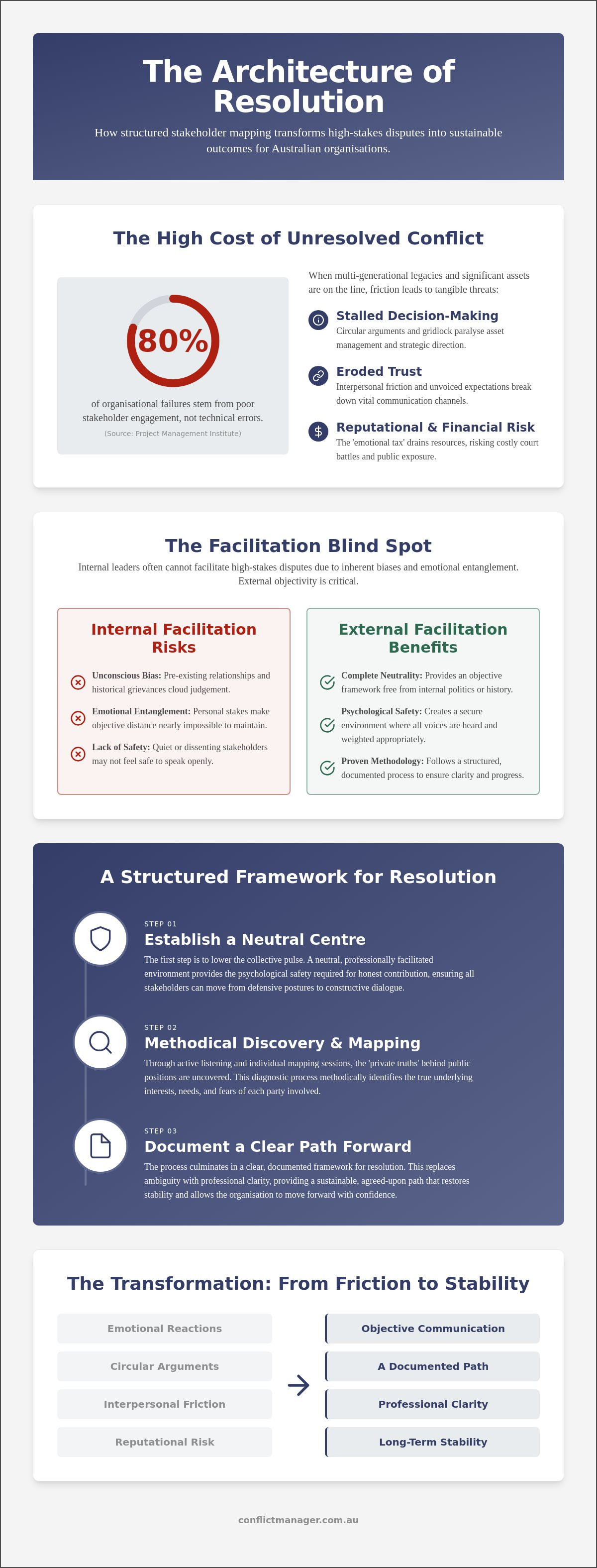
Friction. Stagnation. Risk. When multi-generational legacies and significant assets are on the line, these aren't just words; they're existential threats. According to the Project Management Institute, 80 per cent of organisational failures originate from poor stakeholder engagement rather than technical oversights. You've likely experienced the frustration of circular arguments that stall asset management, yet implementing stakeholder mapping for conflict resolution can provide the structural integrity your situation requires. It's a heavy burden to carry when the reputation of your family office is at stake.
This article demonstrates how structured mapping and neutral facilitation transform volatile disputes into sustainable, clear outcomes for Australian organisations. You'll learn to move beyond reactive defence toward a methodical, objective framework that restores order to high-pressure environments. We'll outline a documented path forward that replaces interpersonal friction with professional clarity; this ensures your organisation achieves long-term stability while avoiding the costs and exposure of the courtroom.
Key Takeaways
- Learn how to transition from emotional reactions to objective communication to protect multi-generational legacies and critical assets.
- Identify the "blind spot" problem that often prevents internal leaders from facilitating their own high-stakes disputes with total impartiality.
- Discover how stakeholder mapping for conflict resolution uncovers hidden interests through a methodical discovery and individual mapping process.
- Understand the necessity of establishing a neutral centre to ensure psychological safety and lower the collective pulse of the room.
- Move beyond circular arguments toward a clear, documented path that restores stability and avoids the reputational damage of public legal battles.
Mapping the Friction: Why Stakeholder Engagement Falters in High-Stakes Disputes
Friction. Silence. Gridlock. High-stakes disputes rarely fail because of technical errors; they fail because the human element becomes too heavy to carry. Stakeholder mapping for conflict resolution is the art of restoring objective communication to these clouded situations. It acts as a structural diagnostic tool, identifying where pressure is building and why. Without this clarity, parties remain trapped in a cycle of reaction, unable to see the path toward a sustainable exit.
In Australian family offices and boards, friction carries an emotional tax that drains resources long before a legal battle begins. This tax manifests as stalled decision-making, eroded trust, and a loss of momentum. Traditional communication breaks down under the weight of sizeable assets or a multi-generational legacy because the stakes feel personal rather than professional. Neutral facilitation serves as the bridge between this disruption and structural stability; it provides a steady hand to guide stakeholders from defensive postures toward a shared logic of resolution.
The Complexity of the Family Office and HNW Dynamics
Within the Australian private wealth sector, the intersection of personal identity and asset management is often fraught. Unvoiced expectations and historical grievances act as invisible barriers to meaningful engagement. Establishing clear family governance is often the only way to prevent a total collapse of dialogue. A formal stakeholder analysis allows these dynamics to be viewed with total objectivity, stripping away the heat of the moment to reveal the underlying structural needs of the family unit.
Organisational Change and the Stakeholder Response
Structural change often triggers defensive postures within boards and executive teams. Fear of loss, whether it's power, status, or security, creates friction that can paralyse an entire organisation. It's vital to identify silent stakeholders who influence outcomes from the periphery of the dispute without ever sitting at the table. Effective stakeholder mapping for conflict resolution provides the clarity needed to navigate these transitions. Mapping is the process of uncovering the 'private truths' behind public positions.
The Architecture of Neutrality: Core Principles for Mapping Stakeholder Interests
Neutrality isn't the absence of opinion; it's the presence of an objective framework. In high-stakes disputes, emotions often cloud the structural reality of the problem. Establishing a neutral centre is the first step in lowering the collective pulse of the room. This environment provides the psychological safety required for honest stakeholder contribution, especially within the sensitive context of private wealth. Without this safety, stakeholders retreat into defensive postures, which only serves to entrench the existing friction. Using stakeholder mapping for conflict resolution ensures that every voice is weighted appropriately, preventing dominant leaders from overshadowing quieter, yet equally vital, participants.
Active listening serves as the primary tool for uncovering the underlying 'why' of a dispute rather than just the 'what'. It requires a steady, objective pace that suggests both efficiency and thoroughness. By methodically identifying the true interests of each party, we move away from circular arguments and toward a structured resolution. For those seeking a deeper understanding of these frameworks, this step-by-step guide to stakeholder mapping offers a foundational perspective on how to categorise and engage diverse interests effectively. When the stakes involve significant Australian assets, this level of precision is non-negotiable.
Professional Empathy as a Strategic Tool
Effective facilitation requires a clear distinction between emotional entanglement and professional empathy. It's about validating a stakeholder’s perspective without taking sides. This process de-escalates immediate conflict by acknowledging the immense weight of responsibility held by family leaders and board members. When people feel heard, their need for defensive posturing diminishes. This shift allows the group to focus on the future rather than historical grievances. If your board is struggling to find this balance, engaging in professional stakeholder facilitation can provide the necessary external objectivity to break the deadlock.
Structural Integrity in Dialogue
Maintaining order during periods of high stress requires firm boundaries. We often use a 'dispute brief' to ground the conversation in facts, which helps prevent the mapping phase from devolving into a session of feelings alone. These boundaries protect the dignity and privacy of all parties involved, ensuring that the process remains professional and discreet. By setting clear expectations for engagement, we create a path where complex stakeholder interests, such as legacy preservation or asset liquidity, can be discussed with total composure. This methodical approach ensures that every transition is navigated with discernment and structural integrity.
Internal Blind Spots vs. External Objectivity: The Case for Professional Facilitation
Proximity. History. Emotion. These elements create an inevitable fog for internal leaders attempting to resolve high-stakes friction within their own ranks. Even the most seasoned executive or family patriarch possesses "blind spots" that obscure the structural reality of a dispute. When a leader facilitates their own conflict, stakeholders often perceive bias; this perception, whether accurate or not, causes parties to retreat into defensive positions. Effective stakeholder mapping for conflict resolution requires a level of detachment that internal figures simply cannot maintain without risking their existing relationships.
The external counselor acts as a steady hand capable of viewing volatile situations with total objectivity. By shifting the burden of difficult conversations to a neutral third party, internal leaders protect the integrity of their long-term relationships. This transition moves the group from a state of reactive defence toward a vision of structured resolution. It allows the organisation to address the friction without becoming emotionally entangled in the dynamics that caused it.
The Risk of DIY Resolution
Well-intentioned efforts to keep a dispute in-house often inadvertently escalate the very tensions they seek to soothe. In the context of Australian family offices, the cost of failed internal facilitation is high. It can lead to public litigation, the depletion of sizeable assets, and the fracturing of multi-generational legacies. Executive teams often lack the psychological distance required for sensitive intergenerational mediation. Without an external lens, internal attempts at resolution frequently devolve into circular arguments that reinforce historical grievances rather than addressing the structural path forward.
The Value of the Neutral Third Party
Credibility. Objectivity. Composure. An external professional brings a sense of order to high-stress environments. By adopting a high-level corporate and psychological register, a facilitator resonates with leaders who require both empathy and efficiency. This neutral party has the license to ask the uncomfortable questions that family members or colleagues often avoid to maintain a fragile peace. Through meticulous stakeholder mapping for conflict resolution, the counselor strips away the noise of past conflicts. They focus instead on a documented, sustainable path that ensures organisational stability. This methodical approach lowers the collective pulse of the room, allowing stakeholders to view the dispute through a lens of logic rather than one of loss.
A Structured Framework for Stakeholder Mapping and Dispute Resolution
Order. Logic. Stability. Resolution isn't a single event; it's a methodical progression from complexity to clarity. To achieve this, we employ a rigorous framework that moves beyond surface-level complaints to the structural roots of the friction. Using stakeholder mapping for conflict resolution provides the blueprint for this journey. It ensures that every action taken is deliberate, objective, and designed to lower the collective pulse of the room.
- Step 1: Discovery and individual mapping. We identify core concerns and "hidden" interests that parties may not feel comfortable voicing in a group setting.
- Step 2: Designing a bespoke engagement environment. We create a controlled space that reduces friction, ensures absolute privacy, and prioritises the dignity of all participants.
- Step 3: Facilitated dialogue sessions. These are structured conversations focused on collaborative problem-solving rather than the assignment of blame.
- Step 4: Synthesis of outcomes. We distil the dialogue into a clear, sustainable resolution agreement that honours the interests of every party.
- Step 5: Post-resolution follow-up. We conduct scheduled reviews to ensure long-term structural stability is maintained and the path forward remains clear.
Discovery and Alignment
The foundation of any successful resolution is laid long before the parties sit at the same table. We begin by conducting private interviews to understand the "private truth" of each stakeholder. This process uncovers the underlying motivations, such as fears regarding asset liquidity or concerns over family legacy, that are often obscured by the heat of the dispute. By identifying these areas of common ground early, we can build a framework for agreement that feels inevitable rather than forced. A 2023 Deloitte study found that professionals who map their stakeholder relationships before major initiatives are 2.5 times more likely to achieve their objectives. This data underscores why thorough preparation is the most critical phase of our process.
The Facilitated Session
In the room, the focus shifts to maintaining momentum. High-emotion moments are inevitable in high-stakes disputes, particularly within Australian family offices or boards. We manage these moments with composed authority, preventing the session from de-railing into historical grievances. Our approach uses rhythmic variation in communication to keep the group focused on the desired outcome. We transition the stakeholders from a state of reactive defence toward future-focused, sustainable solutions. This methodical guidance ensures that the transition from conflict to resolution is handled with total discernment. If your organisation requires this level of structured intervention, you can organise a confidential consultation to discuss your specific needs.
Restoring Stability: How Conflict Manager Facilitates Sustainable Outcomes
Conflict Manager functions as a steady, external hand. We view volatile situations with total objectivity. Our focus remains on guiding stakeholders through high-emotion situations with composure. The objective is never merely to reach a temporary agreement; we seek a sustainable, stable future for the organisation or family. This expert-led approach preserves the integrity of sizeable assets and multi-generational legacies across Australia. It provides a sense of order during periods of high stress or organisational friction.
By using stakeholder mapping for conflict resolution, we provide a clear, documented path forward. This process avoids the reputational damage and financial depletion often associated with public legal battles. It ensures that every transition is navigated with discernment. We act as a neutral third party that brings clarity to clouded situations. This methodology allows stakeholders to lower their collective pulse and focus on long-term structural stability. It moves the conversation away from reactive defence and toward a shared logic of resolution.
Bespoke Solutions for High-Net-Worth Families
Navigating the friction within a family office requires a steady, empathetic touch. We respect the private history of each family while maintaining a professional distance. Integrating family governance principles into the resolution process prevents future disputes from taking root. This methodical approach to Family Conflict Resolution ensures that the family's legacy remains intact. We help stakeholders move from a state of defensive posture toward a shared vision of order. Our role is that of a compassionate guide who understands the weight of responsibility without becoming emotionally entangled in the dynamics.
Stability for Organisations Undergoing Change
Leadership teams and boards often face significant stress during restructuring. We facilitate clarity during these periods of conflict to ensure business continuity. Unaddressed stakeholder friction can cause even the most logical organisational changes to collapse. Our presence acts as a neutral third party that brings logic to clouded situations. This progression feels inevitable and calming, moving the group from complexity toward a vision of structured resolution. If your board or executive team requires a structured approach to navigate these human dynamics, we invite you to enquire about our stakeholder facilitation services. We provide the structural integrity required to move through difficult transitions with confidence. This ensures that the organisational legacy is protected for the future.
Securing a Stable Path Forward for Your Organisation
High-stakes friction doesn't have to result in permanent loss or fractured legacies. By moving from reactive defence to a logical, structured framework, Australian families and boards can protect their multi-generational assets from the weight of public litigation. Stakeholder mapping for conflict resolution serves as the diagnostic foundation for this transition. It allows for the identification of unvoiced interests and the establishment of a neutral centre where honest, professional dialogue finally becomes possible. This methodical approach ensures that even the most volatile disputes are viewed through a lens of total objectivity.
Our approach combines specialised expertise in HNW family dynamics with a composed, neutral perspective that remains unruffled by high-pressure environments. We focus on sustainable, long-term outcomes that restore order and structural integrity to your organisation. Shifting the burden of difficult conversations to a steady third party preserves your most vital relationships while ensuring business continuity remains the priority.
Restore clarity to your organisation with expert stakeholder facilitation. Stability is within reach when you choose a path defined by composure and objective resolution.
Frequently Asked Questions
What is the primary difference between mediation and stakeholder facilitation in a dispute?
Mediation typically centres on resolving a specific legal claim or reaching a settlement agreement between parties. Stakeholder facilitation addresses the broader human and structural dynamics within a group to ensure long-term organisational stability. It's a proactive approach that looks beyond the legal "deal" to the health of the ongoing relationship. This process is particularly effective for Australian family offices where the legacy is as important as the asset itself.
How do you engage stakeholders who are unwilling to participate in the mapping process?
Engagement often begins with private, confidential consultations where an individual's concerns can be voiced without the pressure of a group setting. We focus on identifying the specific barriers preventing their participation; these are often rooted in a fear of loss or perceived bias. By demonstrating the value of a neutral framework, we can often lower the collective pulse and encourage participation. This methodical discovery phase is essential for effective stakeholder mapping for conflict resolution.
How long does a typical stakeholder facilitation engagement take to reach a resolution?
Timelines are determined by the complexity of the dispute and the number of parties involved in the friction. A typical engagement might span from several weeks to three months; this allows for thorough individual mapping and multiple facilitated sessions. We prioritise structural integrity over artificial speed to ensure the outcome remains sustainable. This deliberate pace provides the necessary time for stakeholders to transition from defensive postures toward a shared logic of resolution.
Can stakeholder mapping help prevent a dispute from reaching the Australian court system?
Yes, structured facilitation is designed to resolve friction before it escalates into the public Australian court system. By providing a clear, documented path forward, we help parties avoid the reputational damage and financial depletion of public legal battles. It's a private alternative that preserves dignity while addressing the structural roots of the disagreement. This process ensures that the focus remains on the future of the organisation rather than historical grievances.
What role does confidentiality play when facilitating disputes involving high-net-worth families?
Confidentiality is the foundational pillar of our work with high-net-worth families and family offices. We operate with total discretion to protect private histories and sensitive asset information from any form of public exposure. Every session is conducted within a secure framework that ensures stakeholders feel safe to share their "private truths." This protection is vital for maintaining the integrity of the family legacy while navigating difficult transitions and high-stakes decisions.
Is facilitation suitable for resolving disputes within a family trust or estate?
Facilitation is exceptionally suitable for resolving friction within family trusts or estates where emotions often run high. These disputes often involve deep-seated emotional grievances that technical legal solutions simply cannot address. By using stakeholder mapping for conflict resolution, we can identify the true interests of beneficiaries and trustees alike. This creates a path toward a sustainable outcome that honours the original intent of the trust while restoring family stability.
How do you manage power imbalances between different stakeholder groups during facilitation?
We manage power imbalances by establishing a neutral centre where every voice is weighted based on its structural interest and impact. The facilitator acts as a steady hand to ensure that dominant leaders don't overshadow quieter stakeholders during the mapping phase. We use structured dialogue sessions and firm boundaries to protect the dignity of all participants. This methodical approach ensures that the final agreement is balanced and reflects the collective logic of the group.
What happens if a sustainable outcome cannot be reached through the facilitation process?
If a sustainable outcome isn't immediately achieved, the process still provides immense value through clarity and documentation. Stakeholders walk away with a precise understanding of the core issues and the documented positions of all involved parties. This clarity often reduces the heat of the conflict, even if further steps are required later. We focus on providing a structured diagnostic that identifies the exact barriers to resolution, allowing for more informed decision-making in the future.


