

The most dangerous threat to your company isn't a market shift or a competitor's move; it's the quiet erosion of the partnership at its core. Trust. Momentum. Integrity. These are the structural elements that begin to fracture when the vision that once unified a leadership team starts to diverge, leaving the organisation in a state of precarious stagnation. Learning how to resolve co-founder disputes is rarely about winning an argument, but rather about realigning your professional relationship with the objective requirements of the entity you've built together.
You've likely felt the weight of this friction as it stalls your operational progress and risks damaging your reputation with investors or the public. This article provides a professional framework for navigating high-stakes friction and achieving sustainable, objective resolutions that put the business first. We'll explore a methodical path toward restored clarity in decision-making, the implementation of a robust governance framework, and the absolute preservation of your equity and asset integrity.
Key Takeaways
- Identify whether your friction stems from interpersonal dynamics or structural misalignment to ensure you're addressing the actual root cause.
- Discover how to resolve co-founder disputes by shifting the focus from individual perspectives to the objective requirements of the business entity.
- Build a robust governance framework that serves as a living document, providing a clear map for decision-making as your organisation matures.
- Understand why neutral facilitation offers a more sustainable path to resolution than internal attempts or partisan legal battles.
- Protect your equity and professional reputation by adopting a methodical, entity-first approach to conflict during periods of high stress.
The Anatomy of Co-Founder Friction in Australian Enterprises
Stability. Alignment. Vision. These are the invisible pillars that support every successful enterprise. When the relationship between co-founders begins to fray, the structural integrity of the entire organisation is compromised. It's often assumed that conflict manifests as heated arguments or visible power struggles. In reality, the most corrosive friction is often silent. Understanding how to resolve co-founder disputes starts with acknowledging that the partnership itself is a living asset that requires deliberate maintenance.
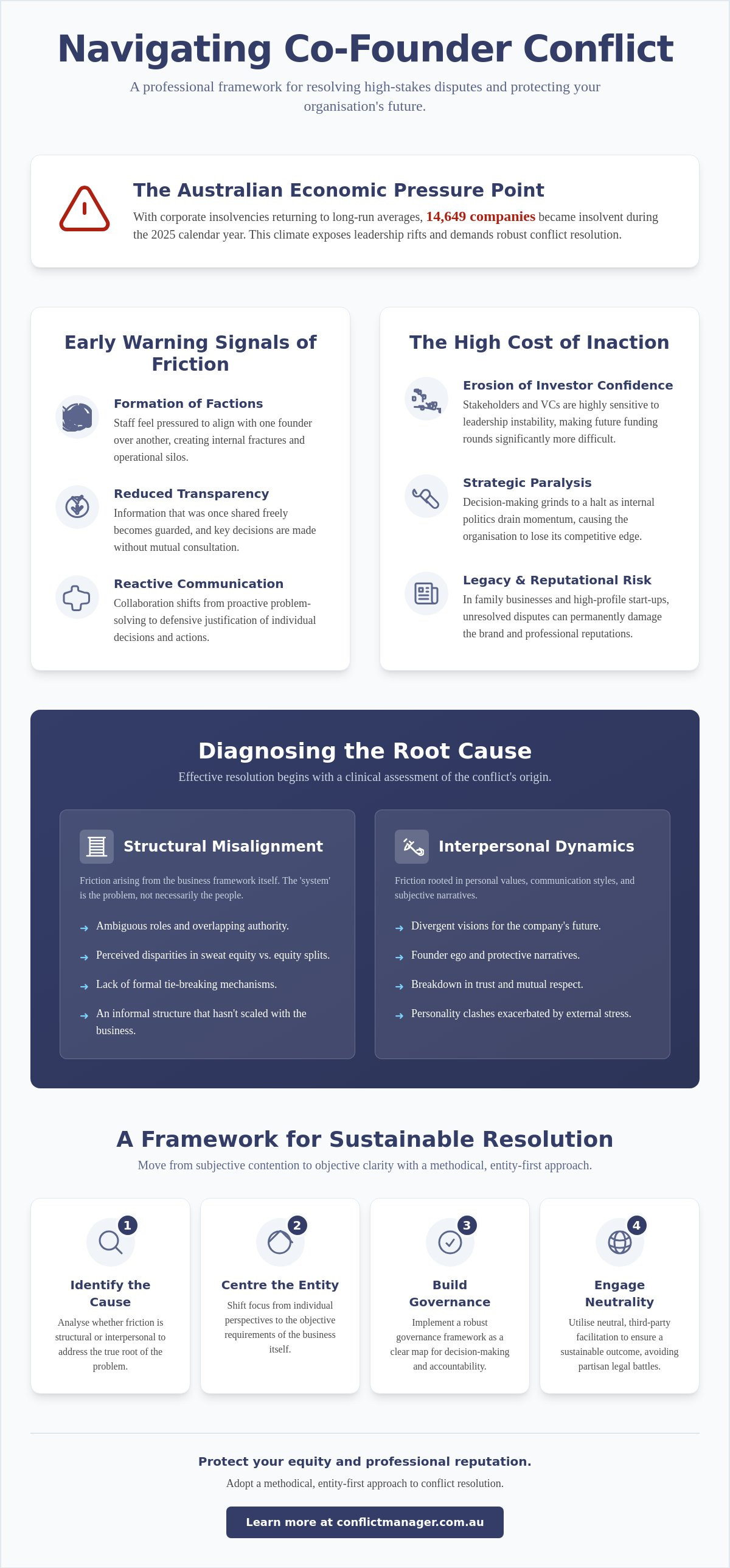
The Australian market in 2026 presents a unique set of pressures. With corporate insolvencies returning to long-run averages, 14,649 companies became insolvent over the 2025 calendar year alone. This economic climate demands rapid adaptation; a pace that can easily expose underlying rifts in leadership. What began as a shared collaborative vision can quickly dissolve into divergent operational priorities. One partner may focus on aggressive digital asset integration following the 2026 Digital Assets Framework Bill, while the other prioritises traditional asset integrity and cash flow preservation.
Recognising the Early Warning Signals
Friction rarely appears overnight. It's a gradual accumulation of small deviations from a shared centre. You might notice a decrease in transparency, where information that was once shared freely becomes siloed within specific departments. Communication shifts from proactive collaboration to a more defensive, reactive justification of individual decisions. In many Australian private wealth contexts, this is where "factions" begin to form. Within a senior leadership team or a family office, staff may feel pressured to align with one founder over another, creating internal fractures that are difficult to heal without objective intervention.
The High Cost of Unresolved Conflict
The price of leadership friction is paid in more than just emotional stress. It has a tangible impact on the bottom line and the long-term viability of the business. Consider these primary risks:
- Erosion of Investor Confidence: Sophisticated stakeholders and venture capital partners are highly sensitive to leadership instability. Friction at the top makes securing further funding rounds significantly more difficult.
- Strategic Paralysis: When founders are at odds, decision-making slows to a crawl. The organisation loses its momentum, and the ability to execute on strategy is drained by internal politics.
- Legacy Risks: In multi-generational family business structures, unresolved disputes can permanently damage the legacy and the transition of wealth to the next generation.
Addressing these issues early is vital. Learning how to resolve co-founder disputes through a structured, professional lens ensures that the entity remains the priority, protecting both the assets and the professional reputations of everyone involved.
Diagnosing the Root Cause: Structural Misalignment vs Interpersonal Dynamics
Objectivity is the first casualty of conflict. When tension rises, founders often retreat into subjective narratives, blaming the other person's ego or changing attitude for the friction. However, a seasoned perspective reveals that many disputes are symptoms of structural flaws rather than simple personality clashes. Understanding how to resolve co-founder disputes requires a cold, clinical assessment of whether the friction is a result of the people involved or the framework they're operating within. Clarity is the goal.
Founder ego often complicates this diagnosis. It's natural to feel protective of the value one brings to the table, yet this perception is rarely identical across the leadership team. Market volatility, such as the rising insolvency rates in construction and hospitality seen throughout early 2026, can exacerbate these internal rifts. When external pressure mounts, internal unity often fractures along pre-existing, though previously hidden, lines of misalignment. External forces act as a catalyst for internal decay.
Structural Fault Lines: Roles, Equity, and Authority
As an organisation scales, the informal approach of the early days becomes a liability. Ambiguity in the division of labour creates overlap and resentment. You might find two founders claiming authority over the same strategic pillar, leading to operational paralysis. Disparities in sweat equity often surface during these transitions, where one partner feels their operational output far exceeds their equity distribution. Without clear tie-breaking mechanisms, especially in common 50/50 ownership structures, these structural gaps become insurmountable obstacles to progress. They are the silent killers of momentum.
Interpersonal Dynamics: Trust and Communication Styles
The founders' shorthand is a powerful but fragile asset. It's that intuitive, unsaid understanding that drives early-stage speed. When this communication stops working, every interaction becomes a chore of reactive justification. Differing appetites for risk also play a significant role. One partner might be ready to pivot toward digital asset frameworks following recent legislative changes, while the other remains cautious. Personal life transitions, common in high-net-worth family office environments, can also shift a founder's commitment level or financial needs. These shifts create a sudden divergence in goals. For those feeling the strain of these shifting dynamics, seeking professional organisational conflict management can provide the necessary distance to see the situation clearly.
The transition from a shared dream to a complex corporate reality is rarely smooth. By distinguishing between a clash of personalities and a clash of roles, you can begin to strip away the emotion from the problem. This allows for a more methodical approach to resolution, ensuring the business survives the friction of its own growth.
A Framework for Resolution: Moving from Contention to Clarity
Silence. Distance. Perspective. Establishing a neutral zone is the first requirement for any successful resolution. This is a deliberate space where the constant, grinding demands of daily operations are temporarily suspended. It's impossible to learn how to resolve co-founder disputes while you're still in the trenches of a shared inbox or a boardroom debate. By stepping away from the immediate friction, you create the psychological room needed to view the partnership as a structural component of the business rather than a personal battleground. This distance allows for the objective analysis required to move forward.
The focus must shift from who is right to what the entity requires for survival and growth. This isn't about compromise for the sake of peace; it's about consensus for the sake of the organisation. A compromise often leaves both parties feeling diminished, while a consensus finds a path that serves the shared asset. This distinction is subtle but vital. It's the difference between a temporary truce and a sustainable resolution. When the business becomes the primary stakeholder in the room, the ego-driven narratives of the individuals begin to lose their power.
Step 1: The Objective Assessment
You must separate the individual from the problem through structured, neutral dialogue. This involves conducting a gap analysis between the current state of the business and the original shared vision. The goal is to identify exactly where the trajectory changed and why the internal mechanisms failed to correct it. To achieve this, you should define the dispute in a single sentence from the perspective of the business: "The current disagreement regarding capital allocation is preventing the organisation from meeting its mandatory sustainability reporting requirements for the 2026 financial year, risking regulatory non-compliance."
Step 2: Facilitated Re-alignment
Roles and boundaries should be re-defined based on current operational strengths rather than the titles chosen at the business's inception. This often involves addressing the equity elephant through objective valuation and performance benchmarks, ensuring that the distribution of ownership reflects the actual value being contributed today. By identifying the non-negotiables for each party, you can find the overlap of interest that allows the business to move forward. This re-alignment ensures that every founder is positioned where they can provide the most value to the entity, reducing the friction caused by role ambiguity.
Finally, this process culminates in a written Resolution Roadmap. This document serves as a contract of intent, ensuring accountability and providing a clear sequence of actions for both parties. It moves the resolution from a theoretical agreement to a practical, operational reality, providing a steady hand to guide the organisation back to stability. Accountability is the final piece of the puzzle.
Strengthening Governance to Pre-empt Future Disputes
Structure. Clarity. Resilience. These are the markers of a mature organisation. While the early days of a business are often defined by informal agreements and handshake deals, long-term stability requires a more rigorous approach. A robust governance framework is the most effective insurance against interpersonal friction. It provides a predetermined set of rules that govern how decisions are made and, more importantly, how disagreements are managed. By removing the ambiguity from leadership, you reduce the emotional weight of every difficult choice.
Governance is not a static requirement. It must be viewed as a living framework that evolves alongside the organisation. In the second half of 2025, ASIC reported that corporate governance matters accounted for 40% of all misconduct issues raised; a statistic that underscores the dangers of structural neglect. As your enterprise matures, your agreements must be updated to reflect new operational realities, shifting market conditions, and the changing needs of the founders. This proactive approach ensures that when you face the question of how to resolve co-founder disputes, the answers are already documented in a neutral, pre-approved format.
Key Governance Pillars for Co-Founders
A comprehensive Shareholders’ Agreement is the foundation of this framework. It should include clear buy-sell provisions and "bad leaver" clauses that protect the entity from a sudden or messy departure. Equity vesting schedules are equally critical, as they ensure that ownership is earned through sustained performance and long-term commitment. Finally, a documented decision-making matrix eliminates authority overlap, providing a clear path for tie-breaking in 50/50 ownership structures. For organisations seeking to build these structures, our organisational conflict management services provide the necessary expertise to align governance with interpersonal dynamics.
The Value of Regular Health Checks
Prevention is always more efficient than repair. Organising quarterly alignment retreats allows founders to address simmering issues before they boil over into full-blown disputes. These sessions should be separate from daily operations, providing a dedicated space for high-level feedback and strategic re-calibration. Implementing a formal feedback loop ensures that communication remains proactive rather than reactive. External audits of organisational culture can also be invaluable, as they identify hidden friction points that the founders may be too close to see. This methodical maintenance keeps the partnership healthy and the business on track.
The Role of Neutral Facilitation in High-Stakes Resolution
Objectivity. Distance. Clarity. When internal efforts to bridge a divide fail, it's usually because the founders are too emotionally entangled in the narrative of the dispute to see the structural solution. Internal attempts at resolution often devolve into a cycle of reactive justification. Every suggestion is viewed through the lens of past grievances. Learning how to resolve co-founder disputes effectively often requires the introduction of a neutral third party who isn't invested in who is right, but rather in the stability of the organisation. This external presence acts as a circuit breaker for the emotional feedback loops that keep founders stuck in contention.
It's vital to distinguish between legal representation and neutral mediation. Legal counsel is inherently partisan. Their mandate is to protect your individual interests and secure the largest possible share of the assets. While necessary in some contexts, this approach is often adversarial. It can accelerate the destruction of the partnership. Neutral facilitation, conversely, prioritises the health of the entity. It seeks a sustainable path forward that preserves value and restores operational order without the scorched-earth consequences of litigation. A composed, external perspective lowers the organisational pulse and allows for a more measured, logical sequence of decision-making.
When to Engage an External Mediator
Engagement should occur before the damage to the organisation becomes irreversible. If communication has reached a total deadlock where no strategic progress is possible, external intervention is no longer optional. You should also consider facilitation if the friction is beginning to bleed into the wider team, affecting the wellbeing of staff or the confidence of your senior leadership. When the financial stakes or the integrity of your assets are too high to risk a messy public divorce, a composed external perspective is the most professional choice. It allows for a transition that is defined by logic rather than impulse.
The Conflict Manager Approach to Resolution
We provide a methodical process designed to achieve sustainable outcomes and restore clarity to clouded leadership structures. Our focus remains on the preservation of value and the dignity of all stakeholders involved, ensuring that the transition, whether toward realignment or a structured exit, is handled with total objectivity. By acting as a steady hand, we guide you through the complexities of interpersonal and structural friction to reach a resolution that serves the business first. This progression moves the partners from a state of complexity toward a vision of structured resolution. Enquire about our Facilitation and Mediation Services to begin the path toward organisational stability.
Restoring the Foundations of Your Enterprise
Leadership is the central pillar of any successful organisation. When that pillar begins to fracture, the resulting instability can jeopardise years of strategic growth and operational momentum. We've examined the importance of distinguishing between personal friction and structural misalignment, the value of robust governance, and the necessity of an entity-first approach to resolution. Ultimately, learning how to resolve co-founder disputes is about more than just ending a disagreement; it's about protecting the long-term integrity of the business and the people within it.
Navigating these high-stakes transitions requires a composed, external perspective to lower the emotional pulse and restore order. Conflict Manager provides expert-led mediation for high-net-worth families and complex organisations, focusing on sustainable, objective outcomes that preserve asset integrity. We offer professional guidance to move you from a state of complexity toward a vision of structured resolution. Achieve clarity and stability with Conflict Manager’s expert facilitation.
Stability is always within reach when you choose a path defined by logic, objectivity, and a shared commitment to the future of the enterprise.
Frequently Asked Questions
How do you resolve a co-founder dispute without going to court?
You resolve it through neutral facilitation or professional mediation. These processes focus on achieving a consensus that serves the business rather than a legal victory. By engaging a seasoned facilitator, you avoid the adversarial nature of litigation and maintain total control over the final outcome. This approach prioritises the structural integrity of the organisation over individual grievances.
Is it possible to save a co-founder relationship after a major breach of trust?
It's possible if both parties can realign their roles around the objective needs of the business. Recovery requires a deliberate shift from personal narratives to structural solutions. Trust is often rebuilt through the consistent application of a new, transparent governance framework rather than emotional reconciliation. It's a matter of professional realignment and shared commitment to the entity's survival.
What happens if co-founders are at a 50/50 deadlock in Australia?
A 50/50 deadlock often leads to operational paralysis unless a pre-existing shareholders' agreement contains a formal tie-breaking mechanism. In the absence of such a document, founders should seek external facilitation to find a path forward. It's worth noting that Australian courts increasingly expect parties to attempt genuine dispute resolution before proceeding to trial, or they may face adverse cost consequences.
How can a neutral third party help in a high-emotion business dispute?
A neutral third party acts as a circuit breaker for emotional feedback loops. They provide the total objectivity needed to view a volatile situation without becoming entangled in it. This perspective helps founders strip away the emotion and focus on the movement and structural integrity of the organisation. Order. Clarity. Stability. These are the outcomes a professional facilitator brings to the table.
What is the difference between business mediation and legal arbitration?
Mediation is a collaborative process where a facilitator helps parties reach their own agreement. Arbitration is a more formal, quasi-judicial process where an arbitrator imposes a binding decision. When considering how to resolve co-founder disputes, mediation often preserves the professional relationship and the business's asset integrity more effectively than the rigid, imposed structure of arbitration.
How do we protect the business reputation during a co-founder dispute?
Protection is achieved through absolute discretion and the maintenance of a unified operational front. By moving the dispute into a private, neutral zone for facilitation, you prevent internal friction from becoming visible to investors, staff, or the public. Maintaining structural integrity behind the scenes is the most effective way to safeguard your legacy and investor confidence during a transition.
Can a shareholders’ agreement prevent co-founder disputes from escalating?
Yes, a well-drafted agreement provides the predetermined rules for conflict resolution. It includes clear buy-sell provisions and decision-making matrices that remove ambiguity from high-stakes situations. When the path to resolution is already documented in a neutral, pre-approved format, the emotional weight of a disagreement is significantly reduced. It serves as the business's primary insurance policy against interpersonal friction.
What are the first steps to take when a co-founder stops performing?
The first step is an objective assessment of performance against the documented roles and responsibilities of the position. You should refer to your governance framework to initiate a formal feedback loop that is separate from daily operations. This moves the conversation from a personal critique to a professional discussion about the requirements of the entity. It's about movement, accountability, and the preservation of organisational momentum.


