

Conflict in a family enterprise is rarely a sudden eruption; it's more often a slow, quiet erosion of the boundaries where personal history begins to colonise professional logic. Silence. Friction. Avoidance. You might find yourself wondering if a heated board meeting is merely a byproduct of a passionate culture or if you're witnessing the first genuine signs of conflict in a family business that could jeopardise your legacy. It's a heavy burden to carry. When the lines between the Sunday roast and the Monday morning strategy session blur, the risk to both your assets and your kinship becomes a constant, low-grade anxiety.
We recognise that the preservation of the family unit is just as critical as the integrity of the balance sheet. This guide will help you distinguish between healthy debate and destructive friction. You'll learn to identify the structural shifts and interpersonal nuances that signal emerging trouble before they escalate. We will explore a clear framework to discuss these issues objectively, establishing a path toward resolution that protects your business stability and your most valued relationships.
Key Takeaways
- Distinguish between healthy tension that drives innovation and the systemic friction that quietly erodes trust within your enterprise.
- Recognise the subtle signs of conflict in a family business, such as the "parent-child" trap, which can stifle professional growth and breed deep-seated resentment.
- Understand why a lack of open disagreement, often referred to as the "Cold War" phase, is frequently more dangerous than a loud dispute.
- Identify the governance red flags, from inconsistent compensation to vague roles, that signal your business logic is being compromised by family emotion.
- Discover how external stakeholder facilitation provides the objective distance needed to resolve complex friction while preserving your family legacy.
Identifying the Early Indicators of Friction
Conflict in a family enterprise is rarely about the balance sheet alone. It is, at its core, a misalignment between family emotional systems and business operational requirements. While every organisation faces hurdles, the common challenges in family businesses often stem from the collision of these two distinct worlds. Identifying the early signs of conflict in a family business is the only reliable way to preserve both your financial legacy and the sanctity of the family dinner table. Early detection allows for a composed response rather than a reactive crisis.
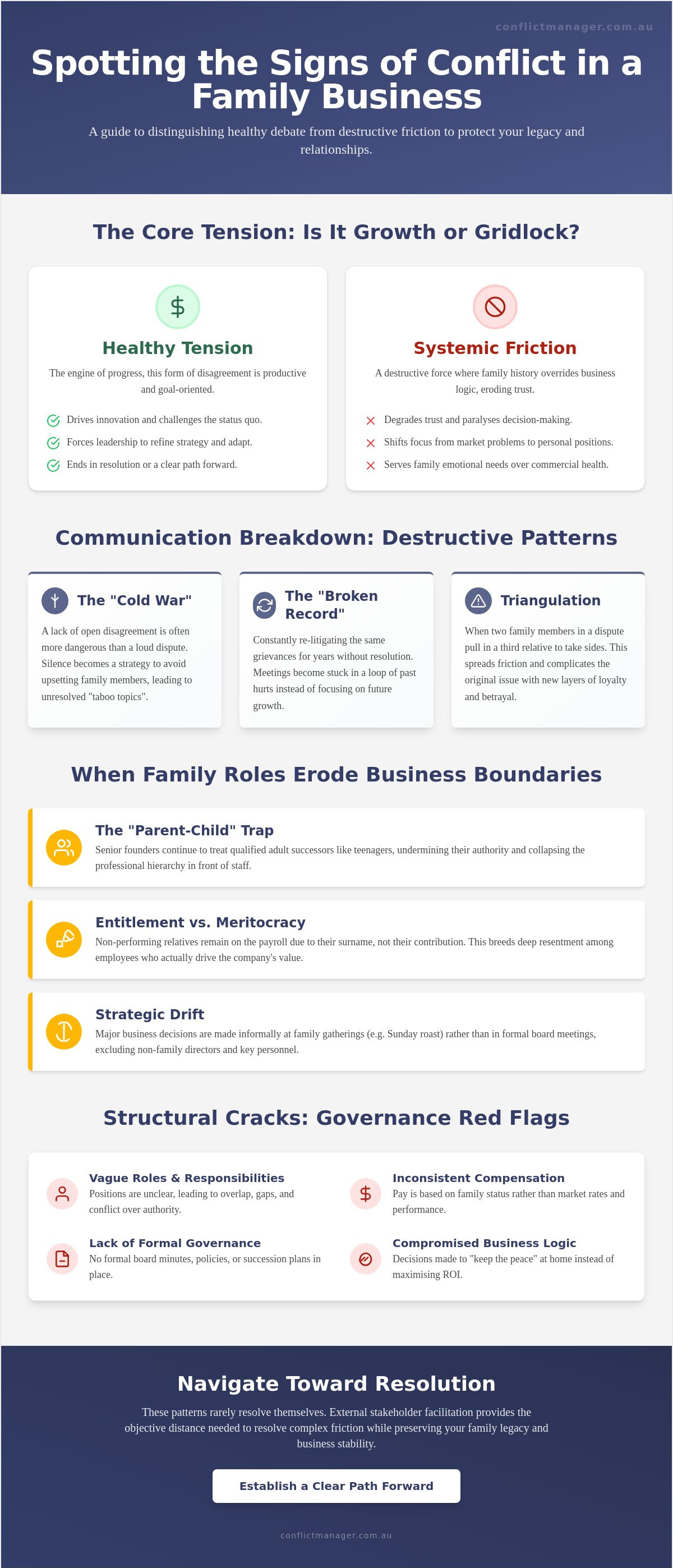
There is a vital distinction to be made between healthy tension and systemic friction. Healthy tension drives innovation. It challenges the status quo and forces the leadership team to refine their strategy. Systemic friction, however, degrades trust and paralyses decision-making. You can sense this shift during what we call a "vibe check". The atmosphere in the boardroom moves from a collaborative spirit to a defensive posture. Eyes narrow. Body language stiffens. The focus shifts from solving a market problem to protecting a personal position or an ancient family hierarchy.
The Subtle Shift from Professional to Personal
When business decisions are made to "keep the peace" at home rather than to maximise ROI, the integrity of the firm is at risk. You might notice the emergence of "taboo topics". These are critical strategic issues that everyone sees but no one is willing to raise in formal meetings for fear of upsetting a sibling or a parent. Silence becomes a strategy. Systemic friction is the point where family history overrides business logic. Once this threshold is crossed, the business begins to serve the family's emotional needs at the expense of its own commercial health.
Distinguishing Normal Bickering from Destructive Patterns
Disagreements are inevitable. In a high-stakes environment, they are even necessary. However, the frequency of these disputes matters less than their intensity and how they conclude. A healthy debate ends in a resolution or a collective commitment to a specific path forward. Destructive patterns, by contrast, often involve "triangulation". This occurs when two family members cannot resolve a dispute and pull in a third relative to take sides or act as a messenger. This spreads the friction across the entire family tree, complicating the original issue with new layers of loyalty and betrayal.
Another red flag is the "broken record" syndrome. This involves re-litigating the same grievances for years without ever reaching a conclusion. If you find your leadership meetings stuck in a loop of past hurts rather than future growth, you are seeing the primary signs of conflict in a family business. These patterns don't resolve themselves through time alone. They require a deliberate shift in how the family interacts with the business structure.
The Erosion of Boundaries: Family Roles vs Business Requirements
Boundaries. Roles. Expectations. These are the structural scaffolding of any robust enterprise, yet in a family context, they are often the first elements to dissolve. When the intimacy of the home begins to permeate the professional environment, the resulting role confusion often manifests as the primary signs of conflict in a family business. This erosion is rarely a single event. It is a gradual process where personal history starts to dictate corporate strategy, leading to a loss of objectivity that can threaten the very assets the family seeks to protect.
One of the most pervasive issues is the "Parent-Child" trap. This occurs when senior leaders, often the founders, continue to treat adult successors like teenagers rather than the qualified executives they have become. This dynamic creates a specific framework for identifying conflict that is rooted in psychological history rather than current performance. When a 45-year-old Managing Director is still being "corrected" by a retired patriarch in front of staff, the professional hierarchy collapses. This often runs alongside the friction of entitlement versus meritocracy, where non-performing relatives remain on the payroll simply because of their surname, breeding deep resentment among those who actually drive the firm's value.
Strategic drift is another common symptom. Major shifts in direction often happen over a Sunday roast rather than being recorded in formal board minutes. This informal decision-making process excludes non-family directors and ignores the "invisible stakeholders"—the spouses or non-active relatives who influence the business from the sidelines. If you recognise these patterns within your own organisation, seeking early stakeholder facilitation can help restore the necessary professional distance before the friction becomes terminal.
Role Confusion in the Family Office
Wearing two hats is a difficult balancing act. It's the challenge of being a loving relative on Saturday and a demanding supervisor on Monday. Family loyalty is frequently weaponised in these environments to silence legitimate professional critique. If a relative's poor performance is viewed as a "family matter" rather than a business issue, accountability disappears. This lack of clarity is particularly damaging to non-family employees. When they see that the rules apply differently to those with the right DNA, your best talent will inevitably look for the exit.
Succession Shadowing and Power Struggles
The "Founder’s Shadow" can loom large over an organisation for decades. It occurs when the retiring generation refuses to cede actual control, even after a formal handover has taken place. Successors then find themselves in a state of perpetual apprenticeship, unable to make the necessary changes to modernise the business. Succession is a process of transition, not a single event of abdication. Without a clear, staged plan for the transfer of authority, the resulting power struggle can paralyse the organisation, leaving the next generation feeling stuck and undervalued.
Communication Patterns: From Overt Disputes to Destructive Silence
Silence. Stillness. Stagnation. These are the hallmarks of the "Cold War" phase in an organisation. While many leaders look for overt shouting matches as the primary signs of conflict in a family business, the total absence of dialogue is often far more destructive. When family members stop arguing, it rarely means they've reached an agreement. It usually signifies they've given up on the possibility of one. This silence leads to information hoarding, where business data is treated as a currency of power or a tool to exclude specific relatives from the decision-making loop.
Resentment also finds its voice through sarcasm or thinly veiled "jokes" during formal meetings. These barbs are designed to puncture a relative's authority without inviting an open confrontation. Another significant red flag is the "meeting after the meeting". If you notice that real strategic decisions are being made in hallway whispers or private phone calls to avoid certain family members, the formal governance structure has effectively collapsed. These shadows indicate that the professional environment is being colonised by personal grievances, leading to a decay in structural integrity.
Recognising Passive-Aggressive Governance
Passive-aggressive behaviour is a subtle but effective form of sabotage. It manifests through delayed approvals, "forgetting" to include key relatives on email chains, or the use of proxies. Sending a junior staff member to deliver unpleasant news to a sibling is a classic way to avoid direct accountability while maintaining friction. In some cases, relatives may even engage in "weaponised incompetence". They deliberately fail at a task or miss a deadline to undermine a project led by a family rival, prioritising personal points-scoring over the firm's commercial success.
The Breakdown of Formal Channels
Formal reporting lines are often the first casualty of family friction. When family members bypass their designated supervisors to go straight to the CEO, usually a parent, the organisational chart becomes meaningless. The Family Council or Board of Directors may continue to meet, but if these sessions have decayed into social gatherings where difficult topics are avoided, they no longer serve their purpose. Strategic proposals become weighed down by emotional baggage from decades of family history, making objective evaluation nearly impossible. This breakdown ensures that internal efforts to resolve issues will likely struggle under the weight of historical bias.
Structural and Governance Red Flags in the Family Office
Structure. Clarity. Accountability. These are the pillars of a functional family office. When they are absent, the resulting vacuum is quickly filled by assumptions and resentment. One of the most visible signs of conflict in a family business is a chronic lack of clear job descriptions. In many Australian family firms, the "everyone does everything" approach is often romanticised as agility. In reality, it usually means everyone fights over everything, as overlapping authorities create constant friction and stalled progress. Without defined boundaries, the professional environment becomes a theatre for personal power struggles.
Compensation is another significant volatility point. Paying family members based on their personal "need" or birth order rather than market value or performance is a fundamental governance failure. It ignores the reality of the labour market and creates an environment where merit is secondary to DNA. This is often compounded by opaque financial reporting. When siblings or cousins feel "kept in the dark" about the true state of the family assets, trust evaporates. Without a formal dispute resolution clause in the shareholders’ agreement, these structural weaknesses can turn a minor disagreement into a terminal legal battle. If your governance feels more like a source of friction than a framework for order, professional organizational conflict management can help restructure these boundaries before they collapse.
Governance as a Shield, Not a Sword
A "Family Constitution" that sits forgotten in a drawer is a clear red flag. It suggests that the family values the image of order more than the practice of it. Unequal access to information among the next generation is particularly toxic, as it creates a hierarchy of "insiders" and "outsiders" within the same bloodline. You should look for these three specific structural signs of decay: overlapping authorities that lead to "veto wars" between departments, a complete lack of KPIs for family employees, and "emergency-only" board meetings that occur only when a crisis has already erupted.
The High-Net-Worth Friction Point
In the context of significant wealth, sizable assets act as a magnifier for small interpersonal grievances. Disagreements over the use of family assets, such as the allocation of time at holiday homes or the use of office space, are rarely about the asset itself. They are about perceived status, respect, and fairness within the family hierarchy. Similarly, friction often arises regarding the family's philanthropic direction or the overarching mission of the wealth. When the purpose of the family's legacy is not clearly defined, every donation or investment becomes a battleground for individual values. These governance gaps are not merely administrative oversights; they are the structural precursors to systemic failure.
Navigating Toward Resolution: The Logic of External Intervention
Objectivity. Distance. Resolution. These are the necessary components for de-escalating deep-seated friction within a legacy enterprise. When you've identified the primary signs of conflict in a family business, the instinct is often to resolve the matter internally. However, the "neutral" family member is rarely seen as truly impartial by all stakeholders. Every relative carries the weight of shared history; every word spoken is filtered through decades of holiday dinners and childhood dynamics. This lack of perceived neutrality is why internal mediation often hits a brick wall, inadvertently entrenching the very positions it seeks to soften.
An external mediator acts as a "Composed Authority", a steady hand capable of viewing volatile situations with total objectivity. By introducing a neutral third party, you effectively lower the collective pulse of the room. The conversation shifts from a cycle of blame regarding past hurts to a methodical focus on future governance. The goal of this intervention isn't for one faction to "win". Instead, it is about achieving a sustainable, clear outcome that ensures the business remains viable and the family bond remains intact. It is a transition from the heat of interpersonal friction to the cool logic of structural integrity.
When to Engage a Neutral Third Party
Recognising when you've reached an impasse is the first step toward recovery. If the same arguments are repeating without resolution, or if high-emotion wealth transfers are causing visible distress, it's time to engage a neutral third party. Professional facilitation provides an objective lens that protects the "Asset Integrity" of the family office. It ensures that decisions are made based on structural logic rather than emotional reactivity, preventing the erosion of the hard-earned legacy. This external perspective is particularly vital when the signs of conflict in a family business begin to impact the confidence of non-family staff or external stakeholders.
The Conflict Manager Approach
Our approach provides the stability needed to guide stakeholders through complex transitions. We focus on creating clarity where there is currently confusion, helping to preserve the family bond while professionalising the business structure. By addressing the structural and interpersonal shifts early, you can navigate toward a vision of structured resolution. We act as a steady hand, ensuring that the heavy weight of responsibility doesn't lead to a collapse of the organisational framework. If you're ready to move beyond the friction and secure your legacy, Enquire about our Family Conflict Resolution services to begin the process of restoration.
Restoring Order and Securing Your Legacy
Clarity. Stability. Continuity. Maintaining these pillars requires a vigilant eye for the subtle shifts where family dynamics begin to compromise corporate governance. You've explored how role confusion, destructive silence, and structural gaps serve as early warnings. By identifying the early signs of conflict in a family business, you move from a state of reactive crisis to one of proactive stewardship. It's about protecting the asset integrity of your family office while ensuring that the bonds of kinship remain resilient against the friction of shared enterprise.
Transitioning from internal impasse to structured resolution often requires a composed, objective voice. We provide expert-led mediation for high-net-worth Australian families, focusing on sustainable outcomes that honour both the balance sheet and the bloodline. Our guidance offers the steady hand needed to navigate high-emotion transitions with total objectivity. Secure your family legacy with professional Conflict Resolution. You have the power to transform friction into a foundation for future growth.
Frequently Asked Questions
What are the first signs that family conflict is affecting the business?
The earliest indicators are often found in the erosion of open communication. You will notice information hoarding, the emergence of "taboo topics" that are avoided in meetings, or decisions being made in private hallway whispers. These primary signs of conflict in a family business suggest that personal grievances have begun to colonise professional structures, leading to a decay in decision-making speed and trust.
Can a family business survive without a formal governance structure?
While small enterprises might manage with informal arrangements, a larger family business rarely survives multi-generational transitions without formal governance. Governance provides the necessary framework for stability and order. According to 2025 research, nearly 46 per cent of family-owned companies lack a formal succession plan, which often leads to the business logic being overwhelmed by family emotional systems as the family tree grows.
How do I tell a family member their performance is damaging the business?
Shift the focus from personal attributes to objective performance benchmarks. Use market-based KPIs and formal job descriptions to discuss the role's requirements rather than the individual's failings. This approach depersonalises the friction. It allows you to address the damage to the business while attempting to preserve the family bond through a steady, professional dialogue.
Is it better to resolve family disputes in court or through mediation?
Mediation is almost always the superior choice for family enterprises. Court proceedings are public, adversarial, and often result in the total collapse of the family unit. Professional stakeholder facilitation offers a private, objective environment where a composed authority can help relatives reach a sustainable resolution that protects both the business assets and the family kinship.
What should we do if the founder refuses to discuss succession planning?
Frame the conversation around the preservation of their legacy rather than their departure. Many founders view succession as a loss of identity or a sign of weakness. By presenting it as a structured transition that secures the firm's future, you can lower their pulse and reduce the defensive posture often associated with these high-stakes discussions.
How can we separate family emotions from business decision-making?
Establishing rigid boundaries between the dining table and the boardroom is essential. You must implement clear job descriptions and formal reporting lines that mirror a non-family corporate environment. When structural logic is prioritised and documented, it creates a buffer that prevents family emotions from clouding strategic decisions or influencing the balance sheet.
What is the role of a Family Council in preventing conflict?
A Family Council serves as a dedicated forum for family-specific issues, keeping them separate from day-to-day business operations. It allows relatives to discuss values, legacy, and philanthropic goals without interrupting the work of the Board of Directors. This separation is a critical tool for identifying the signs of conflict in a family business before they reach the executive level.
When is it too late to call in a professional mediator for a family dispute?
It is rarely too late to engage a professional, but the complexity of resolution increases as resentment deepens. Even if an impasse feels terminal, a neutral third party can often find a path toward a structured exit or a reorganisation of family assets. The goal is to prevent a total loss of asset integrity and the permanent estrangement of the family unit.


