

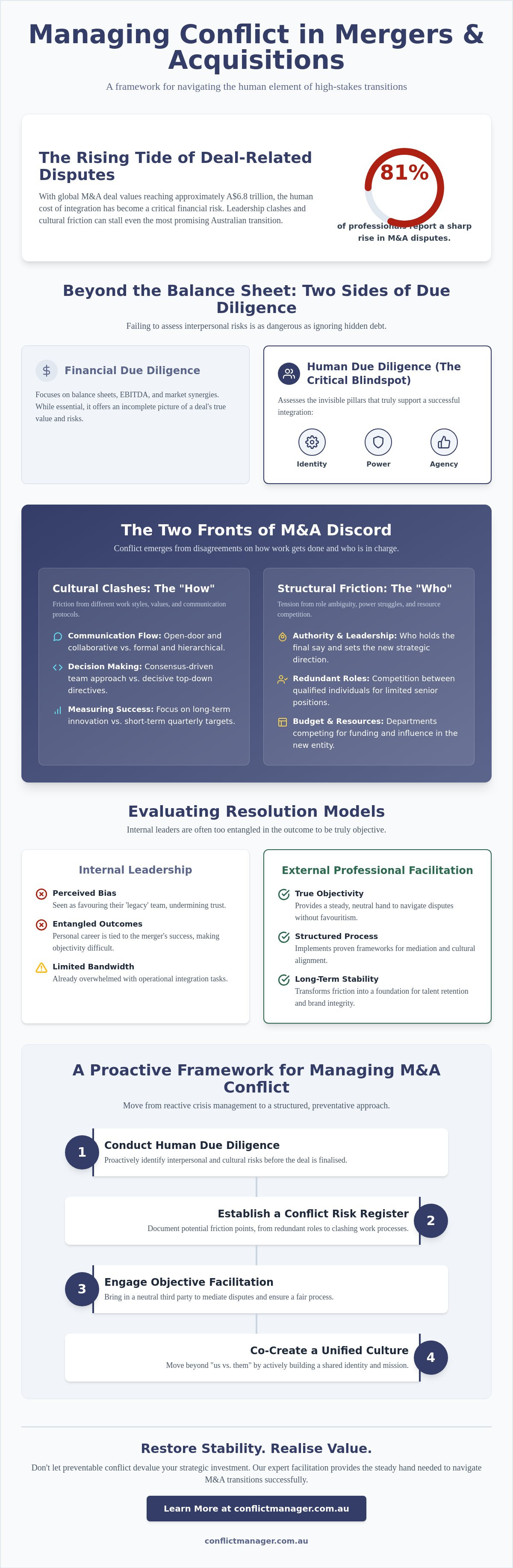
Ambition. Integration. Friction. With global M&A deal values reaching approximately A$6.8 trillion in 2025, it's startling that 81% of professionals report a sharp rise in deal-related disputes. These tensions aren't just legal hurdles; they're the predictable result of leadership clashes and cultural friction that can stall even the most promising Australian transition. Successfully managing conflict during mergers and acquisitions requires more than a rigorous due diligence process. It demands a steady, objective hand to navigate the anxiety and role ambiguity that inevitably surfaces when two distinct corporate identities collide.
You likely recognise that the true cost of a merger isn't found in the advisory fees but in the loss of key talent when the integration feels chaotic. We've designed this guide to provide a composed, professional framework for navigating the human and structural friction that arises during these high-stakes periods. We'll explore how to build a stable organisational culture and retain high-value stakeholders. By the end, you'll have the tools to realise the strategic value of your deal without the interference of emotional volatility or internal ego clashes.
Key Takeaways
- Understand why human due diligence is as vital as financial auditing to identify interpersonal risks before they devalue the deal.
- Learn to distinguish between cultural clashes regarding how work is performed and structural friction over who holds authority in the new entity.
- Discover a proactive framework for managing conflict during mergers and acquisitions by implementing a Conflict Risk Register during the initial due diligence phase.
- Recognise why internal leaders are often too entangled in the outcome of a merger to act as truly objective mediators for stakeholder disputes.
- Explore how professional facilitation transforms organisational friction into a foundation for long-term retention and brand integrity.
Navigating the Friction of Transition: Why Conflict Emerges in M&A
Identity. Power. Agency. These are the invisible pillars that support any successful business. When two companies merge, these pillars don't simply align; they often collide. We define M&A conflict as the inevitable friction that occurs when distinct organisational identities and established power structures are forced into a single frame. While financial analysts focus on synergies and EBITDA, the real work of managing conflict during mergers and acquisitions begins with acknowledging that these transitions are deeply personal. Conflict is rarely about the technicalities of the deal itself; it's about the perceived loss of individual agency and the disruption of a known professional world.
Most Australian firms perform exhaustive financial audits but neglect the "human due diligence" required to ensure a stable integration. Failing to assess interpersonal risks is just as dangerous as ignoring a hidden debt on a balance sheet. In the Australian market, the cultural expectation of a "fair go" acts as a powerful barometer for organisational health. If employees perceive that restructuring is arbitrary or that the new leadership lacks transparency, resistance becomes immediate and vocal. A methodical approach to human due diligence identifies these volatile pockets before the ink is dry, allowing for a structured resolution rather than a reactive crisis.
The Psychology of the Merger: Anxiety and Agency
Uncertainty is a silent killer of productivity. When a merger is announced, employees immediately look for stability in the details: their job titles, their reporting lines, and the security of their superannuation. This creates a vacuum where gossip thrives and anxiety takes root. We often see "survivor syndrome" in acquired teams, where those who remain feel a sense of guilt or persistent fear that they are next on the redundancy list. Acknowledging the difficult reality of this change is the first step toward building trust. You can't build a new culture on a foundation of unaddressed fear.
When "Us vs. Them" Becomes the Default Narrative
Tribalism is a natural human response to perceived threats. Without a shared purpose, integrated departments quickly retreat into "us vs. them" mentalities. This manifests as "legacy bias," where staff cling to former ways of working as a quiet form of protest against the new regime. If you don't address this friction early, it becomes a permanent scar on the organisation, leading to a fragmented culture that never quite achieves the strategic value promised in the initial deal. Managing conflict during mergers and acquisitions isn't just about solving current disputes; it's about preventing these long-term structural fractures from setting in.
The Two Fronts of M&A Discord: Cultural Clashes and Role Ambiguity
Culture. Structure. Identity. These facets of organisational life are often the first to fracture during a transition. While the previous section explored the underlying psychology of anxiety, we must now examine the specific mechanics of discord. Cultural conflict typically centres on the "how" of a business; it involves how decisions are made, how communication flows, and how success is measured. Structural conflict, conversely, focuses on the "who"; it determines who holds the budget, who reports to whom, and who ultimately leads. When these two fronts are left unmanaged, the integration stalls as leaders retreat into defensive postures.
Friction often peaks when a hierarchical, top-down organisation acquires a firm with a flatter, more collaborative structure. This clash isn't just a matter of preference. It's a fundamental disagreement on the nature of authority. In this vacuum of clarity, departmental silos frequently transform into "fortresses." Teams begin to hoard resources and protect information as a defensive mechanism against the perceived invader. For long-term employees of the acquired firm, this manifests as an "identity threat." They aren't just losing a brand; they're losing the professional identity they spent years cultivating. Successfully managing conflict during mergers and acquisitions requires recognising these tribal instincts before they harden into permanent resistance.
Structural Friction: The Battle for the Org Chart
Redundancy. Competition. Overlap. When two org charts are compressed into one, the result is rarely seamless. The most acute conflict arises from redundant senior roles, where two qualified individuals are suddenly competing for a single top spot. Without clear, facilitated governance, these overlaps devolve into "turf wars" over budget and decision-making rights. These disputes devalue the deal by distracting leadership from the strategic goals of the integration. A neutral framework is required to resolve these overlaps quickly and objectively, ensuring that roles are assigned based on the future needs of the business rather than legacy loyalty.
The Unique Stakes of Family Office M&A
Legacy. Emotion. Succession. The stakes shift dramatically when a family office or a multi-generational Australian family business is involved. Unlike a purely corporate transaction, these deals are often entangled with a family's history and sense of self. Multi-generational friction can derail a deal if the younger generation seeks a swift corporate exit while the founders feel a deep, emotional obligation to protect their legacy. These situations require more than just legal advice; they demand expert stakeholder facilitation to navigate the complex overlap of family assets and interpersonal dynamics. Expert mediation ensures that emotional interference doesn't destroy the strategic value of the sale, allowing the family to transition with their relationships and wealth intact.
Evaluating Resolution Models: Internal Leadership vs. External Facilitation
Objectivity. Distance. Clarity. These are the essential components of any successful resolution, yet they are often the first casualties of a corporate merger. When disputes arise, many Australian firms default to an "internal fix," tasking their human resources departments or senior executives with the burden of reconciliation. While this seems efficient on paper, it often ignores the reality of professional entanglement. Internal leaders are rarely seen as neutral; they are active participants in the new hierarchy with their own careers, reporting lines, and reputations at stake. This lack of perceived distance can undermine even the most well-intentioned efforts to restore order.
Managing conflict during mergers and acquisitions requires a level of quiet confidence that internal staff often struggle to maintain under the intense pressure of restructuring. A steady, objective hand is needed to view board-level ego clashes and departmental friction without becoming emotionally involved in the outcome. By introducing an external perspective, the organisation signals a commitment to a fair and methodical resolution. This external presence acts as a stabilising force, providing a sense of order during a period of high volatility and structural flux.
The Limits of Internal HR in High-Emotion Disputes
Internal HR teams frequently bear the heaviest emotional load during an integration. For employees of an acquired firm, HR is often perceived as a tool of the buyer, tasked with enforcing a new culture rather than facilitating a genuine dialogue. This skepticism makes it difficult for internal staff to act as effective mediators. Furthermore, the sheer volume of work involved in restructuring can lead to facilitator burnout. When those tasked with resolving conflict are themselves exhausted by the emotional weight of the transition, the risk of inconsistent or reactive decision-making increases significantly.
The Case for the Neutral Third-Party Mediator
An external facilitator functions as a neutral circuit breaker in deadlocked negotiations. Unlike internal staff, a neutral third party mediator has no stake in the new org chart, allowing them to provide total objectivity when viewing complex human dynamics. This role involves creating a "safe container" for high-stakes leadership conversations where stakeholders can speak candidly without fear of political repercussions. By moving the dialogue from a state of complexity toward a vision of structured resolution, an external expert ensures that the strategic value of the deal is protected from the interference of internal politics and unresolved friction.
A Step-by-Step Framework for Managing Conflict during Mergers
Strategy. Pre-emption. Resolution. A successful integration is never the result of chance; it's the product of a deliberate framework. Managing conflict during mergers and acquisitions must begin well before the deal closes. We recommend moving away from reactive fire-fighting toward a proactive cadence that identifies friction before it becomes a structural failure. This involves creating a Conflict Risk Register during the due diligence phase to pinpoint volatile departments and potential leadership clashes. Rather than relying on one-way town hall presentations, which often heighten anxiety, we advocate for facilitated Alignment Workshops. These sessions provide a structured environment for stakeholders to address the difficult realities of the transition under the guidance of a neutral party.
A clear dispute resolution protocol is essential. This protocol should bypass the traditional chain of command, allowing issues to be surfaced and resolved without the interference of new reporting lines that may not yet be trusted. By establishing these rules of engagement early, you provide a sense of order that settles nerves and protects productivity.
Step 1: Conduct a Human Capital Risk Audit
Identifying the social architecture of the acquired firm is critical. You must map the key influencers who can champion the change and the detractors who may quietly sabotage integration. This audit should also compare decision-making styles, noting whether one firm relies on consensus while the other is strictly hierarchical. Human Due Diligence is the systematic assessment of interpersonal and cultural alignment risks prior to integration. Mapping these differences allows you to predict where friction will occur and prepare a logical response.
Step 2: Establish a Neutral Facilitation Channel
Trust is often fragile during a merger. Setting up an external mediation office or a confidential channel for leadership disputes ensures that grievances don't fester. Maintaining total confidentiality is vital for the integrity of the resolution process. This neutral channel allows executives to resolve high-stakes disagreements without the fear of political fallout within the new hierarchy. If you require a structured approach to these dynamics, our team provides comprehensive organisational conflict management to ensure stability during the most volatile stages of the deal.
Step 3: Facilitating Departmental Integration
When merging departments, the focus should shift toward shared wins. Identify a high-priority project that requires active collaboration from both legacy teams to succeed. This creates a functional necessity for cooperation rather than just a social one. A steady, objective voice is essential during these initial interactions to guide the dialogue and prevent legacy bias from stalling progress. To secure your organisation’s future and ensure a seamless transition, consider engaging our professional stakeholder facilitation services today.
Restoring Stability: The Role of Expert Mediation in Sustainable Outcomes
Growth. Resilience. Integration. These are the rewards of a transition managed with foresight. While the early stages of a deal focus on the mechanics of integration, the final phase of managing conflict during mergers and acquisitions is about securing a foundation that persists long after the press releases have faded. Professional mediation transforms the heat of friction into the clarity of a new, shared purpose. It's the difference between a merger that merely exists on paper and one that thrives as a singular, high-performing entity.
The long-term benefits of a structured resolution are measurable. Retention of high-value talent, protected brand integrity, and a healthy organisational culture are the primary dividends of this approach. When leadership ego clashes are resolved through objective facilitation, the risk of cultural rot is eliminated. This ensures the strategic value of the deal isn't eroded by the silent resentment of a workforce that feels unheard or undervalued. In the Australian market, where talent mobility is high, losing key stakeholders during a transition can cost a firm significantly more than the initial investment in conflict management.
From Friction to Clarity: The Resolution Journey
Leadership teams often experience a profound emotional shift when a neutral party enters the room. The political weight of the merger begins to lift, replaced by a methodical focus on structural alignment. By bringing total objectivity to the table, an external expert allows stakeholders to step away from defensive postures and toward collaborative solutions. This process is essential for facilitating difficult conversations at work, ensuring that the most sensitive disputes are handled with the discretion and authority they require. Addressing these issues early prevents the fragmentation of the new culture, allowing the organisation to move forward as a unified force.
Achieving a Reassured State of Integration
Conflict Manager serves as the steady hand for high-stakes Australian business transitions. We provide the grounded, reassuring presence needed to navigate periods of extreme organisational stress. Managing conflict isn't just a defensive measure; it's a strategic investment in the deal’s ultimate ROI. By choosing a path of structured resolution, you move your organisation from a state of complexity toward a vision of enduring stability. Ensure your merger reaches its full potential with professional facilitation and secure the cultural health of your business for the years ahead. Our role is to act as the wise, external counsellor who brings order to chaos, allowing you to focus on the future of your integrated firm.
Securing the Strategic Value of Your Integration
Integration. Stability. Value. The ultimate success of an Australian merger isn't determined on the day the deal is signed; it's decided in the months of transition that follow. We've explored how human due diligence and proactive risk registers can identify volatile friction before it devalues your assets. By prioritising structural clarity and cultural alignment, you ensure that your organisation doesn't just survive the integration but thrives as a unified entity.
Successfully managing conflict during mergers and acquisitions requires a steady, objective hand capable of viewing high-stakes disputes with total impartiality. We specialise in high-net-worth and family office disputes, bringing national Australian expertise to complex structural changes. Our methodical, neutral approach ensures that high-emotion business disputes are resolved without compromising your strategic goals. Secure your organisation’s future with expert M&A conflict facilitation. With the right guidance, you can move from the complexity of disruption toward a state of reassured, structured resolution. Your integration deserves the stability that only expert facilitation can provide.
Frequently Asked Questions
What are the most common causes of conflict during an M&A transition?
Uncertainty. Redundancy. Friction. The primary drivers of discord are usually structural overlaps and the perceived loss of professional identity. When employees don't know who they report to or if their role still exists, anxiety turns into active resistance. These tensions are often exacerbated by a lack of transparency regarding the new hierarchy, leading to a breakdown in trust between legacy teams and the new leadership.
How can leadership teams prevent cultural clashes before they start?
Audit. Alignment. Integration. Preventing clashes requires a methodical assessment of the "how" behind each business before the merger is finalised. By identifying differences in decision-making styles early, leadership can facilitate workshops that establish a new, shared set of operating principles. This proactive approach ensures that the integration feels like a collaborative evolution rather than a forced takeover, which is essential for maintaining morale.
Why is a neutral third-party mediator better than using an internal HR team?
Objectivity. Distance. Trust. Managing conflict during mergers and acquisitions is often compromised when internal HR teams are viewed as agents of the buyer. A neutral third party provides a safe container for high-stakes discussions; they aren't entangled in the new org chart or future promotion cycles. This independence allows stakeholders to speak with total candour, ensuring that the resolution is based on logic rather than internal politics.
What is human due diligence and why is it important for Australian businesses?
Assessment. Risk. Stability. Human due diligence is the systematic process of auditing the cultural health and leadership dynamics of a firm before an acquisition takes place. For Australian businesses, this is vital to ensure the "fair go" culture isn't compromised. By identifying interpersonal risks early, leaders can prevent the loss of high-value talent that often follows a transition where the human element was neglected in favour of the balance sheet.
How do you manage conflict between departments with competing interests after a merger?
Collaboration. Purpose. Governance. Conflict between merged departments is best resolved by identifying a project that requires a "shared win" for both teams to succeed. This moves the focus from protecting legacy resources to achieving a common goal. Success in these scenarios depends on clear, facilitated rules of engagement that define new boundaries and decision-making rights, preventing departmental silos from turning into fortresses.
What should we do if a key stakeholder threatens to leave during the acquisition?
Retention. Agency. Resolution. If a high-value stakeholder threatens to exit, it’s usually due to a perceived loss of influence or role ambiguity. Engaging a professional facilitator allows for a private, objective negotiation where the stakeholder’s underlying concerns can be addressed. This direct intervention provides a sense of order and reassures the individual that their contribution is valued within the new organisational structure.
Can mediation help resolve disputes in family-owned businesses during an exit?
Legacy. Emotion. Succession. Mediation is particularly effective for family-held assets where multi-generational disagreements can stall a sale or merger. A neutral expert helps separate complex family dynamics from commercial requirements, ensuring that the family legacy is preserved while the strategic value of the exit is realised. This methodical approach protects both the financial outcome and the long-term health of family relationships.
How long does it typically take to achieve cultural alignment after a merger?
Persistence. Evolution. Stability. While structural changes happen quickly, deep cultural alignment typically takes between 12 and 24 months to solidify. This timeline depends on the consistency of leadership and the frequency of facilitated interventions designed to manage conflict during mergers and acquisitions. It isn't a one-off event but a slow, deliberate progression toward a new state of organisational order and shared identity.


