

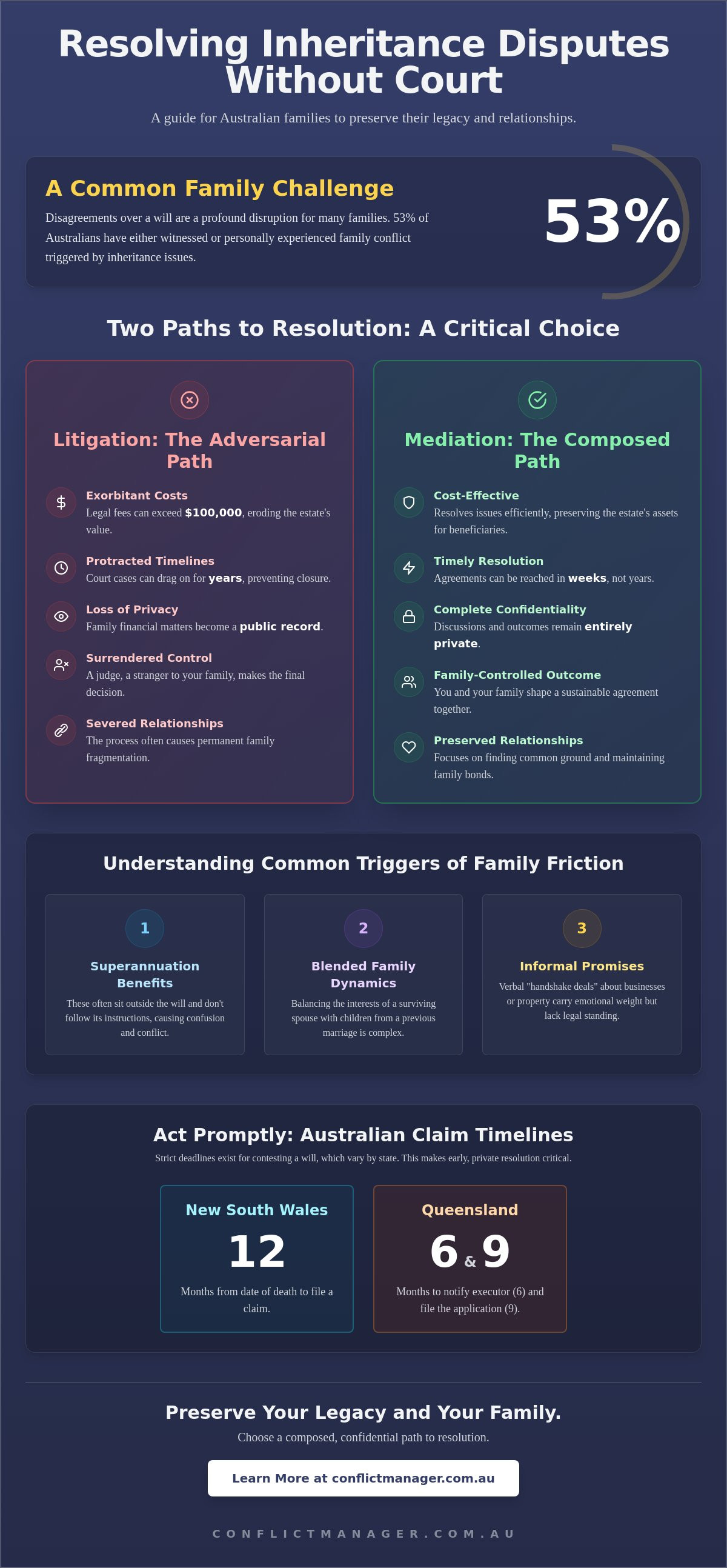
Did you know that 53% of Australians have witnessed or personally experienced family conflict triggered by a will? Disruption. Friction. Fragmentation. These are the quiet realities that often follow a loss, yet many families don't realise they can resolve inheritance dispute without court through professional mediation. This private path offers a way to address grievances before they become permanent scars, keeping your private financial matters away from the public record and out of the Supreme Court.
You likely feel the weight of this responsibility and the fear that legal fees, which can exceed $100,000 for highly contested cases, will erode the very legacy you're trying to protect. We understand that the prospect of severed sibling relationships feels like an inevitable price of seeking fairness; however, it doesn't have to be your reality. This article explores how professional facilitation serves as a steady hand to guide you toward a resolution that maintains family stability. We will examine the specific time limits for Australian claims, the structural benefits of private mediation, and the logical steps to achieve a fair distribution of assets in weeks rather than years.
Key Takeaways
- Identify common triggers of family friction, such as superannuation death benefits, to address issues before they lead to structural fragmentation.
- Recognise why adversarial litigation is often a tactical error that risks the permanent severance of sibling relationships and the public disclosure of private wealth.
- Discover a methodical framework to resolve inheritance dispute without court, focusing on a confidential path that achieves a sustainable outcome for all stakeholders.
- Understand how a neutral conflict manager provides the objective expertise required to navigate high-stakes transitions with composed authority.
- Explore the benefits of specialised mediation for families managing sizeable assets, ensuring that family wealth and personal legacies remain intact.
The Landscape of Inheritance Friction: Understanding the Triggers
Disruption. Friction. Fragmentation. An inheritance dispute is rarely just a legal disagreement; it is a profound disruption of family equilibrium that threatens the structural integrity of a legacy. While many families believe litigation is the only path, those who seek to resolve inheritance dispute without court often find that early intervention preserves more than just the bank balance. It protects the very relationships that the deceased likely intended to sustain.
In Australia, the triggers for these conflicts are increasingly specific and complex. Superannuation death benefits, which often sit outside the estate, frequently cause unexpected friction because they don't follow the instructions left in a will. Blended family dynamics add another layer of complexity, as the interests of a surviving spouse may clash with those of children from a previous marriage. When one party feels excluded, the emotional response is immediate and powerful. If this friction isn't addressed, it quickly escalates into a state of permanent severance.
Family Provision Claims and the Australian Context
The Australian legislative framework allows "eligible persons" to contest a will if they believe they haven't received adequate provision. This creates a tension between a legal right and a moral obligation. The rules vary significantly across the states. For instance, in New South Wales, a claim must generally be made within 12 months of the death. In Queensland, the timeline is even tighter; the executor must be notified within 6 months and the application filed within 9. These deadlines often force families into adversarial stances before they've had time to grieve, making a private resolution even more critical.
High-Net-Worth Complexity: Beyond the Will
High-value estates involve more than just a simple distribution of personal effects. They often encompass family trusts, private companies, and intricate asset structures that standard probate processes are ill-equipped to handle. Friction frequently arises from informal promises made by the deceased during their lifetime, such as a "handshake deal" regarding a family business or a rural property. These verbal commitments carry significant emotional weight but lack legal standing, leading to deep-seated resentment among stakeholders. Addressing these nuanced issues requires a sophisticated understanding of The Mechanics of Mediation, where a neutral facilitator helps parties move past rigid legal positions toward a sustainable, structured agreement. This approach ensures that complex asset portfolios remain intact while providing a clear path for every family member to move forward.
Why Litigation is a Tactical Error for Private Families
Courtrooms are designed to settle legal claims, not to heal families. For private families, choosing litigation is often a tactical error that leads to a "scorched earth" outcome. When you step into a courtroom, you surrender your agency. A judge, who is a stranger to your family's history and values, makes the final decision. This loss of control is a high-risk strategy that often results in a resolution no one truly wants. To resolve inheritance dispute without court is to retain the power to shape your own future.
Privacy is another casualty of the legal system. Court proceedings are a matter of public record. For families managing significant assets or private companies, having financial details and internal friction aired in public is a hidden cost that many don't consider until it's too late. Choosing a private path maintains a veil of confidentiality that protects both the estate and the family's reputation. This discretion is essential for maintaining the structural integrity of a family's standing in the community.
The "litigation tax" is the final blow. Legal fees in contested Australian estates can be substantial, often consuming a significant percentage of the total value. These funds are drawn directly from the inheritance, effectively reducing the legacy left for everyone. This financial drain is typically accompanied by a permanent severance of bonds. It's a high price to pay for a process that rarely offers emotional closure.
The Financial and Emotional Erosion of Court
The true cost of court extends far beyond billable hours. It includes the total loss of family "goodwill." While mediation might take a day or two, court cases frequently drag on for years. This timeline problem prevents executors from closing the estate and keeps beneficiaries in a state of suspended animation. Executors often find themselves trapped between their legal duties and their personal loyalties; it's a psychological burden that can lead to burnout or deep resentment within the family unit.
The Illusion of the 'Win' in Estate Law
A legal victory in court often feels like an emotional defeat. Judges are limited to judicial remedies; they can't restore trust or fix a broken relationship. We have seen cases where a "successful" court claim resulted in the total dismantling of a multi-generational family structure because the remaining members could no longer work together. If you are seeking a path that preserves both wealth and unity, engaging in A Framework for Resolving Disputes Without Court is a more logical alternative. For those who recognise that the current friction requires a steady, external hand, seeking professional Family Conflict Resolution can provide the order needed to move forward.
The Mechanics of Mediation: A Composed Path to Resolution
Order. Clarity. Discretion. These are the pillars of a successful resolution. Mediation is not merely a meeting; it's a structured, confidential process facilitated by a neutral expert who understands the weight of legacy. For those who seek to resolve inheritance dispute without court, this path offers a way to navigate high-stakes transitions with total objectivity. It replaces the chaos of adversarial litigation with a methodical sequence designed to restore order.
The objective extends beyond the simple division of assets. It aims to achieve a sustainable outcome that acknowledges the complexities of The Landscape of Inheritance Friction while preventing the permanent fragmentation of the family unit. A resolution is only truly successful if it remains clear and enforceable long after the initial friction has subsided. By focusing on structural integrity rather than just financial figures, mediation provides a resolution that holds under the pressure of time.
A mediator acts as a steady hand. They neutralise high-emotion environments without becoming entangled in the history of the dispute. Because the process is conducted on a "without prejudice" basis, everything said remains private and cannot be used in future legal proceedings. This confidentiality is the ultimate safeguard for families who wish to resolve inheritance dispute without court, ensuring that personal vulnerabilities and family finances never become a matter of public record.
Facilitation vs. Traditional Mediation
While traditional mediation often focuses on reaching a legal settlement, facilitation manages the nuanced needs of complex stakeholders, such as those within multi-generational family offices. It begins with a comprehensive pre-mediation phase. This prepares each party to move from a rigid position of demand to a more flexible understanding of their underlying interests. This methodical approach creates a foundation for future family governance, transforming a moment of crisis into a structured framework for long-term stability. It's about movement, not just settlement.
The Psychology of the 'Neutral Third Party'
Internal family efforts often fail under pressure. The weight of history and the friction of interpersonal dynamics create a environment where objectivity is impossible. An external counselor brings a sense of order that internal stakeholders cannot provide. By validating each perspective, the facilitator lowers the collective pulse of the room. This shift allows the conversation to move from blame to movement, using logic and empathy to guide the family toward a vision of resolution that feels both inevitable and calming. It's a transition from disruption to a state of structured peace.
A Framework for Resolving Disputes Without Court
Resolution. Order. Finality. Moving from a state of disruption to a structured settlement requires a methodical framework. To resolve inheritance dispute without court, families must transition from reactive emotional stances to an analytical discovery of facts. This progression isn't about winning an argument; it's about restoring a functional equilibrium that allows the estate to be finalised and relationships to be preserved.
The journey begins with a preliminary audit. This involves identifying whether the core friction points are structural, financial, or emotional. Engaging a conflict manager at this stage provides a different perspective than a traditional estate lawyer. While a lawyer focuses on legal entitlements, a conflict manager prioritises the navigation of interpersonal dynamics and the long-term integrity of the family unit. This external hand brings a sense of order that internal efforts often lack.
Step 1: Assessing the Structural Integrity of the Dispute
Is the conflict truly about the money, or is it about the meaning behind the assets? Often, a dispute over a specific property or heirloom is a proxy for deeper issues of perceived favouritism or historical grievances. We must evaluate whether communication channels are merely inefficient or have become toxic. Determining the readiness of stakeholders to engage is critical; a process cannot begin until there is a collective acknowledgment that the current path of friction is unsustainable.
Step 2: The Logic of External Intervention
Proposing mediation to a stubborn family member requires a shift in language. Instead of being framed as a compromise, it should be presented as a way to gain certainty and avoid the public exposure of the courtroom. Selecting a facilitator with specific experience in high-net-worth dynamics is essential. They establish the ground rules, ensuring a safe and objective environment where every voice is heard without the conversation devolving into blame. If you are ready to begin this process, engaging in Stakeholder Facilitation can provide the necessary structure.
Step 3: Crafting the Sustainable Outcome
The discovery phase establishes a shared set of facts regarding assets and liabilities. This transparency lowers the collective pulse and allows for a negotiation arc that moves toward a vision of resolution. To ensure finality, the outcome is formalised through a Deed of Family Arrangement. This document is legally binding and provides the structural closure needed to move forward. Many families also choose to create a legacy document; this outlines how future transitions will be managed, ensuring that the hard-won peace is maintained for the next generation.
Preserving the Legacy: The Conflict Manager Approach
Order. Stability. Legacy. A conflict manager acts as a seasoned professional who provides a sense of structure during periods of high organisational friction. When a family faces the disruption of a contested estate, the primary goal is often to resolve inheritance dispute without court while maintaining the integrity of the family unit. Our methodology follows a methodical and logical sequence, moving stakeholders from a state of complexity toward a vision of structured resolution. This progression feels inevitable and calming, as it prioritises the navigation of difficult transitions over adversarial victory.
A quiet approach is often the most powerful tool for maintaining asset integrity. High-stakes environments don't require more noise; they require a steady, objective voice that understands the weight of responsibility. By opting for a private resolution, families ensure that their internal dynamics and financial structures remain confidential. This discretion is essential for those managing significant portfolios where public disclosure could lead to reputational or structural damage. It allows for the preservation of wealth without the "scorched earth" consequences of public litigation.
Expert Guidance for High-Net-Worth Families
We adopt the model of a wise, external counselor. We view volatile situations with total objectivity to ensure that high-emotion friction doesn't dictate the family's future. Our focus on specialised family office mediation is designed for those managing sizeable assets, where the stakes involve more than just a simple bank balance. By acting as a neutral third party, we bring clarity to clouded situations; we help stakeholders see past their immediate grievances to the broader structural needs of the family office. This neutral stance is what allows us to navigate high-emotion situations and reach outcomes that stand the test of time.
Achieving Stability and Clarity
Our commitment is to sustainable outcomes that extend far beyond the conclusion of the immediate dispute. Facilitation services support the structural changes and intergenerational transitions necessary to keep a legacy alive. We provide the order required to manage complex human dynamics without becoming emotionally entangled in them. This focus on long-term stability ensures that every resolution is both fair and functional. You can achieve clarity with Conflict Manager's family mediation services to protect your family's wealth and relationships. Choosing to resolve inheritance dispute without court is a logical step toward a state of permanent resolution and family peace.
Securing the Future of the Family Legacy
Legacy. Stability. Continuity. These core values are often the first casualties in an adversarial courtroom battle. Choosing to resolve inheritance dispute without court is more than a simple financial decision; it is a commitment to the structural integrity of your family unit. You have seen how litigation acts as a tactical error that dismantles bonds and exposes private wealth to the public record. By contrast, a methodical facilitation process allows for a sustainable outcome where every stakeholder feels heard and every asset is protected.
Our approach provides the steady hand needed to navigate these high-stakes transitions with total objectivity. We specialise in expert-led mediation for high-net-worth families and neutral third-party facilitation for complex asset structures. This focus ensures that the resolution you reach is both fair and relationship-preserving, standing the test of time. It's time to move from a state of disruption toward a vision of structured peace and order. Secure your family's legacy with a composed approach to resolution. You have the power to define how your family moves forward, ensuring that your legacy remains a source of strength rather than friction.
Frequently Asked Questions
Is an out-of-court settlement legally binding in Australia?
Yes, an out-of-court settlement is legally binding once it is formalised into a written agreement, such as a Deed of Family Arrangement. This document provides the structural finality required to close an estate and ensures that all stakeholders are bound by the agreed terms. It acts as a safeguard against future claims and provides a clear record of the resolution.
What happens if one family member refuses to attend mediation?
Mediation is a voluntary process that requires the consent of all parties to be effective. If one member refuses to participate, the process cannot proceed in its joint form; however, an external counselor can often facilitate preliminary discussions to address underlying fears or blocked communication channels. Highlighting the high cost and public nature of litigation often encourages a shift toward engagement.
How much does mediation cost compared to going to court?
Choosing to resolve inheritance dispute without court is significantly more cost-effective than proceeding to a final hearing. Research indicates that highly contested court cases in Australia can exceed $100,000 in legal fees, which are often drawn directly from the estate's total value. Mediation involves a professional fee that represents a small fraction of those potential litigation costs, preserving more wealth for the beneficiaries.
Can we resolve a dispute if there is no valid will?
You can certainly resolve a dispute even when no valid will exists, a state known as intestacy. While the law provides a default distribution formula, family members can mutually agree to vary this distribution through a private settlement. This flexibility allows the family to account for informal promises or specific needs that the law's rigid structure might otherwise overlook.
How long does the mediation process typically take for an inheritance dispute?
The mediation process is remarkably efficient compared to the years often required for a court judgment. Most disputes can be resolved within a few weeks of the initial audit, with the actual joint sessions typically concluding in one or two days. This speed allows for the timely distribution of assets and provides the emotional closure families need to move forward without prolonged friction.
What is a 'Deed of Family Arrangement' and how does it help?
A Deed of Family Arrangement is a legal instrument used to vary how an estate is distributed, regardless of what the will or intestacy laws state. It is a powerful tool for finalising out-of-court settlements because it provides a binding record of the agreement. This document ensures the outcome is sustainable and protects the executor from future liability by confirming the consent of all stakeholders.
Do I still need a lawyer if we choose to mediate?
While a conflict manager provides the neutral facilitation required to resolve inheritance dispute without court, individual stakeholders are often encouraged to seek independent legal advice. Lawyers play a different role; they ensure you understand your entitlements while the mediator focuses on the movement toward a shared agreement. This balance of expertise ensures the final settlement is both fair and structurally sound.
Is the mediation process confidential if we eventually end up in court?
Yes, the mediation process is strictly confidential and conducted on a "without prejudice" basis. This means that any concessions, offers, or statements made during the sessions cannot be used as evidence if the matter eventually proceeds to a courtroom. This privilege creates a safe, private environment where families can explore creative solutions without the fear of legal prejudice.


