

Conflict at the executive level is not a failure of leadership, but a natural tension that requires a neutral hand to convert friction into strategic movement. Friction. Misalignment. Stagnation. You've likely felt the weight of these dynamics, knowing that when trust erodes at the top, the entire organisation begins to drift. Navigating executive team conflict management requires a steady hand to steer volatile interactions back toward a common centre. It's about recognising that while disagreement is inevitable, prolonged dysfunction is a risk that your board simply cannot afford to take.
You're seeking a return to functional collaboration and a way to move past the noise of interpersonal disputes. This article provides a methodical, expert-led framework for navigating high-stakes leadership friction and restoring strategic alignment. We'll examine the logic of external intervention and provide clarity on roles, helping you transform current disruptions into a vision of structured resolution. You'll discover how to implement sustainable governance that ensures your team remains focused on its shared, long-term objectives.
Key Takeaways
- Identify why executive friction is often a symptom of structural failure rather than mere interpersonal disagreement.
- Learn to recognise the subtle warning signs that transform productive strategic debate into destructive power struggles.
- Implement a methodical framework for executive team conflict management that begins with a deep, confidential diagnostic phase.
- Understand the strategic role of a neutral third party in restoring objectivity and stability during high-stakes disputes.
- Develop sustainable governance structures that secure long-term alignment and functional collaboration among senior stakeholders.
The Landscape of Executive Team Conflict Management in 2026
The boardroom environment in 2026 is defined by rapid, often jarring, transformation. Disruption. Uncertainty. Pressure. These aren't just buzzwords; they're the daily reality for leadership teams trying to maintain their footing in a volatile market. Traditional approaches to resolving disputes are proving inadequate because the stakes have shifted. The old-school "open-door" policy, while well-intentioned, often fails to address the deep-seated structural misalignments that occur when high-level objectives collide. Effective executive team conflict management is no longer about ensuring everyone likes each other. It's about ensuring the organisation's engine doesn't seize up under the weight of its own internal friction. When leaders aren't aligned, the entire company loses its sense of direction.
The 2026 Catalyst: Structural Change and Market Pressure
Technology is moving faster than governance. The rapid integration of AI is creating new turf wars as departments vie for control over strategic data. One leader might see AI as a simple efficiency tool, while another views it as a total business model shift. This divergence in risk-appetite makes executive team conflict management incredibly complex. It requires sophisticated conflict management strategies to align these competing visions and ensure that market pressures don't tear the leadership fabric apart.
The High Price of Executive Inertia
Ignoring friction doesn't make it disappear; it just makes it more expensive. We see projects stall and productivity decline as the ripple effect of boardroom discord reaches every level of the company. The "silent departure" is a particularly modern risk, where executives disengage mentally long before they actually resign. They simply stop advocating for the best outcomes. This internal rot eventually becomes visible to shareholders and the public, compromising the brand's perceived stability and eroding external trust.
Moving from temporary peace to sustainable structural stability is the only viable path forward for a modern enterprise. It's not enough to simply stop the shouting or the passive-aggressive emails. You need to address the underlying mechanics of how your team functions. This requires a shift in perspective, viewing conflict not as a personality flaw, but as a signal that your current structures are no longer fit for purpose. By addressing these issues head-on, you can transform destructive energy into a catalyst for genuine organisational growth and clarity.
Structural Integrity: Why Leadership Teams Fracture Under Pressure
Ego. Power. Ambition. These foundations of executive friction are often the most visible symptoms of a team in distress, yet they're rarely the root cause. While individual personalities certainly influence the boardroom dynamic, a truly effective approach to executive team conflict management looks past the person to the underlying architecture. Many leadership teams fracture because of systemic structural failures rather than simple interpersonal clashes. Ambiguous reporting lines and "grey areas" in governance invite conflict by forcing leaders to compete for the same strategic territory, creating a culture of defensiveness that stifles innovation.
Defining Executive Conflict: Personal vs. Systemic
Systemic executive conflict is a fundamental mismatch between a leader's assigned authority and their actual responsibility. In the Australian business landscape, this frequently manifests as the "Founder’s Shadow." This is particularly common in family offices or firms that have transitioned from private to corporate structures, where legacy emotional ties often collide with modern governance requirements. Identifying these structural fault lines is a critical prerequisite for any lasting resolution. When the system itself is flawed, even the most collaborative leaders will eventually find themselves at odds.
The Psychology of the C-Suite: High Stakes and High Emotions
Standard workplace mediation techniques often fall short at the executive level because they don't account for the unique pressures of the C-suite. The weight of fiduciary duty is immense, and it often manifests as defensive behaviour that might look like stubbornness but is actually a perceived protection of the company's interests. Navigating executive team conflict management in these environments requires a seasoned hand that understands both the human and the structural components of the problem.
Leaders frequently fall into the "Expert Trap," where their deep specialisation in fields like finance or technology prevents them from seeing the broader organisational horizon. This creates a dangerous pivot point between productive dissent vs. destructive power struggles. When specialised leaders can't find common ground, the resulting inertia can paralyse the entire firm, leading to missed opportunities and a loss of market confidence.
The Board of Directors also plays a pivotal role in this dynamic. A Board that provides conflicting directives or fails to define clear boundaries for the C-suite essentially mandates conflict. If you're noticing that internal efforts to resolve these tensions are stalling, it might be time to consider professional organizational conflict management to bring objective clarity to the situation. Boards that fail to act as a unified front often inadvertently encourage back-channeling and turf wars, creating a vacuum that ego and ambition are all too happy to fill.
Distinguishing Productive Dissent from Destructive Power Struggles
Silence in the boardroom is rarely a sign of stability. Often, it's a precursor to stagnation or, worse, a total collapse of communication. A leadership team that never disagrees is likely a team that has stopped thinking critically about the challenges ahead. However, the distinction between vigorous strategic debate and a toxic power struggle is often remarkably thin. Effective executive team conflict management requires a keen eye to identify when the line has been crossed. When dissent is healthy, it acts as a catalyst for refinement; when it turns destructive, it paralyse decision-making and erodes the very foundations of organisational trust.
The Anatomy of Healthy Strategic Friction
Healthy friction relies on three primary pillars: transparency, objective data, and a relentless focus on shared goals. It's about fostering an environment where "radical candour" is the norm rather than the exception. In this space, leaders can challenge each other's perspectives without attacking their character. According to Harvard's guide to managing team conflict, understanding the underlying causes of friction is essential for moving toward a resolution that serves the collective interest. This "Steady Hand" approach ensures that difficult board-level conversations remain focused on strategic outcomes rather than personal grievances.
The Red Flags of Destructive Conflict
The warning signs of destructive conflict are often subtle before they become systemic. Back-channeling, where leaders hold "the meeting after the meeting" in private, is a primary indicator of team erosion. This behaviour creates siloed kingdoms where information is hoarded like currency rather than shared as a vital resource. When you observe a significant drop in decision-making speed or a refusal to collaborate on cross-functional initiatives, the conflict has likely transitioned from strategic to personal. Recognising these signals early is a vital component of executive team conflict management, as it marks the point where internal efforts have reached their limit.
Emotional intelligence serves as the anchor during these periods of high stress. It's the ability to maintain professional composure when the stakes are at their highest, ensuring that individual identities remain separate from the ideas being debated. A leader who can navigate friction without causing a fracture is a leader who understands the weight of their responsibility to the broader organisation. If your C-suite has reached a point where every disagreement feels like a personal slight, the focus must shift from winning arguments to restoring the structural integrity of the leadership team itself.
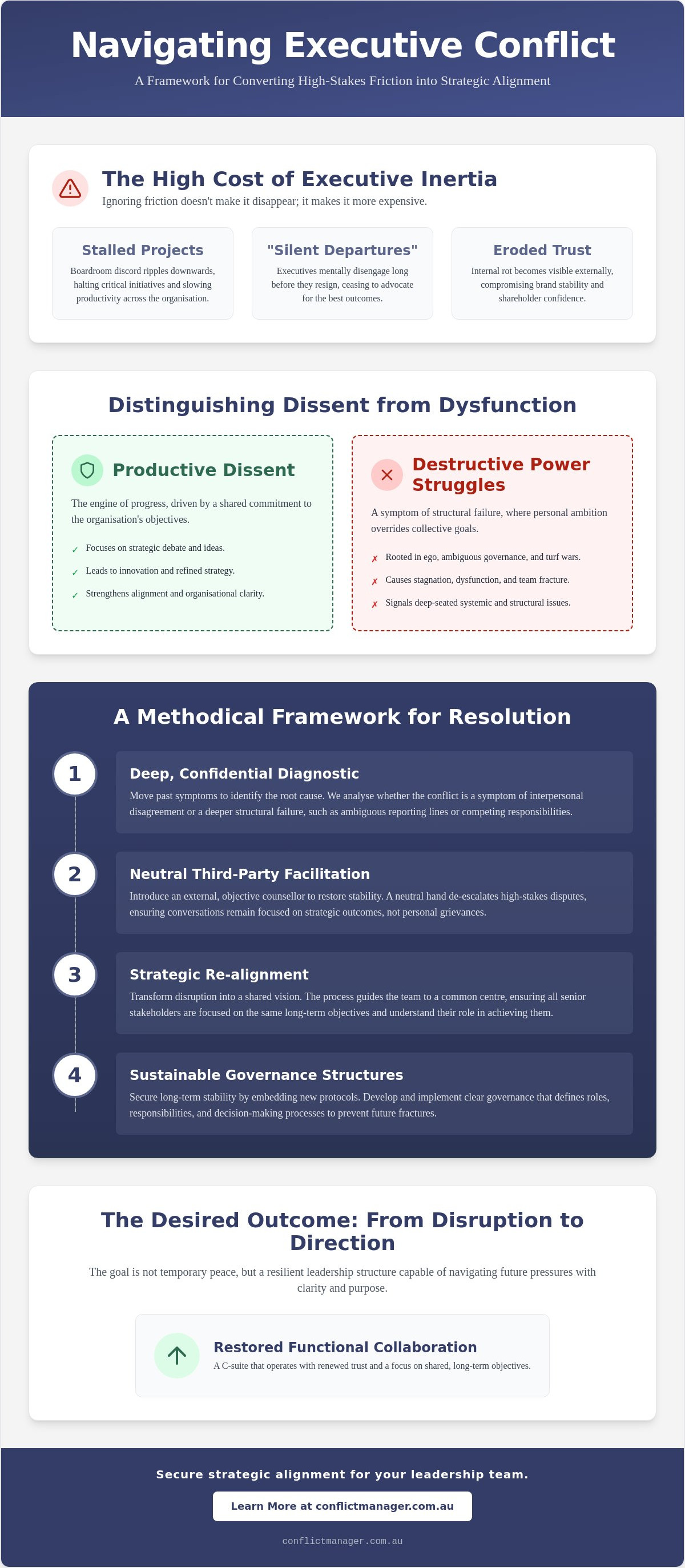
Methodical Resolution: A Framework for Navigating C-Suite Disputes
Neutrality. Objectivity. Sustainability. These principles form the foundation of a disciplined approach to executive team conflict management. When internal efforts to bridge the gap between leaders have stalled, a methodical framework provides the necessary distance to see the situation with total clarity. It's not about assigning blame or finding a winner. Instead, it's about restoring the structural integrity of the leadership team so the organisation can move forward with a unified purpose. This progression from complexity toward resolution is the result of a deliberate, four-stage process.
- The Diagnostic Phase: Uncovering the root cause of friction through confidential, one-on-one stakeholder facilitation to move past surface-level symptoms.
- The Facilitation Phase: Guiding leaders through high-emotion transitions with a steady hand, ensuring that the dialogue remains focused on strategic alignment.
- The Integration Phase: Embedding new communication protocols and governance structures that prevent the recurrence of previous power struggles.
- The Sustainability Phase: Securing long-term stability by establishing clear roles and shared objectives that are resilient to future market pressures.
The Diagnostic: Beyond the Surface Symptoms
Gathering the unfiltered truth requires a level of psychological safety that's often impossible to achieve within the internal hierarchy. An external mediator can conduct confidential interviews to map the "nodes" of friction across the organisation, revealing the difference between what leaders say in public and the underlying tensions that actually drive their behaviour. This phase isn't just about identifying problems; it's about understanding the complex human and structural dynamics that allowed the conflict to take root in the first place. Mapping these fault lines allows for a resolution that is targeted and enduring.
Facilitating Clarity: The Neutral Third-Party Advantage
An external counsellor possesses a unique advantage: they can say what internal HR or even the Board cannot. This "Quiet Approach" uses composure and precise, nuanced language to lower the pulse of the room, shifting the focus from "Who is right?" to "What is the sustainable path forward?" By removing emotional entanglement, the facilitator brings a sense of order to even the most volatile C-suite disputes. This objectivity is essential for helping specialised leaders see past their own "siloed kingdoms" and back toward the broader organisational horizon.
For organisations navigating these complex transitions, engaging in professional Stakeholder Facilitation ensures that resolution is reached through logic and expertise rather than exhaustion or compromise. Once the immediate friction is lowered, the focus shifts to embedding the governance structures necessary for lasting peace. This methodical approach ensures that the leadership team doesn't just return to a state of "not fighting," but instead moves toward a higher level of functional collaboration that can withstand the challenges of a shifting market.
The External Counsellor: Achieving Sustainable Clarity through Facilitation
Order. Stability. Clarity. These are the outcomes of a well-facilitated resolution. Seeking external support for executive team conflict management is often perceived as a last resort, yet in reality, it's a sophisticated strategic investment in the firm's most valuable asset: its leadership. For Australian family offices and complex organisations, the stakes are far too high to leave resolution to chance. Professional mediation provides a neutral space where the weight of responsibility can be shared and the friction of interpersonal dynamics can be viewed with total objectivity. This process doesn't just stop the bleeding. It restores the structural integrity of the entire enterprise.
Conflict Manager acts as a steady hand during these periods of high organisational friction. We bring a sense of order to clouded situations, allowing leaders to step back from the immediate heat of a dispute and see the broader strategic horizon. This isn't about clinical intervention. It's about moving toward a higher level of functional collaboration. By removing emotional entanglement from the equation, we help teams transition from a state of reactive crisis toward a vision of structured, long-term resolution. The goal is always to move past the noise and back to the core business objectives that matter most.
Sustainable Outcomes: Governance as a Preventative Measure
Governance acts as the structural skeleton of a healthy firm. By building conflict-resilient structures through expert facilitation, you ensure that future disagreements are handled through established protocols rather than personal friction. Clear stakeholder agreements are essential here. They define the boundaries of authority and the expectations of collaboration, leaving little room for the "grey areas" where conflict typically thrives. When the board and executive team are aligned on the path forward, the organisation gains a level of momentum that's otherwise impossible to achieve. This alignment is the foundation of sustainable growth.
Engaging the Steady Hand
Introducing an external counsellor to a sceptical leadership team requires a delicate touch. It's about framing the intervention not as a sign of failure, but as a tool for preserving professional relationships and protecting asset integrity. The long-term value of this approach lies in its ability to refine the very way your leaders interact. You aren't just resolving a single dispute; you're embedding a new culture of communication that values objective data and shared goals over individual ego. This transition ensures that the leadership team remains unruffled by future market pressures.
Preserving the health of your C-suite is a strategic necessity for business continuity and investor confidence. By engaging a neutral third party, you provide your leaders with the tools they need to navigate high-stakes transitions without compromising the firm's strategic momentum. It's a methodical progression from complexity toward a state of calm, professional alignment. Achieve clarity with Conflict Manager’s expert facilitation services.
Securing the Future of Leadership Stability
Alignment. Momentum. Resilience. Reclaiming these qualities is the final step in moving your organisation from a state of friction toward a period of renewed growth. We've seen that executive team conflict management is less about resolving personal grievances and more about addressing the structural fault lines that allow discord to flourish. By distinguishing between productive dissent and destructive power struggles, you can foster a culture where disagreement fuels innovation rather than inertia. It's a transition that requires objectivity and a methodical framework to ensure the outcome is both sustainable and clear.
Complexity doesn't have to lead to dysfunction. With expert-led mediation for high-net-worth families and complex organisations, you can achieve outcomes focused on structural integrity and long-term clarity. Our composed, neutral approach to high-emotion business disputes provides the order necessary to navigate even the most volatile C-suite transitions. Restore stability to your leadership team with our expert mediation services.
The path back to functional collaboration is found through the guidance of a steady, external hand. You have the opportunity to transform current disruptions into a foundation for future success. It's time to move forward with confidence.
Frequently Asked Questions
How does executive team conflict management differ from standard workplace mediation?
Executive-level resolution addresses systemic structural failures and fiduciary responsibilities that standard mediation often overlooks. While basic mediation focuses on interpersonal harmony, executive team conflict management prioritises the organisation's strategic integrity. It requires a deeper understanding of corporate governance and the unique psychological pressures of C-suite roles. We focus on restoring the engine of the business rather than just smoothing over a single argument.
When is the right time to engage a neutral third-party mediator for the C-Suite?
You should engage a neutral third party when internal attempts to bridge the gap have reached an impasse or when decision-making speed begins to noticeably decline. If you notice "back-channeling" or key leaders disengaging from strategic debate, the friction has likely moved beyond internal resolution. Early intervention prevents the "silent departure" of top talent and protects the firm's external reputation from being compromised by internal discord.
Can organisational conflict management actually improve strategic performance?
Strategic performance improves when the leadership team moves from defensive posturing to functional collaboration. By removing the "Expert Trap" and the siloed hoarding of information, the organisation can react more swiftly to market changes. Resolution provides the clarity needed for unified execution; it ensures that every member of the leadership team is pulling in the same direction toward a shared strategic horizon.
How do you handle conflict in a family office where personal and professional lines blur?
Managing conflict in a family office requires a delicate balance between legacy emotional ties and modern professional governance. We use stakeholder facilitation to create clear boundaries where personal history and professional duty intersect. By establishing formal stakeholder agreements, family members can navigate difficult transitions without damaging either the family bond or the integrity of the firm's assets.
What is the role of the Board in executive-level conflict resolution?
The Board's primary role is to provide clear boundaries and act as a unified front to prevent C-suite fragmentation. When a Board fails to define roles or provides conflicting directives, it inadvertently mandates conflict. A strong Board supports the resolution process by endorsing a methodical framework and ensuring the executive team remains focused on long-term objectives rather than short-term power struggles.
How do we ensure confidentiality and preserve our reputation during mediation?
Confidentiality is maintained through a diagnostic phase that uses private, one-on-one interviews to gather unfiltered truth without public exposure. By using an external counsellor, you ensure that sensitive information remains privileged and outside the standard internal reporting lines. This objective distance protects the brand's perceived stability while allowing leaders to speak candidly about the root causes of friction.
What are the most common triggers for leadership team conflict in 2026?
The most common triggers in 2026 include turf wars over AI integration and misaligned risk appetites during economic volatility. As technology moves faster than traditional governance, leaders often find themselves competing for control over strategic data or digital transformation budgets. These structural shifts create new fault lines that require sophisticated executive team conflict management to align competing visions for the company's future.
How long does a typical executive-level conflict resolution engagement take?
The duration of an engagement depends on the depth of the structural misalignment, but most follow a methodical four-stage process. The initial diagnostic and facilitation phases can take several weeks; the integration and sustainability phases ensure that new protocols are embedded over a longer period. We focus on achieving lasting clarity rather than temporary peace, ensuring the leadership team is resilient to future pressures.


