

What if the most effective way to protect your legacy isn't to hire someone to fight for it, but to find someone to facilitate its survival? Friction. Disruption. Uncertainty. These forces often drive us toward the traditional legal path, yet the adversarial nature of litigation frequently worsens the emotional rift. You've likely felt the weight of mounting legal fees and the persistent fear that private family or business matters might soon become public record. It's a common concern, especially when the goal is to find a sense of order rather than a prolonged battle.
Choosing professional conflict resolution instead of lawyers offers a more stable, private, and restorative alternative to the courtroom. You'll discover how expert-led mediation provides a path to sustainable clarity and binding agreements without the destructive side effects of litigation. We will look at the logic of external facilitation, the importance of maintaining your reputation, and the methodical steps required to reach emotional closure and structural peace.
Key Takeaways
- Understand why traditional legal positioning often overlooks the delicate human dynamics at the heart of a dispute.
- Discover the benefits of choosing conflict resolution instead of lawyers to achieve a private, binding, and sustainable agreement.
- Compare the efficiency of mediation timelines, often measured in fortnights, against the years required for litigation.
- Order. Privacy. Restoration. Learn how to identify the tipping point for external facilitation and how to propose it to an adversarial party with confidence.
- Explore how a methodical approach to conflict management protects multi-generational legacies and the integrity of your organisational assets.
Beyond the Adversarial: Why Litigation Often Fails the Human Element
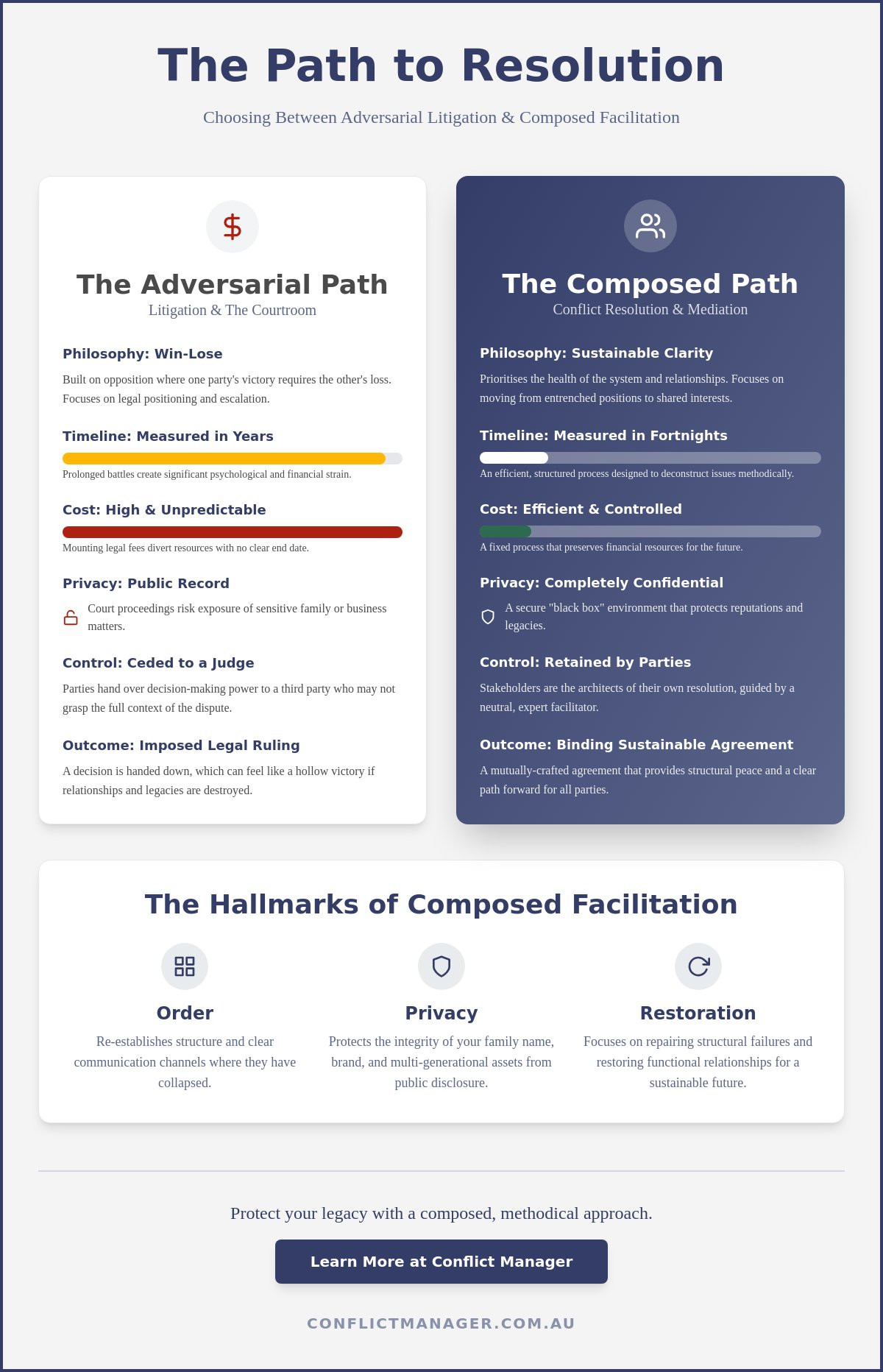
The transition from adversarial litigation to collaborative resolution represents more than a change in procedure. It is a fundamental shift in philosophy. Traditional legal battles are built on a foundation of opposition; one party must lose for the other to win. This zero-sum logic often ignores the complex human and structural dynamics that exist within a family or a business. By choosing conflict resolution instead of lawyers, you move toward a model that prioritises the health of the system over the victory of an individual.
The solicitor-led model frequently prioritises legal positioning over relationship restoration. Strategy. Posturing. Escalation. These elements define the traditional path. While solicitors are trained to protect legal interests, their adversarial nature can inadvertently widen the emotional rift between parties. A composed, objective third party offers a "Quiet Path". This approach acknowledges that the underlying friction is often a structural failure rather than a purely legal one. In Australia, the legal framework increasingly encourages Alternative Dispute Resolution (ADR) before cases ever reach a courtroom. This shift reflects a growing recognition that sustainable clarity is rarely found at the end of a gavel.
The Adversarial Trap in High-Stakes Disputes
A legal victory in court can often feel like a hollow achievement if the family legacy or organisational culture is dismantled in the process. The psychological toll of prolonged litigation on multi-generational stakeholders is significant. Trust is eroded. Communication collapses. Financial resources are diverted toward a fight that has no clear end date. Taking a matter to court often signals a loss of control. You are no longer the architect of your own resolution. Instead, you hand the power to a judge who may not fully grasp the nuances of your specific history or future goals.
Preserving Privacy and Reputation
Privacy. Discretion. Integrity. These are the hallmarks of a successful transition. Australian court proceedings are generally a matter of public record. For family offices or high-profile businesses, this level of transparency carries inherent risks to the brand and the family name. Opting for conflict resolution instead of lawyers acts as a "black box" for sensitive matters. Mediation provides a secure, private environment where stakeholders can navigate difficult transitions without the fear of public disclosure. This methodology ensures that the integrity of the family brand remains intact, protecting both current assets and the reputation of future generations.
The Structural Integrity of a Dispute: Understanding the Mechanics of Mediation
Conflict is rarely just about a clause in a contract or a line in a will. It is a structural failure. When communication channels collapse and trust evaporates, the system itself stops functioning. In these high-stakes environments, a professional mediator acts as a neutral architect of resolution. They don't advocate for one side. Instead, they examine the structural integrity of the dispute. By stripping away the noise of high emotions, they reveal the core issues that have been clouded by months or years of friction. Choosing conflict resolution instead of lawyers allows for a methodical deconstruction of these mechanical failures without the destructive force of a court battle.
Moving stakeholders from entrenched positions to shared interests is the primary objective. Resolving conflict outside the courtroom requires a total shift in focus. Instead of asking who is "right" according to a statute, the process asks what is required to move forward. This methodology creates a sense of order. It provides a framework where parties can speak without the fear of legal repercussions or public exposure. The decision to prioritise conflict resolution instead of lawyers reflects a commitment to structural peace rather than temporary legal relief. For those seeking bespoke organisational conflict management, this structured approach is often the only way to preserve the underlying assets while navigating a difficult transition.
Expert-Led Facilitation vs. Legal Representation
There is a profound difference between being represented and being guided. A solicitor represents your interests, often by attacking the other party's position. This creates a defensive environment that encourages further entrenchment. A neutral facilitator manages power imbalances through a steady hand and quiet confidence. They don't need aggressive advocacy to find a path forward. In volatile environments, this composed authority prevents the escalation that typically accompanies the solicitor-led adversarial trap, allowing for a more civil and efficient dialogue.
Sustainable Outcomes and Mutual Buy-In
Agreements reached through mediation often have significantly higher compliance rates than court orders. This isn't a coincidence. It is because the parties involved have total buy-in. They helped build the solution themselves. A judge is limited by the law; they can only offer what the statutes allow. Mediation allows for bespoke solutions that a court simply doesn't have the jurisdiction to provide. This flexibility ensures the long-term stability of the family or business, creating a binding agreement that supports the future rather than litigating the past.
Comparing the Outcomes: Legal Rulings vs. Sustainable Agreements
Finality. Flexibility. Foresight. These are the pillars of a sustainable agreement. When a magistrate delivers a ruling, the decision is final, yet it often lacks the structural flexibility required to manage the ongoing reality of a family office or a complex partnership. By choosing conflict resolution instead of lawyers, stakeholders ensure that the outcome is not just a legal end, but a functional beginning. While a court focuses on the past to assign blame, mediation looks toward the future to establish order. This shift in focus is what allows for the preservation of multi-generational wealth and the continuity of the business brand.
The cost of a dispute is rarely confined to the solicitor's billable hour. There is a hidden tax on the organisation: the cost of lost focus. When leaders are preoccupied with litigation, business continuity suffers. Multi-generational wealth can be eroded not just by legal fees, but by the stagnation that occurs when a family is at war. Diversifying the Methods for Resolving Conflicts allows for a more nuanced protection of assets. It's about protecting the structural integrity of the enterprise while navigating the human friction that threatens to derail it. This methodical approach ensures that the resolution supports long-term stability rather than just temporary legal relief.
Binding Decisions vs. Mutual Agreements
Ownership of the resolution is the key differentiator. When you choose conflict resolution instead of lawyers, you aren't just seeking a "deal"; you're building a framework you actually intend to keep. Australian law treats mediated settlement agreements as enforceable contracts, providing the same level of security as a court-ordered judgment but with far greater buy-in from all parties involved. Under Australian law, a signed Deed of Settlement arising from mediation functions as a legally binding contract that is enforceable in court should any party fail to uphold its terms. This legal weight provides total peace of mind while maintaining the bespoke nature of the agreement.
The Timeline of a Resolution
Efficiency. Momentum. Clarity. The Australian court system is currently navigating significant backlogs, meaning a trial date might be years away. In contrast, expert facilitation can often be organised within a fortnight. This speed is vital for business continuity. Scheduling intensive sessions at the stakeholders’ own pace allows for a rapid return to business as usual. It reduces the period of organisational friction, ensuring that the dispute doesn't become the defining characteristic of the business. By moving at a measured yet efficient pace, mediation brings order to clouded situations much faster than the traditional legal path.
Navigating the Transition: How to Shift from Conflict to Collaboration
The pivot from litigation to mediation is a strategic manoeuvre rather than a retreat. It requires a fundamental re-evaluation of what constitutes success. When a dispute reaches a state of stagnation, the focus must shift from winning to resolving. Choosing conflict resolution instead of lawyers at this juncture allows stakeholders to reclaim control over their own narrative. Proposing this shift is not an admission of a weak legal hand. It is a statement of strength. It signals that you value the integrity of the business or family legacy more than the pursuit of an adversarial victory.
A successful transition relies on the selection of a mediator who possesses specific experience in high-stakes corporate or family office environments. This isn't a role for a generalist. You require a seasoned professional who understands the structural complexities of multi-generational wealth and the friction of interpersonal dynamics. This expert acts as a steady hand, viewing volatile situations with total objectivity. By preparing the organisation for a structured facilitation process, you move the conversation away from historical grievances and toward a vision of future order. This methodical approach ensures that the transition feels inevitable and calming, lowering the pulse of all involved.
Assessing the Dispute Maturity
Disputes often follow a predictable lifecycle. There is an escalatory phase where emotions are high and legal posturing is at its peak. However, there is also a "tipping point" where the legal path becomes a war of attrition. At this stage, the costs—both financial and emotional—begin to outweigh any potential legal gain. Recognising this maturity is essential. If the primary goal has shifted from seeking justice to simply seeking an end to the friction, it's time to change the methodology. You can learn more about when to engage a neutral third-party mediator to determine if your situation is ready for a structured resolution.
Engaging the Neutral Third Party
The first session is about establishing the ground rules for engagement. A wise external counsellor creates a secure environment where stakeholders feel heard without the fear of legal repercussions. One of the most effective tools in this process is "caucusing" or private sessions. Unlike traditional legal meetings where parties are forced into direct confrontation, private sessions allow the facilitator to address sensitive issues individually. This manages power imbalances and high-emotion friction without the need for aggressive advocacy. It ensures that even if personal contact is difficult, a resolution remains entirely possible.
If you're ready to move away from the adversarial trap and toward a binding, sustainable agreement, our team can help. Reach out to discuss our Family Conflict Resolution services today.
The Conflict Manager Approach: Restoring Order through Composed Facilitation
Order. Stability. Continuity. These are the primary objectives of the Conflict Manager methodology. When high-stakes disputes threaten the structural integrity of a family or business, internal efforts to resolve the friction often struggle under the weight of history and emotion. Our approach provides a steady hand, acting as a neutral third party that brings clarity to clouded situations. By moving from a state of complexity toward a vision of structured resolution, we ensure that the human and financial assets of the organisation remain protected throughout the transition. This methodical flow is designed to lower the pulse of all stakeholders, building trust through a logical and predictable sequence.
Choosing conflict resolution instead of lawyers is a strategic decision to prioritise asset integrity over adversarial victory. Litigation is often a blunt instrument; it can dismantle a multi-generational legacy in the pursuit of a narrow legal win. Our facilitation process is both sophisticated and bespoke. It begins by acknowledging the difficult reality of the disruption, then transitions into an analytical explanation of the underlying friction. This progression feels inevitable and calming, allowing leaders to step back from the heat of the moment and focus on the structural health of their enterprise. We act as a wise, external counsellor, viewing volatile situations with total objectivity to ensure the resolution is as durable as it is fair.
Specialised Family Office Mediation
Family offices operate at a unique intersection of intimate dynamics and sizable asset management. Protecting the family trust and complex inheritance structures requires more than just legal knowledge. It requires discernment. Our bespoke agreements are designed to navigate the friction of internal transitions while maintaining total privacy. For families who value their future as much as their current assets, this path offers a reassuring sense of order that a public courtroom can never provide. We focus on the preservation of the family brand, ensuring that the transition of wealth does not result in the erosion of the family's foundational values.
Organisational Stability and Clarity
Leadership friction can paralyse an organisation, especially during periods of restructuring or significant change. We guide executive teams through these difficult transitions with quiet confidence and professional objectivity. The goal is to achieve sustainable outcomes that allow the business to thrive post-dispute, rather than merely surviving the process. If you are navigating a period of high stress or organisational friction, we invite you to enquire about our professional facilitation services. By establishing a thematic foundation of trust and efficiency, we help you restore order and secure your organisational legacy for the years ahead.
Securing Your Legacy through Structural Peace
Legacy. Integrity. Order. These are the outcomes of a deliberate choice to prioritise long-term health over short-term legal victories. By shifting focus from historical grievances to future stability, you protect the structural foundation of your enterprise. Choosing conflict resolution instead of lawyers ensures that sensitive matters remain private, protecting your family brand and business reputation from the risks of public record. It's about finding a path that restores relationships while securing binding, enforceable agreements.
Conflict Manager provides a steady hand for those navigating these difficult transitions. As specialists in high-net-worth family office mediation with national coverage across Australia, we bring expertise in managing complex organisational structural change. We help you move from a state of disruption toward a vision of inevitable clarity. Restore clarity to your family or business with expert facilitation. Order is possible even in the most volatile environments. We look forward to helping you find it.
Frequently Asked Questions
Is conflict resolution through mediation legally binding in Australia?
Agreements reached through mediation are legally binding in Australia once they're formalised into a signed Deed of Settlement. This document functions as an enforceable contract, providing the same security as a court order but with the benefit of mutual buy-in. It ensures the resolution is durable and protects the structural integrity of the agreement for all parties involved.
Can we still use a mediator if the other party has already engaged a lawyer?
You can absolutely engage a mediator even if the other party has already sought legal representation. Choosing conflict resolution instead of lawyers doesn't require the absence of legal advice; rather, it shifts the focus from adversarial litigation to collaborative facilitation. Many solicitors actually favour mediation as it provides a more efficient path to a settlement for their clients.
How much does mediation cost compared to a traditional court case?
Mediation is almost universally more cost-effective than a traditional court case due to the reduced time and administrative overhead. While litigation can drain resources over several years, professional facilitation focuses on reaching a conclusion in a matter of weeks. This approach avoids the "hidden tax" of lost organisational focus and the escalating fees associated with a prolonged legal battle.
What happens if we cannot reach an agreement during the facilitation process?
If an agreement isn't reached, all parties retain their right to proceed to court or pursue other legal avenues. However, the facilitation process often clarifies the core issues, making any subsequent steps more focused and less disruptive. Most participants find that even a partial agreement provides a greater sense of order than they had at the start of the process.
Is the mediation process confidential for high-profile family offices?
Confidentiality is a cornerstone of the mediation process, especially for high-profile family offices. Unlike court proceedings, which are generally matters of public record in Australia, mediation occurs in a private environment. This ensures that sensitive financial structures and family dynamics remain entirely shielded from public scrutiny, preserving the integrity of the family brand.
How long does a typical conflict resolution process take with Conflict Manager?
A typical process is measured in fortnights rather than the years often required for litigation. The timeline depends on the complexity of the dispute and the availability of the stakeholders. Because we operate at your pace, we can organise intensive sessions that bring clarity and stability much faster than the traditional court system. This efficiency is a primary reason to choose conflict resolution instead of lawyers.
Can mediation help with disputes involving family trusts and inheritance?
Mediation is particularly effective for disputes involving family trusts and inheritance because it can handle bespoke structural complexities. We look at the human and financial mechanics of the trust to ensure the legacy remains intact. This methodical approach allows for creative solutions that a judge might not have the jurisdiction to order under standard statutes.
Do I need to be in the same room as the person I am in conflict with?
You don't need to be in the same room as the other party to achieve a successful resolution. We often use "shuttle mediation" or private sessions, where the facilitator moves between parties to manage the dialogue. This manages high-emotion friction and power imbalances without the need for direct confrontation, ensuring a safe and productive environment for everyone.


