

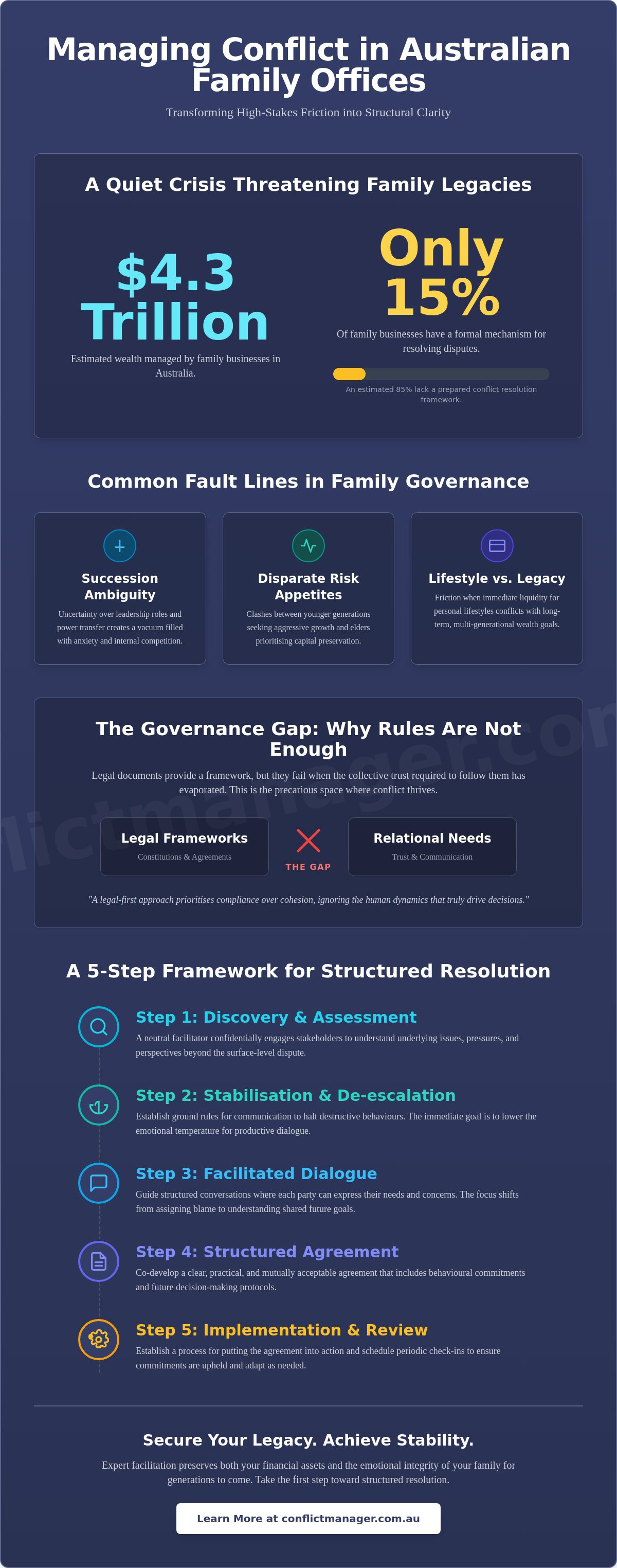
Legacy. Stability. Continuity. These pillars often feel fragile when internal friction threatens the very assets they're meant to protect. It's a sobering reality that only 15% of family businesses in Australia have a formal mechanism for resolving disputes, even though they manage an estimated $4.3 trillion in wealth. You likely recognise that the complexity of your family office isn't just a financial matter; it's a delicate human equation. When emotional stakes rise, the absence of a clear framework often leads to role confusion or a fear of public legal battles. This guide explores how to manage conflict in family office environments by applying a methodical, professional lens to interpersonal dynamics. We'll show you how to transform high-stakes friction into a source of structural clarity. You'll gain a clear understanding of why objective facilitation is essential for navigating the 2026 tax adjustments and ensuring the preservation of your family's heritage for generations to come.
Key Takeaways
- Recognise the subtle friction between personal identity and fiduciary responsibility that often underlies complex multi-generational wealth transfers.
- Learn how to manage conflict in family office settings by identifying the governance gap where formal constitutions and agreements lack the influence to change behaviour.
- Assess the strategic value of a neutral third party to provide a steady hand and objective perspective during periods of intense organisational stress.
- Follow a methodical five-step framework, encompassing discovery and stabilisation, to move from internal complexity toward a state of structured resolution.
- Understand how expert stakeholder facilitation preserves both your financial assets and the emotional integrity of your family legacy for future generations.
The Pressure Cooker: Why Conflict Arises in the Australian Family Office
Identity. Role. Duty. These elements form the bedrock of the family office, yet they also create the fault lines where pressure builds. Conflict in this environment is rarely a simple disagreement over a single transaction; it's a fundamental friction between personal identity, family roles, and fiduciary responsibilities. In the Australian context, this tension is uniquely amplified as offices transition from the singular vision of primary wealth creators to the collective stewardship of multi-generational families. This shift often reveals the challenges in family-owned companies where the boundaries between the dinner table and the boardroom become blurred and porous.
Understanding how to manage conflict in family office structures requires identifying the primary triggers that disrupt equilibrium. These typically fall into three categories:
- Succession ambiguity: Uncertainty regarding who will lead and how power will be transferred creates a vacuum filled by anxiety.
- Disparate risk appetites: Younger generations may seek aggressive growth in private markets while elders prioritise capital preservation.
- Lifestyle versus legacy spending: Friction often arises when the desire for immediate liquidity to fund personal lifestyles clashes with the long-term goal of multi-generational wealth preservation.
The stakes couldn't be higher. Unmanaged friction leads to rapid asset erosion through poor decision-making and profound emotional fatigue that can tear families apart. It's a quiet crisis that threatens the very legacy the office was built to protect.
The Intersection of Emotion and Asset Integrity
The "founder’s shadow" often persists long after the first generation steps back, influencing how subsequent generations perceive their own agency and worth. Frequently, deep-seated personal grievances manifest as technical or financial disagreements over portfolio allocation or liquidity events. If a sibling feels undervalued, they might express that hurt by blocking a strategic investment. Intergenerational friction is a structural necessity rather than a personal failure. By acknowledging this, families can begin to separate the person from the problem, ensuring that emotional history doesn't dictate financial futures.
Evolving Dynamics in the 2026 Australian Landscape
Recent economic shifts have recalibrated how Australian families view risk and governance. We've seen a move toward the "consortium" model, where multiple branches of a family must co-govern a single pool of wealth. This requires a level of composure and sophisticated facilitation that wasn't necessary when a single founder made every call. With the 30% minimum tax on discretionary trusts—announced in the 2026-27 Federal Budget to take effect in 2028—families are facing new structural pressures. Maintaining composure during periods of market volatility and regulatory change is paramount to preventing internal fractures from becoming permanent breaks.
Beyond Governance: Why Structural Rules Often Fail to Resolve Friction
Governance. Protocol. Procedure. These are the traditional tools used to maintain order within a family office. While shareholders’ agreements and family constitutions provide a vital framework, they're often insufficient on their own. They're static. They lack the pulse of human emotion. When tension escalates, we often encounter what professionals call the "governance gap." This is the precarious space where the rules are clearly defined on paper, but the collective trust required to follow them has evaporated.
Many stakeholders mistakenly believe that a more robust legal document is the primary answer to how to manage conflict in family office environments. However, a legal-first approach prioritises compliance over cohesion. It treats the family solely as a corporate entity. It ignores the deep-seated relational dynamics that drive decision-making. Structural integrity requires more than just signed paperwork; it demands active, empathetic facilitation to keep the lines of communication open. Without this, the most sophisticated charter is merely ink on a page.
The Limitation of Legal Frameworks
Legal frameworks are designed to protect "rights," yet they often fail to address relational "needs." When a dispute reaches a courtroom or a strictly legalistic resolution, the family usually suffers a pyrrhic victory. The assets might be preserved, but the relationships are often permanently fractured. Professional organizational conflict management fills the void left by standard governance. It provides a way to address the underlying emotional drivers that legal documents simply aren't equipped to handle. This approach focuses on restoration rather than just regulation.
When the Constitution Becomes a Weapon
In a high-stress environment, even the best-designed family constitution can be weaponised. A disgruntled member might use specific clauses to stall progress, block investments, or settle old scores under the guise of "following the rules." This tactical use of governance creates a stalemate that drains both financial and emotional capital. This is why objective oversight is essential. A neutral party ensures that rules are applied with clarity and fairness, preventing governance from becoming a tool for obstruction. True governance is a living process, not a static document. It requires consistent engagement to ensure it serves the family's evolving needs.
The Neutral Advantage: Internal Management vs Professional Facilitation
Privacy. Discretion. Integrity. These are the non-negotiable requirements for any high-wealth Australian family. It's understandable that the primary objection to engaging an external advisor is the fear that a stranger will disrupt the family's inner sanctum. However, relying solely on internal efforts to manage high-stakes friction is often where the real risk lies. When considering how to manage conflict in family office environments, the choice isn't between privacy and exposure; it's between a cycle of emotional reactivity and the steadying influence of professional facilitation.
Internal "fixes" are almost always hampered by the very history they seek to resolve. They're often emotional, biased, and ultimately temporary. A family member attempting to play the role of mediator is still a participant in the family system. They carry their own triggers, perspectives, and historical baggage. In contrast, professional facilitation provides an objective, sustainable, and structured path forward. A seasoned mediator remains unruffled by the high-emotion situations that typically paralyse internal stakeholders, acting as a neutral anchor during periods of transition.
Overcoming the Privacy Objection
Professional facilitators operate with total discretion. Their role isn't to judge or expose, but to observe and guide with a sense of composed authority. An external counselor can view volatile situations with total objectivity because they aren't entangled in the family's historical grievances. There's a profound sense of reassurance that comes from a methodical, external perspective. It allows family members to speak freely in a controlled environment, knowing that the process is designed to protect the family's reputation rather than compromise it. This external lens brings clarity to clouded situations that internal efforts simply cannot reach.
The Cost of Delayed Intervention
Waiting to act carries a heavy "friction tax." This represents the hidden costs of unmanaged conflict on daily business operations, from stalled decision-making to the loss of key non-family talent. Internal efforts to patch over deep-seated issues can inadvertently deepen the divide, as participants often feel their concerns aren't being heard by a truly neutral party. Recognising the need for intervention early leads to Sustainable Conflict Resolution Outcomes. By removing the burden of mediation from family members, you allow them to return to their primary roles as stewards and stakeholders, ensuring the structural integrity of the office remains intact while the family legacy is preserved.
A Methodical Framework for Managing High-Stake Family Disputes
Resolution. Order. Integration. Moving from a state of internal disruption to one of structured clarity requires more than just good intentions; it demands a repeatable, professional process. When considering how to manage conflict in family office settings, we must move beyond the "quick fix" mentality. A methodical framework ensures that the resolution is not merely a temporary truce, but a fundamental realignment of the family’s shared mission. This journey typically involves five distinct stages: Discovery, Stabilisation, Facilitation, Resolution, and Integration.
The transition begins with Discovery, where we identify the root cause rather than the presenting symptom. Stabilisation follows, focusing on lowering the emotional pulse to allow for logical discussion. During Facilitation, we guide stakeholders through the friction toward a shared vision, which eventually leads to a formal Resolution. Finally, Integration ensures that the office’s governance structures are updated to reflect this new clarity, preventing the same issues from resurfacing in the future.
Discovery and the Root Cause Analysis
True discovery involves peeling back the layers of a dispute to separate financial disagreements from underlying psychological triggers. A conflict over a specific investment is often a proxy for a deeper need for recognition or a fear of losing influence. During initial consultations, the most critical data often resides in the pauses; it's a matter of listening for what is not being said. We use precise language and complex sentence structures to provide internal contrast and clarify nuanced points, ensuring every stakeholder feels their position is understood with total objectivity. This depth of analysis prevents the "governance gap" discussed earlier from widening.
Stabilisation: The Art of the Quiet Conversation
Stabilisation is about creating an environment where composure replaces reactivity. We manage high-emotion business disputes by removing them from the boardroom and placing them on neutral ground. This structured dialogue allows family members to step out of their habitual roles and engage as professional partners. For families seeking to avoid the public exposure of legal battles, there are several effective alternatives to court for private disputes:
- Facilitated Negotiation: A structured process where a neutral party helps define the terms of a settlement.
- Expert Conciliation: Using a specialist to provide non-binding recommendations based on industry standards.
- Private Mediation: A confidential forum focused on reaching a mutually beneficial agreement without judicial intervention.
If your family office is currently experiencing the weight of unmanaged friction, engaging in professional stakeholder facilitation can provide the steady hand needed to move from complexity to resolution.
Securing the Legacy: Achieving Stability through Expert Mediation
Clarity. Stability. Legacy. These are the defining traits of a family office that has successfully navigated the transition from internal disruption to structural harmony. Throughout this guide, we've examined why traditional governance often falters under the weight of human emotion and why a neutral perspective is essential for uncoupling personal grievances from fiduciary duties. Achieving a state of order isn't merely about silencing disagreement; it's about transforming that friction into a foundation for future growth. It's a journey from complexity toward a vision of resolution.
Expert mediation provides the methodical framework necessary to protect both the family's financial assets and its emotional integrity. When you address how to manage conflict in family office structures through professional facilitation, you're investing in the long-term viability of the entire estate. Conflict Manager acts as that steady hand, viewing volatile situations with total objectivity to ensure that transitions, whether they involve leadership succession or complex portfolio recalibration, occur with minimal disruption. We provide the compassionate guidance required to understand the weight of responsibility without becoming emotionally entangled in the dynamics.
The Sustainable Outcome
True success in a family office isn't just the absence of active disputes, but the presence of enduring clarity. This clarity allows for the seamless execution of intergenerational wealth transfers, ensuring that the next generation inherits a legacy of cooperation rather than a burden of resentment. By preserving family legacy through external mediation, you create a resilient environment where stakeholders can focus on their primary roles as stewards. This structured resolution provides a sense of certainty that allows the family to move forward with confidence, knowing their communication channels are open and their shared vision is secure. It transforms potential fractures into opportunities for alignment.
Taking the First Step Toward Resolution
Engaging a professional facilitator is a proactive measure that should ideally occur before friction becomes an existential threat to the office's survival. Our initial consultation process is designed to be a grounded and reassuring experience, providing a neutral space to explore the root causes of tension without the fear of public exposure or legal battle. It's a methodical first step toward restoring the structural integrity of your organisation and lowering the pulse of high-stakes interactions. By prioritising professional intervention, you ensure that your family's history remains a source of strength rather than a point of contention. Achieve clarity for your family office with our expert mediation services.
Restoring Equilibrium and Ensuring Lasting Stewardship
Resilience. Clarity. Continuity. These are the markers of a family office that has successfully transitioned from internal friction to a state of structured resolution. While legal frameworks are necessary, they cannot address the deep-seated emotional drivers that often disrupt fiduciary duties. Understanding how to manage conflict in family office environments requires a shift from reactive internal fixes to a methodical, external facilitation process. By identifying the root causes of friction and employing a structured framework for stabilisation, you preserve both your financial assets and your family’s emotional integrity.
Our approach at Conflict Manager provides the steady hand needed to navigate these high-stakes transitions. We offer specialised expertise in high-net-worth mediation, ensuring that your journey toward resolution is grounded in objectivity and focused on long-term asset integrity. It's time to move beyond the governance gap and secure the future of your multi-generational wealth. Secure your family legacy with professional conflict management and begin the process of restoring order to your organisational dynamics. You're capable of transforming disruption into a source of renewed structural strength.
Frequently Asked Questions
How do we start the conflict resolution process without offending family members?
Start by positioning the initiative as a commitment to the family’s long-term legacy rather than a reaction to a specific person's behaviour. It’s helpful to present the process as a standard professionalisation step, much like a strategic review or a financial audit. This framing removes the stigma of "fixing a problem" and replaces it with the goal of enhancing structural clarity for everyone involved. When discussing how to manage conflict in family office environments, focusing on the health of the collective assets usually lowers individual defensiveness.
Can a family office constitution really prevent conflict?
A constitution is a vital foundational document, but it cannot prevent conflict on its own. It acts as a compass rather than a cage. While it defines roles and expectations, the actual resolution of friction requires active facilitation to bridge the gap between the written rules and the lived reality of family dynamics. A constitution provides the framework; professional facilitation provides the breath of life that makes those rules functional during times of high stress.
What is the difference between family mediation and traditional legal arbitration?
Family mediation is a voluntary, collaborative process focused on reaching a mutually beneficial agreement, whereas legal arbitration is an adversarial proceeding where a third party imposes a binding decision. Mediation prioritises the preservation of relationships and emotional integrity. Arbitration focuses strictly on legal rights and often leaves the family unit fractured. Mediation allows for bespoke solutions that a rigid legal process simply cannot offer.
How long does a typical conflict resolution engagement take for a family office?
The duration of an engagement varies based on the depth of the friction and the number of stakeholders involved. Typically, a structured process moves through discovery and stabilisation over several weeks. More complex multi-generational disputes may require several months to reach a state of sustainable integration and governance updates. The goal is a thorough resolution rather than a rushed settlement that fails to address the root cause.
Is it possible to resolve a dispute if one family member refuses to participate?
Resolution is still possible even if one member initially declines to engage. By working with the participating members to clarify roles and strengthen governance, you shift the broader family system. This often creates a new environment where the reluctant individual eventually finds it beneficial to join the conversation. Improving the conduct and clarity of the majority often compels the outlier to reconsider their position.
How much does professional conflict management cost compared to legal fees?
Professional conflict management is generally more cost-effective than protracted legal battles because it prevents the "friction tax" of stalled business operations and asset erosion. While we don't quote specific fees, the focus remains on preserving long-term asset integrity. You're investing in a solution that avoids the high financial and emotional toll of a public court case. It’s an investment in stability rather than an expense of litigation.
What happens if the mediation process doesn’t lead to a total agreement?
Partial agreement is often a significant step toward total resolution. If a complete consensus isn't reached immediately, the process still provides stabilisation and clearer communication channels. This reduced volatility allows the family to function effectively while working through the remaining nuanced points over time. It’s about moving from chaos to a manageable state of disagreement.
How do we ensure family secrets remain private during the mediation process?
Confidentiality is the cornerstone of professional facilitation. All participants sign rigorous non-disclosure agreements before the process begins to ensure that sensitive family matters and internal financial data remain strictly private. This provides a secure environment where stakeholders can speak with total candour without fear of public exposure. Maintaining discretion is essential for protecting the family’s reputation and social standing in the Australian community.


