

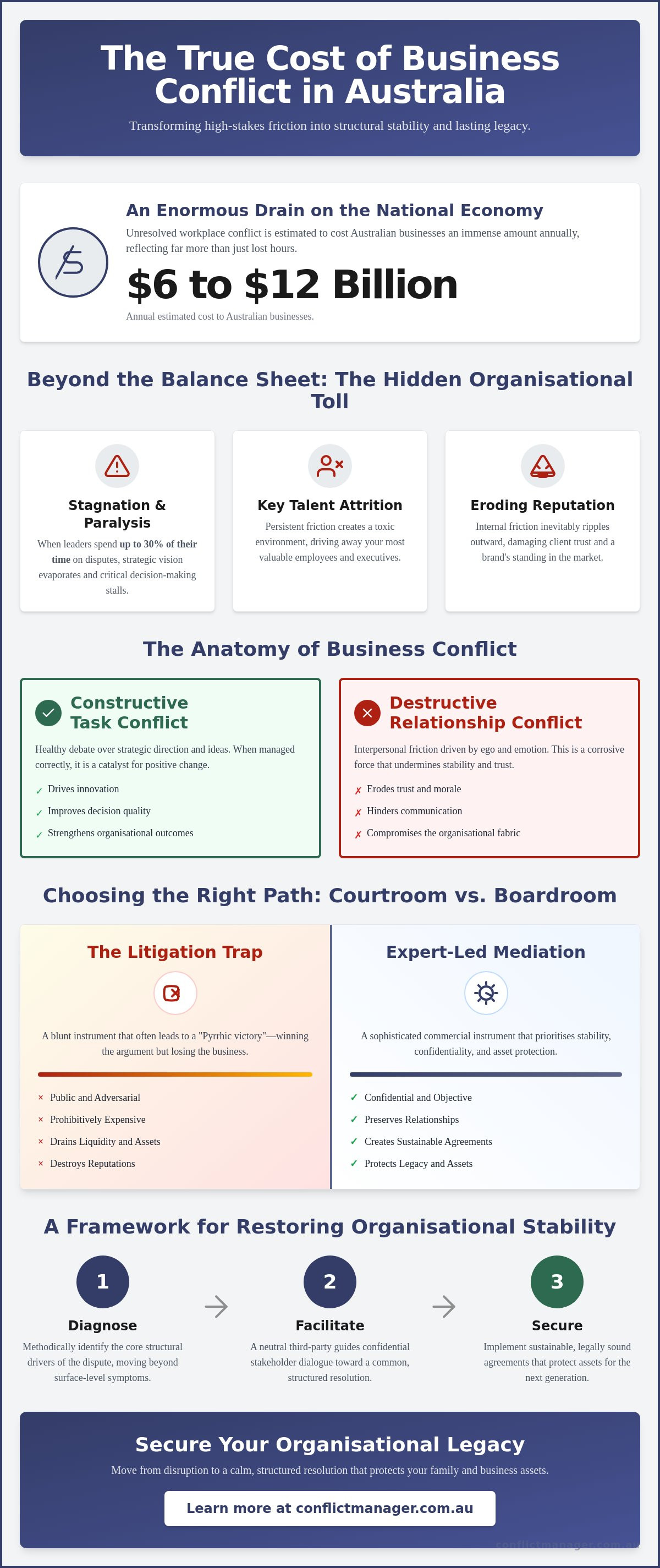
Workplace conflict is estimated to cost Australian businesses between $6 and $12 billion annually, a figure that reflects the immense weight of unresolved tension. For many, the true price isn't just financial; it's the exhausting emotional toll of boardroom friction and the paralysis of decision-making when stakeholders no longer align. You likely recognise the dread of a looming legal black hole or the fear that public litigation could dismantle years of hard-earned reputation. Effective conflict resolution for business owners isn't about winning a battle; it's about preserving the structural integrity of your enterprise while protecting family and business assets from the volatility of the courtroom.
Isolation. Uncertainty. Stagnation. We understand that when internal efforts struggle under pressure, the path forward often feels obscured by complexity and high-stakes emotion. This article explores how to transform high-stakes friction into long-term structural stability through expert-led mediation and strategic facilitation. You'll discover a methodical approach to restoring organisational clarity, ensuring that every agreement reached is both sustainable and legally sound. We will examine how a neutral third party moves your business from a state of disruption toward a calm, structured resolution.
Key Takeaways
- Recognise the hidden costs of unresolved friction, such as key talent attrition and the stagnation of critical decision-making.
- Distinguish between constructive task-based disagreements and destructive relationship-based friction to better manage structural shifts like succession.
- Understand why external conflict resolution for business owners provides the confidentiality and objectivity needed to avoid the public litigation trap.
- Learn a methodical diagnostic framework that identifies the structural drivers of dispute before facilitating stakeholder dialogue.
- Secure your organisational legacy by implementing sustainable, legally sound agreements that protect assets for the next generation.
The True Cost of Unresolved Friction in Australian Business
Stagnation. Attrition. Erosion. In the context of Australian enterprise, conflict functions as a slow, persistent drain on organisational momentum. While many view a boardroom dispute as a temporary hurdle, the reality is a pervasive structural friction that compromises the very foundation of the company. Workplace conflict is estimated to cost Australian businesses between $6 and $12 billion annually, a figure that reflects more than just lost billable hours. It represents the quiet decay of focus. Professional conflict resolution is not merely a soft skill; it's a critical commercial necessity for those who wish to maintain their competitive edge. Applying strategic conflict resolution for business owners allows for the restoration of order before these costs become insurmountable.
For high-net-worth family offices, the stakes are uniquely intertwined. The intersection of commercial interest and interpersonal dynamics creates a volatile environment where a disagreement over a portfolio can quickly devolve into a threat to the family legacy. It's a delicate balance. Owners often hesitate to seek external facilitation, fearing that inviting a third party might signal a loss of control or expose private vulnerabilities to the public eye. The necessity of professional conflict resolution for business owners becomes apparent when the cost of inaction begins to outpace the cost of intervention.
Beyond the Balance Sheet: The Psychological Toll
The weight of leadership is heavy enough without the added burden of constant stakeholder misalignment. Decision fatigue is a real consequence of ongoing friction. When a business owner is forced to spend 30% of their time dealing with disputes, their capacity for strategic vision evaporates. This psychological toll erodes the trust required for future growth. Internal friction doesn't stay internal. It ripples outward, eventually reaching clients and stakeholders, which can permanently damage a brand’s standing in the Australian market.
The Litigation Trap in Australia
The Australian legal system is notoriously adversarial, public, and often prohibitively expensive. Choosing the courtroom over the boardroom frequently leads to a pyrrhic victory where you might win the legal argument only to find the business’s reputation in tatters and its liquidity drained. Alternative Dispute Resolution serves as a sophisticated commercial instrument that prioritises structural stability and asset protection over the blunt force of legal intervention. It offers a way to reach a sustainable, legally sound agreement without the destructive theatre of the court.
Deciphering the Anatomy of Business Conflict
Conflict is rarely a singular event. It is an evolving process. Within the high-stakes environment of Australian enterprise, understanding the underlying structure of a dispute is the first step toward resolution. We must distinguish between task conflict, which involves healthy debate over strategic direction, and relationship conflict, which is characterised by interpersonal friction and ego. While the former can drive innovation, the latter acts as a corrosive force. Professional conflict resolution for business owners focuses on identifying these distinctions before they compromise the organisational fabric. It requires a calm, analytical eye to see through the surface-level noise to the structural misalignment beneath.
The true nature of the dispute is rarely found in the "what" of the situation. It is almost always found in the "how" and the "who". It is about how decisions are communicated and who feels their authority is being undermined. Recognising these nuances requires a level of discernment that only comes from experience in high-pressure environments. If your board or family office is experiencing these structural friction points, seeking organisational conflict management can provide the clarity needed to move forward with composure.
Structural Change as a Catalyst
Change breeds friction. Mergers, acquisitions, and generational handovers are high-risk periods where the internal equilibrium is disturbed. In many Australian enterprises, a palpable tension exists between the "old guard", who built the foundation, and the "new vision", which seeks to adapt to modern markets. These friction points are often inevitable byproducts of growth. Identifying them early allows for a managed transition rather than a reactive crisis. Success in these moments depends on the ability to facilitate a dialogue that respects the past while making necessary space for the future.
The Myth of Neutrality in Internal Resolution
Internal stakeholders can never be truly objective. Everyone has a vested interest. HR departments and legal counsel, while skilled, operate within the same hierarchy they are attempting to mediate. They are part of the system, which makes them susceptible to the "echo chamber" effect common in private boards and family offices. Insights from the Program on Negotiation at Harvard Law School suggest that successful mediation requires a level of neutrality that internal staff simply cannot provide. A steady hand from outside the organisational orbit brings the total objectivity required to navigate volatile human dynamics without becoming emotionally entangled in them.
Internal Management versus External Mediation: A Strategic Comparison
Discretion. Privacy. Control. The instinct to resolve a dispute privately is often the first response of a seasoned leader. It's a natural inclination. However, the effectiveness of an internal "sit-down" varies significantly based on the complexity of the friction involved. While a casual meeting might address a minor operational hiccup, high-stakes conflict resolution for business owners requires a more rigorous, facilitated approach. Formal facilitation provides a structured environment that internal management simply cannot replicate, especially when the parties involved are peers or family members with significant equity.
Confidentiality remains a paramount concern for Australian enterprises. Public litigation doesn't just drain capital; it exposes sensitive commercial data and personal dynamics to the public record. In contrast, external mediation operates within a private, protected space. This ensures that the business’s reputation remains intact while stakeholders work toward a sustainable agreement. The speed to resolution is equally compelling. While the Australian court system can drag disputes out for months or even years, professional mediation often reaches a conclusion within days or weeks. This efficiency represents a high-ROI investment in business stability, allowing leaders to return their focus to growth rather than grievances.
When to Manage Internally
Certain situations are well-suited for internal resolution. Low-stakes operational disagreements that don't involve fundamental structural changes can often be handled through existing management channels. If your organisation has clear, pre-existing governance frameworks that provide a definitive answer, external help may be premature. However, the DIY approach has strict limitations. Once a dispute moves from "what we are doing" to "how we feel about each other", the internal capacity to remain objective often collapses.
When External Intervention is Essential
External intervention becomes a strategic necessity when the dispute involves shareholders, partners, or family members with a vested interest in the business's assets. These are high-emotion scenarios where communication has often effectively broken down. In these instances, the presence of a neutral facilitator is the only way to bypass the echo chamber of internal politics. Engaging a neutral third party is most effective when the first signs of stakeholder paralysis emerge but before formal legal letters have been exchanged. By choosing professional conflict resolution for business owners early, you protect the legacy of the enterprise from the volatility of unmanaged human dynamics.
A Framework for Restoring Organisational Stability
Structure. Process. Clarity. Restoring order to a fractured board or family office requires a methodical progression that moves beyond simple conversation. It's not enough to merely talk through grievances; one must actively dismantle the structural faults that allowed the friction to manifest. A professional approach to conflict resolution for business owners follows a logical sequence designed to lower the pulse and build trust through a predictable, objective sequence. This methodology ensures that the resolution is not a temporary truce but a permanent realignment of the business's core interests.
The framework begins with a Diagnostic phase, where we identify the underlying structural and interpersonal drivers of the dispute. Is the friction caused by a lack of role clarity, or is it a deeper disagreement over the company's future direction? Once the root cause is isolated, we move into Facilitated Dialogue. This step creates a safe, objective space for stakeholders to be heard without the fear of immediate reprisal or defensive posturing. From here, the process shifts to Option Generation, where we move the conversation from rigid positions to shared interests. This transition allows for the discovery of sustainable paths that might have been obscured by high-stakes emotion. The final stages involve Formalisation, documenting the resolution to ensure accountability, and Integration, where the agreement is carefully woven back into the business’s daily operations.
The Art of Facilitated Dialogue
Dialogue at the leadership level is a nuanced exercise in discernment. A neutral third party manages high-emotion outbursts with total objectivity, ensuring that the conversation remains productive rather than destructive. This process often uncovers the unspoken issues, such as perceived slights or long-standing power imbalances, that drive boardroom friction. Active listening is the primary tool here. By validating the perspectives of all stakeholders, the facilitator creates the psychological safety required to address the most difficult truths. If your board meetings have become stagnant or volatile, engaging in professional Stakeholder Facilitation can provide the steady hand needed to navigate these complex human dynamics.
Drafting Sustainable Outcomes
A resolution only holds value if it is practical, measurable, and durable. We focus on drafting outcomes that can withstand the pressures of the Australian commercial environment. This involves future-proofing the agreement to prevent the recurrence of previous disputes, often by integrating the new terms into existing shareholder agreements or family constitutions. The goal is a legally sound framework that provides clear guidance for future decision-making. By formalising these agreements, you protect the business legacy and ensure the enterprise thrives for the next generation.
The Role of Expert Facilitation in Preserving Business Legacy
Stability. Integrity. Continuity. In the wake of significant organisational friction, the presence of a neutral third party provides a necessary anchor for those in positions of responsibility. It's a common misconception that seeking external help is a sign of weakness. On the contrary, engaging professional conflict resolution for business owners is a mark of proactive leadership. It demonstrates a commitment to preserving the structural health of the company over the long term. By introducing a steady, unruffled hand into a volatile environment, you transition from a state of disruption to one of structured, calm resolution.
A professional facilitator acts as a wise, external counsellor, viewing high-stakes environments with total objectivity. This role is not about taking sides; it's about understanding the weight of responsibility and the friction of interpersonal dynamics without becoming emotionally entangled in them. This objective perspective allows for the restoration of order during periods of intense stress. When a business owner chooses to involve a seasoned professional, they're investing in a sustainable outcome that maintains the integrity of sizable assets and protects the company’s reputation from the fallout of public litigation.
Specialised Mediation for Family Offices
Australian family offices and high-net-worth enterprises operate within a unique set of complexities. The intermingling of multi-generational wealth and inheritance often creates friction points that standard corporate processes cannot address. Balancing the needs of active family members who manage the daily operations with passive stakeholders who hold significant equity requires a high degree of discernment. Specialist conflict resolution for business owners ensures that the family bond remains intact even when difficult commercial decisions must be made. It's about protecting the reputation of the family alongside the value of the assets, ensuring that the legacy built by one generation isn't dismantled by the disputes of the next.
Securing the Future of the Organisation
The long-term benefits of an aligned leadership team cannot be overstated. When the path forward is clear and stakeholders are in agreement, the business is free to pursue growth without the persistent drag of internal dispute. Securing the future of the organisation depends on the ability to resolve current friction in a way that is both durable and legally sound. This isn't just about the present. It's about ensuring the business thrives for the next generation. We invite you to enquire about our bespoke facilitation services for Australian business owners to see how we can assist in restoring order and clarity to your organisation.
Securing Structural Stability for the Future
Clarity. Order. Resolution. We've examined how business friction, while exhausting, often signals a need for structural realignment rather than a failure of leadership. By distinguishing between task-based debate and relationship-driven dispute, you can identify the precise friction points that hinder your organisation's momentum. Professional conflict resolution for business owners provides the objective, steady hand required to navigate these transitions with total composure. It's about moving beyond the litigation trap to find sustainable, private outcomes that preserve both your commercial assets and your personal reputation.
Our expert-led mediation for high-net-worth families is specifically designed to handle the nuances of multi-generational wealth and succession. We specialise in facilitating organisational structural change, ensuring that every stakeholder is heard within a safe, objective space. This methodical approach delivers durable agreements without the destructive theatre of court intervention. Restore clarity to your organisation with expert-led facilitation. You've worked hard to build your legacy; we're here to help you protect it. A state of structured, calm resolution is well within your reach.
Frequently Asked Questions
What is the difference between business mediation and legal arbitration?
Mediation is a facilitative process where a neutral third party helps stakeholders reach their own mutually acceptable agreement. In contrast, arbitration is an adjudicative process where an arbitrator hears evidence and makes a binding decision for the parties. Mediation offers greater control over the final outcome, whereas arbitration mirrors the courtroom by imposing a resolution that may not satisfy either side's long-term structural interests.
How long does the conflict resolution process typically take for a business owner?
The timeline for resolution is significantly shorter than the legal alternative. While litigation in Australian courts can span several years, a facilitated mediation often concludes within days or weeks. The process typically involves an initial diagnostic phase followed by one or two intensive sessions. This efficiency allows leadership teams to move from a state of disruption to restored clarity with minimal operational downtime.
Is business mediation confidential in Australia?
Business mediation is strictly confidential within the Australian context. The process is typically conducted on a "without prejudice" basis, which ensures that any admissions or proposals made during the session cannot be used as evidence in future court proceedings. This privacy is a cornerstone of conflict resolution for business owners, as it allows for honest dialogue without the risk of public exposure or reputational damage.
Can mediation help if my business partner refuses to speak to me?
Mediation is particularly effective when direct communication has collapsed. A facilitator can conduct separate sessions, often called "shuttle diplomacy," to relay interests and identify common ground without the parties needing to be in the same room initially. This objective intervention breaks the cycle of silence. It provides a structured environment where difficult commercial truths can be addressed even when personal rapport has been temporarily lost.
How much does professional conflict resolution cost compared to litigation?
Mediation represents a fraction of the cost associated with traditional litigation. While court proceedings involve escalating solicitor fees, barrister costs, and filing charges, professional facilitation is a controlled investment. It focuses on rapid resolution, which preserves liquidity and prevents the "legal black hole" of costs that often swallows small to medium enterprises. By choosing conflict resolution for business owners early, you safeguard the company’s financial health.
What happens if we reach a resolution but one party doesn’t follow it?
Resolutions reached through mediation are typically documented in a legally binding settlement agreement or a deed. If a party fails to adhere to the agreed terms, the document serves as a contract that can be enforced through the Australian legal system. This formalisation ensures accountability and provides the same level of security as a court order, while remaining a private and tailored arrangement.
When is the "right" time to call in an external mediator?
The optimal time to engage a mediator is at the first sign of stakeholder paralysis. If you find that critical decisions are being deferred due to internal friction, or if communication has become purely transactional, external intervention is warranted. Waiting until legal letters are exchanged often hardens positions. Early facilitation preserves the possibility of a collaborative outcome before the dispute becomes unnecessarily adversarial.
Do I need a lawyer present during the conflict resolution process?
Legal representation is not a requirement for the mediation process to be successful. Many business owners choose to attend with their advisors to ensure they understand the legal implications of any proposed agreement. While the mediator remains an objective neutral party, your lawyer can provide specific advice on your rights. This combination of facilitation and legal guidance often leads to the most durable results.


