

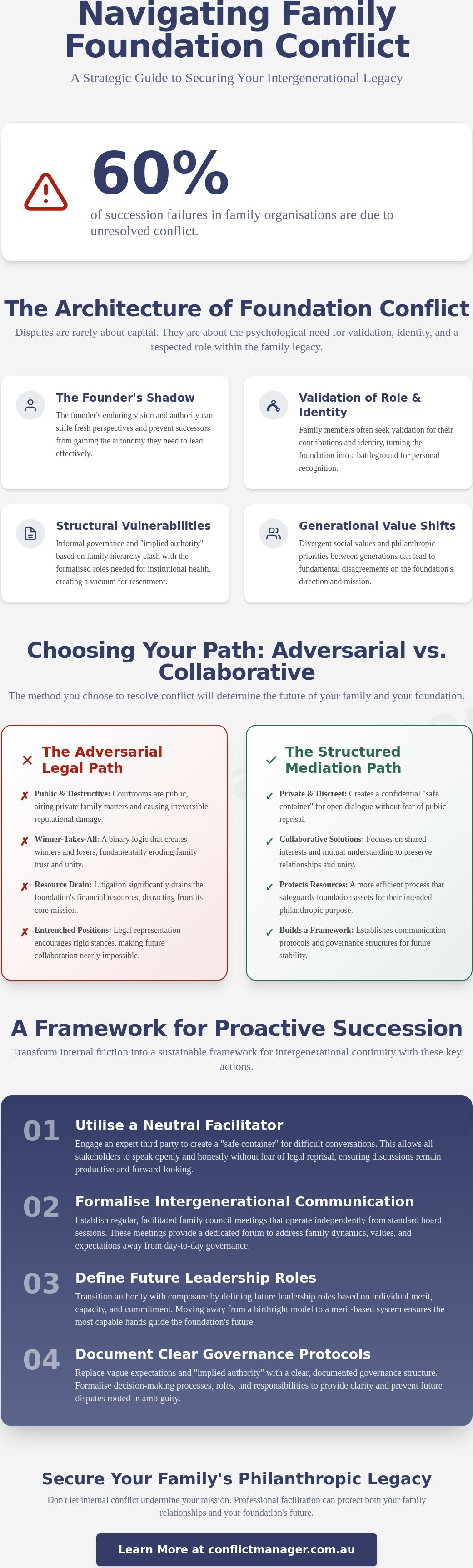
Legacy. Duty. Friction. These forces often collide when a family foundation transitions from its visionary founder to the next generation, yet conflict accounts for 60 per cent of succession failures in family organisations. Implementing effective family foundation conflict resolution is not merely about settling arguments; it's about protecting the structural integrity of your philanthropic mission against the weight of the founder's shadow. It's a delicate process of balancing personal history with professional obligation.
You likely understand the emotional burden of reconciling private family values with the public requirements of foundation governance. The fear of public litigation or a damaged reputation can feel overwhelming, especially when trying to grant successors the autonomy they need to lead. This article provides a structured path to transform that internal friction into a sustainable framework for intergenerational continuity. We'll examine how to establish private dispute resolution protocols and create a clear governance structure that ensures your family's wealth and authority transfer remains both orderly and discreet.
Key Takeaways
- Identify the psychological drivers behind foundation disputes, shifting the focus from financial assets to the vital validation of roles and individual identity.
- Discern why adversarial legal frameworks often fail and how structured family foundation conflict resolution protects your philanthropic mission and public reputation.
- Utilise a neutral facilitator to create a "safe container" for difficult conversations, allowing stakeholders to speak openly without the fear of legal reprisal.
- Formalise intergenerational communication through regular, facilitated family council meetings that operate independently from standard board sessions.
- Transition authority with composure by defining future leadership roles based on individual merit and capacity rather than traditional birthright.
Understanding the Architecture of Family Foundation Conflict
Vision. Authority. Friction. Family foundation conflict is the tension born from divergent perspectives on how philanthropic assets should be deployed and who holds the mandate to decide. While many observers focus on the technicalities of tax status or trust deeds, they often miss the psychological heart of the matter. These disputes aren't typically about the capital itself; they're about the validation of a family member's role and the preservation of their personal identity within a collective legacy. When the foundation becomes the primary theatre for family dynamics, the mission is often the first casualty.
In the Australian philanthropic landscape, foundations frequently operate with a level of privacy that, while beneficial for focus, can lead to institutional opacity. We identify three primary triggers that ignite internal discord: a lack of transparency in grant-making decisions, the enduring "founder's shadow" that stifles fresh perspectives, and the natural shift in social values between generations. If these tensions remain unaddressed, the stakes are absolute. You risk not only the erosion of the foundation's core mission but the permanent fracturing of family bonds that may have taken decades to build.
The Emotional Register of Philanthropic Wealth
Philanthropy is rarely a purely objective exercise. It's a complex interplay between genuine altruistic goals and a deep-seated need for personal recognition or control. When unaddressed emotional histories are brought into the boardroom, they manifest as rigid, unyielding positions that block progress and complicate conflict resolution methods. Succession friction is the gap between a founder's desire for continuity and a successor's need for autonomy. This emotional weight requires a seasoned hand to navigate, ensuring that individual needs don't eclipse the foundation's broader purpose.
Structural Vulnerabilities in Private Governance
Informal governance is a quiet catalyst for internal tension. In many Australian family foundations, "implied authority" based on family hierarchy often clashes with the "formalised roles" required for institutional health. This institutional ambiguity creates a vacuum where resentment grows and communication breaks down. Without a neutral third party to provide an objective lens, private friction almost inevitably escalates into organisational paralysis. Professional family foundation conflict resolution creates the structural integrity needed to survive these transitions, replacing vague expectations with clear, documented protocols that protect both the family and the fund.
Why Traditional Legal Paths Often Fail the Family Legacy
Adversity. Judgment. Erosion. When internal friction reaches a boiling point, the instinctual response is often to seek legal counsel. While the law provides a framework for rights and obligations, it's a blunt instrument when applied to the delicate ecosystem of a family foundation. The legal system operates on a binary logic of winners and losers. This zero-sum approach is fundamentally incompatible with the collaborative requirements of a multi-generational philanthropic mission, where the goal isn't just to be right, but to remain united.
Traditional litigation destroys the nuance required for long-term harmony. When family members engage in a "winner-takes-all" battle, they inadvertently dismantle the trust that sustains their collective work. Legal representation, by its very nature, is designed to protect the individual's interest at the expense of the collective. This often leads to entrenched positions, making effective family foundation conflict resolution nearly impossible to achieve once the first affidavit is filed. The cost isn't just the significant drain on foundation resources; it's the irreversible damage to the shared vision that once defined the family's purpose.
The Public Risk of Private Disputes
Discretion is a silent asset. In the Australian market, where business and philanthropic interests are often deeply intertwined, the reputational damage of a public legal battle can be catastrophic. Courtrooms are public forums, and the details of private family dynamics, once aired, cannot be retracted. This exposure can ripple through associated business interests, affecting stakeholder confidence and brand integrity. Maintaining a composed, private environment for resolving high-emotion disputes isn't just a matter of preference; it's a strategic necessity for legacy preservation. Seeking professional facilitation allows families to address their grievances without inviting the scrutiny of the public eye.
Litigation as a Reactive Instrument
Waiting for a legal trigger is often a sign of failed leadership. Litigation is reactive, occurring only after the structural integrity of the relationship has already buckled. For the next generation, witnessing an adversarial battle between their elders can be profoundly alienating, often leading to a complete withdrawal from foundation engagement. Proactive facilitation offers a sophisticated alternative, addressing the psychological and structural roots of friction before they manifest as legal crises. By choosing a path of structured dialogue over reactive action, foundations can secure their legacy while keeping the family's dignity intact.
The Mechanics of Expert-Led Foundation Mediation
Stability. Neutrality. Clarity. These are the hallmarks of a professional intervention when internal dynamics threaten to derail a philanthropic mission. The introduction of a neutral third party provides a necessary stabilising hand in volatile family environments, offering a perspective that is unburdened by history or bias. Unlike the binary, public outcomes of a courtroom, family foundation conflict resolution focuses on creating a "safe container" for difficult conversations. This is a private space where stakeholders can speak with candour, exploring the roots of their disagreement without the fear of legal reprisal or reputational exposure.
The core work of mediation involves uncoupling emotional grievances from the structural decision-making of the foundation. It's common for decades of family history to manifest as rigid board-level positions, yet these are often symptoms of a deeper need for validation rather than true policy disagreement. Expert facilitation works to peel back these layers, identifying the shared interests that almost always exist beneath the surface of divergent generational positions. Whether the friction stems from a shift toward impact investing or a debate over successor autonomy, the goal is to find the common ground that preserves the foundation's integrity.
Establishing the Framework for Resolution
The process begins with discovery. This is a rigorous phase where the facilitator seeks to understand the unique dynamics, history, and objectives of each stakeholder involved. By moving from reactive outbursts to a set of defined rules of engagement, the family transitions into a mode of structured, professional communication. Professional mediation aims for a sustainable outcome where all parties feel their core interests have been acknowledged. This framework ensures that the resolution isn't just a temporary truce, but a functional blueprint for future governance.
Navigating High-Emotion Transitions
De-escalating tension during foundation board meetings or family councils requires a specific set of techniques designed to lower the emotional temperature. When conversations become overly personalised, a seasoned facilitator uses objective data and mission-alignment to ground the discussion in reality. This shift from "who is right" to "what serves the mission" allows the family to move past individual ego. Throughout this process, the neutral party maintains total objectivity while providing compassionate, expert guidance, acting as a steady hand that remains unruffled by the high stakes of the environment.
A Framework for Proactive Succession Governance
Governance. Order. Foresight. Transitioning a foundation requires more than just updating trust deeds or ensuring compliance with Australian regulations. It requires a structural commitment to transparency that addresses the human element of wealth. While many organisations focus on the technicalities of ancillary funds, they often overlook the psychological friction that accompanies a change in leadership. A proactive approach to family foundation conflict resolution involves five distinct steps to secure institutional health and protect the family's legacy.
- Step 1: Formalise communication by establishing regular, facilitated family council meetings. These should occur outside of standard board sessions to discuss family-specific concerns without cluttering operational agendas.
- Step 2: Define roles and responsibilities based on individual merit and capacity. Authority should be earned through expertise rather than granted by birthright alone, ensuring the foundation remains professionally managed.
- Step 3: Develop a "Family Foundation Constitution" that codifies core values and specific dispute-resolution protocols.
- Step 4: Engage a neutral third party to audit the current state of family alignment. This process identifies latent friction before it manifests as a crisis.
- Step 5: Implement a phased transition of authority. This allows for mentorship and psychological adjustment, avoiding the "cliff-edge" retirements that often fuel successor anxiety.
The Role of the Family Constitution
A constitution is not a legal filing, but a moral and operational compass. It should include clear mission statements, defined exit strategies for family members who wish to step away, and transparent governance rules. This document acts as a "north star" during periods of high stress or structural change, providing an objective reference point that transcends individual personalities. For many families, this framework is the cornerstone of effective Family Office Mediation, as it establishes the rules of engagement long before they're needed.
Mentorship and the Gradual Transfer of Power
Abrupt changes in foundation leadership fuel anxiety and subsequent conflict. When a founder cedes control too quickly, or stays too long, the resulting power vacuum or "founder's shadow" can paralyse the organisation. Structuring a transition period that respects the founder's legacy while empowering the next generation is essential. External facilitation is particularly vital during this "overlap" phase. It provides a steady hand to manage the inevitable power struggles, ensuring that the transfer of authority is seen as a progression rather than a loss. If you're currently facing these transitions, seeking professional stakeholder facilitation can provide the objectivity needed to maintain family harmony.
Securing the Legacy with Conflict Manager
Order. Clarity. Preservation. When the internal dynamics of a foundation begin to oscillate between productive debate and destructive friction, the path forward requires more than internal willpower. It requires an external, neutral perspective that can view volatile situations with total objectivity. Conflict Manager provides the seasoned expertise necessary for effective family foundation conflict resolution, acting as a steady hand during periods of high stress or organisational transition. We understand that the weight of a family legacy can be heavy, and our role is to ensure that weight doesn't crush the mission it was intended to support.
Our approach is methodical and logical. We begin by acknowledging the reality of the disruption, then transition into an analytical explanation of why internal efforts may be struggling under the pressure of history and expectation. By introducing a neutral third party, families can move away from the circular arguments that often paralyse private boards. We bring a sense of composed authority to the table, helping stakeholders navigate difficult transitions with the quiet confidence that a structured resolution is not just possible, but inevitable.
Composed Authority in High-Stakes Mediation
We handle the weight of responsibility and the friction of interpersonal dynamics with total objectivity. In high-stakes environments where sizeable assets and public reputations are at risk, our focus remains squarely on sustainable outcomes that preserve both foundation assets and family integrity. Australian families trust our seasoned expertise because we remain unruffled by complex human and structural dynamics. We provide the stability needed to view volatile situations through an objective lens, ensuring that the foundation's structural integrity remains intact even when personal relationships are under strain.
Initiating the Resolution Process
Inviting an external facilitator into a private family environment is an act of strategic foresight. It signals a commitment to the mission that transcends individual grievances. During a preliminary consultation, you can expect a methodical path forward that prioritises clarity and empathy. We guide you from a state of disruption toward a vision of structured resolution and intergenerational continuity. This process allows successors to find their autonomy while founders secure their legacy, transforming friction into a clear path for future growth. To begin this transition, organise a confidential consultation with Conflict Manager and secure the future of your philanthropic mission.
Restoring Structural Integrity to the Philanthropic Mission
Legacy is a living structure. It requires maintenance, foresight, and a willingness to address the human friction that naturally arises during intergenerational shifts. We've explored how moving beyond adversarial legal frameworks allows families to focus on the psychological heart of their disputes. By uncoupling emotional history from board-level decisions, you ensure that the foundation's mission remains the central priority. This process isn't just about settling arguments; it's about building a framework that survives the transition of power and protects the family's public standing.
Implementing professional family foundation conflict resolution is a strategic investment in your family's institutional health. It replaces the uncertainty of the "founder's shadow" with a sustainable path for successor autonomy. Conflict Manager brings a methodical approach to complex structural transitions, offering the specialised expertise required to navigate high-stakes environments with total discretion. Our commitment to private and sustainable resolution outcomes provides the stability your foundation needs to thrive for generations.
Take the first step toward a composed and orderly transition. Secure your family legacy with an expert-led consultation at Conflict Manager. It's time to transform disruption into a vision of structured continuity and shared purpose.
Frequently Asked Questions
What is the primary cause of family foundation conflict in Australia?
Family conflict is the cited cause for 60 per cent of succession failures in family organisations. In the Australian context, the friction often stems from the "founder's shadow," where the original benefactor's vision clashes with the evolving social values of the next generation. This tension is rarely about the assets themselves. It's about the validation of roles and the preservation of individual identity within the foundation's governance.
How does foundation mediation differ from traditional legal advice?
Mediation focuses on collaborative legacy preservation, whereas legal advice is inherently adversarial. Traditional legal paths often rely on a "winner-takes-all" framework that can destroy the delicate nuance required for multi-generational harmony. Expert family foundation conflict resolution provides a private, "safe container" for dialogue, allowing families to reach a consensus without the public exposure or high costs of court proceedings.
Can a family foundation survive a major intergenerational dispute?
Survival is entirely possible when families transition from informal governance to a structured framework. While only 13 per cent of family organisations survive to the third generation, those that do often implement formalised communication and clear roles. Success requires uncoupling emotional grievances from structural decision-making, ensuring that the philanthropic mission remains the primary focus during periods of high organisational stress.
When is the best time to engage a neutral third-party mediator for succession?
Engagement should ideally begin five to ten years before a planned leadership transition. Proactive facilitation allows for a phased transfer of authority, giving both the founder and the successors time for psychological adjustment. Engaging a neutral third party during this overlap phase helps identify latent friction before it manifests as a crisis that threatens the foundation's operational integrity or public reputation.
What happens if one family member refuses to participate in mediation?
Participation in mediation is voluntary, yet a single refusal doesn't necessarily halt the process of organisational improvement. A facilitator can still work with the willing board members to formalise governance protocols and communication standards. Often, as the benefits of a structured path become evident, hesitant members may choose to engage to ensure their own interests and vision are represented in the final framework.
How long does the family foundation facilitation process typically take?
The timeline depends on the complexity of the family dynamics and the foundation's structural requirements. Most engagements involve a series of facilitated sessions conducted over several months to allow for deep discovery and the gradual implementation of new protocols. This deliberate pace ensures that the resolution is sustainable and that all stakeholders have the time needed to process significant transitions.
Is family mediation confidential and legally binding in Australia?
Confidentiality is a cornerstone of the process in Australia, protecting the family's reputation and business interests from public scrutiny. While the dialogue itself is private, the outcomes of mediation can be formalised into legally binding agreements or updated trust deeds. This provides a secure, structured path for intergenerational wealth and authority transfer that carries the weight of a formalised commitment.
How much does professional conflict resolution for families cost?
The investment is typically a fraction of the expense associated with traditional litigation. While industry averages for general mediation vary, professional family foundation conflict resolution is a bespoke service tailored to the scale of the foundation's assets and the complexity of the dispute. It's helpful to view this as an investment in legacy preservation rather than a simple administrative cost, as it prevents the irreversible drain of a legal battle.


