

Silence. Friction. Litigation. These are the unintended consequences of an estate plan that remains a secret until it’s too late. You’ve likely spent decades building your wealth, yet the prospect of discussing it with your children feels fraught with risk. You worry about fostering entitlement, or perhaps you’re anxious about how a blended family will react to specific distributions. It’s a common burden for those in positions of high responsibility who understand that wealth is as much a psychological weight as it is a financial one.
True family estate communication management isn’t a single conversation; it’s a deliberate, structural process that ensures your legacy remains a source of stability rather than a catalyst for dispute. Even with the federal exemption now at 15 million dollars per individual under the OB3 Act, the technicalities of the law won't solve interpersonal friction. By addressing the psychological and organisational hurdles now, you can secure a future where your wealth transfer is methodical and your family harmony is preserved. This article provides a clear framework for navigating these transitions, offering the clarity and order needed to protect what you’ve built for the generations to come.
Key Takeaways
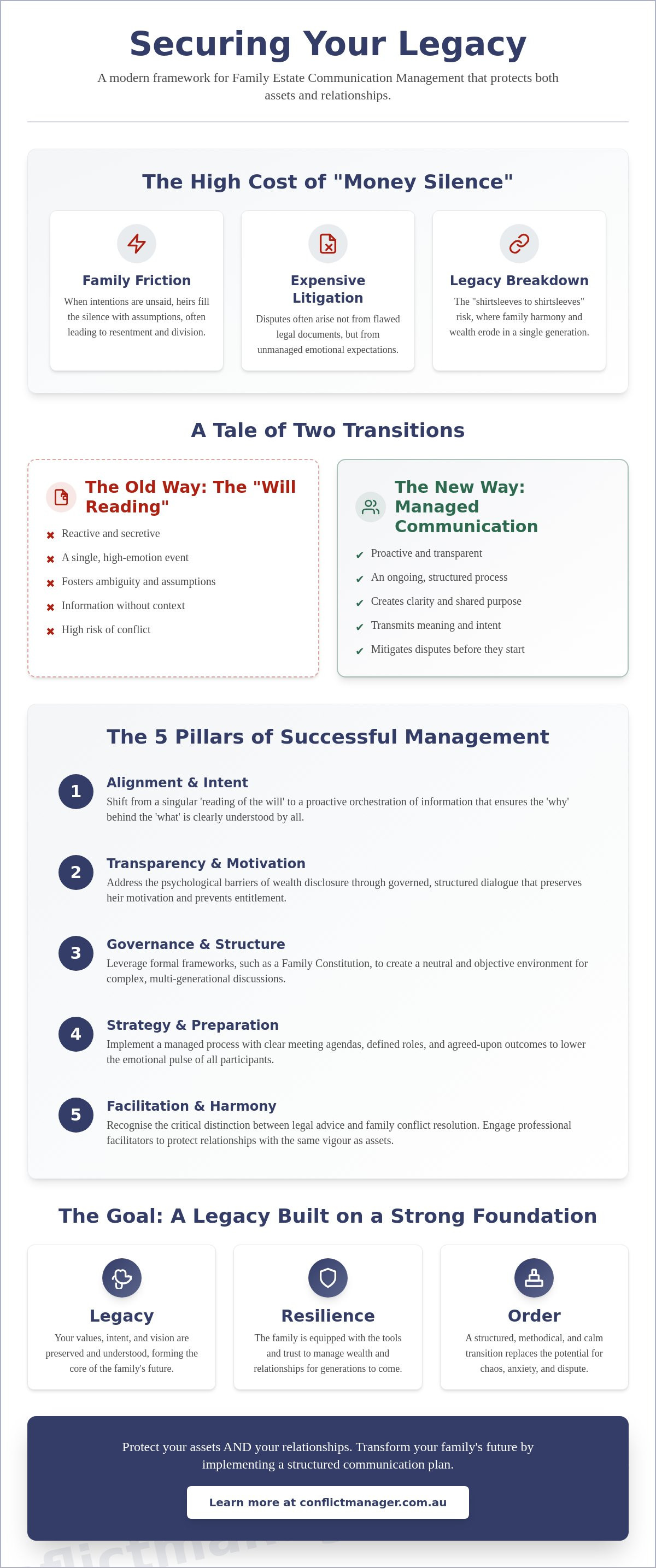
- Alignment and intent. Shift from a singular 'reading of the will' to a proactive orchestration of information that ensures all stakeholders are heard.
- Transparency and entitlement. Address the psychological barriers of wealth disclosure through governed dialogue that preserves heir motivation.
- Governance and structure. Leverage formal frameworks like a Family Constitution to create a neutral environment for complex discussions.
- Strategy and preparation. Master family estate communication management by establishing clear agendas that lower the emotional pulse of participants.
- Facilitation and harmony. Recognise the distinction between legal advice and family conflict resolution to protect both your assets and your relationships.
What is Family Estate Communication Management?
Legacy. Resilience. Order. These are the foundational elements of a successful wealth transition. While many view the distribution of assets as a purely technical exercise, the reality is far more nuanced. Family estate communication management is the strategic orchestration of information flow between benefactors, heirs, and stakeholders. It moves beyond the traditional, often traumatic, "reading of the will" to establish a proactive, ongoing management discipline.
In the field of estate planning, this approach focuses on the human architecture. It's about ensuring that the structural integrity of your financial decisions isn't compromised by interpersonal friction. In the Australian family office or private wealth sector, this management functions as a governance mechanism. It bridges the gap between high-level legal strategies and the everyday emotional realities of the family unit. By treating communication as a managed process, you transform a potentially volatile transition into a structured movement toward a shared future.
The Distinction Between Information and Communication
There is a critical difference between the transfer of data and the transmission of meaning. Handing a child a copy of a trust deed provides them with information, yet it offers no context regarding your intent or the responsibilities attached to that wealth. Without the "why" behind the "what", heirs are left to fill the silence with their own assumptions; these assumptions often lead to resentment or entitlement. Estate communication management is the proactive mitigation of "money silence" to protect intergenerational stability. It involves deliberate framing, where the benefactor’s values are articulated as clearly as the asset values themselves.
The High Cost of Silence in Australian Estates
The "shirtsleeves to shirtsleeves" phenomenon is a global risk, but it carries a specific weight in Australia. We often see a culture of "money silence" where wealth is treated as a taboo subject until a crisis occurs. This lack of transparency is expensive. When intentions are left unsaid, the vacuum is filled by legal challenges and family breakdowns. Australian estates frequently face litigation not because the legal documents were flawed, but because the emotional expectations were unmanaged. The psychological weight of navigating a complex blended family or a multi-generational business without a roadmap creates friction that few families survive intact. Proactive management removes the ambiguity that fuels these disputes, replacing anxiety with a sense of shared purpose.
The Psychology of Wealth: Overcoming the Barriers to Transparency
Wealth is rarely a neutral topic. It carries the weight of history, effort, and expectation. For many Australian benefactors, the hesitation to disclose an estate plan stems from a deep-seated taboo surrounding money. This silence is often a protective mechanism. They fear that transparency will breed entitlement, effectively stripping the next generation of their drive to achieve. Yet, this opacity creates its own risks. It leaves heirs in a state of perpetual uncertainty, where they are unable to plan their own futures with any degree of structural integrity.
The "Fair vs. Equal" dilemma is perhaps the most significant source of intergenerational friction. While a mathematical split of assets is simple, it's rarely perceived as "fair" in complex family systems. One child may have contributed decades to a family business while another pursued a different path. Navigating these nuances requires a sophisticated level of family estate communication management. When blended families are involved, the stakes are even higher. Trust must be built through deliberate, objective dialogue rather than assumed through bloodlines.
Deconstructing the Benefactor’s Hesitation
The reluctance to share details often masks a fear of losing control. There is a delicate balance between holding power and empowering others; many benefactors worry that once the plan is known, their influence will wane. Additionally, the anxiety of mortality plays a significant role. Discussing an estate requires confronting one’s own end, a task many defer until a crisis forces their hand. By re-framing transparency as a gift of clarity, you move away from a loss of privacy and toward the creation of a legacy built on trust. Utilising tips for family conversations about estate planning can help bridge this gap, turning a daunting task into a manageable process.
Managing Heirs’ Expectations and Emotional Responses
Heirs often operate under a "psychological contract," a set of unwritten expectations about their place in the family’s financial future. When the reality of an estate plan contradicts these internal narratives, the result is often a feeling of betrayal. To mitigate this, benefactors must address perceived favouritism through objective communication frameworks. It's not enough to state the figures. You must acknowledge the emotional weight of inheritance with empathy. If internal dynamics feel too volatile to manage alone, seeking professional stakeholder facilitation can provide the neutral ground necessary to resolve these underlying tensions before they escalate into litigation.
Structural Frameworks for Effective Communication
Stability requires a foundation. In the context of Australian wealth, that foundation is rarely found in the technical documents alone. While wills and trust deeds provide the legal skeleton, they lack the narrative flesh that prevents family decay. Effective family estate communication management relies on establishing formal frameworks that move discussions away from the emotionally charged "kitchen table" and into a more structured environment. This transition signals to all stakeholders that the transition of wealth is a professional responsibility, not merely a personal preference.
A Family Constitution or Statement of Intent serves as the primary governance tool. It articulates the family’s values, the purpose of the wealth, and the expectations for the next generation. For those managing complex Australian family trusts or private companies, integrating these discussions into the annual governance cycle is essential. It prevents the silence that often breeds litigation. When dealing with communicating an estate plan with unequal division of assets, the narrative justification becomes as vital as the legal structure itself. Without a formal framework, these decisions can appear arbitrary, leading to a permanent fracture in family unity.
Formalising the Information Flow
Consistency builds trust. Ad-hoc announcements regarding inheritance often trigger defensive reactions. Instead, families should adopt a schedule of regular updates. This might include a "Legacy Folder" that contains more than just the Will; it should house letters of wishes, asset lists, and contact details for key advisors. A Letter of Wishes is particularly powerful. It provides a narrative voice to legal documents, explaining the "why" behind specific distributions. This level of transparency ensures that heirs aren't left to interpret silence through the lens of their own insecurities.
Internal vs. External Facilitation
Power dynamics are difficult to ignore. In many Australian family businesses, a dominant patriarch or matriarch may inadvertently stifle honest dialogue. Their presence can create a "compliance culture" where heirs agree in person but harbour resentment in private. This is where external facilitation becomes necessary. A neutral third party doesn't take sides. They manage the flow of the conversation, ensuring that every stakeholder has a voice without the fear of emotional reprisal. Moving from internal control to external facilitation is often the final step in ensuring a legacy remains intact across multiple generations.
Implementing the Family Estate Meeting: A Step-by-Step Guide
Execution. Strategy. Resolution. Moving from the abstract framework of a family constitution to the practical reality of a meeting requires a high degree of composure. Family estate communication management is most vulnerable during these face-to-face encounters. Without a methodical plan, the meeting risks becoming a theatre for historical grievances rather than a forum for future stability. Success depends on a transition from the informal to the intentional.
Begin by defining the agenda in isolation. You shouldn't invite family members until you've clarified exactly what is on the table and, more importantly, what is not. Frame the invitation around the concept of stewardship and clarity. This reduces the immediate anxiety associated with discussions of mortality and money. When heirs understand that the meeting is designed to protect their future interests, they are far more likely to participate with a constructive mindset.
Setting the Scene for Productive Dialogue
Location matters. The family home is often saturated with emotional baggage and historical power dynamics that can subconsciously influence the dialogue. Instead, choose a neutral, professional environment such as a private boardroom or a quiet conference centre. Establish ground rules early, including no interruptions, a focus on the future, and a commitment to confidentiality. The agenda acts as a structural anchor. It keeps the discussion objective even when the subject matter is deeply personal, ensuring that the group remains focused on the primary objectives of the wealth transfer.
Navigating High-Emotion Friction
Old wounds often resurface when wealth is the catalyst for discussion. When conflict arises, use the "Parking Lot" method to acknowledge tangential disputes without allowing them to derail the primary estate focus. Note these issues for later discussion, ensuring the meeting stays on track and within its designated boundaries. Active listening serves as a vital tool for validating heirs’ concerns without necessarily changing the estate’s structural distribution. If the friction becomes unmanageable, engaging an expert in family conflict resolution ensures that a neutral hand guides the transition toward a peaceful outcome.
A meeting without documentation is merely a conversation. Record the outcomes, the remaining questions, and the agreed-upon next steps. Distribute these summaries within forty-eight hours to maintain the momentum of clarity. This follow-up ensures that the sense of order established during the meeting isn't lost to the passage of time or the selective memory of participants. By formalising the conclusion, you reinforce the structural integrity of the entire estate process.
The Role of Professional Mediation in Legacy Protection
Legality. Humanity. Balance. While a solicitor ensures the structural validity of a trust or will, they are rarely equipped to manage the volatile emotional currents that follow. There is a fundamental distinction between legal advice and conflict mediation. One defines the boundaries of ownership; the other protects the integrity of the relationships within those boundaries. For Australian families, successful family estate communication management often requires both perspectives to operate in tandem. One provides the "what," while the other manages the "how."
A neutral third party brings a level of composure that is difficult to maintain when family history is involved. Mediation offers a confidential, swift alternative to the adversarial nature of the legal system. In the courtroom, the focus is on winning a share of the assets; in mediation, the focus is on preserving the family unit. This objective approach allows for a more nuanced exploration of "fairness" that transcends simple arithmetic, ensuring that the legacy you leave behind isn't overshadowed by the cost of its distribution.
When to Engage an External Mediator
Identifying the need for intervention early is a mark of leadership rather than a sign of failure. Red flags often manifest as "money silence," where certain heirs withdraw from discussions, or as open hostility during initial planning stages. Waiting for these tensions to reach a courtroom is a costly error. Proactive mediation allows for a facilitator to step in before the dispute becomes a public legal battle. An objective outsider sees the structural flaws and historical biases that family members are often too close to recognise, providing a path toward resolution that internal efforts simply cannot reach.
Conflict Manager’s Approach to Family Estate Resolution
Conflict Manager provides the steady hand necessary to navigate these difficult transitions. Our methodology is built on a deep understanding of both human and organisational dynamics, focusing on sustainable outcomes that prioritise family stability alongside asset integrity. We don't merely address the surface-level friction; we look at the underlying structures that cause it. By acting as a neutral third party, we bring clarity to clouded situations and ensure that every stakeholder feels heard without the conversation becoming emotionally entangled.
Our focus is on creating a sense of order during periods of high stress. We help families move from a state of disruption toward a vision of structured resolution, ensuring that the wealth transfer process strengthens the family bond rather than breaking it. To ensure your family legacy is protected through structured dialogue, contact Conflict Manager for a confidential consultation. We provide the expertise and discernment needed to safeguard your intergenerational future.
Securing Your Legacy Through Structured Dialogue
Wealth transition is a structural movement that requires more than just legal precision. It demands a deliberate approach to family estate communication management that prioritises the psychological safety of every heir. By establishing formal governance through family councils and structured meetings, you replace the anxiety of the unknown with the stability of a shared intent. These frameworks ensure that your legacy remains a source of unity rather than a catalyst for friction.
Conflict Manager provides expert-led mediation for high-net-worth families across Australia, offering a specialised focus on family office conflict resolution. Our objective approach brings the composure needed to navigate even the most volatile transitions. Secure your family’s future with professional estate mediation and ensure your intentions are translated into lasting harmony. Protecting your assets is a financial task; protecting your family is a leadership responsibility that you don't have to carry alone.
Frequently Asked Questions
How do I start a conversation about our estate without sounding like I am dying?
Frame the discussion as an act of stewardship and future planning rather than a precursor to an end. Focus on the preservation of your legacy and the protection of the family’s stability. By shifting the narrative toward the empowerment of the next generation, you move the conversation away from mortality and toward a sense of shared responsibility and order.
What is the difference between an estate lawyer and a family estate mediator?
An estate lawyer provides the legal architecture of your will, while a mediator focuses on the human architecture of family estate communication management. The lawyer ensures your documents are valid under Australian law. The mediator ensures your heirs don't tear those documents apart through litigation by resolving underlying emotional friction and managing complex interpersonal dynamics.
Should I tell my children exactly how much they are going to inherit?
Transparency is generally the most effective way to prevent future resentment and litigation. While you don't necessarily need to disclose every dollar, providing a clear range and explaining the "why" behind your decisions removes the vacuum of silence. This clarity allows heirs to plan their own financial futures with structural integrity rather than relying on assumptions.
How can we manage estate communication in a blended family with step-children?
Utilise objective governance frameworks to remove the perception of favouritism or exclusion. In blended families, trust must be built through deliberate, structured dialogue rather than assumed through bloodlines. Using a neutral third party to facilitate these meetings ensures that every stakeholder feels heard, which is essential for maintaining harmony across complex family trees.
What happens if one family member refuses to participate in estate discussions?
Proceed with the members who are willing to engage while keeping the door open for the resistant individual. Sometimes, a refusal to participate stems from anxiety or a fear of conflict. Engaging a professional facilitator can often lower the emotional pulse of the situation, making it easier for a reluctant family member to enter the room without feeling defensive.
How often should we review and communicate changes to our estate plan?
Review your plan every three to five years or whenever significant legislative shifts occur. For example, the OB3 Act passed in July 2025 significantly increased federal exemptions for 2026. Regular communication ensures your heirs aren't surprised by changes in tax laws or asset valuations, maintaining the momentum of clarity you've worked hard to establish.
Can professional mediation really prevent our family from going to court?
Yes, by addressing the emotional and psychological roots of conflict that legal documents cannot reach. Litigation in Australia is rarely about the law itself; it's usually about unmanaged expectations and perceived injustices. Professional mediation provides a structured environment to resolve these issues privately, saving your family from the public and financial cost of a courtroom battle.
What are the most common mistakes families make when discussing their inheritance?
Silence and the assumption that "equal" is always "fair" are the most frequent errors. Many benefactors avoid family estate communication management because they fear causing friction, yet this silence is exactly what breeds resentment. Failing to provide a narrative for your decisions leaves heirs to create their own, often inaccurate, stories about your intent and their value within the family.


