
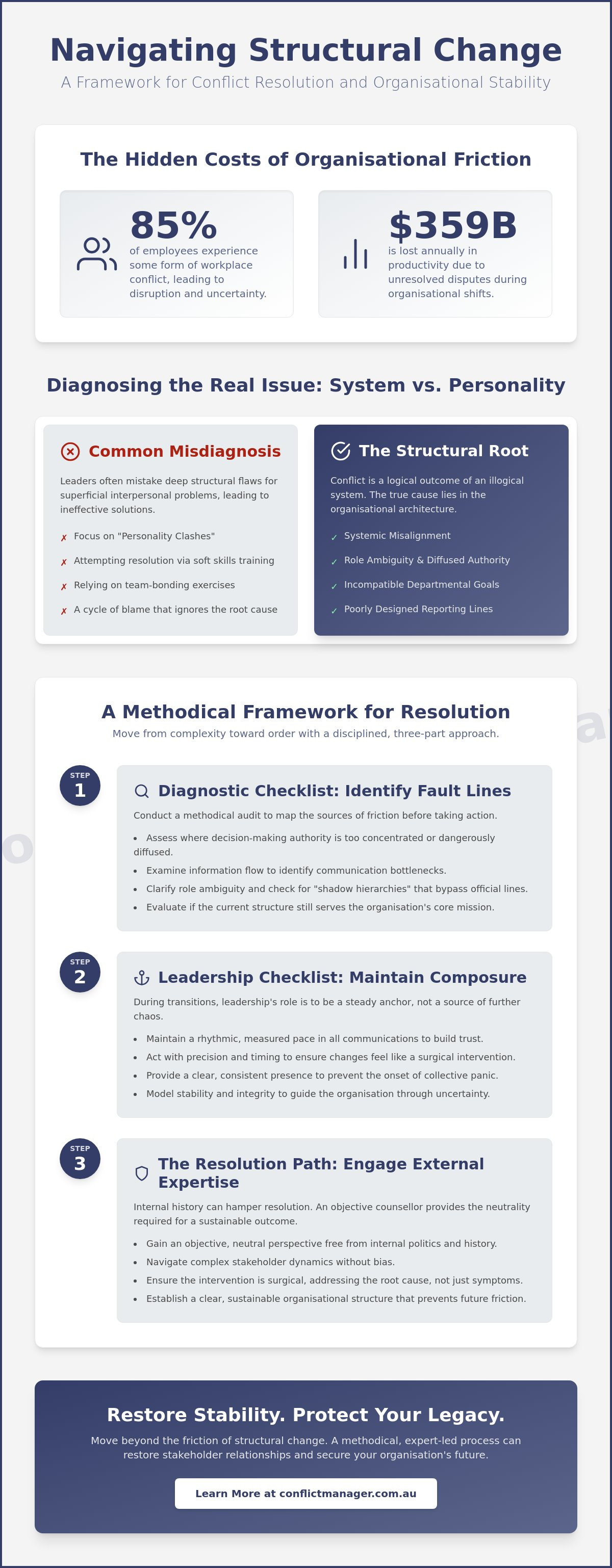
Disruption. Friction. Uncertainty. With 85% of employees experiencing some form of workplace conflict, the true cost of organisational shifts often hides within the $359 billion lost annually to unresolved disputes. Structural change conflict management is not merely a reactive necessity; it is a strategic discipline required to protect asset integrity and family legacy during periods of transition. You likely recognise that when internal friction stalls productivity, the weight of responsibility feels immense. It's common for high-emotion disputes among key stakeholders to derail even the most logical restructuring plans, especially when internal mediation attempts fail to find neutral ground.
Discover a methodical, expert-led checklist designed to navigate these complexities and maintain stability. This framework provides the objective, professional guidance needed to restore stakeholder relationships and establish a clear organisational structure. We will examine the logic of external intervention and the steps required to achieve a sustainable resolution that prevents future friction. By moving from complexity toward order, you can ensure your transition remains a catalyst for growth rather than a source of permanent fracture.
Key Takeaways
- Clarity. Stability. Integrity. Recognise that friction often stems from systemic misalignment rather than individual personality clashes to better address the root causes of organisational tension.
- Learn to conduct a methodical audit that identifies structural fault lines where decision-making authority is either too concentrated or dangerously diffused.
- Master the precision and timing required for structural change conflict management to ensure your restructuring efforts act as a surgical intervention for long-term organisational health.
- Discover how to maintain a rhythmic and measured pace in your communication to act as a steady anchor and prevent the onset of collective panic during transitions.
- Understand why internal history can hamper resolution and how an objective external counsellor provides the neutral perspective needed to navigate complex stakeholder dynamics.
Understanding the Dynamics of Structural Change Conflict Management
Clarity. Stability. Integrity. These are the foundations of structural health. In any thriving organisation, these pillars provide the framework within which talent can flourish. However, when the scaffolding of a business is altered, the resulting friction is often misdiagnosed. We frequently mistake systemic misalignment for individual personality clashes, yet the root of the issue is rarely found in the temperament of the people involved. It's found in the design. Successful resolution requires viewing the organisation as a living, breathing architecture of roles rather than a mere collection of individuals.
Effective structural change conflict management demands a shift in perspective. The distinction between interpersonal friction and structural fault lines is often blurred by the heat of the moment. When the lines of this architecture move, the humans within it naturally collide. Resolution involves stepping back to observe these collisions with total objectivity, identifying where the structure itself is forcing people into opposition. It's about realigning the system so that the people within it can once again move in harmony.
Defining the Structural Root of Friction
Friction often emerges from invisible fault lines within the hierarchy. Consider the tension created when departments report to different executive heads with incompatible goals. One team might be incentivised for rapid growth, while another is rewarded for risk mitigation. This isn't a failure of character; it's a structural contradiction. Recognising how reward systems can inadvertently pit team members against one another is vital for maintaining operational efficiency. Role ambiguity, where decision-making authority is dangerously diffused, further erodes stakeholder confidence and creates a vacuum that is quickly filled by anxiety and dispute.
Why Interpersonal Solutions Often Fail Structural Problems
Many leaders attempt to resolve these issues through "soft skills" training or team-bonding exercises. While well-intentioned, these efforts are often futile when the underlying hierarchy is fundamentally broken. You can't negotiate your way out of a poorly designed reporting line. Structural flaws frequently masquerade as "personality conflicts" in high-pressure environments, leading to a cycle of blame that ignores the systemic cause. A broader understanding of Organizational conflict reveals that these disputes are frequently the logical outcome of an illogical system. Objective intervention is necessary to see beyond the immediate emotional noise. It allows for a surgical approach to restructuring that addresses the cause rather than the symptom, ensuring that the resolution is both sustainable and restorative for the long-term health of the legacy.
Diagnostic Checklist: Identifying Structural Fault Lines
Audit. Analysis. Composure. A methodical audit is the foundational step toward restoring organisational composure when the complexities of structural change conflict management become overwhelming. It's impossible to resolve friction that hasn't been clearly mapped. We must identify exactly where decision-making authority is concentrated or, conversely, where it's dangerously diffused among too many stakeholders. Examining the flow of information across the board reveals communication bottlenecks that often trigger defensive, reactive behaviours. It's also vital to evaluate whether the current structure still serves the original mission of the family legacy. Structures often outgrow their purpose, leaving the organisation brittle and prone to fracture.
Assessing Role Ambiguity and Reporting Lines
Clarity is the primary antidote to organisational anxiety. Do all stakeholders have a clear, documented understanding of their specific responsibilities? In high-stakes environments, we often find "grey areas" where two or more leaders claim overlapping authority, leading to inevitable friction and stalled productivity. You should also check for "shadow hierarchies" where informal power structures bypass official reporting lines. These hidden networks can undermine even the most well-planned organisational conflict management strategies by creating a sense of unfairness. Identifying these gaps allows for the application of specific conflict management techniques that focus on structural realignment. This ensures that everyone knows their place within the architecture, reducing the need for constant, exhausting negotiation.
Evaluating Goal Incompatibility Across Departments
Misaligned incentives are a silent killer of long-term stability. Are department-specific KPIs creating friction with the broader organisational objectives? It's common to find "siloed" groups that prioritise internal metrics over collective stability and growth. When one team's success requires another's failure, conflict is a design feature, not a bug. This systemic misalignment puts asset integrity at risk and can cause high-emotion disputes among key stakeholders. Auditing the frequency and quality of cross-functional collaboration at the leadership level ensures that everyone is pulling in the same direction. If collaboration feels forced or infrequent, the structural design likely needs a steady, professional hand to re-centre its focus. A methodical approach to structural change conflict management ensures that these silos are dismantled before they can cause permanent damage to the organisation's legacy.
Tactical Checklist: Implementing Structural Change Conflict Management
Precision. Timing. Objectivity. Once the diagnostic audit has revealed the underlying fault lines, the transition to action must be handled with a steady, neutral hand. Implementation is not merely about moving boxes on an organisational chart; it is a surgical intervention designed to excise dysfunction and promote long-term health. In the context of structural change conflict management, every adjustment must be tethered to a clear, communicated rationale. Stakeholders need to understand the "why" behind the shift to prevent the onset of defensive posturing. Without this transparency, even the most logical realignment can be perceived as an arbitrary exercise of power.
Consider the ripple effect of every change on the broader organisational ecosystem. A modification in one department's reporting line can inadvertently shift the power balance in another, potentially creating new friction points. Leaders must remain unruffled by these secondary waves, viewing them with total objectivity. By maintaining a measured pace, you ensure that the restructuring serves as a stabilising force rather than a source of further disruption. This methodical approach allows the organisation to settle into its new form with minimal trauma to the family legacy or asset integrity.
Reconfiguring Team Composition and Hierarchy
Success often requires the strategic separation of personalities at odds. This doesn't always mean termination; rather, it involves the physical or functional division of projects to reduce daily friction. Adjusting reporting lines so that conflicting groups report to a single, neutral executive can also provide the necessary distance for tempers to cool. When decisions reach a stalemate, implementing "majority rule" protocols can break the deadlock. However, this process must be transparent and perceived as fair by all parties to avoid claims of bias or favouritism. These tactical shifts ensure that the hierarchy supports collaboration rather than obstructing it.
Aligning Reward Systems with Collective Outcomes
Systemic friction is frequently fueled by misaligned incentives. Shifting from individual-centric performance metrics to shared, team-based evaluation frameworks encourages stakeholders to prioritise collective stability over personal gain. It's vital to ensure that financial incentives don't inadvertently undermine the cooperative spirit of the organisation. When rewards are tied to the success of the whole, the impetus for internal competition diminishes. By synchronising financial gains with collective milestones, organisations dismantle the structural impetus for competition-based conflict and foster a culture of shared success. This alignment is a cornerstone of effective structural change conflict management, transforming potential rivals into partners with a common purpose.
Leadership Checklist: Maintaining Composure During Transition
Stability. Presence. Resolve. The leader acts as the anchor for the entire enterprise. Their composure dictates the emotional temperature of every room they enter. During the friction inherent in structural change conflict management, a leader's ability to remain unruffled is their most potent asset. It's about maintaining a rhythmic, measured pace in communication. This prevents the onset of organisational panic that often follows structural disruption. When you speak with a steady hand, you signal that the situation is being managed with professional discernment. This grounded approach allows stakeholders to feel secure even when their roles are in flux.
Acknowledge the difficulty of the transition while remaining focused on the vision of resolution. It's not helpful to ignore the emotional weight that structural shifts place on a team. Instead, a leader should provide a sense of order by being the most objective person in the room. Neutrality is a skill that requires the ability to listen without becoming emotionally entangled in the disputes. By distancing yourself from the immediate noise, you can see the structural logic that others might miss. This perspective is what allows a leader to guide their organisation from a state of complexity toward a structured, sustainable future.
Communication Protocols for High-Stakeholders
Rumours and anxiety thrive in a vacuum. To counter this, establish a regular cadence of updates that provides a predictable flow of information. This rhythm creates a sense of order and reduces the likelihood of stakeholders filling the silence with their own fears. For high-net-worth stakeholders or key family members, prioritise direct, one-on-one facilitation. These private sessions allow for the addressing of bespoke concerns that might be too sensitive for a general meeting. Clear, concise announcements should be the standard; use commas or semicolons to provide internal contrast and clarity in complex organisational messages. If you require professional assistance in managing these delicate dialogues, consider engaging expert stakeholder facilitation to ensure all voices are heard without compromising the project's integrity.
Managing Emotional Residue and Morale
Even when a restructure is objectively positive, it can trigger a sense of loss or displacement among long-term stakeholders. Recognise that these feelings are a natural byproduct of change. Providing a safe, facilitated environment for stakeholders to voice objections without fear of retribution is critical for long-term morale. It prevents dissent from going underground, where it can quietly undermine the new structure. Focus on "sustainable outcomes" that prioritise the long-term health of the family or business legacy. By addressing the emotional residue of the transition, you ensure that the new organisational architecture is built on a foundation of trust rather than lingering resentment.
The Resolution Path: Engaging External Expertise
Perspective. Distance. Objectivity. These are the qualities most difficult to maintain when you're standing in the centre of a storm. Internal efforts to address friction are often hampered by the very history they seek to resolve; the weight of past decisions and personal loyalties can cloud even the most disciplined mind. Engaging external expertise for structural change conflict management is not an admission of failure. It's a strategic investment in the structural integrity and legacy of the organisation. An external counsellor brings a steady hand unburdened by internal politics, allowing them to view volatile situations with total clarity. This objective lens is what transforms a period of disruption into an opportunity for permanent, positive realignment.
Professional mediation is more than a temporary fix. It's an investment in the long-term health of the business and the preservation of the family legacy. When you bring in a seasoned professional, you're introducing a sense of order that internal parties often cannot provide. This external presence acts as a neutral third party that brings clarity to clouded situations, ensuring that the weight of responsibility doesn't lead to emotional entanglement. Resolution, in this context, is not merely the absence of conflict; it is the presence of a sustainable framework that allows the organisation to function with renewed purpose and stability.
Recognising the Limits of Internal Facilitation
Internal facilitation often reaches a natural ceiling. When "circular arguments" persist despite repeated mediation, it indicates that the root cause is deeper than interpersonal skills. It suggests a systemic flaw that the participants are too close to see. There is also the inherent risk of "mediator bias" when internal leaders attempt to resolve disputes within their own teams; it's nearly impossible to be perceived as neutral when you hold the power of performance reviews or budget allocations. Identifying the point where emotional entanglement prevents a clear view of structural solutions is vital. At this juncture, continuing with internal efforts may only serve to deepen the resentment and stall productivity further. A professional approach acknowledges these limitations and seeks a path that prioritises the health of the collective over the comfort of the individual.
The Strategic Value of Neutrality
A neutral third party possesses the unique ability to ask the "difficult questions" that internal staff may avoid out of politeness or fear of retribution. This external expert guides stakeholders through high-emotion situations with a composure that is difficult to replicate from within. They act as a compassionate but detached guide, ensuring that the focus remains on the architecture of the business rather than the personalities of its inhabitants. By choosing a path of professional intervention, you ensure that your organisation's transition is managed with the precision it deserves. This is the final step in a successful structural change conflict management strategy, moving the business from a state of complexity toward a vision of structured resolution. Achieve clarity and stability with Conflict Manager’s expert facilitation.
Securing Your Organisational Legacy
Order. Integrity. Resolution. Moving beyond the friction of transition requires a shift from viewing conflict as a personal failing to seeing it as a structural misalignment. By auditing reporting lines and synchronising reward systems, you protect the very assets and legacy you've worked to build. This methodical approach ensures that your organisation remains resilient in the face of inevitable change. It allows for a transition that feels like a natural evolution rather than a traumatic disruption.
Effective structural change conflict management is ultimately about restoring the harmony between your people and your architecture. While internal attempts to mediate can become bogged down in history, professional intervention provides the total objectivity needed to move forward. We offer expert-led mediation for high-net-worth families and sustainable resolution for complex organisational disputes through composed, objective facilitation across Australia. Achieve Clarity and Stability with Conflict Manager. Your path toward a structured and peaceful future is well within reach; it simply requires the right hand to guide the way.
Frequently Asked Questions
What exactly is structural change conflict management?
Structural change conflict management is the methodical realignment of an organisation’s architecture to resolve friction arising from systemic design flaws. It focuses on adjusting reporting lines, roles, and incentives rather than attempting to fix individual personalities. By addressing the root causes of misalignment, this approach provides a stable foundation for long-term operational health and restores stakeholder relationships.
How do I know if my conflict is interpersonal or structural?
You can identify a structural issue if the friction persists even after staff changes or if the dispute follows a predictable pattern across different departments. Interpersonal conflicts are typically isolated to specific individuals; however, structural fault lines force even the most collaborative people into opposition. If the system itself creates incompatible goals, the problem is architectural rather than personal.
Can structural change really resolve deep-seated family office disputes?
It certainly can. By establishing clear decision-making protocols and separating family roles from executive responsibilities, structural change provides the distance needed to manage high-stakes dynamics. This framework acts as a protective layer for the family legacy, ensuring that emotional disputes don't compromise asset integrity or business continuity during periods of transition.
What are the most common structural fault lines in Australian businesses?
In many Australian enterprises, the most frequent fault lines include "shadow hierarchies" where informal power bypasses official channels and role ambiguity in rapidly growing firms. Communication bottlenecks between siloed departments also rank highly. These issues often lead to stalled productivity and a sense of unfairness among key stakeholders, putting the stability of the organisation at risk.
How does a neutral third party assist with organisational restructuring?
A neutral third party brings total objectivity to the process, acting as a steady hand capable of viewing volatile situations without emotional entanglement. They facilitate the difficult conversations that internal leaders might avoid to maintain personal relationships. Their presence ensures that the restructuring is perceived as fair, transparent, and focused solely on the long-term health of the organisation.
What factors influence the cost of professional conflict resolution services?
Several variables influence the investment required, including the complexity of the organisational structure and the number of stakeholders participating in the facilitation. The depth of the initial diagnostic audit and the ongoing support needed during the implementation phase are also significant factors. Every engagement is bespoke, reflecting the unique dynamics and specific requirements of the business or family office.
How long does it typically take to see results from structural mediation?
While a sense of relief and clarity often follows the initial diagnostic phase, a full organisational realignment typically requires several months to bed in. Stakeholders need time to adjust to new reporting lines and protocols. The speed of resolution is often dictated by the complexity of the dispute and the commitment of the leadership team to the new framework.
What happens if structural change is implemented without expert facilitation?
Implementing structural change conflict management without a neutral facilitator often leads to perceptions of bias or favouritism. This can trigger organisational panic and worsen the very friction the change was intended to resolve. Without expert guidance, the ripple effects of structural shifts can inadvertently create new fault lines that are even more difficult to repair than the original dispute.


