

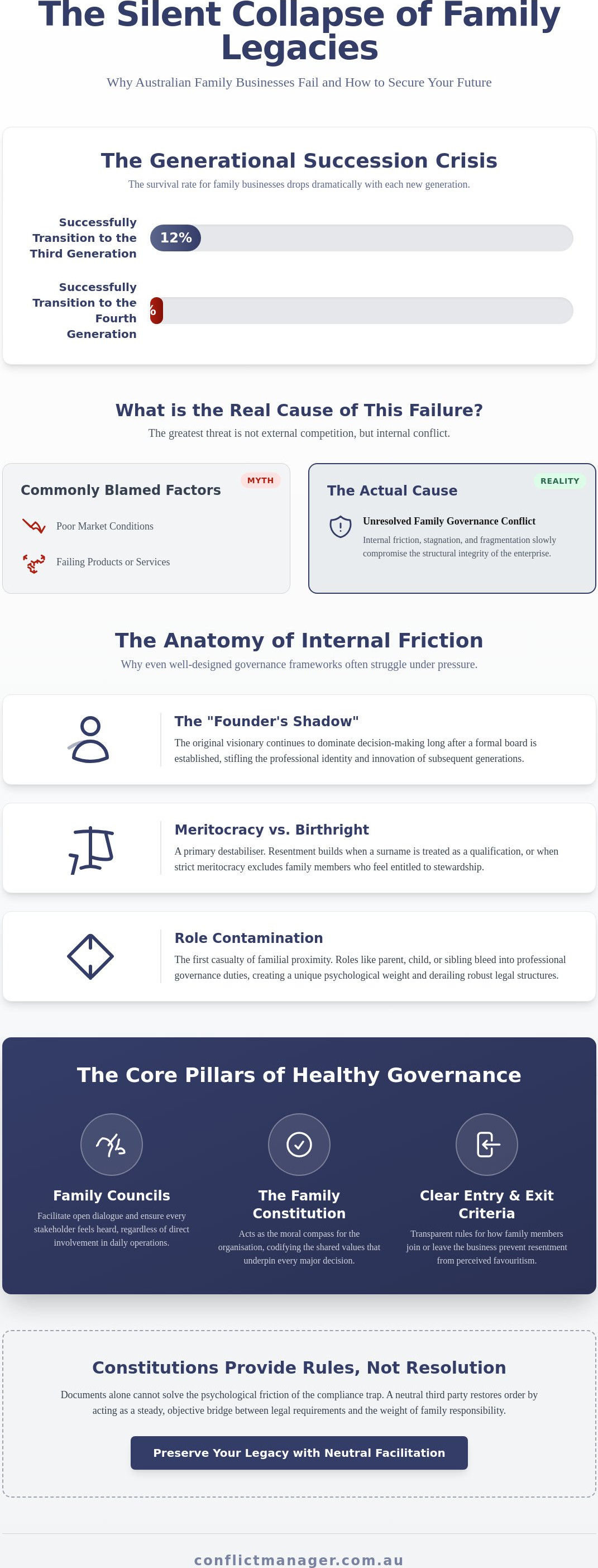
Only 12 per cent of family businesses successfully transition to the third generation; a figure that collapses to a mere 3 per cent by the fourth. This attrition is rarely a byproduct of poor market conditions or failing products. Instead, it is often driven by unresolved family governance conflict that slowly compromises the structural integrity of the enterprise. Friction. Stagnation. Fragmentation. These are the silent costs of internal tension that transform productive boardrooms into arenas for circular arguments.
It's exhausting to watch formal constitutions be ignored when personal histories collide with commercial realities. You likely feel the weight of a legacy that seems increasingly fragile under the pressure of internal bickering. We'll show you how to move toward a governance structure that actually manages human emotion and establishes clear boundaries between family roles and business duties. By the end of this guide, you'll have a roadmap to return to calm, objective decision-making that preserves your family's hard-earned success for the next generation.
Key Takeaways
- Understand why structural frameworks alone cannot manage the complex human sentiments inherent in the Australian family office landscape.
- Identify how the "Founder’s Shadow" and the tension between meritocracy and birthright frequently ignite a family governance conflict.
- Recognise the limitations of formal constitutions; these documents provide the rules, but they cannot solve the psychological friction of the compliance trap.
- Adopt proactive strategies like neutral facilitation and scheduled family health checks to identify and resolve tension before it escalates into a dispute.
- Discover how a neutral third party can restore order by acting as a steady, objective bridge between legal requirements and the weight of family responsibility.
The Intersection of Structure and Sentiment: Understanding Family Governance Conflict
Governance is often misunderstood as a mere collection of legal documents or restrictive rules. In reality, it is the architecture of harmony. It provides the framework for collective decision-making and ensures that wealth preservation remains a shared objective rather than a source of individual competition. However, even the most meticulously designed systems can falter. When personal aspirations diverge from the collective vision, a family governance conflict often emerges, threatening the structural integrity of the entire enterprise.
The Australian context presents a unique set of challenges for the modern family office. Here, private wealth and public responsibility frequently collide. High-net-worth families often find themselves managing significant commercial assets while under the scrutiny of a transparent regulatory environment. This pressure makes conflict an almost inevitable byproduct of multi-generational growth. As new members enter the fold, their priorities naturally evolve. The challenge isn't to eliminate this tension, but to distinguish between healthy friction, which fosters innovation, and destructive disputes, which lead to fragmentation.
Many family businesses fail to recognise that governance itself can become a flashpoint if it's perceived as a tool for control rather than a platform for collaboration. True resolution requires a steady, objective perspective that acknowledges the weight of the past while planning for the future.
The Core Pillars of Family Governance in Australia
To maintain order, a family must establish clear mechanisms for communication and oversight. These structures act as the stabilizers for the family's commercial interests. Key components include:
- Family Councils: These bodies facilitate open dialogue and ensure that every stakeholder feels heard, regardless of their direct involvement in daily operations.
- The Family Constitution: More than a legal contract, this document serves as the moral compass for the organisation, codifying the values that underpin every major decision.
- Entry and Exit Criteria: Establishing transparent rules for how family members join or leave the business prevents the resentment that stems from perceived favouritism or trapped capital.
The Emotional Tax of Governance
Professionalism is often the first casualty of familial proximity. It's common for roles like parent, child, or sibling to contaminate professional governance duties. This role confusion creates a unique psychological weight. Successors often carry a profound fear of being the generation that loses the legacy, which can lead to risk-aversion or defensive decision-making. Emotional baggage, often decades in the making, can derail even the most robust legal structure. Without a strategy to manage this family governance conflict, the internal friction will eventually compromise the external success of the business.
The Anatomy of Friction: Why Governance Frameworks Often Struggle Under Pressure
The most sophisticated frameworks often fail because they ignore the invisible currents of human emotion. While the structural components of family governance provide a necessary skeleton, they lack the flexibility to absorb the shock of personal evolution. Friction doesn't usually arise from a lack of rules. It stems from the "Founder’s Shadow," where the original visionary continues to dominate decision-making long after a formal board has been established. This creates a persistent family governance conflict as second and third-generation members struggle to assert their own professional identities against a legacy that feels immutable.
The tension between meritocracy and birthright remains a primary destabiliser. When a surname is treated as a qualification, the professional integrity of the family office is compromised. Conversely, when strict meritocracy excludes family members who feel entitled to stewardship, the resulting resentment can simmer for decades. This is often exacerbated by "informal governance," where critical strategic shifts are decided over a Sunday roast rather than in a minuted meeting. Such back-channel communication erodes trust. It makes formal structures feel like a performance rather than a process. Engaging an objective expert for stakeholder facilitation can help bridge these generational gaps before they become irreconcilable.
The Multi-Generational Divide
Different generations rarely share the same appetite for risk or the same vision for wealth preservation. Wealth Creators (G1) are often defined by their frugality and entrepreneurial drive, while Wealth Stewards (G2 and G3) may prioritise ESG principles, philanthropy, or digital transformation. Bridging the communication gap between Baby Boomers and Millennials requires more than just a meeting. It requires a shared language. Without this, family governance conflict becomes the default state as each generation perceives the other’s priorities as a threat to the family’s long-term stability.
Structural Weaknesses and Governance Gaps
Crises reveal the cracks in a family constitution. A document that is too vague provides no guidance during a contested divorce or a sudden death, while one that is too rigid can stifle necessary adaptation. The entry of "silent stakeholders," such as spouses or non-active family members, often fuels friction if their roles aren't clearly defined. A lack of transparency in decision-making creates a vacuum that is inevitably filled by suspicion and resentment. When information is hoarded or logic is obscured, the governance structure ceases to function as a tool for unity and instead becomes a source of division.
The Limitation of the Document: Why Constitutions Alone Cannot Resolve Deep-Seated Disputes
A common misconception within the Australian business landscape is that a well-drafted constitution acts as a panacea for internal strife. While these documents establish the rules of engagement, they are ultimately static. They lack the capacity to address the fluid, often volatile nature of human emotion. Friction. Resentment. Silence. These are the precursors to a breakdown that no legal clause can prevent. A family governance conflict often thrives in the gaps between what is written and what is felt, requiring more than a signature to resolve.
Many families fall into the "compliance vs. commitment" trap. They tick the boxes and follow the rules, but the underlying bitterness remains unaddressed. This is why "living governance" is so critical. It moves beyond the family governance components that define roles and instead focuses on the quality of the interactions between those roles. Governance must be an active process. It’s the "how" of communication, not just the "what" of the rules. When the focus stays on the document rather than the dialogue, the legacy is already at risk.
Legal Logic vs. Emotional Reality
Lawyers are trained to find a resolution through the lens of rights and obligations. In the context of a family dispute, "winning" often involves proving a point or securing an asset through superior legal logic. However, a victory in the boardroom can lead to a permanent loss at the dinner table. There is a fundamental difference between legal mediation and holistic conflict facilitation. Choosing a family lawyer to facilitate an emotional dispute is a frequent error; their tools are designed for the finality of combat, not for the delicate, ongoing restoration of trust.
The Risk of Litigation
Unresolved friction inevitably moves toward the public theatre of the Australian court system. Litigation is costly, not just in financial terms, but in reputational capital. In a tightly knit business community, a public family feud can erode the trust of partners, lenders, and employees. The "Quiet Path" of mediation offers a superior alternative. It allows for the resolution of a family governance conflict behind closed doors, preserving the dignity of the family while restoring the stability of the enterprise. Restoration, not retribution, should be the ultimate goal of any external intervention.
Cultivating Clarity: Strategic Approaches to De-escalating Governance Friction
Proactive management is the only sustainable antidote to systemic tension. While many families wait for a crisis to erupt before seeking help, the most resilient enterprises treat family governance conflict as a manageable risk rather than an inevitable disaster. Shifting from a reactive stance to a structured, de-escalation framework requires a commitment to transparency. It involves moving beyond the "what" of the rules and into the "how" of professional interaction. By establishing a cadence for regular "Family Health Checks," stakeholders can identify simmering friction before it hardens into a permanent dispute.
Clarity begins with the "Separation of Concerns." This framework demands a rigorous distinction between three often-blurred domains: family, ownership, and management. Conflict frequently arises when the emotional needs of the family unit bleed into the capital requirements of ownership or the operational demands of management. When a sibling’s personal grievance dictates a boardroom vote, the structure has failed. Implementing transparent communication protocols ensures every stakeholder feels heard, regardless of their shareholding percentage, creating an environment where objective logic can prevail over historical sentiment.
The Role of the Neutral Facilitator
Objectivity. Distance. Calm. An external party brings a level of perspective that is impossible to achieve from within the family circle. Through "shuttle diplomacy," a facilitator can engage with individual family members privately to understand their underlying concerns without the pressure of a group setting. The facilitator serves as the steady hand that allows stakeholders to view volatile situations with clarity, ensuring that the weight of the past does not dictate the trajectory of the future. This process de-identifies the problem, moving the focus from "who is wrong" to "what is the solution."
Practical Tools for Dispute De-escalation
Effective governance requires a toolkit of specific, repeatable actions. Interest-based negotiation is particularly effective in a family office setting; it encourages members to look past their rigid "positions" on investment strategies to find the shared "interests" that unite them. Another powerful mechanism is the "Pause and Reflect" period. By mandating a forty-eight-hour cooling-off period before finalising a contentious vote, the board allows emotional spikes to subside, ensuring decisions are made with composure rather than impulse. Training family members in basic conflict literacy further improves boardroom dynamics, turning potentially destructive arguments into productive debates. If your internal discussions have become circular or stagnant, engaging professional stakeholder facilitation can provide the external structure needed to restore order.
The Neutral Third Party: Restoring Stability to the Family Office Ecosystem
Internal attempts to resolve a family governance conflict often reach a point of diminishing returns. When the same arguments recur during board meetings, the issue isn't usually a lack of effort; it's a lack of distance. Conflict Manager acts as the specialist who bridges the gap between rigid legal structures and the fluid reality of human emotion. Our approach is composed, objective, and deeply empathetic. We provide the steady hand necessary to navigate volatile situations, ensuring that the weight of responsibility is acknowledged without becoming entangled in the friction of interpersonal dynamics. By acting as a neutral third party, we bring a level of total objectivity that internal stakeholders, no matter how well-intentioned, simply cannot maintain.
Achieving Sustainable Outcomes
A temporary truce is not a resolution. True success involves moving toward long-term structural and relational stability that can withstand future pressures. For an Australian family office, preserving the "Family Brand" is paramount. This requires a discreet, private resolution process that keeps internal matters out of the public eye. Conflict Manager facilitates clarity during high-stakes transitions, such as the CEO successions anticipated by 78 per cent of family businesses within the next decade. By focusing on sustainable outcomes, we ensure that the resolution of a family governance conflict actually strengthens the legacy rather than merely silencing the argument. We look beyond the immediate dispute to identify the underlying structural weaknesses that allowed the friction to manifest in the first place.
Next Steps for the Family Office
Engaging an external specialist begins with a single, confidential conversation. During this initial stage, the focus remains on listening and mapping the unique dynamics of your family ecosystem. You can expect a process that is methodical and logical, designed to lower the emotional temperature of the room. Preparing the family for a facilitated governance review involves framing the intervention as a strategic investment in the future. It's not an admission of failure. Instead, it's a commitment to the professionalisation of the family office. We invite you to consider an external audit of your current governance friction to identify where structural gaps may be inviting unnecessary tension. To begin this process, you may enquire about our bespoke family office mediation services to restore order and stability to your organisation.
Securing the Future of the Family Enterprise
Order. Continuity. Resilience. Preserving an intergenerational legacy requires more than a rigid family constitution; it demands a commitment to managing the human dynamics that underpin every commercial decision. We've explored how a family governance conflict often stems from the intersection of deep-seated sentiment and structural gaps. While formal documents provide a necessary foundation, they cannot replace the clarity that comes from professional de-escalation and transparent communication.
True stability is achieved when the family moves from a state of reactive friction to one of proactive stewardship. Conflict Manager specialises in expert-led mediation for high-net-worth families, providing discreet and objective facilitation for complex Australian organisations. We understand the specific pressures of multi-generational wealth transfers and the weight of responsibility that comes with them. Restore clarity to your family governance—speak with a Conflict Manager specialist today. Your legacy is too valuable to be left to chance; a structured resolution is the surest path to enduring harmony.
Frequently Asked Questions
What is the most common cause of family governance conflict in Australia?
Role confusion. Identity. Power. The most frequent trigger for family governance conflict in Australia is the blurring of boundaries between familial roles and commercial responsibilities. When a sibling’s position on a board is dictated by birthright rather than merit, the structural integrity of the enterprise is compromised. This lack of role clarity often leads to perceived favouritism and deep-seated resentment that no amount of commercial success can fully mask.
Can a family constitution really prevent disputes between siblings?
A family constitution provides the rules of engagement, but it cannot resolve the psychological friction of a deep-seated dispute. It acts as a moral compass rather than a cure. While these documents are essential for establishing a framework, they require active, "living governance" and professional facilitation to remain effective over time. Without a genuine commitment to the process, a constitution is merely a static piece of paper that lacks the breath of human agreement.
How does a neutral mediator differ from our family lawyer?
A family lawyer focuses on legal rights and obligations, which often leads to a "win-lose" outcome that can fracture a family permanently. In contrast, a neutral facilitator focuses on interest-based negotiation and relational stability. We bridge the gap between legal structure and human emotion. This approach prioritises the restoration of trust and the preservation of the family brand over proving legal points in a boardroom or a courtroom.
What should we do if one family member refuses to participate in mediation?
Participation shouldn't be forced, but it can be encouraged through individual stakeholder facilitation. We often begin by meeting with family members privately to understand their specific concerns and build trust in the process. This "shuttle diplomacy" allows for a safe space where a reluctant member can be heard without the pressure of a group setting. Often, resistance is a byproduct of fear rather than a lack of desire for a peaceful resolution.
Is it possible to resolve a dispute that has been going on for years?
Yes, even multi-generational disputes can be resolved by shifting the focus from historical grievances toward future structural integrity. Resolution. Restoration. Stability. By de-identifying the problem and moving away from circular arguments, we help families break the cycle of stagnation. This requires an objective perspective that can view the situation without becoming emotionally entangled in the family's past or the weight of their current responsibilities.
How much does professional conflict resolution typically cost for a family office?
The cost of professional conflict resolution varies depending on the complexity of the family office structure and the duration of the engagement. While it's an investment in the long-term stability of the legacy, it is generally far less expensive than the financial and reputational costs of public litigation. Families should view these services as a strategic expense designed to protect their most valuable assets and their intergenerational harmony from fragmentation.
What is the first step to take when a governance board meeting becomes hostile?
The first step is to immediately adjourn the meeting and implement a mandatory "Pause and Reflect" period. Hostility. Impulse. Fragmentation. When emotional spikes occur, objective decision-making becomes impossible. Taking a temporary break allows the pulse of the room to lower and prevents stakeholders from taking rigid positions that they may later regret. This pause creates the necessary space for a neutral facilitator to step in and restore order.
How do we maintain privacy during a high-stakes family dispute?
Privacy is best maintained by avoiding the public theatre of the Australian court system. Litigation is a matter of public record, which can expose private family matters to lenders, partners, and the media. Using discreet, private facilitation ensures that a family governance conflict is resolved behind closed doors. This "Quiet Path" protects the family's dignity and ensures that the internal dynamics of the family office remain confidential and secure.


