

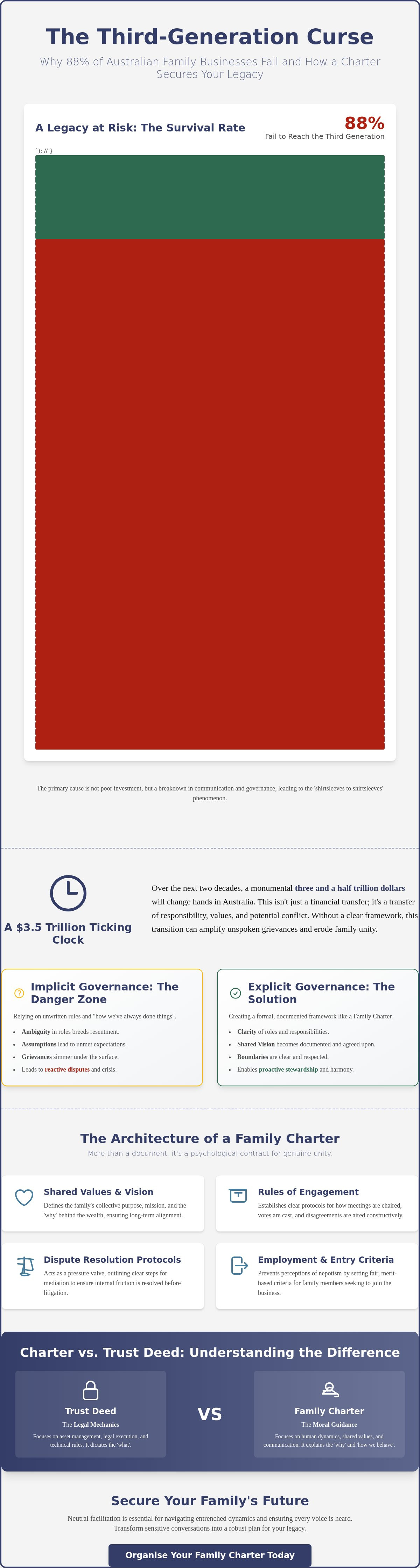
Eighty-eight per cent of Australian family businesses fail to reach the third generation. Legacy. Stability. Continuity. These concepts often dissolve under the pressure of unspoken grievances and the complex weight of a three and a half trillion dollar intergenerational wealth transfer. You likely recognise the subtle shift when dinner table conversations begin to feel like board meetings, or when the fear of wealth depletion starts to overshadow your original vision. Implementing a family charter for conflict prevention provides the necessary structural anchor to navigate these transitions. It allows you to move beyond the third-generation curse by establishing clear boundaries before friction becomes a crisis.
You understand that wealth is as much about psychological health as it is about asset management. This article explores how a formalised charter mitigates intergenerational conflict and clarifies roles within your family office. We will outline the process of transforming implicit expectations into an explicit governance framework, ensuring your family legacy remains intact through the coming decades of change.
Key Takeaways
- Understand why seventy per cent of family businesses fail to reach the second generation and how a charter provides a reliable structural anchor.
- Learn how to organise a family charter for conflict prevention by defining shared values and establishing clear rules of engagement for decision-making.
- Identify the vital distinction between the legal mechanics of a trust deed and the moral guidance offered by a well-crafted charter.
- Explore why neutral facilitation is essential for navigating entrenched power dynamics during the sensitive discovery and implementation phases.
Navigating Intergenerational Wealth Conflict in the Australian Family Office
Australia is witnessing a monumental shift in capital. Over three and a half trillion dollars will change hands over the next two decades. This movement creates a unique friction. Intergenerational wealth conflict isn't merely a dispute over numbers. It's the tension between the preservation of a hard-won legacy and the evolving aspirations of individual heirs. While trust deeds and shareholder agreements provide a technical framework, they often fail to address the underlying emotional and psychological currents that drive family disputes. A family charter for conflict prevention serves as the primary tool for managing these human dynamics before they escalate into litigation.
Traditional legal structures are designed for execution, not resolution. They dictate what happens to an asset, but they rarely explain why or how the family should behave during the process. This gap is where most disputes take root. As the Australian family office landscape becomes increasingly complex, the need for a structural anchor becomes undeniable. Proactive intervention is the only way to ensure that the transition of wealth doesn't become the catalyst for the dissolution of the family unit.
The 'Third-Generation' Risk and Asset Integrity
Data suggests that 88 per cent of Australian family businesses do not survive to the third generation. We often see the 'shirtsleeves to shirtsleeves' phenomenon, where wealth created by the first generation is dissipated by the third. This depletion rarely stems from poor investment choices. Instead, it's a symptom of communication breakdown. Friction points usually emerge around succession timing, the frequency of distributions, and the philanthropic direction of the family office. Without a clear agreement, these tensions erode the structural integrity of the estate. A family charter for conflict prevention provides the clarity needed to protect the collective interest from individual discord.
Implicit vs. Explicit Governance
Many families rely on implicit governance. This is the "how we've always done it" approach. It relies on unwritten rules and historical patterns. Ambiguity in roles breeds resentment. When expectations aren't voiced, they become assumptions. When assumptions aren't met, they become grievances. An explicit governance framework brings clarity to clouded interpersonal dynamics. By implementing a Family Constitution and a Family Council, families can transition from reactive disputes to proactive stewardship. This process transforms silent expectations into a shared, documented vision that protects both the assets and the relationships. It's about moving from a state of uncertainty toward a structured, sustainable future.
The Architecture of a Family Charter: Beyond Governance to Genuine Unity
A robust charter is more than a list of rules. It's a psychological contract. Purpose. Alignment. Direction. These elements form the foundation of a family charter for conflict prevention, ensuring that every stakeholder understands the collective intent behind the wealth. When drafting the components of family governance, the focus must shift from mere asset protection to the preservation of relational harmony. A well-constructed document serves as a mirror, reflecting the family's shared identity while providing the structural integrity needed to survive the pressures of growth and transition.
Establishing 'Rules of Engagement' provides a structured path for communication. These protocols define how family meetings are chaired, how votes are cast, and how disagreements are aired without damaging the family fabric. By setting these standards early, you remove the emotional volatility that often derails high-stakes discussions. This framework ensures that even the most difficult conversations are conducted with a sense of order and mutual respect, allowing the family to navigate friction without falling into dysfunction.
Protocols for dispute resolution act as a necessary pressure valve. They outline clear steps for mediation, ensuring that internal friction is addressed before it necessitates external litigation. Similarly, defining entry criteria for family members seeking employment prevents the perception of nepotism or entitlement. This clarity protects the business's operational integrity and the family's internal sense of fairness, fostering an environment where merit and legacy coexist. Clear boundaries ensure that roles are based on capability rather than birthright.
Codifying Family Values and Mission
Starting with a shared 'why' reduces the defensive posturing often seen in wealth discussions. When you identify values that transcend financial interests, such as stewardship or community impact, you create a common ground that feels safe for all generations. The mission statement serves as the North Star for all future family decisions, providing a consistent reference point when difficult choices arise. This alignment ensures that the family's wealth remains a tool for their collective vision rather than a source of division.
Defining Roles and Responsibilities
Confusion over authority is a primary driver of resentment. It's essential to distinguish between family ownership, board representation, and management roles. Active stakeholders who manage daily operations have different perspectives from passive shareholders who primarily seek capital growth. Setting firm boundaries between family life and business operations ensures that the stress of the boardroom doesn't spill over into the family home. If you find these dynamics becoming increasingly difficult to navigate, seeking professional stakeholder facilitation can help restore balance and clarity.
Family Charter vs. Trust Deeds: Understanding the Structural Differences
Legality. Mechanics. Enforcement. These are the foundational pillars of a trust deed, yet they represent only a fraction of a family's governance needs. While a trust deed is a rigid instrument designed to satisfy regulatory requirements and legal mandates, a family charter for conflict prevention operates as a morally persuasive anchor. It defines the "why" behind the "how." By establishing a clear sense of purpose, the charter guides the execution of legal documents, ensuring that the technical management of assets remains aligned with the family's core values.
A charter offers a level of flexibility that traditional legal structures simply cannot match. Trust deeds are often difficult and costly to amend, frequently requiring court intervention or complex resolutions. In contrast, a charter is an adaptive framework that can evolve alongside the family. It bridges the gap between soft governance, which focuses on relationships and culture, and hard governance, which deals with contracts and compliance. This synergy creates a comprehensive system where the spirit of the family's intent is protected as fiercely as the assets themselves. It's a method of ensuring that the family's vision isn't lost within the dense language of a trust deed.
The Moral Contract: Why Non-Binding Works
The psychological power of a written "handshake" agreement shouldn't be underestimated. Even though a charter isn't typically legally binding in an Australian court, its moral weight is significant. It builds social capital within the family unit by fostering trust and mutual accountability. When friction arises, the charter provides internal remedies that allow the family to resolve issues without immediately resorting to legal counsel. This internal resolution process preserves both wealth and relationships, preventing the public and emotional fallout of litigation. It's about creating a culture where the family's word to one another is the ultimate authority.
Integrating the Charter with Existing Legal Frameworks
Structural integrity requires that your charter and your legal documents speak the same language. It's vital to ensure the charter doesn't contradict Australian trust law or specific corporate regulations, particularly as tax landscapes shift with new measures like the 30 per cent minimum tax on discretionary trusts starting in 2028. The charter should serve as a preamble to more formal documents, such as shareholder agreements or buy-sell arrangements. By reviewing your existing legal framework to reflect the spirit of the charter, you create a seamless transition from family values to business operations. This alignment ensures that every legal action taken by the family office is grounded in a shared, documented consensus.
The Facilitation Journey: How to Organise and Implement Your Charter
Implementation is a methodical progression. It requires patience. Objectivity. Commitment. Developing a family charter for conflict prevention begins with the initial assembly. This gathering should occur in a neutral environment, far from the familiar triggers of the family home or the corporate office. By removing the physical cues of established power dynamics, you create a space where stakeholders can transition from their day-to-day roles into their identities as stewards of a shared legacy. This shift in environment is the first step toward building a new, collaborative culture.
The discovery phase follows this initial meeting. It involves private, confidential interviews with each family member. In these one-on-one settings, individuals often reveal concerns they would never voice in a group setting. These sessions uncover the implicit tensions that threaten stability. Once these perspectives are gathered, the drafting process begins. This is an iterative journey. It moves through multiple versions, ensuring that every voice is reflected in the final text. Ratification only occurs when there is genuine consensus, transforming the document into a living philosophy that the family genuinely owns.
Managing High-Emotion Situations During Drafting
High-stakes discussions often unearth historical grievances. These emotional echoes can derail the most logical governance plans. De-escalating these moments requires a focus on the future rather than a litany of past errors. When an outlier family member resists formalisation, it's often because they fear a loss of autonomy or see the process as unnecessary corporate interference. Addressing these fears directly by highlighting the risks of ambiguity, such as the potential for future litigation, usually brings them back to the table. Using precise punctuation and clear sentence structures helps clarify nuanced points of view during heated debates, ensuring that the intent of each speaker is accurately captured without further inflammatory language.
Best Practices for Sustainable Implementation
The process of creating the charter is often more valuable than the physical document. The conversations held, the compromises made, and the shared vision discovered during facilitation build a foundation of trust. To ensure the charter remains effective, many families establish a Family Council. This body oversees the application of the charter and ensures that decisions remain aligned with the agreed-upon values. Setting a cadence for biennial reviews is also essential. This regular review cycle keeps the document relevant as new generations enter the family office and as the Australian economic landscape shifts. If your family is struggling to begin this journey, professional stakeholder facilitation provides the objective oversight needed to navigate these complex transitions.
Securing the Legacy: The Role of Professional Mediation in Charter Development
Internal attempts to draft a governance framework often encounter a predictable ceiling. History. Hierarchy. Habits. These entrenched dynamics make it nearly impossible for a family member to act as a truly neutral facilitator. When the person leading the discussion has a vested interest in the outcome, objectivity vanishes. A family charter for conflict prevention requires a steady, external hand to navigate these sensitive transitions. Without this distance, the process risks becoming another theatre for old grievances rather than a path to structural stability. Conflict Manager acts as this steady hand, providing the composure needed to lead families through high-stakes environments.
Professional facilitation ensures that the loudest voice doesn't dictate the family's future. In many high-wealth environments, power is concentrated in the hands of the founders or the most active business leaders. This concentration can inadvertently silence younger generations or passive stakeholders, leading to a document that lacks genuine buy-in. An external expert acts as a neutral third party, bringing total objectivity to volatile situations. They ensure that the governance framework reflects a collective consensus rather than a top-down mandate, protecting the integrity of both the business and the family unit.
The Benefit of External Objectivity
An expert mediator identifies communication blind spots that family members are often too close to see. They act as a vital buffer during high-emotion business disputes, allowing stakeholders to express frustration without causing permanent relational damage. This approach ensures a fair go for everyone involved. Regardless of their position in the family hierarchy, each individual is given the space to articulate their vision for the legacy. This inclusivity is what transforms a simple document into a resilient psychological anchor, ensuring that the charter resonates with every generation.
Achieving Sustainable Resolution Outcomes
The goal is to move from a temporary truce to a permanent, structured resolution. Proactive governance through a family charter for conflict prevention significantly reduces the long-term cost of friction, both financially and emotionally. By addressing the root causes of tension early, families avoid the significant costs associated with protracted litigation and the depletion of social capital. It's about securing a future where the family remains unified and the assets remain intact through a methodical, logical progression. If you are ready to begin this process, you can Contact Conflict Manager to facilitate your family's path to clarity.
Establishing a Sustainable Legacy
Order. Clarity. Resilience. These are the markers of a family that has successfully transitioned from implicit tension to explicit governance. By implementing a family charter for conflict prevention, you provide your family office with a structural anchor that survives the complexities of a multi-generational wealth transfer. This process ensures that shared values, rather than individual grievances, dictate the movement of your estate. It's a shift from reactive dispute management to proactive stewardship that protects both assets and relationships.
Expert mediation remains the most effective way to navigate the psychological and structural friction inherent in high-stakes environments. At Conflict Manager, we provide the composed, neutral third-party facilitation required to identify communication blind spots and build genuine consensus. Our deep expertise in high-net-worth family office mediation ensures that your legacy is preserved through sustainable, long-term outcomes. Secure your family's future with expert mediation and charter facilitation. You've worked hard to build your legacy; we provide the steady hand to ensure it endures for generations to come.
Frequently Asked Questions
Is a family charter legally binding in Australia?
A family charter is typically a non-binding moral agreement rather than a legal contract enforceable in Australian courts. It serves as a statement of intent that guides the interpretation of legal documents like trust deeds or shareholder agreements. While it lacks the technical enforcement of a contract, its power lies in the psychological commitment and social capital built during the drafting process.
How long does it take to draft a comprehensive family constitution?
The timeline for drafting a comprehensive constitution usually spans six to twelve months. This duration allows for the necessary discovery phase, individual interviews, and iterative drafting sessions required for genuine consensus. Rushing the process often undermines the document's effectiveness because stakeholders need time to process complex emotional and structural shifts in a stable environment.
What happens if a family member refuses to sign the charter?
If a family member refuses to sign, it's essential to address their underlying concerns through professional facilitation rather than coercion. Often, resistance stems from a fear of losing autonomy or a misunderstanding of the charter's purpose. Excluding a member can create future friction; therefore, the focus remains on finding a middle ground where their voice is heard without compromising the collective stability.
Can a family charter help with succession planning in a family business?
A family charter for conflict prevention is a vital tool for succession planning because it establishes clear criteria for family members entering the business. It defines leadership transition protocols and outlines the roles of active versus passive stakeholders. By codifying these rules early, you prevent the ambiguity that often leads to disputes during a change in leadership.
How often should our family review and update the charter?
Families should ideally review their charter every two to three years to ensure it remains a living document. Regular reviews ensure the framework remains relevant as new generations reach maturity or as the family's financial landscape changes. Major life events, such as a marriage or the sale of a significant asset, should also trigger a review to maintain alignment with current realities.
What is the difference between a family council and a family office?
A family council focuses on governance and relational harmony, while a family office manages the family's wealth and administrative needs. The council is the forum where the family discusses values, vision, and the application of the charter. In contrast, the family office is the operational entity that executes investment strategies and handles day-to-day financial management tasks.
How much does professional facilitation for a family charter cost?
The cost of professional facilitation varies based on the complexity of the family structure and the number of stakeholders involved. Fees typically reflect the level of expertise required to navigate high-stakes interpersonal dynamics and the duration of the engagement. You should consider this an investment in the structural integrity and long-term harmony of your family's legacy.
Can a charter prevent inheritance disputes after a principal passes away?
While a charter cannot legally prevent a challenge to a will, it significantly reduces the risk of disputes by clarifying the principal's intent. When heirs have already agreed to the principles of stewardship within a family charter for conflict prevention, they are less likely to pursue litigation. It provides a moral framework that encourages internal resolution over the high emotional and financial costs of legal battles.


