

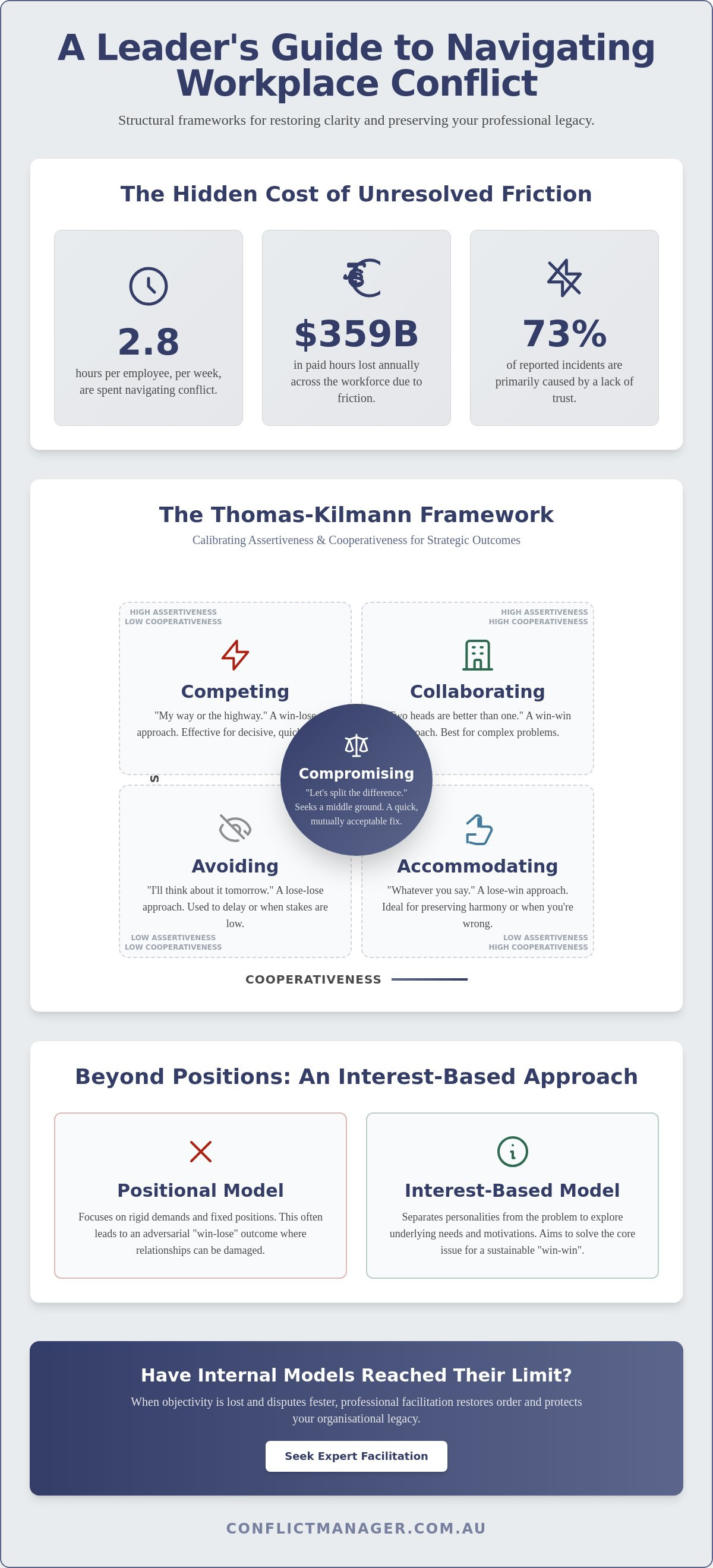
Data from April 2026 reveals that employees spend an average of 2.8 hours every week navigating professional friction, a drain on time that frequently compromises organisational momentum. Friction. Attrition. Instability. These pressures often manifest as tangible drains on your company's resources and emotional capital, leaving even the most seasoned leaders feeling entangled in disputes that seem to have no clear exit. It's a heavy weight to bear, particularly when you're trying to maintain a sense of order amidst a shifting regulatory environment where previous certainties, such as federal harassment guidance, have been recently rescinded.
You likely recognise that internal efforts often struggle to remain objective when the stakes are high and the emotional ties are deep. This article promises to equip you with the structural frameworks required to navigate these high-stakes disputes and restore clarity to your team. We'll explore specific workplace conflict resolution models designed to align your leadership response with the structural gravity of the friction, providing a clear map for sustainable outcomes that preserve your professional legacy.
Key Takeaways
- Understand how workplace conflict resolution models serve as cognitive maps, providing the necessary distance to navigate structural friction with total objectivity.
- Master the Thomas-Kilmann framework to precisely calibrate your levels of assertiveness and cooperativeness based on the specific needs of the dispute.
- Learn to move beyond rigid positional demands by employing interest-based methods that separate individual personalities from the underlying professional problem.
- Discover how to apply these structural frameworks to preserve organisational stability during volatile transitions like mergers, restructuring, or leadership changes.
- Recognise the critical indicators that suggest internal efforts have reached their limit, signalling the need for professional stakeholder facilitation to restore order.
Understanding the Architecture of Workplace Conflict Resolution Models
Conflict. Friction. Disruption. These are the inevitable byproducts of ambitious people working toward complex goals. When professional friction arises, it often feels like a chaotic breakdown of the natural order. However, sophisticated workplace conflict resolution models serve as cognitive maps, providing a way to navigate interpersonal and structural tension with composure. These frameworks don't just solve problems. They provide a lens through which leaders can view volatile situations with total objectivity, moving from reactive emotionality to a vision of structured resolution.
Internal efforts to resolve disputes often falter because the participants are too close to the heat. When leadership is emotionally entangled, the perspective narrows. This narrowing makes it difficult to see the structural roots of the problem, leading to "organic" fixes that are often temporary and superficial. Without a formal model, the focus shifts from the problem to the person, which only serves to deepen the divide and erode the centre of the organisation.
The Cost of Unresolved Organisational Friction
Avoiding difficult conversations is a costly strategy. Data from April 2026 suggests that employees spend an average of 2.8 hours per week dealing with conflict. For a large enterprise, this translates into a staggering financial leak, contributing to an estimated $359 billion in paid hours lost annually across the workforce. Beyond the balance sheet, unresolved friction erodes stakeholder confidence and threatens asset integrity. When disputes fester, they damage the "centre" of a business or family office, creating a state of structural instability that can persist for years. According to research from January 2026, a lack of trust is the primary cause of this friction, accounting for 73% of reported incidents.
Why Models Matter in High-Stakes Environments
Frameworks provide a neutral language for all parties involved. By using established conflict management models, leaders can depersonalise the friction. This shift is essential during periods of significant change, such as mergers or succession planning. A model-driven approach ensures that decisions are based on logic and structural needs rather than temporary emotional states. It's about preserving professional legacies. By following a clear map, you ensure that the resolution is sustainable and that the organisation's integrity remains intact even after the immediate pressure has subsided. Effective workplace conflict resolution models don't just aim for a quick fix; they aim for a restoration of organisational clarity that can withstand future pressures.
The Thomas-Kilmann Framework: Navigating the Five Classic Styles
The Thomas-Kilmann Conflict Mode Instrument (TKI) stands as the industry standard for understanding how individuals engage with disagreement. Within the landscape of workplace conflict resolution models, it provides a sophisticated structure for categorising behaviour based on two primary psychological drivers: assertiveness and cooperativeness. Assertiveness measures the extent to which an individual attempts to satisfy their own concerns, while cooperativeness measures the attempt to satisfy the concerns of others. This tension between self and other creates a grid where leadership styles are not just personal preferences; they are strategic choices.
Assertiveness vs. Cooperativeness: The Strategic Balance
High-stakes environments, such as those undergoing rapid AI adoption or facing the scrutiny of the new 2025-2029 EEOC National Enforcement Plan, often skew leadership balances toward a "Competing" mode. This drive for self-preservation is a natural response to perceived structural instability. The TKI framework is a tool for identifying default behavioural patterns in leadership. By recognising these defaults, a leader can consciously shift their position on the grid to suit the specific gravity of the dispute. Understanding this balance is central to effective organisational conflict management, ensuring that internal friction doesn't lead to permanent structural damage.
When to Deploy Each Mode in a Business Context
Competitors often claim that "Collaborating" is the only valid goal. This perspective oversimplifies the reality of executive responsibility. While the "Collaborating" mode is ideal for complex issues where both parties' concerns are too important to be compromised, it requires a significant investment of time and emotional energy. In contrast, "Accommodating" can be a powerful tool for preserving a long-term alliance when the issue at hand is more important to the other party than it is to you. It's a calculated move that builds social capital for future high-gravity disputes.
Similarly, "Avoiding" is often maligned, yet it serves a vital purpose for trivial issues or when the potential for disruption outweighs the benefits of resolution. This strategic withdrawal allows leaders to preserve their energy for more substantial friction. Moving toward an Interest-Based Relational (IBR) approach involves knowing which mode to inhabit at any given moment. Effectiveness isn't about being "nice"; it's about being situational. Whether you're "Compromising" to find a middle ground or "Competing" to protect a vital business principle, the choice must be deliberate and aligned with the organisation's long-term health.
Interest-Based Relational (IBR) vs. Positional Models
Understanding your default mode is only the first step. To effectively utilise workplace conflict resolution models, one must master the distinction between interest-based and positional approaches. Interest-Based Relational (IBR) resolution is a methodology designed to separate people from the problem. It acknowledges that while the issue may be structural, the participants are human. By focusing on underlying interests rather than surface-level demands, leaders can maintain the integrity of professional relationships while dismantling the friction that threatens organisational stability.
While the Thomas-Kilmann Conflict Mode Instrument helps identify your behavioural tendencies, IBR provides the tactical framework for the dialogue itself. It shifts the focus from winning a point to solving a problem. This transition is essential when internal efforts begin to falter under the weight of high-emotion disputes, as it provides a neutral ground where logic can prevail over reactivity.
The IBR Approach: Separating Emotion from Structure
Execution. Clarity. Respect. The IBR approach follows a methodical sequence that begins by ensuring the relationship remains the priority. It demands that leaders keep people and problems separate, listening to all perspectives before exploring collaborative options. This process requires a specific brand of quiet confidence. It's the ability to remain unruffled in a heated boardroom while guiding others toward objective facts. IBR is defined as a conflict resolution framework that prioritises mutual respect and the preservation of professional relationships over the pursuit of a tactical or ego-driven victory. By adhering to these steps, leaders foster an environment of psychological safety, which is particularly vital in multi-generational family offices where the lines between professional and personal are frequently blurred.
Positional Bargaining: The Risks to Family Wealth
Positional bargaining represents the antithesis of this structured clarity. In this model, parties dig into rigid, often arbitrary demands. It's a zero-sum game where one person's gain is perceived as another's loss. This rigidity is exceptionally dangerous in high-stakes environments like succession planning or major asset transfers. When negotiations become ego-driven, the result is often litigation, asset fragmentation, and the erosion of long-term family wealth. Data from January 2026 suggests that poor communication accounts for 52% of conflict incidents, a figure that rises when parties refuse to look past their own positions. Moving toward interests is not a sign of weakness. It's the only logical path to a sustainable outcome that preserves both the capital and the professional legacy of the stakeholders involved.
Aligning Models to Organisational Structural Change
Pressure. Transition. Ambiguity. These are the inevitable characteristics of significant organisational change. Whether you're navigating a merger, a complex succession, or a total restructuring, the strain on interpersonal dynamics is often the first point of failure. During these periods, organisational conflict management serves as a foundational pillar rather than an optional extra. It provides the steady hand required to maintain stability when the ground beneath the leadership team begins to shift.
A common objection from executive stakeholders is that standard workplace conflict resolution models cannot account for their "unique" family dynamics or specific corporate culture. This perspective is understandable but often misguided. The bespoke nature of a family office or a private enterprise does not exempt it from the laws of human friction. In fact, the more complex the human layer, the more necessary a structural framework becomes to prevent emotional entanglement from damaging the business's core assets.
Step-by-Step Implementation for Composed Leaders
Success in high-stakes environments requires a methodical approach. First, you must diagnose the structural gravity of the dispute. Is this a temporary role clash, or does it represent a fundamental threat to the organisation's integrity? Second, select the appropriate model. You might lean on the behavioural insights of the TKI framework or the relational focus of IBR. Third, establish neutral ground. This involves creating a psychological and physical space where logic can breathe. When communicating these frameworks to stakeholders, avoid academic jargon. Instead, use clear, objective terminology that describes the movement toward a shared vision. A measured pace in your delivery helps clarify nuanced points, ensuring every party feels the weight of the process without feeling overwhelmed by it.
Managing High-Emotion Variables
When the pulse in the boardroom rises, the capacity for rational decision-making falls. Composed leaders use models to depersonalise critiques of business performance. Instead of saying a partner has failed, the framework allows you to state that the current process is not meeting the organisation's stated objectives. This subtle shift in language preserves individual dignity while addressing the structural flaw. It lowers the emotional temperature and refocuses the energy on resolution. If your internal efforts are struggling to maintain this distance, facilitating difficult conversations at work through an external expert can provide the total objectivity required to break a deadlock. Ready to stabilise your leadership team? Explore our approach to organisational conflict management today.
Strategic Facilitation: When Internal Models Reach Their Limit
Expertise. Distance. Objectivity. Even the most robust workplace conflict resolution models have an upper limit when the friction involves high-gravity structural disputes or multi-generational family dynamics. While these frameworks provide a vital cognitive map, they can't always account for the deep-seated emotional entrenchment that occurs when internal stakeholders attempt to facilitate their own resolutions. There comes a point where "self-help" models are no longer sufficient to navigate the complexity of the situation without risking further organisational fragmentation.
The logic of external intervention is rooted in the need for total neutrality. An internal leader, no matter how well-intentioned, often carries the perceived burden of bias or historical baggage. This perception alone can be enough to stall a resolution process. A seasoned professional remains unruffled by these high-stakes environments, acting as a steady hand that brings order to clouded situations. At Conflict Manager, we provide the composed authority required to guide organisations through their most volatile transitions.
The Limit of Internal Resolution
Perception is reality in professional disputes. When an "insider" attempts to mediate, other parties may view their efforts through a lens of suspicion, questioning whether the proposed solution truly serves the collective interest or merely a specific faction. This is particularly prevalent in family offices, where the psychological phenomenon of entrenchment can lead to rigid, defensive positions that standard models struggle to pierce. When internal efforts to apply workplace conflict resolution models reach this impasse, the only logical path forward is to engage a neutral third party mediator. This external perspective provides the necessary distance to view the dispute with total objectivity, allowing for a vital recalibration of the organisational centre.
How Expert Facilitation Restores Stability
Strategic facilitation is a methodical process. It involves more than just settling an argument; it's about Stakeholder Facilitation that aligns individual interests with the long-term integrity of the business. Unlike legal battles, which often result in asset fragmentation and permanent relational damage, expert facilitation seeks sustainable outcomes that preserve professional legacies. It moves the conversation away from tactical victories toward a shared vision of structural clarity. By lowering the emotional pulse of the room, a professional facilitator creates a space where complex human and structural dynamics can be addressed without fear of further disruption. The result is a restoration of order and a clear path toward a stable future, ensuring that the organisation's foundation remains secure for the stakeholders of tomorrow.
Restoring Organisational Clarity and Legacy
Structural integrity. Composed leadership. Sustainable resolution. Navigating professional friction requires more than just intuition; it demands a methodical application of proven workplace conflict resolution models. By understanding the architecture of these frameworks, you move away from reactive emotionality toward a state of grounded objectivity. Whether you're calibrating your approach through the Thomas-Kilmann axes or separating people from problems via interest-based methods, the goal remains the same: the preservation of your organisation's centre.
There are moments when the gravity of a dispute exceeds the reach of internal tools. In high-stakes environments like family offices or during major structural shifts, the presence of a neutral third party is often the only way to break through entrenchment. Conflict Manager provides specialised mediation for high-net-worth family offices and brings composed authority to the most volatile business disputes. We focus on sustainable outcomes that protect asset integrity and your long-term professional legacy. It's possible to move through disruption toward a vision of order and stability. Restore clarity to your organisation with expert facilitation and ensure your leadership remains unruffled by the friction of change.
Frequently Asked Questions
What is the most effective conflict resolution model for family businesses?
The Interest-Based Relational (IBR) model is the most effective framework for family offices and private enterprises. It prioritises the preservation of long-term relationships while simultaneously addressing the underlying structural issue. By separating individual personalities from the professional problem, family members can navigate friction without damaging the emotional bonds that underpin their shared legacy.
How does the Thomas-Kilmann model differ from the IBR approach?
The Thomas-Kilmann model is a diagnostic tool used to identify default behavioural modes based on levels of assertiveness and cooperativeness. In contrast, the Interest-Based Relational approach is a tactical dialogue framework. While one helps you understand your natural tendencies, the other provides a methodical sequence for the actual resolution process. Both are essential components of sophisticated workplace conflict resolution models.
Can workplace conflict resolution models be used for board-level disputes?
Yes, these models provide a neutral language that is essential for high-stakes governance and boardroom friction. Using a formal framework allows directors to depersonalise critiques of business performance and refocus on the organisation's strategic objectives. This structured approach maintains the "centre" of the business during volatile transitions or disagreements over asset integrity.
Why is "Collaborating" not always the best conflict management style?
Collaborating is resource-intensive and requires a significant investment of time and emotional energy. While it aims for a win-win outcome, it isn't always the most strategic choice for trivial issues or when a swift decision is required to maintain momentum. Composed leaders often use "Avoiding" or "Accommodating" as calculated moves to preserve energy for higher-gravity disputes.
How do I choose between mediation and using an internal conflict model?
Internal workplace conflict resolution models are suitable for routine friction where stakeholders can remain objective. However, you should engage professional mediation when perceived bias or emotional entrenchment prevents a logical path forward. If the dispute threatens the structural stability of the organisation, the distance provided by an external third party is often the only way to restore clarity.
What are the steps of the Interest-Based Relational (IBR) model?
The IBR model follows a methodical six-step sequence designed to lower the emotional pulse of a dispute. These steps include prioritising good relationships, keeping people and problems separate, and paying close attention to the underlying interests presented. Leaders must then listen first before talking, set out the objective facts, and finally explore collaborative options together to reach a sustainable outcome.
How much does unresolved workplace conflict cost an Australian business annually?
Data from April 2026 suggests that employees spend an average of 2.8 hours per week navigating professional friction. While the total monetary impact depends on the scale of the enterprise, this persistent drain on time leads to significant financial leakage through lost productivity and paid hours. Beyond the balance sheet, the cost includes increased sick leave and a 77% disengagement rate among affected staff.
Is a neutral third party always necessary for high-stakes disputes?
A neutral third party isn't always the first step, but they become necessary when internal efforts reach their limit. When stakeholders are too close to the heat, their perspective narrows, making it difficult to view the situation with total objectivity. Engaging an expert facilitator provides the steady hand required to guide a leadership team through complex human and structural dynamics without further disruption.


