

The most significant risk to a corporate transition isn't a regulatory hurdle or a valuation gap. It's the friction that occurs when two distinct cultures are forced into a single vessel. Isolation. Friction. Erosion. While the new 2026 ACCC merger control regime demands your technical attention, the internal post-merger integration conflict often does more damage to the deal's ultimate value. You've likely noticed the subtle shift when the initial excitement of the acquisition fades; it's the moment when synergy becomes a source of stress rather than a strategic advantage.
It's common to feel that despite meticulous due diligence, the human element is pulling the organisation apart. You're facing talent flight and decision-making paralysis that feels impossible to resolve from within. This guide provides the clarity you need to manage these structural and human frictions effectively. We'll examine how to stabilise your leadership team, retain your most valuable human capital, and finally realise the strategic goals that drove the merger in the first place.
Key Takeaways
- Recognise that post-merger integration conflict isn't just a cultural accident. It's a structural reality that requires precise management to protect your deal's projected value.
- Distinguish between the common cliché of "culture clash" and the mechanical friction created by overlapping reporting lines or ambiguous authority.
- Realise that talent flight isn't inevitable. It's often a symptom of an organisational centre that hasn't been properly aligned through neutral facilitation.
- Understand the direct link between unresolved leadership friction and the erosion of the synergies that originally justified the merger.
- Discover how stakeholder facilitation provides the objectivity needed to map influencers and resolve deep-seated organisational disputes.
The Evolving Landscape of Post-Merger Integration Conflict in Australia
In 2026, the Australian M&A market has undergone a fundamental transformation. While deal volume in 2025 saw a slight decrease of 8 per cent, the nature of these transactions shifted toward the acquisition of intellectual property and specialised expertise. This makes human capital the primary asset on the balance sheet. Technical due diligence often focuses on the 200 million dollar GST turnover thresholds mandated by the new ACCC regime, yet it frequently misses the subtle, corrosive nature of Post-merger integration (PMI) conflict. This friction isn't merely a disagreement over office layout. It's the collision of legacy systems with high-level human expectations.
Alignment. Clarity. Momentum. These are the first casualties when a merger is treated as a purely financial exercise, often leading to a state where the very synergies promised to shareholders begin to dissolve before the ink is even dry. Navigating the initial disruption of a corporate marriage requires a sense of composed authority. It's about providing a steady hand that understands the weight of responsibility and the friction of interpersonal dynamics without becoming emotionally entangled in them.
The 2026 Australian Corporate Context
The new mandatory and suspensory merger control regime, effective since 1 January 2026, has introduced a layer of regulatory scrutiny that extends beyond competition law into the very fabric of organisational restructuring. Executives now find themselves navigating a landscape where Phase 1 and Phase 2 reviews create extended periods of uncertainty. This uncertainty is amplified by Australia's widespread adoption of hybrid work, which complicates the task of integrating diverse corporate identities across distributed teams. Post-merger integration conflict is a breakdown in structural alignment rather than a mere personality clash.
The High Cost of Silence
Leadership teams often make the mistake of waiting for things to settle after Day 1. This is a strategic error. In a market where 85 per cent of corporate dealmakers recently described their investments as opportunistic, the lack of a clear, immediate integration plan creates a vacuum. This vacuum is quickly filled by anxiety, particularly among mid-level management who bear the brunt of operational friction. When the organisational centre fails to hold, the result isn't just a drop in productivity; it's a full-scale retention crisis. Unresolved tension manifests in early warning signs like decision-making paralysis, "turf wars" over reporting lines, and a general erosion of the strategic goals that drove the merger.
Decoupling "Culture Clash" from Structural Integration Tension
The term "culture clash" is often a convenient label for a complex, multi-layered mess. It suggests an irreconcilable difference in values that is too abstract to manage effectively. To resolve the tension, one must look beneath the surface of 'culture incompatibility' to identify the mechanical drivers of dispute. These drivers are rarely about high-level ethics. They're the result of structural friction. Conflicts arise from overlapping roles, redundant reporting lines, and the sudden dilution of decision-making authority. When two organisations become one, the mechanical misalignment creates heat. This heat is what we mistakenly call culture.
Structural ambiguity fuels personal resentment. When an executive doesn't know where their remit begins and another's ends, the resulting post-merger integration conflict isn't a personality flaw; it's a logical response to a lack of clarity. Interpersonal friction is often the emotional shadow cast by structural instability. People feel a loss of status, autonomy, or legacy identity. They aren't being difficult. They're reacting to a perceived threat to their professional integrity and their established place in the corporate hierarchy. Identifying these mechanical drivers is the first step toward restoring order.
Identifying "Turf Wars" and Power Dynamics
Status. Authority. Legacy. The psychology of the "acquired" versus the "acquirer" creates a predictable defensive crouch. Those from the acquired firm often feel like a colonised people, clinging to legacy loyalties as a form of protection. They build invisible barriers to new organisational objectives, not out of spite, but to safeguard what remains of their former world. Navigating the "we have always done it this way" mentality requires more than a board mandate. It requires an empathetic understanding of how individual status is tied to legacy processes. Without this, "turf wars" become an inevitable drain on resources.
Communication Tangles and Messaging Inconsistency
Messaging is the glue of any integration. Yet, inconsistent narratives from legacy leadership teams often act as a solvent. Aggressive integration that prioritises speed over stability can destroy business competitiveness by alienating the very people who hold the keys to the company's future. Clarity is the only antidote. When communication fails, the resulting post-merger integration conflict ripples through the ranks, turning minor misunderstandings into major roadblocks. When the organisational centre provides a single, steady voice, the emotional temperature of the merger begins to drop. If these tensions are left to fester, they become systemic. Engaging in organisational conflict management early allows for these mechanical drivers to be dismantled before they harden into permanent resentment.
The Invisible Erosion: How Friction Compromises Deal Value
Stagnation. Friction. Decay. These are the silent forces that dismantle deal value long after the regulatory approvals are granted. While the 2025 Australian M&A landscape saw a total deal value of US$79.5 billion, the ultimate success of these transactions depends on more than just the initial price tag. Unresolved post-merger integration conflict acts as a slow-release poison to the synergies promised to shareholders. When leadership teams are preoccupied with internal friction, the focus shifts from market dominance to personal preservation. This internal focus creates a productivity paralysis that is as expensive as it is preventable.
The long-term damage extends to the brand's reputation as an employer of choice. In Australia's relatively small corporate ecosystem, word of a botched integration travels quickly. High-potential candidates are increasingly discerning; they look for environments of stability and clear direction. If your organisation is perceived as a site of constant internal strife, you'll find it increasingly difficult to attract the calibre of talent needed to drive future growth. This erosion of employer brand is often invisible until the next recruitment cycle, but its impact on the bottom line is undeniable.
Human Capital Flight and Knowledge Loss
The most immediate threat to a merger's success is the exit of high-level talent. In Australia's tight professional market, the departure of a key executive doesn't just leave a vacancy; it triggers a cascade of knowledge loss. Replacing a senior leader often involves costs far exceeding their annual salary once recruitment fees and onboarding time are factored in. This "brain drain" effect erodes the customer relationships that were likely a primary driver of the acquisition. Deal value is a function of people, not just assets. When the organisational centre fails to provide stability, top-tier talent will inevitably seek it elsewhere, taking their expertise and client loyalties with them.
Decision-Making Paralysis and Market Lag
Internal disputes act like grit in a machine. They slow down the decision-making process at a time when the market demands agility. If leadership is "inward-looking", fighting over reporting lines or legacy processes, they miss the window for new product launches or service improvements. This market lag allows competitors to seize the initiative while your organisation is busy negotiating its own internal peace. Maintaining a competitive edge requires a leadership team that is aligned and outward-facing. Without neutral facilitation to resolve these structural tensions, the organisation remains stuck in a state of reactive reorganisation, unable to execute the very strategy that justified the merger.
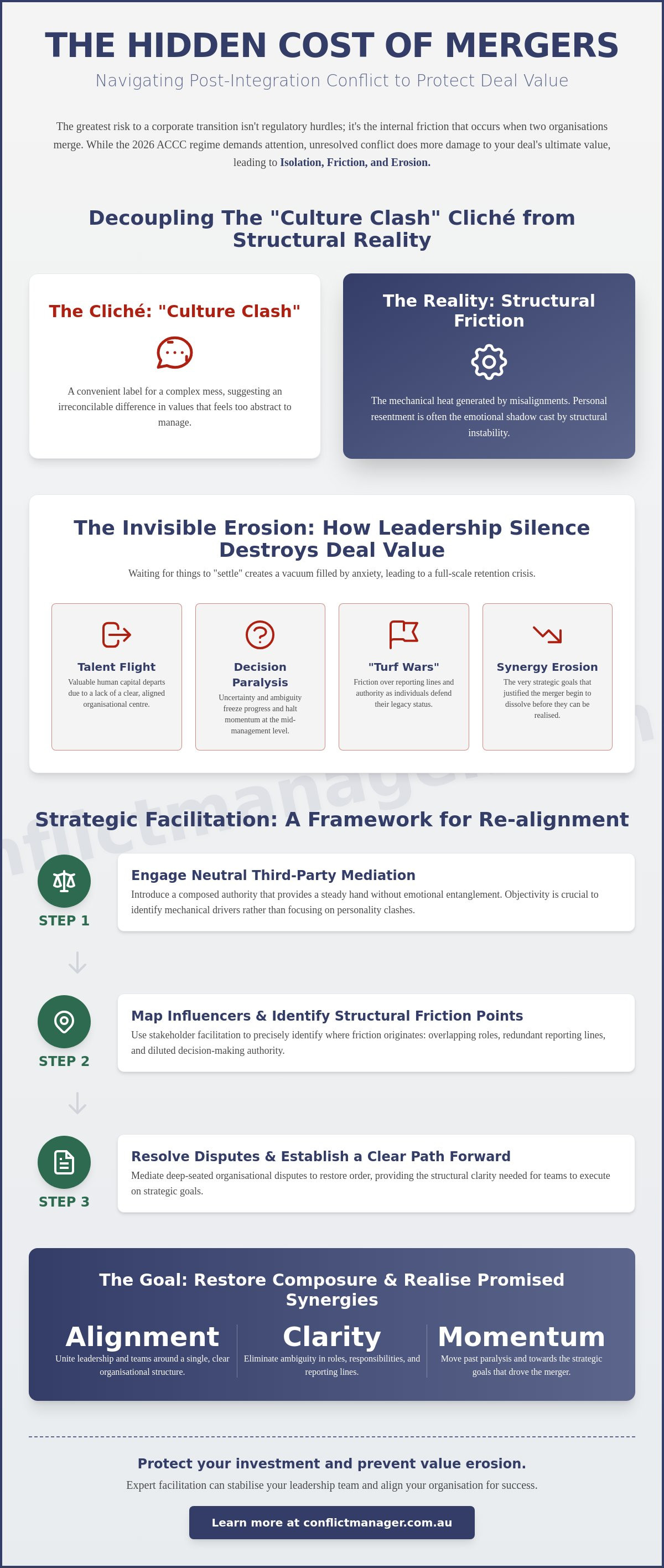
Strategic Facilitation: A Framework for Organisational Re-alignment
Objectivity. Perspective. Resolution. These are the qualities that internal leadership teams often lack when they are in the thick of a complex transition. Resolving a post-merger integration conflict requires a vantage point that is entirely removed from the legacy loyalties and reporting lines of the merging entities. Without this external clarity, attempts at mediation often become just another theatre for the ongoing power struggle. A neutral third party provides the distance necessary to view volatile situations with total objectivity, ensuring that the resolution is based on structural integrity rather than political expediency.
The process of re-alignment is methodical and logical. It begins with stakeholder mapping, where we identify the true influencers and friction points that technical due diligence missed. This is followed by facilitated dialogue, which creates a structured, safe space for legacy leaders to air grievances that have likely been festering since Day 1. Only after these grievances are acknowledged can we move toward co-designing the "New Centre". This phase involves building a shared vision that transcends legacy identities, followed by establishing sustainable governance structures to manage future organisational tension. This progression moves the leadership from a state of complexity toward a vision of structured resolution.
The Power of Neutrality in High-Stakes Mediation
Internal HR departments or legacy executives are rarely perceived as neutral arbiters. They have skin in the game. Their own roles, reporting lines, and status are often at stake in the very restructuring they are trying to manage. A steady, external hand is essential to lower the collective pulse of the organisation. By introducing a professional who is unruffled by high-stakes environments, you provide a sense of order. This external presence allows for a sophisticated, measured pace of dialogue. It creates a space where punctuation and pause are used to clarify nuanced points, ensuring that every stakeholder feels heard without the conversation becoming emotionally entangled.
Building Sustainable Outcomes
Compromise is often a temporary truce that leaves both sides feeling dissatisfied. In the context of a merger, compromise usually leads to a "watered-down" version of the original strategic goals. We aim for integration, which is a fundamental re-alignment that respects the legacy of both organisations while creating something entirely new. This approach ensures that the resolution is durable and that the organisational centre holds under pressure. For those currently navigating these waters, our organisational restructuring conflict checklist provides a practical starting point for identifying hidden friction. To ensure your transition achieves its full strategic potential, engaging in professional stakeholder facilitation is the most direct path to leadership stability.
Restoring Composure: The Role of Neutral Third-Party Mediation
Conflict is an inherent byproduct of growth. When two corporate entities converge, the resulting post-merger integration conflict isn't a sign of a failed strategy; it's a signal that the new structure requires calibration. Managing this friction with composure is what separates successful transitions from those that erode value. Professional mediation provides a neutral ground where confidentiality and objectivity are prioritised. This allows for the restoration of structural stability without the emotional entanglement that often plagues internal attempts at resolution.
Consider a recent transition within the Australian financial services sector. Two legacy firms found themselves in a state of total paralysis six months post-Day 1. Overlapping remits had led to a breakdown in trust between the senior leadership teams, threatening the very synergies that justified the deal. By introducing neutral facilitation early, the parties were able to move past personal grievances to redefine their shared authority. This intervention didn't just save the relationship; it protected the strategic goals that were at risk of being lost to internal attrition and indecision.
Why Conflict Manager is the Steady Hand You Need
Order. Stability. Resolution. Our approach to high-emotion business disputes is grounded in a deep understanding of both human and structural dynamics. We act as a wise, external counselor, viewing volatile situations with total objectivity. For high-net-worth family offices and complex organisations, we provide bespoke facilitation that respects the weight of responsibility held by stakeholders. We guide you from a state of disruption toward a vision of structured resolution, ensuring the organisational centre remains firm even during periods of intense change.
Taking the First Step Toward Clarity
Engaging an external mediator shouldn't be seen as a last resort. It's a proactive measure to ensure the long-term health of your organisation. Waiting until friction becomes a full-blown crisis often leads to irreversible talent flight and the loss of key intellectual property. Initiating a confidential consultation allows for an objective assessment of your organisational health before the damage becomes systemic. You can enquire about our organisational conflict management services to begin the process of re-alignment and restore focus to your market objectives.
Composure is a choice. In the high-stakes environment of 2026, the ability to navigate post-merger integration conflict with a steady hand is a distinct competitive advantage. It allows you to move beyond the noise of interpersonal friction and return your focus to the strategic goals that drove the merger. Clarity is possible when you choose to manage the transition with order, empathy, and professional distance.
Securing the Strategic Value of Your Transition
The path to a successful merger requires more than financial alignment. It demands a deliberate focus on the human and structural architecture of the new organisation. You've seen how identifying mechanical friction points and addressing leadership tensions early can prevent the erosion of deal value. By moving beyond the cliché of "culture clash" and engaging with the reality of structural overlap, you protect the very synergies that justified the transaction. This process isn't about avoiding disagreement; it's about providing the order needed to resolve it with precision and empathy.
Managing post-merger integration conflict is an exercise in composed leadership. It's about acknowledging the weight of responsibility while maintaining the objectivity needed to see a way forward. Our seasoned professional mediators provide national Australian expertise through a bespoke approach tailored for complex organisational and family office structures. We act as the steady hand that guides you from disruption toward a vision of structured resolution. This allows your leadership team to stop looking inward at friction and start looking outward at growth. It's the most direct route to a stable and aligned future.
Secure the future of your merger with expert facilitation. Clarity is within reach. With the right facilitation, your organisation can emerge from the transition stronger, more aligned, and ready to capture the market opportunities that lie ahead.
Frequently Asked Questions
What is the most common cause of post-merger integration conflict?
The primary cause is structural ambiguity regarding decision-making authority and overlapping roles. While stakeholders often label these disputes as personality clashes, the root is usually a failure to clarify who holds the remit for specific outcomes. This lack of clarity creates defensive behaviours that inevitably impede organisational progress.
How long does post-merger integration conflict typically last?
Conflict doesn't have a natural expiry date and can persist indefinitely if it's not actively managed. It typically reaches a critical point between six and eighteen months after the transaction closes. This is the period when initial goodwill is replaced by the fatigue of unresolved operational friction, making a post-merger integration conflict particularly volatile.
Can culture clash be identified during the due diligence phase?
Due diligence can identify high-level value differences, but it rarely captures the granular friction of combined operations. You can compare policy manuals, yet you can't easily predict how two distinct leadership styles will interact under high-stakes pressure. The most significant tensions often emerge only after the teams begin working within a shared reporting structure.
Why is a neutral third party more effective than internal HR for merger disputes?
A neutral third party brings total objectivity that internal HR simply cannot provide during a transition. HR professionals are often perceived as being aligned with their legacy organisation, which creates a barrier to trust for the "acquired" team. An external mediator remains unruffled by internal politics and focuses entirely on the structural integrity of the new organisation.
What happens if post-merger conflict is left unresolved?
Unresolved post-merger integration conflict leads to the invisible erosion of the synergies that originally justified the deal. It results in decision-making paralysis and a significant drop in productivity as teams focus on internal politics instead of market execution. Eventually, the strategic goals of the merger become secondary to managing the internal crisis.
How does post-merger friction affect employee retention in Australia?
Friction is a primary driver of high-level talent flight in the Australian corporate sector. Key executives and specialists are often the first to leave when they perceive a lack of stability or a breakdown in the organisational centre. This loss of human capital directly impacts customer relationships and erodes the long-term value of the acquisition.
What is the difference between structural and cultural conflict in a merger?
Structural conflict arises from mechanical issues like redundant reporting lines and ambiguous remits. Cultural conflict is the emotional response to a loss of legacy identity or differences in day-to-day working styles. While they are distinct, structural ambiguity often fuels the personal resentment that people mistake for cultural incompatibility.
How much does professional mediation for a corporate merger cost?
The cost of professional mediation depends on the complexity of the organisational structure and the number of stakeholders involved in the process. Rather than a fixed commodity price, it's a bespoke service designed to protect a multi-million dollar investment. The expense of mediation is invariably lower than the cost of losing a single key executive or failing to reach synergy targets.


