

For a high-net-worth family, the public courtroom isn't just a venue for justice; it's a structural threat to everything you've built. Privacy. Discretion. Legacy. These are the pillars of a successful family estate, yet they're often the first things sacrificed when a dispute enters the public record. You've likely felt the mounting anxiety that comes with circular arguments and the looming risk of reputational damage. It's a heavy burden to carry, especially when you're trying to maintain organisational stability while navigating deep-seated interpersonal friction.
Choosing confidential family dispute resolution allows you to step away from the blunt instrument of the court system and toward a more sophisticated, private path. You don't have to watch your assets deplete through years of litigation or see your family's private matters become a matter of public scrutiny. We'll explore how expert-led alternatives can restore order and provide sustainable outcomes for asset management. This article examines the strategic benefits of private mediation and how the Family Law Amendment Act 2024 supports a shift toward more tailored, discreet resolutions that preserve your family's future.
Key Takeaways
- Understand why the rigid, public nature of the Australian court system often clashes with the nuanced requirements of family office governance and private legacies.
- Discover how confidential family dispute resolution provides a legal shield, keeping sensitive internal friction away from the public gaze.
- Learn to distinguish between facilitated discussions for emerging friction and structured mediation for more established conflicts.
- Identify whether your family’s current disruption is structural, financial, or interpersonal to determine the most effective resolution framework.
- Explore how a steady, objective third party can help your family move from emotional exhaustion toward sustainable asset management and organisational stability.
Beyond the Courtroom: Why Litigation Often Fails High-Stakes Family Dynamics
The Australian judicial system is built on the principle of transparency. While this serves the public interest, it often acts as a catalyst for the erosion of private family structures. Litigation is a blunt instrument. It prioritises legal precedent over personal history. For high-net-worth families, the risks of the courtroom are manifold. When a dispute enters the public domain, the control you once held over your family's narrative begins to dissipate.
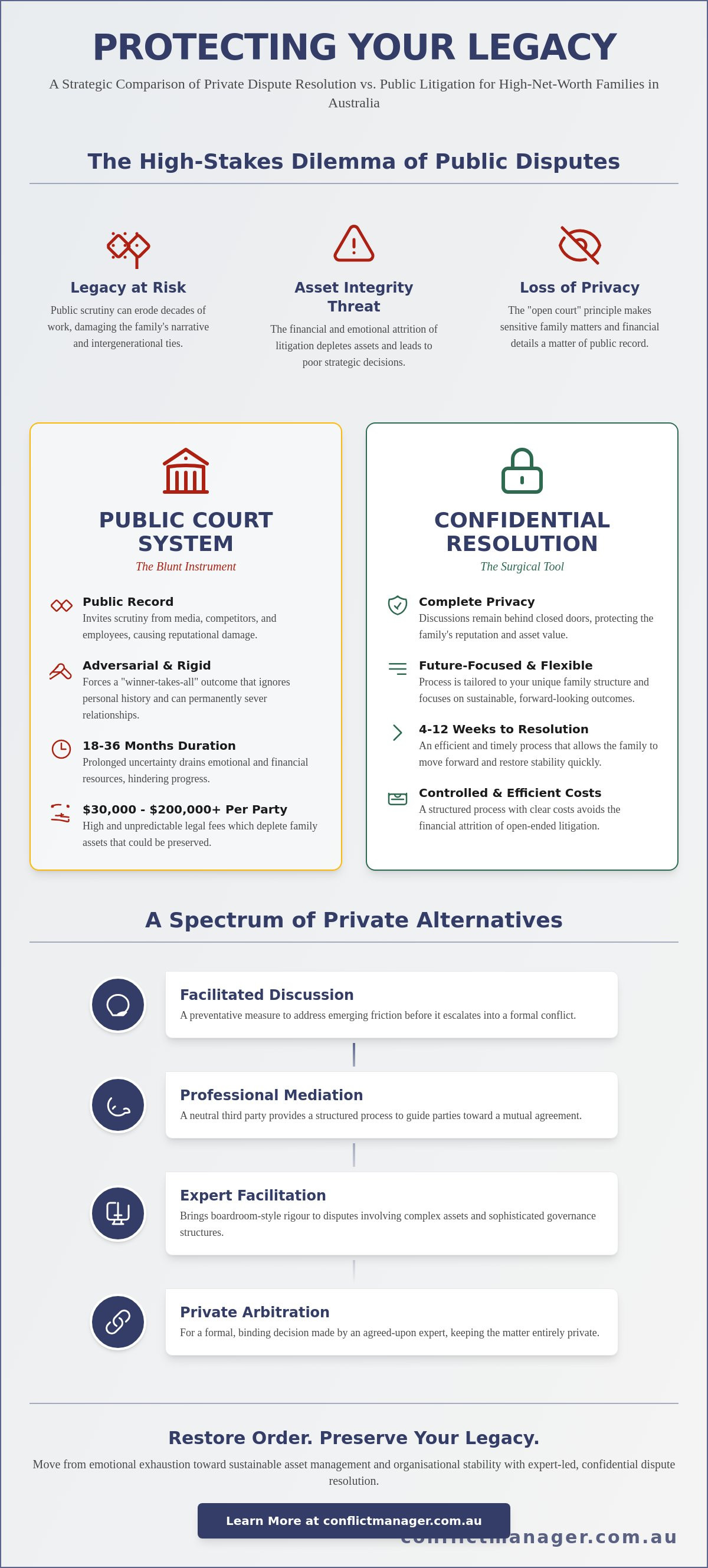
Publicity. Rigidity. Attrition. Alienation. These are the hallmarks of a contested court hearing. In Australia, the "open court" principle means that most proceedings are a matter of public record. For a family managing a significant legacy, this exposure can be catastrophic. It invites scrutiny from competitors, employees, and the media. Beyond the loss of privacy, the court operates on rigid formulas. These legal frameworks often fail to account for the sophisticated governance of a family office or the complex interdependency of shared assets. The adversarial nature of the process frequently forces a "winner-takes-all" outcome. This can permanently sever intergenerational ties that took decades to build.
The financial burden is equally significant. While court fees are fixed, the total spend on contested proceedings often reaches between $30,000 and $200,000 per party. This financial depletion is compounded by the immense emotional cost of time. A court matter can drag on for 18 months to three years, whereas private resolution often reaches a conclusion within 4 to 12 weeks. The longer a dispute remains unresolved, the more it eats away at the family's collective energy and focus.
The Definition of Confidential Family Dispute Resolution
Confidential family dispute resolution offers a different path. It's a private, voluntary process where a neutral expert facilitates dialogue between parties. Unlike the public system governed by the Family Law Act 1975, this approach remains entirely behind closed doors. The focus shifts from historical blame to future-focused, sustainable outcomes. It allows families to resolve friction without the performative aggression of a courtroom. It's a surgical tool designed for precision rather than a sledgehammer designed for impact.
The Threat to Family Legacy and Asset Integrity
Public disputes carry a heavy price tag that extends far beyond legal fees. When internal friction becomes public knowledge, the perceived value of family brands and business interests can plummet. Stakeholders lose confidence. Key personnel become unsettled. This legal fatigue often leads to rushed, poor strategic decisions that harm the family office for years to come. Protecting the human capital of the family is just as vital as safeguarding the financial capital. Without a stable interpersonal foundation, the structural integrity of the estate is always at risk. A private resolution preserves the family's reputation and ensures that the transition of wealth remains an internal matter.
The Spectrum of Private Alternatives to Family Litigation
Disruption. Friction. Escalation. Resolution. While the public system offers a single, rigid path, the private sector provides a spectrum of interventions tailored to the specific weight of the dispute. For many high-net-worth families, the goal isn't just to end a fight but to preserve a structure. This is where confidential family dispute resolution becomes a strategic asset rather than just a legal requirement. The spectrum of private resolution isn't a one-size-fits-all model. It's a curated selection of methodologies designed to meet the specific pressure points of your family's unique situation.
At the lighter end of the scale, facilitated discussion serves as a preventative measure. It's used when friction is emerging but hasn't yet hardened into a full-scale conflict. Professional mediation introduces more structure, where a neutral third party guides the parties toward a mutually beneficial agreement. For disputes involving complex assets, expert facilitation brings a boardroom-style rigour to the table. Some families prefer collaborative practice, where legal and financial experts commit to working entirely outside the court framework. Finally, private arbitration offers a formal, binding decision made by an expert, ensuring the matter stays out of the public record.
Expert Facilitation for Family Offices and Trusts
Complex financial structures require more than just a listener. They require a facilitator who understands the intricate mechanics of trusts, corporate governance, and intergenerational wealth. This process often takes place on neutral ground, far removed from the emotional triggers of the family home or the sterile aggression of a law firm. It's about finding the intersection between family emotion and corporate duty. When dealing with FDR in complex cases, the safety of the process and the objectivity of the facilitator are paramount. This level of expertise ensures that the structural integrity of the estate remains the primary focus.
Mediation as a Strategic Governance Tool
Mediation is often mischaracterised as a reactive fix for a broken relationship. In reality, it's a proactive tool for building a framework for future decision-making. It supports long-term succession planning by ensuring that wealth transfer doesn't become a catalyst for collapse. A mediator acts as a steady hand, providing the order necessary to move through volatile dynamics without losing sight of the legacy. It's a way to codify communication before the next transition occurs. If you're currently facing organisational friction, engaging in professional stakeholder facilitation can help re-establish the stability your family office requires.
Privacy vs. Publicity: The Strategic Advantage of Confidentiality
Discretion. Security. Integrity. For a high-net-worth family, these aren't just values; they're the foundation of their public-facing identity. While litigation is a public performance, confidential family dispute resolution acts as a private sanctuary. It allows for the resolution of friction without the risk of sensitive information becoming part of the public record. This strategic advantage is particularly vital when the family's reputation is inextricably linked to their business interests or philanthropic legacy. Maintaining a unified front isn't about deception. It's about the responsible management of the family brand during a period of transition.
Confidentiality in the Australian Legal Context
The rules of confidentiality in family dispute resolution are codified to provide a safe harbour for difficult conversations. Under the Family Law Act 1975, most communications made during the process are inadmissible in court. This legal shield encourages family members to speak with total candour. They can explore creative solutions or admit to past mistakes without the fear that their words will be weaponised in a future hearing. It's a psychological safety net that allows for the vulnerability necessary to reach a genuine consensus. There are, of course, necessary exceptions, such as the disclosure of a risk of harm or the commission of an offence, which ensure the process remains ethical and safe. Once an agreement is reached, it can be formalised into legally binding Consent Orders. This provides the finality of a court ruling without the exposure of a public trial.
Maintaining Stakeholder and Market Confidence
External stakeholders, including banks, investment partners, and key employees, value stability above all else. A public legal battle suggests a lack of internal control and can trigger clauses in lending agreements or cause top-tier talent to seek more secure environments. By resolving disputes quietly, the family maintains an image of "Quiet Confidence." The facilitator ensures a strict "no-leak" protocol is observed, preventing internal friction from impacting the bottom line. It's about containing the heat of the conflict so it doesn't melt the structural integrity of the organisation. When you choose a private path, you're not just resolving a dispute; you're protecting the market's perception of your family's strength. This methodical approach ensures that even during periods of internal transition, the external world sees only a steady hand at the helm.
Assessing Your Path: Choosing the Right Resolution Framework
Stalemate. Escalation. Erosion. Identifying the exact nature of the friction is the first step toward reclaiming order within a complex family system. Before committing to a specific path, you must discern whether the conflict is structural, financial, or purely interpersonal. A structural dispute might involve the governance of a family office, while a financial one often centres on the distribution of assets or trust management. Purely interpersonal friction, however, is often the most volatile, as it can cloud even the most logical financial decisions. Choosing confidential family dispute resolution requires a clear-eyed assessment of these dynamics to ensure the intervention matches the weight of the problem.
Expertise matters. A mediator with a purely legal background might miss the psychological undercurrents that drive circular arguments. Conversely, a psychological approach alone may lack the corporate rigour required to navigate trust deeds or shareholder agreements. You need a resolution framework that respects the urgency of the situation. If the friction is actively damaging the family's assets or market reputation, immediate intervention is no longer a choice; it's a necessity for preservation. Readiness is the final metric. All stakeholders don't need to agree on the solution yet, but they must be willing to engage in a good-faith dialogue to find one.
The Checklist for External Intervention
Recognising the moment to step outside the family circle is a sign of leadership, not failure. You should consider external intervention when internal efforts have reached a definitive stalemate. If high emotion is consistently overriding objective financial logic, the structural integrity of the legacy is at risk. Another clear signal is the transition from direct conversation to the exchange of legal letters. Once the dialogue becomes formalised through third-party legal representation, the opportunity for a private, flexible resolution begins to narrow. It's often more effective to pause the legal machinery and engage in professional family conflict resolution before the positions harden further.
Selecting a Neutral Third-Party Mediator
The right facilitator remains unruffled by high-stakes environments. They possess a quiet authority that brings order to a room without the need for performative dominance. For multi-generational wealth holders, this composed expertise is essential for building trust across different age groups and interests. When evaluating a potential facilitator, ask about their specific experience with complex family systems and their approach to power imbalances. They should act as a steady hand, viewing the situation with total objectivity while understanding the heavy weight of family responsibility. Their role is to provide the clarity that internal stakeholders, who are often too close to the friction, cannot achieve on their own.
Restoring Stability: How Conflict Manager Navigates Family Friction
Stability. Order. Resolution. Transition. These four pillars form the foundation of our approach to family conflict resolution. At Conflict Manager, we view volatile situations with total objectivity, acting as a steady hand capable of seeing through the fog of interpersonal friction. We understand that in high-stakes family systems, the disruption is rarely just about financial assets. It's about identity, the weight of responsibility, and the preservation of a multi-generational legacy. Our role as a neutral third party is to provide the clarity that internal stakeholders often struggle to achieve when under immense pressure.
The focus remains on sustainable outcomes. We don't merely aim to settle a temporary dispute; we work to protect both the legacy and the family unit itself. Our deep expertise in high-net-worth environments allows us to speak the language of the family office while addressing the underlying psychological currents that drive conflict. This dual focus ensures that the resolution reached today doesn't become the catalyst for a new disruption tomorrow. By providing a structured environment for dialogue, we move the family from a state of complexity toward a vision of long-term stability.
A Composed Path to Resolution
We facilitate difficult conversations with quiet confidence and professional discernment. Our methodical progression begins by acknowledging the difficult reality of the current disruption. We then move into an analytical phase, exploring why internal efforts might be struggling to find a foothold. Finally, we guide the parties toward a structured resolution that respects the structural integrity of the estate. Throughout this process, our commitment to total objectivity remains absolute. We ensure that every decision is made with the preservation of asset integrity in mind. This measured pace is designed to lower the pulse of the room and build trust through a logical, predictable sequence.
Taking the First Step Toward Clarity
Taking the first step toward resolution is often the most difficult, yet it's also the most necessary. We invite you to consider an initial consultation to assess the suitability of our framework for your specific situation. This is a low-risk, high-reward opportunity to gain an external perspective on the friction within your family office or trust structure. Engaging in confidential family dispute resolution is a strategic choice that prioritises discretion over public litigation. It allows you to address internal friction quietly, before it impacts your market reputation or bottom line. You don't have to navigate these transitions alone. Contact Conflict Manager to discuss your family office or organisational resolution needs.
Securing Your Family's Future Through Private Resolution
Choosing to step away from the public courtroom is a decision to prioritise the structural integrity of your legacy. You've seen how litigation can risk unwanted exposure and permanently sever intergenerational ties. By contrast, confidential family dispute resolution offers a private sanctuary where friction is managed with professional discernment and total objectivity. This path doesn't just resolve a current argument; it builds a framework for sustainable asset management and long-term family unity. It allows you to maintain control over your narrative while navigating the complexities of wealth and responsibility.
Conflict Manager provides specialised expertise in high-net-worth family office mediation with national coverage across Australia. We act as a neutral third party to bring order to periods of high stress, ensuring that your family's quiet confidence remains undisturbed by internal transition. Our focus is always on legacy-preserving outcomes that protect the human capital of your family alongside the financial capital. Explore our composed approach to family dispute resolution to begin the transition from disruption toward clarity. Restoring stability is a methodical process, and we're here to provide the steady hand your family requires.
Frequently Asked Questions
What is the difference between family mediation and family dispute resolution (FDR)?
Family mediation is a broad term for any assisted dialogue, whereas Family Dispute Resolution (FDR) is a specific legal framework under Australian law. To meet the requirements of the Family Law Act 1975 for parenting orders, the process must be conducted by an accredited FDR practitioner. While general mediation offers a flexible approach to friction, FDR provides the formal accreditation necessary to move matters forward if a private consensus isn't reached.
Is confidential family dispute resolution legally binding in Australia?
The process of confidential family dispute resolution is not binding in itself, but the outcomes can be formalised into legally enforceable documents. Once an agreement is reached, it's typically drafted into Consent Orders or a Binding Financial Agreement. These documents are then filed with the court to provide the same finality as a judicial ruling, ensuring the resolution is durable and respected by all parties without the need for a public trial.
Can we use mediation if there are complex business assets or trusts involved?
Private resolution is specifically designed to handle the intricate mechanics of family offices, discretionary trusts, and multi-generational business assets. Unlike the public court system, which often applies rigid formulas to asset division, private facilitation allows for a nuanced understanding of corporate governance. It provides a composed environment where stakeholders can navigate the intersection of commercial duty and family legacy without risking the structural integrity of their holdings.
What happens if one family member refuses to participate in mediation?
Participation in any private resolution framework is a voluntary commitment to good-faith dialogue. If a key stakeholder refuses to engage, the process cannot proceed to a joint session. In parenting matters, an accredited practitioner may then issue a Section 60I certificate. This document acknowledges that mediation was attempted or invited, which is a necessary step before the Australian court system will consider an application for parenting orders.
How long does the private dispute resolution process typically take?
A private resolution process is usually completed within 4 to 12 weeks from the initial intake. This methodical progression is significantly faster than the 18 months to 3 years often required for contested litigation to reach a final hearing. By resolving friction early, families avoid the long-term emotional attrition and organisational instability that accompany protracted legal battles in the public record.
Is everything we say in mediation truly confidential from the court?
Confidentiality is a legal requirement protected by the Family Law Act, meaning most communications made during the process are inadmissible in court. This protection allows for total candour and the exploration of creative solutions without the fear of words being weaponised later. There are limited, essential exceptions to this rule, such as the disclosure of a risk of harm to a child or the commission of a serious criminal offence.
How much does private family dispute resolution cost compared to court?
Private resolution is a far more efficient use of family resources than contested litigation. While a court battle can cost between $30,000 and $200,000 per party in legal fees and administrative costs, the investment in private mediation is a small fraction of that spend. It allows families to protect their wealth and preserve the human capital of their organisation rather than depleting assets through years of adversarial conflict.
Do we still need lawyers if we choose the mediation path?
Lawyers aren't mandatory for the mediation sessions themselves, but obtaining independent legal advice is a vital part of a secure resolution. Legal professionals play a key role in reviewing the final agreement and ensuring it's correctly formalised into Consent Orders. This collaborative approach ensures that while the mediator provides the steady hand for the discussion, your individual legal interests remain protected throughout the transition.


