

What if the greatest threat to your family's multi-generational legacy isn't market volatility, but the unspoken friction at the dinner table? Friction. Erosion. Dissolution. These abstract pressures can quickly become concrete realities when intergenerational expectations clash, making the need for professional dispute management for high net worth families increasingly apparent. You likely feel a deep sense of responsibility to protect the family name, yet the fear of public exposure or asset dilution through the courts is a constant concern. It's an exhausting cycle that often feels impossible to break from within.
Internal attempts to resolve these tensions often falter because emotional history clouds objective logic, turning simple transitions into structural stalemates. By prioritising discretion and objective facilitation, you can navigate these complex shifts without sacrificing your privacy or your portfolio. This article outlines how to move from circular arguments toward clear governance; we'll explore the logic of external intervention and the specific frameworks that ensure your legacy remains both whole and harmonious for the decades ahead.
Key Takeaways
- Recognise how proactive, neutral intervention prevents the structural decay of family offices and protects the long-term integrity of private wealth.
- Master the balance between family dynamics and corporate governance by distinguishing between technical asset management and emotional stakeholder needs.
- Discover why mediation offers more flexible, bespoke outcomes than litigation for preserving specific management roles and philanthropic legacies.
- Adopt a framework for dispute management for high net worth families that prioritises objective fact-finding to separate financial data from personal narratives.
- Learn how professional facilitation acts as a steady hand to guide your family from a state of disruption toward a sustainable, structured resolution.
The Anatomy of High Net Worth Disputes: Why Traditional Resolution Fails
Conflict is not a failure of character; it is a natural byproduct of complexity. In the context of significant wealth, dispute management for high net worth families serves as a proactive, neutral intervention designed to de-escalate friction before it reaches a court of law. This approach moves beyond the reactive "litigation-first" mindset, which treats every disagreement as a legal breach to be won or lost. Instead, a "resolution-first" strategy views conflict as a structural misalignment that requires precise, expert adjustment to preserve both capital and relationships.
Institutional silence often masks structural decay. When families attempt to "hide" conflict within their internal structures, the friction doesn't disappear; it simply erodes the foundation of their What is a Family Office? or holding entities. This internal pressure eventually manifests as stalled decision-making, staff turnover, or the sudden, public collapse of long-standing arrangements. In 2026, Australian family wealth disputes are uniquely defined by the tension between record-breaking asset values and the complex social responsibilities of a more globally-minded next generation.
The Intergenerational Friction Point
The gap between "the founders" and "the heirs" is rarely just about money. It's about values. While G1 founders typically prioritise capital preservation and traditional growth, G2 and G3 successors often seek to align wealth with contemporary philanthropic goals or higher-risk digital investment strategies. This expectation gap creates a "friction point" where neither side feels heard. Without a neutral zone for facilitated communication, these differing views on investment risk and capital utility quickly escalate into personal grievances that threaten the very legacy the wealth was intended to build.
The Cost of Public Litigation
Privacy. Discretion. Integrity. These are the immediate casualties when family matters enter the Australian court system. Beyond the obvious risk to reputation, litigation imposes a significant "litigation tax" through the erosion of assets via protracted legal fees and the invasive process of discovery. Public battles invite external scrutiny that most families simply cannot afford. Private mediation, by contrast, ensures total confidentiality while allowing for bespoke outcomes that a court cannot provide. It offers a way to resolve the dispute management for high net worth families without the public exposure that often leads to irreversible brand and personal damage.
Structural Integrity vs. Emotional Friction: Navigating the Family Office
Asset management is a technical discipline. Relationship management is a human one. When these two spheres collide within a family office, the resulting friction can destabilise even the most robust financial structures. Effective dispute management for high net worth families requires a clear distinction between the technical asset, which is governed by law and logic, and the emotional stakeholder, who is driven by history and identity. In professional documentation, we use precise punctuation to separate the technical asset from the emotional stakeholder; this creates a crucial distinction that provides clarity for all parties involved.
Internal resolution often fails because family members are trapped in historical roles. A CEO who is also a younger brother may struggle to assert authority over an elder sibling who holds no formal position but carries significant emotional weight. History repeats. Roles persist. These unspoken rules often override the most meticulously drafted shareholder agreements. This is where a neutral third party brings essential objectivity. By viewing volatile situations without being entangled in the family's past, a facilitator can provide a steady hand to guide the transition from chaos to order. This level of conflict resolution for family businesses ensures that the focus remains on the family's shared future rather than its individual grievances.
When Governance Meets Grievance
A Family Constitution is often viewed as a panacea. However, it's only as effective as the communication it facilitates. Composed authority is needed to bridge the gap between formal corporate governance and the raw reality of family friction. If you find your governance structures are being tested by interpersonal tension, seeking a structured facilitation process can help restore order. True governance isn't just about the rules on the page; it's about the shared understanding that allows those rules to function under pressure.
Managing Conflict in Family Trusts and SMSFs
In Australia, the intersection of beneficiary rights and trustee power is a frequent source of legal static. Disputes within Self-Managed Super Funds (SMSFs) over investment strategy or succession can lead to severe ATO scrutiny or regulatory breaches. When family members disagree on the fund's direction, the risk to the entire portfolio increases. Expert mediation allows these technical disagreements to be resolved in a controlled environment, protecting the fund's compliance status while addressing the underlying stakeholder concerns. This methodical approach ensures that regulatory requirements are met without sacrificing family harmony.
Strategic Resolution: Why Mediation Surpasses Litigation for Private Wealth
Litigation is a blunt instrument. It operates on a binary logic of winners and losers, often ignoring the nuanced realities of multi-generational wealth. For those seeking sustainable dispute management for high net worth families, the collaborative nature of mediation offers a more sophisticated alternative to the adversarial Australian court system. While a judge is limited by strict legal precedents and can only order specific financial remedies, mediation allows for bespoke outcomes. These can include the creation of specific management roles, the restructuring of philanthropic legacies, or the design of unique governance protocols that a court simply cannot mandate.
Speed is another critical factor. Litigation often drags on for years, leaving assets in a state of paralysis and families in a state of exhaustion. Mediation typically concludes in weeks. This efficiency is vital for families who must continue to co-invest and manage shared interests. It preserves the structural integrity of the portfolio while ensuring that the human relationships at the centre of the wealth remain intact. It is a process designed for those who value time and harmony as much as they value capital.
Choosing a resolution-first approach means prioritising the long-term health of the family ecosystem. In a court setting, the focus is on past grievances and legal breaches. In a facilitated mediation, the focus shifts toward future functionality. This forward-looking perspective is essential for families who intend to maintain a shared legacy across decades, as it provides the tools for ongoing cooperation rather than the finality of a legal severance.
The Mediator as a Steady Hand
A seasoned mediator acts as a neutral anchor in a storm of high emotions. They remain unruffled by the high-stakes environment, focusing instead on moving the conversation from rigid positions to underlying interests. In cases of extreme friction, shuttle mediation is employed. This process involves managing parties in separate spaces, allowing the facilitator to filter out the emotional static and focus on the logical path forward. This methodical approach lowers the pulse of the situation and builds trust through a logical, sequenced resolution that respects the dignity of all stakeholders.
Confidentiality and the Non-Disclosure Advantage
Privacy is a paramount concern for prominent families. Public disputes can severely damage a family brand and market standing, leading to a decline in business valuations and a drop in employee morale. Private mediation is protected by strict non-disclosure agreements, ensuring that internal disagreements never reach the public record. This discretion is essential for maintaining the reputation of the family office and ensuring that external stakeholders, including banks and investment partners, remain confident in the stability of the organisation leadership and legacy.
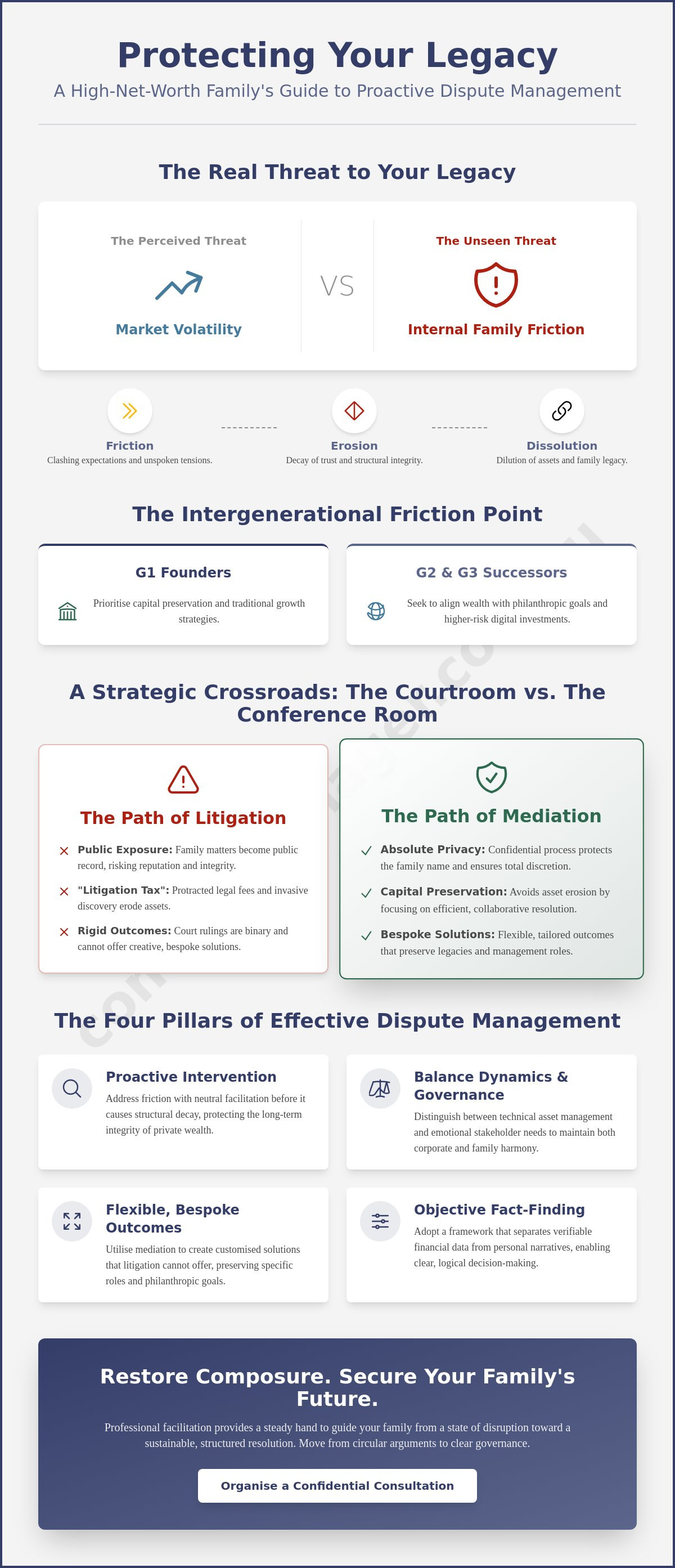
Four Pillars of Effective Dispute Management in Multi-Generational Families
Strategic resolution is built on foundations of order. For families navigating the complexities of multi-generational wealth, a structured methodology is required to move from friction to harmony. The process of dispute management for high net worth families relies on four critical pillars that ensure both the assets and the interpersonal dynamics remain secure.
- Pillar 1: Objective Fact-Finding. This involves the rigorous separation of financial data from personal narrative. By establishing a shared set of facts, families can address the "what" without being derailed by the "who."
- Pillar 2: Facilitated Communication. Dialogue requires a safe environment. This pillar focuses on creating a neutral zone where difficult conversations can occur without the interference of historical family roles.
- Pillar 3: Structural Realignment. Static structures often cause friction. Effective management requires adjusting governance, such as trust deeds or family constitutions, to reflect the current realities of the family's growth and generational shifts.
- Pillar 4: Sustainable Agreements. A resolution is only as good as its longevity. This pillar focuses on crafting outcomes that are legally robust and relationally restorative, ensuring they survive the transition to the next generation.
Establishing the Neutral Zone
Old patterns die hard. In the absence of a neutral zone, family meetings often devolve into predictable arguments that have persisted for decades. An external facilitator is essential here to manage the inherent power imbalances between founding generations and their successors. They set clear ground rules that prevent defensive posturing and ensure every voice is heard with equal weight. A neutral zone provides the psychological safety required for stakeholders to move beyond defensive posturing toward genuine collaboration. By stripping away the emotional static of the family home or the corporate office, parties can engage with a sense of composed authority. If your internal discussions have reached a stalemate, engaging a specialist in stakeholder facilitation can provide the objective perspective needed to break the cycle.
Crafting Sustainable Outcomes
Quick fixes are often just temporary truces. To achieve true resolution, one must address the root causes of friction rather than merely suppressing the symptoms. Documenting these resolutions requires a delicate balance; the final agreement must be legally binding while remaining relationally restorative. It should feel like a natural evolution of the family legacy, not a forced legal settlement. We encourage a rhythmic, measured pace in all family communications during this phase. This deliberate approach allows for thorough reflection and ensures that every stakeholder feels the outcome is both fair and durable. Such a process moves the family from a state of disruption toward a vision of structured, long-term stability.
Restoring Composure: Professional Facilitation for Sustained Family Harmony
High-stakes environments demand a specific type of presence. Conflict Manager acts as the steady hand, navigating the complex human and structural dynamics that define multi-generational wealth. The transition from a state of disruption to a vision of structured resolution is not instantaneous. It requires a methodical approach that prioritises the integrity of the family unit alongside the protection of the portfolio. Our focus remains on building a foundation for future stability, ensuring that today's resolution becomes tomorrow's governance standard.
The Logic of External Intervention
Internal efforts often struggle because everyone involved is already part of the family ecosystem. Even trusted, long-term solicitors can find their objectivity compromised by years of proximity to the founders or the heirs. An objective expert sees the structural misalignments that internal parties might miss; they provide a neutral perspective that is unencumbered by historical bias. There is also a significant psychological benefit to offloading the management of friction to a professional. It allows family members to return to their primary roles as parents, siblings, and business partners, rather than remaining stuck as adversaries. You can learn more about The Benefits of Professional Conflict Resolution through our bespoke facilitation services.
Securing the Legacy
Significant family wealth carries a heavy weight of responsibility. It is a legacy that requires constant vigilance and a willingness to address friction before it leads to asset dilution or public exposure. Effective dispute management for high net worth families is about more than just ending an argument. It's about ensuring that the values and capital built over decades remain intact for those who follow. This work requires a compassionate guide who understands the weight of responsibility and the friction of interpersonal dynamics without becoming emotionally entangled in them.
Order. Clarity. Resolution. These outcomes are within reach when you choose a path of professional facilitation. We invite you to begin a dialogue that moves your family away from the cycle of circular arguments and toward a sustainable future. For a quiet, professional assessment of your situation, Contact Conflict Manager for a confidential discussion on family wealth dispute resolution. Together, we can restore the composure your legacy deserves.
Securing Your Family's Shared Future
Legacy. Stability. Continuity. These are the markers of a wealth strategy that transcends mere financial growth. As we have explored, the most resilient families are those who treat conflict as a structural misalignment rather than a personal failure. By prioritising neutral facilitation over adversarial litigation, you ensure that your private matters remain private. You protect your assets from the erosion of public court battles, and you preserve the interpersonal bonds that are the true foundation of your family office. Effective dispute management for high net worth families is an investment in the long-term health of your entire ecosystem.
Conflict Manager provides the steady hand needed to navigate these transitions with total objectivity. Through expert-led mediation and a focus on absolute confidentiality, we help you move from a state of disruption toward a vision of sustainable, structured resolution. Our approach is designed to produce outcomes that are both legally robust and relationally restorative. Begin the path toward a composed resolution with Conflict Manager and secure the legacy you have worked so hard to build. You don't have to carry the weight of intergenerational friction alone; a clearer, more harmonious path forward is possible.
Frequently Asked Questions
How does dispute management differ from hiring a family lawyer?
Dispute management focuses on neutral resolution rather than adversarial representation. While a lawyer's primary role is to protect your individual legal rights, our approach to dispute management for high net worth families is to protect the collective legacy. We act as a steady, objective third party to facilitate communication and find structural solutions that a binary legal battle often ignores. It's the difference between winning a case and resolving a conflict.
Can mediation work if family members are no longer on speaking terms?
Yes, we often work with families where direct communication has completely broken down. We employ a process known as shuttle mediation, where parties are managed in separate spaces to prevent further friction. This allows the facilitator to filter out emotional static and focus on the logical path forward. It's a methodical way to build a resolution without the need for direct contact that might otherwise trigger old patterns of conflict.
What is the typical timeframe for resolving a complex family office dispute?
Most facilitated resolutions conclude in a matter of weeks. This stands in stark contrast to the Australian court system, where litigation can drag on for several years and exhaust both emotional and financial resources. The exact duration depends on the complexity of the assets and the number of stakeholders involved. However, the goal is always a swift, sustainable outcome that allows the family to return to a state of order and composure.
Is the outcome of a private mediation legally binding in Australia?
The resolution becomes legally binding once all parties sign a formal settlement agreement. This document functions as a contract that can be enforced through the courts if necessary. We work to ensure that the structural realignment and governance changes agreed upon are documented with total clarity. This provides a robust framework that secures the family's future and prevents the same grievances from resurfacing in the next generation.
How do we introduce the idea of an external mediator to a resistant family member?
Position the facilitator as a neutral resource designed to protect the family's privacy and portfolio. Emphasise that this is a confidential process aimed at reducing the "litigation tax" and avoiding the public exposure of private matters. It's about maintaining autonomy. By choosing dispute management for high net worth families, you're opting for a bespoke solution that you control, rather than leaving your legacy in the hands of a judge.
What happens if we cannot reach an agreement through facilitation?
If a final agreement isn't reached, all parties retain their original legal rights and can still choose to pursue litigation. However, the facilitation process often clarifies the core issues and narrows the scope of the disagreement. Even a partial resolution can simplify any subsequent legal actions, making them less costly and time-consuming. Most families find that the objective fact-finding phase alone brings a much-needed sense of clarity to the situation.
How much does professional dispute management cost compared to litigation?
Mediation is almost always more cost-effective than a public court battle. While we don't provide fixed quotes, avoiding the discovery process and protracted legal fees preserves a significant portion of the family's capital. Litigation isn't just a financial cost; it's a drain on the family's reputation and time. Our focus is on providing a premium, bespoke service that delivers a high return on investment through the restoration of harmony and structural integrity.
Do you work alongside our existing accountants and solicitors?
We frequently collaborate with a family's existing network of professional advisors. We don't replace your solicitors or accountants; instead, we provide the neutral zone where their technical data can be used to build a collaborative resolution. We act as the central anchor, ensuring that the legal and financial advice you receive is integrated into a broader strategy for sustained family harmony. This ensures that the final agreement is both technically sound and relationally restorative.


