

Friction. Stagnation. Risk. Most executive disputes aren't actually failures of personality, but rather symptoms of structural ambiguity that have finally reached a breaking point. When the C-suite stalls, the entire organisation feels the drag. You've likely watched strategic momentum evaporate while legacy assets are placed under unnecessary pressure. In these moments, standard HR protocols often feel ill-equipped for the complexities of leadership team conflict management, leaving the business in a state of precarious uncertainty.
This article provides the methodical frameworks necessary to transform executive tension into a foundation for long-term organisational clarity. We'll examine the path from emotional de-escalation to restored alignment, moving beyond temporary fixes toward sustainable governance. You'll gain a structured path to resolution that protects your professional legacy and ensures your leadership team regains the composure needed to drive the business forward with confidence.
Key Takeaways
- Recognise that executive friction is frequently a symptom of structural ambiguity and role overlap rather than simple personality clashes.
- Understand why internal HR departments often struggle to address C-suite disputes and how a neutral third party can rebalance high-stakes dynamics.
- Implement methodical frameworks for leadership team conflict management that prioritise objective discovery and the de-escalation of emotional tension.
- Learn how to transition from immediate dispute resolution toward the creation of sustainable governance structures that ensure long-term alignment.
The Anatomy of Leadership Friction: Why Executive Teams Clash
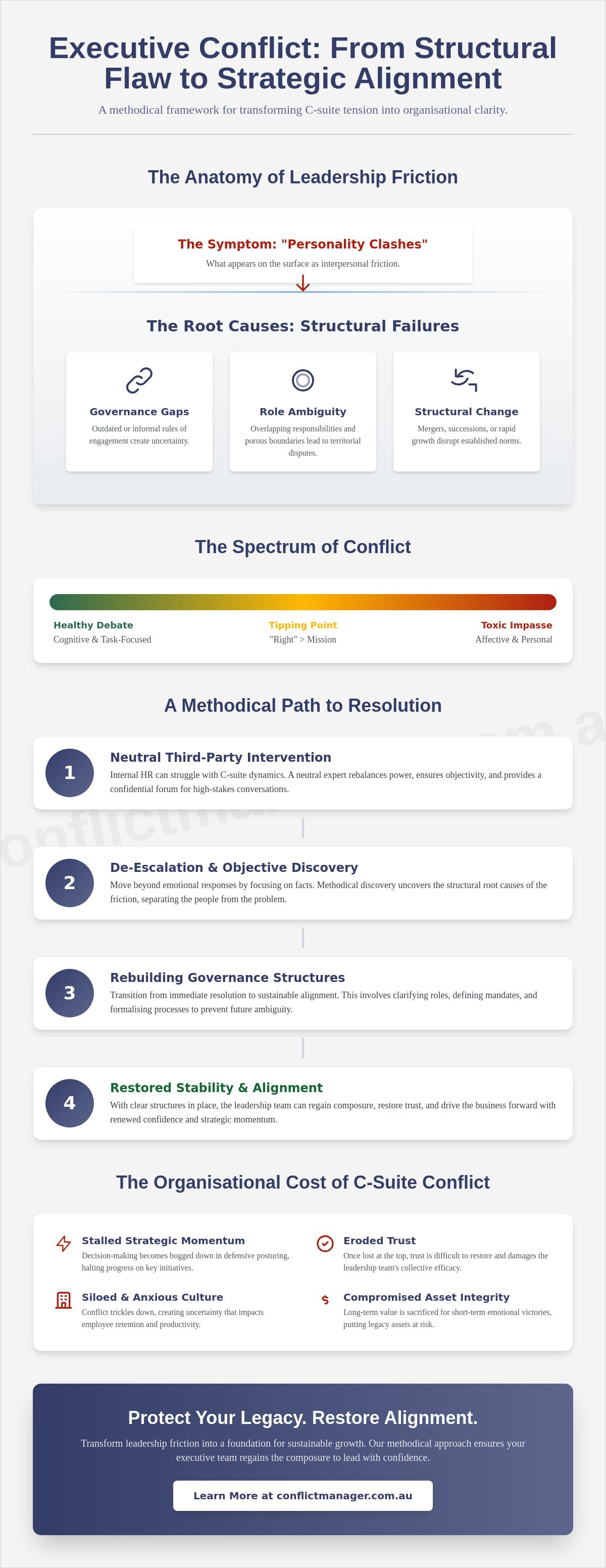
Stagnation. Friction. Erosion. Executive disputes are rarely the result of simple personality clashes, though they often manifest that way. Instead, these impasses represent a profound strategic disruption that can stall the engine of an entire organisation. When the leadership team is misaligned, the clarity required to steer the business through complex transitions evaporates, leaving a vacuum that is quickly filled by uncertainty and hesitation. Effective leadership team conflict management begins by recognising that these disputes are not merely interpersonal grievances but are, in fact, structural failures that threaten the integrity of the business itself.
The financial and operational costs of this friction are substantial. Strategic momentum slows as decision-making becomes bogged down in defensive posturing. Trust, once eroded at the top, is difficult to restore and often leads to a compromised state of asset integrity where long-term value is sacrificed for short-term emotional victories. The C-suite environment is a unique crucible. Leaders at this level carry the weight of legacy, the pressure of stakeholder expectations, and the responsibility of significant assets, making them uniquely susceptible to high-emotion disputes where the stakes leave little room for error.
The Spectrum of Conflict: From Healthy Debate to Toxic Impasse
Understanding the broader discipline of conflict management helps leaders differentiate between productive friction and destructive stagnation. Cognitive conflict, which is task-oriented and based on differing professional perspectives, is essential for innovation and robust strategy. However, when this shifts into affective conflict, the focus moves from the "what" to the "who," and the dispute becomes relationship-based and personal. The tipping point occurs when the desire to be right outweighs the commitment to the collective mission. A seasoned professional maintains a sense of composed authority, watching for these early warning signs before a healthy debate descends into a toxic impasse that requires external intervention.
The Impact on Organisational Integrity
Leadership conflict never remains confined to the boardroom. It trickles down through every layer of the company, creating a culture of silos and anxiety that directly impacts employee retention and productivity. This is particularly acute in family offices and private firms where legacy assets and multi-generational interests are at play. In these environments, a dispute isn't just about a business decision; it's about the future of a family's reputation and wealth. Leadership conflict is a structural failure that necessitates a neutral perspective. By addressing the root causes of friction, organisations can protect their assets and restore the steady hand required for sustainable growth.
Governance, Role Ambiguity, and the Structural Drivers of Conflict
Ambiguity. Overlap. Friction. While interpersonal tension is the visible symptom, the root of executive discord is almost always found in the architecture of the organisation. When mandates are vague and responsibilities bleed into one another, even the most collaborative leaders will eventually find themselves at odds. This isn't a failure of character. It's a predictable outcome of structural design. Effective leadership team conflict management requires looking past the individuals to the governance frameworks that guide their interactions. If the underlying system is flawed, even the most skilled communicators will eventually reach an impasse.
Role Ambiguity: The Silent Catalyst of Executive Friction
In high-stakes environments, the question of "who does what" is rarely as simple as an organisational chart suggests. Territorial disputes often arise when boundaries are porous. This is particularly evident in family-run businesses or rapidly scaling firms where "founder syndrome" persists. Here, the original visionary may struggle to cede control to professional managers, creating a power vacuum or a dual-authority trap. Establishing clear mandates isn't just about efficiency. It's about providing the psychological safety that comes from knowing exactly where one's authority begins and ends. Without this clarity, leaders spend more energy defending their turf than driving the business forward. This territoriality isn't necessarily driven by ego; it's often a defensive response to the uncertainty of one's own role and influence.
Structural Change as a Conflict Trigger
Transition is a period of heightened vulnerability. Mergers, acquisitions, or leadership successions shift the foundational "rules of engagement," often without a formal update to the governing documents. This flux creates a breeding ground for silos. When the structure changes, leaders naturally retreat into their own departments to protect their teams and interests. Methodical analysis of these structural gaps can prevent interpersonal wars before they start. By identifying where the new system lacks clarity, you can proactively address friction. If your board or executive team is currently navigating such a shift, seeking professional Stakeholder Facilitation can provide the objective oversight needed to bridge these gaps. This external perspective ensures that the focus remains on the strategic objective rather than the personal anxieties of those involved.
Governance serves as the skeletal system of the enterprise. If the bones are misaligned, the movement of the entire body will be painful and restricted. Robust frameworks should mitigate tension by providing a clear path for decision-making and dispute resolution. When these frameworks are absent or outdated, they don't just fail to stop conflict; they actively exacerbate it. Power dynamics within a board can quickly become toxic if there's no clear mechanism for breaking deadlocks or managing dissenting voices. Moving toward a state of structural stability requires a willingness to audit these systems with total objectivity, ensuring that the rules of the game are understood and respected by all parties. This methodical approach transforms conflict from a destructive force into a catalyst for better governance.
Proven Strategies for Facilitating High-Stakes Resolution
Methodical. Calm. Objective. Moving from an impasse to a resolution requires a departure from the "win-loss" mentality that often defines executive disputes. In high-stakes environments, the goal isn't to win an argument; it's to secure the future of the organisation. This shift in focus is the cornerstone of effective leadership team conflict management. It moves the conversation away from the ego and back toward the strategic mission. By focusing on the outcome rather than the grievance, leaders can begin to see a path through the friction.
Establishing a neutral ground is the first priority. This isn't just about a physical location; it's about the psychological environment. When a facilitator maintains a sense of composed authority, they create a container where stakeholders can speak their truths without fear. This facilitated discovery phase is critical. It's the process of looking beneath the "stated position" to find the "underlying interest." A director might argue against a merger because of "operational risk," but the underlying interest might be the preservation of a specific team culture they've spent decades building. Uncovering these hidden drivers allows for a resolution that addresses the root cause rather than the surface symptoms.
Step-by-Step Framework for Leadership Alignment
- Step 1: Individual Stakeholder Interviews. We begin by conducting private sessions to establish a baseline of concerns. This allows each leader to speak freely, without the need for defensive posturing or the performative aggression that often occurs in group settings.
- Step 2: Joint Facilitation Sessions. Once the underlying issues are mapped, the team is brought together. The focus remains strictly on objective data and shared strategic goals; this ensures the conversation doesn't drift back into personal grievances or historical disputes.
- Step 3: The Resolution Roadmap. The process concludes with a formal document that outlines clear accountability, specific timelines, and precise metrics for success. This roadmap provides the clarity required for long-term stability and ensures that all parties are moving in the same direction.
Managing High-Emotion Dynamics with Composure
Volatile conversations don't have to be destructive. De-escalation is achieved not by suppressing the truth, but by acknowledging the emotional weight behind it. Empathy is a strategic tool in this context. By understanding the roots of stakeholder anxiety, a facilitator can navigate through the heat of the moment to reach the logic beneath. Sustainable resolution requires a balance of psychological insight and structural reform. Once the emotional temperature is lowered, the team can return to the business of governance with a renewed sense of purpose and a clearer understanding of their collective responsibilities.
The Case for Neutral Third-Party Intervention
Objectivity. Distance. Clarity. When a leadership team is embroiled in friction, the internal systems designed to manage staff often prove insufficient. Internal HR and legal departments, while capable in operational contexts, are inherently tethered to the organisational hierarchy. They report to the very executives involved in the dispute. This creates a conflict of interest that renders true neutrality impossible. Effective leadership team conflict management requires an external lens; a perspective that is unburdened by internal reporting lines or future career anxieties.
The "Observer Effect" is a powerful tool in high-stakes resolution. The mere presence of a neutral, authoritative third party changes the dynamic of the negotiation, encouraging more measured and professional behaviour from all participants. This seasoned professional brings a sense of order to organisational chaos, acting as a circuit breaker for emotional volatility. By standing outside the internal power structure, an external facilitator is immune to the politics that often silence employees, allowing them to surface necessary truths that internal staff might be too compromised to address.
When Internal Efforts Escalate the Issue
Internal resolution attempts frequently fall into an "echo chamber" effect. Because every internal stakeholder has a history, a bias, or a vested interest in the outcome, their interventions can inadvertently reinforce existing tensions. If a member of the leadership team attempts to mediate, their history with those involved will colour every word spoken. Perceived favouritism is a constant threat. When one party feels the mediator is aligned with their opponent, the process doesn't just stall; it collapses. Choosing to "handle it ourselves" in high-stakes scenarios often leads to expensive litigation or permanent damage to the firm's reputation, as the absence of a neutral hand allows defensive posturing to drive strategic decisions.
The Value of a Seasoned External Counselor
An external councillor brings a "steady hand" to the boardroom, understanding the weight of responsibility without being entangled in it. Generic HR templates often fail in high-net-worth family or executive contexts because they don't account for the unique psychological and structural complexities at play. A bespoke approach is required to navigate these difficult transitions. For businesses undergoing significant structural change, professional Organizational Conflict Management provides the objective framework needed to bridge gaps and restore alignment. This external perspective ensures that the focus remains on the strategic objective rather than the personal anxieties of those involved.
Restoring stability to a fractured leadership team is a methodical process that requires total objectivity. If your board or executive team has reached an impasse that internal efforts cannot resolve, it's time to engage a neutral party. You can protect your legacy and clear the path for future growth by securing expert Stakeholder Facilitation today.
Restoring Stability: A Methodical Approach to Leadership Alignment
Alignment. Stability. Legacy. While the immediate resolution of a dispute provides relief, the true measure of success lies in the transition toward long-term organisational health. Effective leadership team conflict management is not a one-off event but a foundational shift in how the executive team operates. It requires moving beyond the heat of the moment to establish governance structures that are resilient enough to outlast the current leadership team. A commitment to resolution is, at its core, a commitment to the enduring legacy of the organisation. This methodical progression moves the leadership group from a state of complexity toward a vision of structured, sustainable resolution. It's about building a system where the weight of responsibility is shared rather than contested.
Implementing Sustainable Outcomes
To prevent the recurrence of friction, teams must develop robust "Conflict Protocols." These are not restrictive rules but frameworks that allow for healthy, cognitive disagreement without leading to strategic derailment. They provide a clear path for surfacing dissenting views before they fester into personal grievances. Periodic check-ins are essential to ensure the "Resolution Roadmap" remains a living document rather than a forgotten agreement. These sessions allow for the recalibration of roles and expectations as the business evolves. For high-net-worth stakeholders navigating these complexities within a private context, Family Office Mediation offers a bespoke environment to address both the professional and personal dimensions of the dispute. This ensures that the resolution respects both the balance sheet and the family bond.
Securing the Future of the Organisation
Expert-led resolution does more than just stop a fight. It preserves the integrity of sizable assets and family legacies that might otherwise be liquidated or devalued through prolonged infighting. The final stage of this journey is the transition from a state of disruption to a vision of structured, quiet confidence. When the rules of engagement are clear and the strategic path is aligned, the leadership team can return to its primary purpose. Steering the business with composure and foresight becomes possible once the structural friction is removed. This restored alignment acts as a safeguard against future volatility, ensuring that leadership team conflict management remains a proactive part of your governance strategy. To begin the process of restoring order to your executive team, enquire about our expert-led stakeholder facilitation services today.
Restore Alignment and Strategic Momentum
Clarity. Stability. Growth. We've explored how structural ambiguity often masquerades as personality clashes and why a neutral hand is essential to break the impasse at the executive level. Moving from emotional volatility to governance-based stability isn't just about ending an argument; it's about protecting the long-term integrity of your organisation's legacy. Effective leadership team conflict management transforms disruptive tension into a catalyst for more robust, sustainable governance.
Whether you require expert-led mediation for a high-net-worth family office or specialised guidance through a complex structural change, our approach focuses on achieving outcomes that prioritise clarity and long-term stability. You don't have to navigate these high-stakes dynamics in isolation. By engaging a steady, objective partner, you can ensure that your leadership team returns to the business of steering the firm with confidence and purpose. Secure your organisation’s future with professional conflict resolution today. The path to a more aligned and resilient future begins with a single, methodical step toward resolution.
Frequently Asked Questions
How is leadership team conflict management different from standard workplace mediation?
Leadership team conflict management differs from standard mediation by addressing high-level strategic alignment and structural governance rather than just operational grievances. Standard mediation often focuses on behavioural issues between staff members. In the boardroom, the focus shifts to protecting sizable assets and ensuring organisational integrity through methodical framework adjustments.
Can a leadership team resolve its own conflicts without external help?
While teams can resolve minor friction internally, high-stakes disputes often require a neutral hand to avoid the "echo chamber" effect. Internal leaders are often part of the conflict system itself. A neutral third party provides total objectivity, which is difficult to achieve when internal reporting lines and personal histories are involved.
What are the most common causes of conflict within a board of directors?
The most common causes include poor communication, personality clashes, and a lack of trust. Verified research indicates that poor communication accounts for 52% of workplace conflicts, while personality clashes contribute to roughly 44% to 49% of disputes. On a board, these issues are often exacerbated by role ambiguity and conflicting strategic visions.
How long does the leadership conflict resolution process typically take?
The timeline depends on the complexity of the dispute, but the process usually moves through three distinct phases. It begins with individual discovery, moves into joint sessions, and concludes with the creation of a Resolution Roadmap. This methodical progression ensures that leadership team conflict management produces sustainable results rather than a temporary patch.
Is external mediation confidential for high-profile organisations or families?
Confidentiality is a foundational element of the process to protect the organisation's reputation and legacy. High-profile organisations and families require a secure environment where sensitive strategic and financial matters can be discussed openly. A neutral facilitator acts as a vault for these discussions, ensuring that internal friction doesn't become public knowledge.
How do we know if our leadership conflict requires a neutral third party?
You likely need an external party when internal HR feels compromised or when the dispute involves members of the C-suite. If strategic momentum has evaporated or if you're witnessing a high emotional toll on leadership, it's time for an intervention. A neutral presence acts as a circuit breaker for cycles of defensive posturing.
What happens if one stakeholder refuses to participate in the resolution process?
If a stakeholder is hesitant, the facilitator initially works with them individually to understand the roots of their resistance. Participation is usually encouraged by highlighting the strategic risks to the business and the threat to their personal legacy. The goal is to move from defensive retreat toward a vision of shared organisational stability.
Can conflict management help with intergenerational succession in a family office?
Conflict management is essential for succession, as it provides a structured framework for navigating the friction of transition. It helps balance the emotional weight of family dynamics with the structural requirements of the business. By establishing clear governance protocols, families can ensure a stable handoff of assets to the next generation.


