

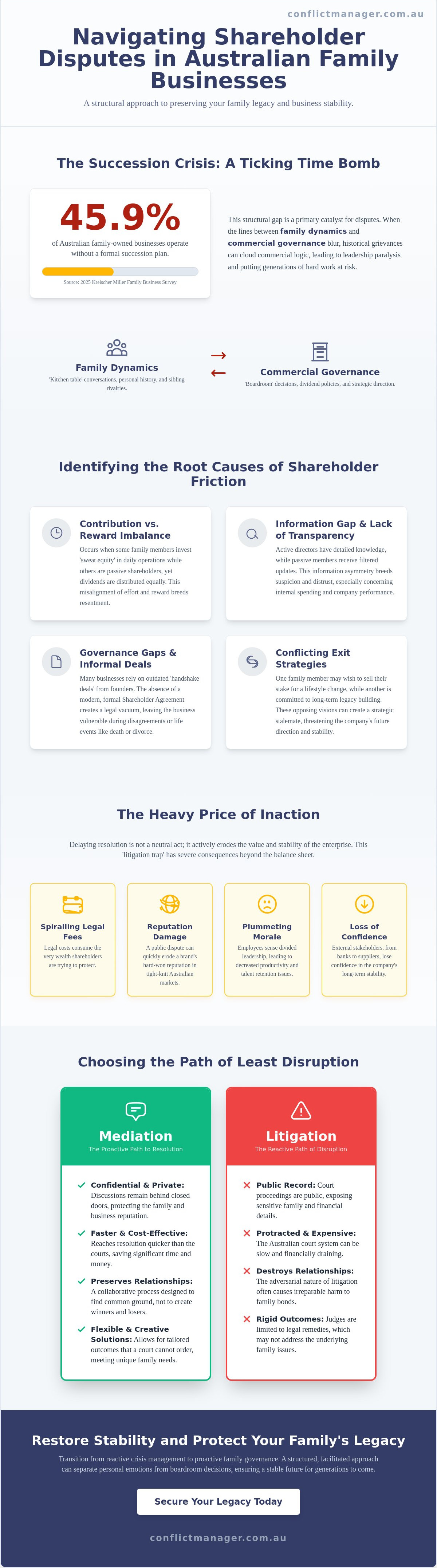
Friction. Ambiguity. Erosion. These are the quiet forces that often precede a total breakdown in governance within a legacy enterprise. With 45.9% of family-owned businesses operating without a formal succession plan, according to the 2025 Kreischer Miller Family Business Survey, it's no surprise that shareholder disputes in family businesses often stem from structural gaps rather than simple greed. You likely feel the heavy burden of this uncertainty. It's the anxiety that a commercial disagreement might escalate into a scorched earth legal battle that dismantles everything your family has built over generations.
We understand that you're seeking a way to resolve these standoffs without destroying the relationships that matter most. This guide offers a composed, structural approach to navigating high-stakes shareholder friction while preserving both your family legacy and business stability. You'll discover a methodical path to separating your commercial responsibilities from your personal roles. We will examine how objective facilitation and professionalised governance can move your organisation from a state of volatile complexity toward a vision of calm, structured resolution.
Key Takeaways
- Understand why the overlap between family dynamics and commercial governance creates unique vulnerabilities in legacy enterprises.
- Discover a structured framework for addressing shareholder disputes in family businesses that prioritises objective facilitation over adversarial legal action.
- Evaluate the strategic benefits of private mediation; it offers a faster and more confidential resolution than the public Australian court system.
- Learn how to conduct a Governance Audit to clarify legal standings and transition from reactive crisis management to proactive family governance.
- Gain insights into preserving your family legacy by effectively separating personal emotions from boardroom decision-making.
The Anatomy of Shareholder Disputes in Family Businesses
Trust. Governance. Continuity. These are the pillars of any successful enterprise, yet they are often the first to crumble when internal friction takes hold. At its core, a shareholder dispute is a fundamental breakdown in the governance and trust that binds equity holders together. While any company can face internal friction, shareholder disputes in family businesses are uniquely volatile because the stakes aren't merely financial; they're deeply personal. The lines between 'kitchen table' conversations and 'boardroom' decisions often blur. This overlap creates an environment where historical grievances can cloud commercial logic, leading to a paralysis of leadership.
In the Australian context, these complexities are frequently magnified by the use of Proprietary Limited (Pty Ltd) structures and discretionary trusts. These vehicles are common for their tax benefits and asset protection, but they can also obscure clarity regarding control and entitlement when transparency fades. A Family Office often serves as a vital circuit breaker in these scenarios, managing the delicate intersection of wealth and family dynamics before the friction becomes terminal.
Structural vs. Interpersonal Friction
Disputes often manifest as disagreements over dividend policies or reinvestment strategies, yet the root cause is frequently a long-standing sibling rivalry or a generational shift in values. The presence of 'shadow directors', family members who exert significant influence without holding a formal title, further complicates the resolution process. These individuals can sway decisions from the periphery, making it difficult for formal leadership to maintain a clear strategic direction. Structural friction is the misalignment of formal governance and informal family expectations. When minority shareholders feel their interests are being ignored, they may seek legal recourse for shareholder oppression, a common catalyst for protracted litigation.
The Cost of Inaction
Delayed resolution carries a heavy price. In the Australian market, where business networks are tight-knit, a public dispute can rapidly erode a brand's hard-won reputation and the integrity of its assets. Shareholders often fall into the 'litigation trap', where spiralling legal fees begin to consume the very wealth they are attempting to protect. Beyond the financial ledger, the internal atmosphere suffers. Employee morale typically plummets when staff sense a divided leadership, and external stakeholders, from banks to suppliers, may lose confidence in the company's long-term stability. Addressing shareholder disputes in family businesses early isn't just about peace; it's about commercial survival.
Identifying the Root Causes of Shareholder Friction
Resentment. Disparity. Entrenchment. These emotional states often underpin the most complex shareholder disputes in family businesses. One of the primary catalysts is the 'Contribution vs. Reward' imbalance. This typically occurs in multi-generational enterprises where some family members dedicate their careers to the daily operations, while others remain passive equity holders. When dividends are distributed equally despite vastly different levels of sweat equity, the active directors often feel undervalued, while passive shareholders may feel suspicious of internal spending. This disparity is not merely a financial issue; it is a structural failure to align individual effort with collective gain.
This tension is frequently exacerbated by an 'Information Gap'. Active directors naturally possess a granular understanding of the firm's financial health, whereas passive family members rely on periodic, often filtered, updates. Without total transparency, this asymmetry breeds distrust. When life events like divorce, death, or sudden incapacity occur without a robust succession plan, these existing fractures can widen into a total breakdown of the commercial structure. Differing exit strategies also play a role. One sibling might wish to sell their stake to fund a lifestyle change, while another remains committed to legacy-building for the next generation. These conflicting visions create a stalemate that threatens the business's stability.
Governance Gaps and Informal Arrangements
Many Australian family businesses rely on 'handshake deals' made by founders decades ago. While these arrangements were built on high levels of trust, they rarely hold weight in a modern commercial environment. Outdated Shareholder Agreements, or the total absence of them, create a legal vacuum. In these instances, the Australian Corporations Act may intervene in ways that neither party anticipated, often imposing rigid solutions on what is a deeply nuanced family dynamic. Engaging in structured stakeholder facilitation can help bridge these governance gaps before they necessitate legal intervention.
The Emotional Weight of Legacy
Legacy is a powerful motivator, yet the desire to 'honour the founder' can sometimes lead to irrational decision-making. High-emotion situations often cloud the objective valuation of the business, as shareholders attach sentimental value to assets that the market views purely in fiscal terms. This psychological toll is significant. Family members may feel 'trapped' within a structure that no longer serves their personal or financial goals, leading to a sense of claustrophobia that manifests as professional obstructionism. Recognising these emotional drivers is the first step toward a methodical resolution.
How to Resolve Shareholder Disputes: A Methodical Process
Clarity. Order. Resolution. Moving from internal gridlock to a structured path requires a deliberate shift in perspective. A 'Governance Audit' serves as the initial diagnostic tool, clarifying the legal and financial standing of all equity holders. This process exposes the gaps between current operations and the formal requirements of the Australian Corporations Act. By engaging a neutral third-party facilitator, the organisation can navigate these complexities without the emotional entanglement that usually stalls internal attempts at resolution. Resolving shareholder disputes in family businesses demands a process that respects both the family's history and the company's future.
Step 1: Establishing a Neutral Ground
Meetings should never occur at the family home or the business headquarters. These spaces are saturated with history and hierarchy. A neutral centre allows participants to step out of domestic roles and into a space of objective negotiation. Setting firm ground rules prevents historical grievances from derailing progress. Every shareholder must feel heard. Before commercial terms are debated, the facilitator ensures each party’s perspective is acknowledged, creating the psychological safety required for compromise.
Step 2: Objective Valuation and Fact-Finding
Disputes often stall on the question of worth. Independent experts provide a 'single source of truth' for business valuation. When the 'valuation argument' is removed, shareholders focus on future strategy rather than historical slights. Forensic accounting plays a critical role if trust has eroded, providing a transparent audit of funds. This data-driven approach is efficient. 2026 data from WifiTalents indicates the median time to resolve a dispute through mediation is 16 days, compared to 60 days for non-mediated resolutions.
Step 3: Crafting Sustainable Outcomes
The goal is a sustainable path forward, not a 'win-lose' scenario. This may involve restructured roles or a graceful exit via a 'Buy-Sell' mechanism. A 'Heads of Agreement' codifies commercial expectations and family conduct, while a formal Family Charter provides the framework for future governance. Finally, legal documents like the company Constitution are updated. Communicating the resolution to the wider organisation restores stability and ensures shareholder disputes in family businesses do not permanently damage the corporate culture.
Mediation vs. Litigation: Choosing the Path of Least Disruption
Privacy. Discretion. Integrity. These are the hallmarks of a resolution reached behind closed doors, far from the public gaze of the Australian court system. When shareholder disputes in family businesses enter the courtroom, they become a matter of public record, often exposing sensitive financial data and deeply personal grievances to competitors and the media alike. Mediation offers a shield against this exposure. It allows legacy enterprises to resolve internal friction within a confidential environment, ensuring that the brand’s reputation remains intact while the structural issues are addressed with total objectivity.
The disparity in timelines is equally stark. While the median federal civil case in Australia can extend to 35.6 months if it proceeds to trial, the median time to resolve a dispute through professional mediation is just 16 days. This efficiency is not merely about speed; it is about capital preservation. Litigation is a process of attrition where legal fees, often exceeding $200,000 for complex matters, erode the very wealth the parties are fighting to secure. Mediation aims for a workable future. Litigation, by contrast, frequently ends in total family estrangement, leaving the business stable but the relationships beyond repair.
When Litigation is Unavoidable
There are rare instances where the courtroom becomes the only viable venue. Red flags such as proven fraud, illegal asset stripping, or a total refusal by one party to engage in good faith may necessitate a judicial outcome. Even in these high-stakes scenarios, the mediation process serves a strategic purpose by narrowing the issues in dispute. This prevents the court from becoming bogged down in minor grievances. While legal teams rely on expert witnesses to dissect past failures, facilitators focus on the mechanics of a future agreement, providing a bridge that legal counsel is often not equipped to build.
The Power of Professional Facilitation
Professional facilitation brings a sense of composed authority to a volatile environment. Lawyers are trained in the language of rights and obligations, yet they often lack the psychological register required to manage the high-emotion elements of a family standoff. A facilitator acts as a steady hand, viewing the situation with total objectivity and guiding shareholders away from reactive behaviour toward logical sequence. This approach ensures that the friction of interpersonal dynamics does not lead to structural collapse. If you are facing a stalemate, engaging in stakeholder facilitation provides a structured alternative to the attrition of the courtroom. Facilitation is a strategic investment in the business's structural integrity.
Restoring Stability and Protecting the Family Legacy
Renewal. Alignment. Resilience. These are the outcomes of a successfully navigated crisis. While the process of resolving shareholder disputes in family businesses is undeniably taxing, it provides a rare opening for total structural renewal. You've moved past the immediate friction. Now, the objective shifts toward transforming reactive management into a proactive governance model that safeguards the enterprise for decades to come. This transition requires a steady hand and a commitment to viewing the business not as a source of personal contention, but as a collective asset with a distinct core purpose. It's about moving from a state of disruption toward a vision of enduring stability.
External advisors play a vital role in this phase. They act as a neutral buffer, ensuring that the progress made during mediation isn't eroded by old habits or lingering resentments. By maintaining a long-term relationship with a professional facilitator, you ensure that the organisation remains agile and focused on growth rather than internal politics. This external perspective allows shareholders to re-engage with the business's core mission, stripping away the emotional weight that previously clouded their commercial judgment.
Implementing Robust Governance Frameworks
The lessons learned during a dispute are the best raw materials for a 'bulletproof' Shareholder Agreement. This document should go beyond legal boilerplate to address the specific triggers unique to your family's dynamic, including clear buy-sell provisions and refined dividend policies. Appointing an independent Board of Directors is another strategic move. These directors provide objective oversight, acting as a circuit breaker when family interests and commercial goals begin to diverge. Utilising Conflict Resolution Consulting ensures that your governance remains a living, breathing framework that adapts to the business's evolving needs, rather than a static document that gathers dust.
Moving Forward with Composed Confidence
A post-dispute environment is defined by clarity and order. With the 'Information Gap' closed and exit strategies clarified, shareholders can re-engage with the business’s vision with renewed energy. This state of composed confidence is the foundation for the next stage of growth. As you look toward the future, engaging a Family Office Mediation expert can help facilitate the next generational transition before friction occurs. This proactive approach ensures that legacy is preserved through structural integrity rather than just goodwill. If you're ready to move from complexity toward a vision of structured resolution, reach out to Conflict Manager for a confidential discussion about your situation.
Securing the Future of Your Legacy
Clarity. Order. Continuity. Resolving shareholder disputes in family businesses requires a deliberate transition from reactive emotional patterns to a methodical, governance-led framework. You've seen how identifying root causes and choosing private mediation over the public attrition of the court system preserves both your commercial capital and your family's relational integrity. By implementing robust governance, you transform a period of friction into a strategic catalyst for long-term stability.
We provide national coverage across Australia, bringing a composed and objective approach to the most volatile environments. With a specialised focus on high-emotion, high-asset disputes, our team offers the seasoned expertise required for high-net-worth family office mediation. We act as the steady hand that guides you through complex transitions without becoming emotionally entangled in the underlying dynamics.
Secure your family's legacy with expert facilitation
A structured resolution is the most powerful gift you can give to the next generation. It's time to move toward a future defined by order and renewed purpose.
Frequently Asked Questions
What are the most common causes of shareholder disputes in Australia?
Common triggers include differing strategic visions and the 'Contribution vs Reward' imbalance. In Australia, the prevalence of Pty Ltd structures often means governance relies on informal trust between family members. When that trust erodes, the lack of formalised roles leads to friction that threatens the business's stability. Addressing these structural gaps early prevents a total breakdown in leadership and preserves asset integrity.
Can a shareholder be removed from a family business without their consent?
A shareholder cannot typically be removed without their consent unless your company Constitution contains a specific 'compulsory acquisition' clause. Without such a provision, Australian law protects minority interests against oppression. Resolution usually requires a negotiated buyout or a structural realignment facilitated by an objective third party to ensure the transition is fair, final, and legally sound for all parties involved.
How much does it cost to resolve a shareholder dispute through mediation?
Mediation is a strategic investment that avoids the significant capital erosion of the courtroom. While litigation for contract disputes often reaches a median cost of $91,000, mediation preserves assets by reaching a resolution in a fraction of the time. This approach ensures that capital remains within the family business rather than being consumed by protracted legal fees and the administrative costs of a public trial.
What is the difference between a Shareholder Agreement and a Family Charter?
A Shareholder Agreement is a legally binding contract that dictates commercial rights, such as voting, share transfers, and exit strategies. Conversely, a Family Charter is a non-binding framework that outlines the family’s values, vision, and conduct. Using both documents together ensures that legal certainty is balanced with the emotional nuances and the long-term legacy of a multi-generational family enterprise.
Is mediation legally binding in Australia?
Mediation is a voluntary process, but the outcome is legally binding once a formal settlement agreement is signed by all parties. In Australia, this contract is enforceable in court like any other commercial agreement. This provides the finality of a judicial decision without the public exposure, high costs, or the adversarial nature of a Supreme Court trial, which can last years.
How do we protect our business's reputation during an internal dispute?
Protecting your reputation requires keeping internal friction out of the public record. Only 1% of federal civil cases reach trial, yet those that do can permanently damage brand integrity and stakeholder confidence. Professional facilitation allows you to resolve issues privately, ensuring that external stakeholders, banks, and suppliers only see a unified and stable leadership team focused on commercial objectives.
What happens if we don't have a formal Shareholder Agreement in place?
Without an agreement, your business is subject to the default rules of the Australian Corporations Act. This creates a legal vacuum where the law may impose rigid outcomes that don't account for your family's unique history or values. Resolving shareholder disputes in family businesses becomes significantly more complex and expensive when no formalised exit or dispute resolution path has been established in advance.
When should we involve an external conflict manager instead of a lawyer?
Involve an external conflict manager when the standoff is driven by interpersonal dynamics or differing visions for the company’s future. Lawyers are essential for drafting final documents, but a facilitator manages the 'high-emotion' elements that legal training does not cover. This proactive approach prevents escalation, provides a sense of order, and builds a foundation for long-term structural health and family unity.


