

Friction. Gridlock. Erosion. The most expensive outcome of a high-stakes executive dispute isn't the final legal fee, but the irreparable fracture of a professional legacy. You likely recognise that when multi-generational tension or stakeholder disagreement reaches the boardroom, the standard instinct is to prepare for public litigation. However, for leaders who prioritise reputational integrity and organisational stability, exploring alternatives to court for business disputes is often the more sophisticated strategic choice. It's a path that values the long-term health of the company over the immediate satisfaction of a courtroom verdict.
We understand that internal resolution efforts often buckle under the pressure of complex human dynamics and structural weight. This guide explores how expert mediation and stakeholder facilitation can resolve deep-seated executive friction while preserving the foundations of your business. You'll discover a methodical approach to navigating these transitions, moving from a state of disruption toward a vision of structured, sustainable resolution. We will examine the logic of external intervention and how it provides the clarity necessary to protect your professional standing and the future of your organisation.
Key Takeaways
- Recognise that leadership friction is often a symptom of structural misalignment rather than personal failure.
- Evaluate the strategic benefits of alternatives to court for business disputes, specifically regarding the preservation of confidentiality and the ability to craft flexible, bespoke outcomes.
- Implement a methodical framework for resolution that begins with an objective assessment of structural drivers and comprehensive stakeholder mapping.
- Understand why the adversarial court system often fails to protect high-stakes executive relationships and multi-generational legacies.
- Discover how professional facilitation provides a neutral, steady presence to guide organisations through periods of high emotional stress toward sustainable clarity.
Beyond the Courtroom: Understanding Alternatives to Court for Business Disputes
Disruption. Friction. Resolution. When a commercial relationship begins to fray, the immediate instinct is often to look toward the legal system for a binary answer. However, the adversarial nature of the courtroom is frequently ill-suited to the nuanced realities of executive leadership and family business structures. By Understanding Alternatives to Court, Australian boards can move away from public conflict toward a more controlled, private environment. These facilitated processes involve a neutral third party who guides stakeholders toward clarity, stability, and sustainable outcomes. It's a shift from asking who is right to asking what is required for the organisation to thrive.
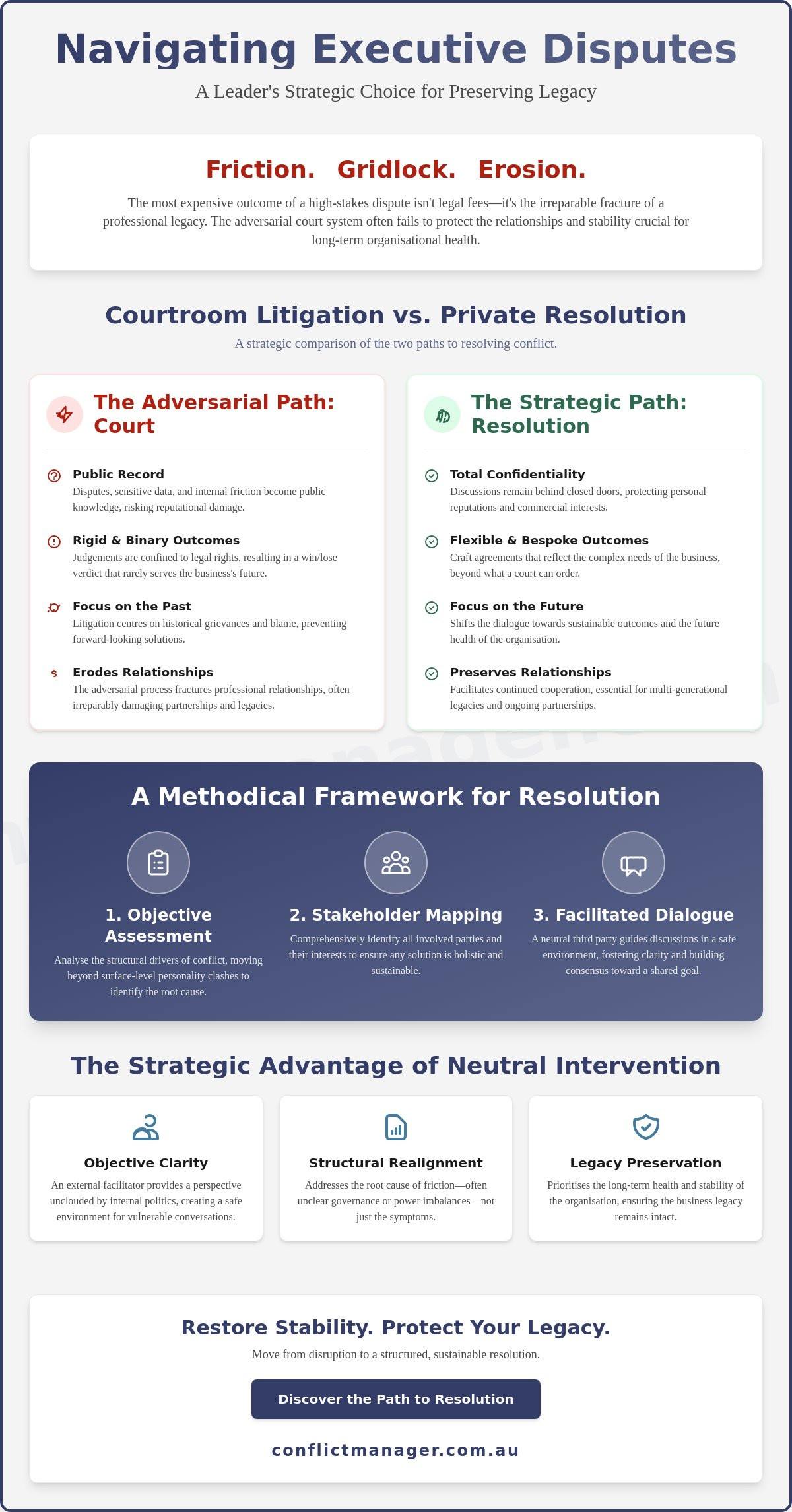
Australian boards are increasingly opting for these pathways because litigation is inherently public and rigid. In a courtroom, the focus remains on historical grievances and legal rights, which often fails to address the underlying structural misalignments. For leaders, the primary risk isn't just a financial loss; it's the reputational damage and the destruction of a professional legacy. Choosing alternatives to court for business disputes allows for total discretion, ensuring that sensitive commercial data and internal frictions remain behind closed doors. This is particularly vital in the Australian market, where professional circles are tight and reputation is a primary currency. Private resolution offers a level of control that a judicial order simply cannot match, allowing for bespoke agreements that reflect the complex needs of the business.
The Strategic Importance of Neutrality
Objectivity. Distance. Safety. Internal HR departments or legal counsel often find themselves in an impossible position during high-stakes friction. They're part of the firm's history and are often emotionally or professionally entangled in the outcome. A truly neutral external facilitator acts as a steady hand, providing a perspective that's unclouded by internal politics. This distance creates a safe environment for stakeholders to express vulnerability and explore options that wouldn't be possible in a standard board meeting or a legal deposition. It's about creating a space where the weight of responsibility can be examined without the fear of immediate judgment or professional reprisal.
Shifting from Litigation to Resolution
A legal win is rarely an organisational victory. While a court might deliver a judgment based on contract law, it cannot rebuild a shattered partnership or restore decision-making efficiency. Shifting the focus toward interest-based negotiation allows parties to move beyond rigid rights-based arguments. This approach focuses on the future health of the business. It establishes a foundation for continued cooperation, which is essential when the parties must continue to work together or manage shared assets long after the immediate dispute is settled. By prioritising sustainable outcomes over legal points, leaders can ensure the business legacy remains intact, even after significant periods of internal disruption.
The Mechanics of Friction: Why Leadership Conflict Requires a Different Approach
Pressure. Misalignment. Stagnation. When executive teams find themselves in a state of recurring friction, the root cause is rarely as simple as a clash of personalities. Instead, conflict is frequently a visible symptom of deeper structural misalignment. In these instances, the rigidity of a legal trial fails to address the underlying mechanics of why a team has stopped functioning. Leaders seeking alternatives to court for business disputes often find that a more analytical, neutral approach is required to untangle these complex human and operational knots.
Power Dynamics and Executive Gridlock
Governance. Authority. Inertia. Unclear governance structures are the primary fuel for internal disputes. When decision-making lines are blurred, power imbalances naturally emerge, leading to executive gridlock. This paralysis isn't just an internal frustration; it's a measurable drain on strategic growth. The cost of conflict serves as a significant and quantifiable depletion of executive bandwidth that could otherwise be directed toward market expansion or innovation. Organisations that fail to address these dynamics often find their competitive advantage eroding as leadership focus shifts from the market to internal survival, making it essential to explore alternatives to court for business disputes before the damage becomes irreversible. For those navigating such transitions, organisational conflict management offers a structured path toward restoring operational clarity.
The Weight of Emotion in Private Wealth
Legacy. Identity. Pride. In the context of private wealth and family-run enterprises, the friction becomes even more rhythmic and complex. Multi-generational wealth transfers and succession planning introduce a high-emotion register that clouds the objective management of corporate assets. Decisions are no longer purely financial; they're influenced by family history and the weight of a professional legacy. Navigating the unique friction found within family trust and estate management requires a steady hand capable of viewing the situation with total objectivity. While organisations like the Federal Mediation and Conciliation Service provide a framework for formal dispute resolution, the specific needs of a family board in Australia require a more bespoke, empathetic touch. It's about acknowledging the human element without becoming entangled in it, ensuring that the business remains stable even as the family navigates its own difficult transitions.
Court vs. Private Resolution: A Strategic Comparison for Leaders
Exposure. Vulnerability. Risk. The decision to pursue litigation is often viewed as a show of strength, yet in the context of high-stakes leadership, it can be the ultimate strategic vulnerability. Many executives hold the misconception that proposing mediation suggests a weak legal position. In reality, choosing alternatives to court for business disputes is a sign of sophisticated risk management. It demonstrates a leader's commitment to protecting the organisation's structural integrity over the ego of a public win. While a court imposes a binary judgment, private resolution allows stakeholders to retain control over the outcome, ensuring the final agreement reflects commercial reality rather than just legal precedent.
The preservation of professional partnerships is perhaps the most significant differentiator. Litigation is designed to produce a winner and a loser, a process that almost inevitably ends professional relationships permanently. For Australian businesses where the network of stakeholders is often tightly interwoven, this level of bridges-burning is rarely productive. Private facilitation prioritises the restoration of a working baseline. It allows for the possibility of future cooperation by addressing the friction without the performative aggression required by the courtroom. This approach recognises that the health of the business legacy is often tied to the stability of its leadership team.
Confidentiality and Reputational Integrity
Privacy. Protection. Peace. For family offices and boardrooms, the threat of a public record is a significant liability. In Australia, court proceedings are generally open to the public, meaning sensitive financial data and internal frictions can become matters of public interest. Private facilitation protects the integrity of the brand and the family name by keeping these discussions entirely confidential. There is a profound psychological relief in resolving disputes away from the public gaze. It allows for a level of honesty that is impossible in a courtroom, where every word is recorded and potentially weaponised by competitors or the media.
Cost, Time, and Executive Bandwidth
Efficiency. Momentum. Future. The disparity in timelines is stark. Litigation in Australian courts can often stretch across multiple years, consuming vast amounts of executive bandwidth. In contrast, mediation is a focused process that can often lead to resolution in a fraction of the time. The hidden costs of court go beyond legal fees. There is the loss of strategic focus, the erosion of staff morale, and the stalling of critical projects. Choosing alternatives to court for business disputes should be viewed as an investment in the future stability of the organisation. It preserves the energy required for market growth, ensuring that the dispute remains a manageable transition rather than a defining crisis.
A Framework for Selecting the Right Path to Resolution
Assessment. Mapping. Method. Resolution. Moving from a state of disruption toward a vision of structured peace requires more than just a desire for quiet; it demands a methodical framework that prioritises organisational integrity. For leaders evaluating alternatives to court for business disputes, the process begins with a rigorous Initial Assessment. This stage is critical for untangling the underlying structural misalignments from the high-emotion emotional drivers that often cloud executive judgment. We then move to Stakeholder Mapping, where we identify the true interests and influence of all parties involved. This often involves looking beyond the formal organisational chart to understand the informal power dynamics that fuel decision-making gridlock.
Once the landscape is mapped, we select the most appropriate method, whether that be mediation, facilitation, or expert determination. Each path offers a different level of intervention, and the choice depends entirely on the specific friction at hand. This leads to Facilitated Engagement, a period of focused dialogue where difficult conversations are managed with total objectivity. The final step is the creation of a Sustainable Agreement. These outcomes must be clear, actionable, and robust, providing a definitive roadmap for the future that leaves no room for the ambiguity that often invites further conflict.
Facilitating Difficult Conversations at the Leadership Level
Precision. Sensitivity. Discretion. The 'quiet approach' is essential when dealing with high-stakes egos and the sensitivities of board-level or family office friction. We employ techniques designed to move stakeholders from entrenched, rights-based positions toward shared commercial interests. It's a delicate balance of power. We ensure every voice is heard without allowing the loudest or most dominant personality to hijack the process. This creates a safe environment where vulnerability is possible, allowing for the honest dialogue required to reach a genuine, impasse-breaking resolution that respects the professional legacy of all involved.
Establishing Governance and Structural Clarity
Order. Integrity. Stability. A successful resolution doesn't just settle the current disagreement; it refines the very governance structures that allowed the friction to occur. By using the resolution process to clarify roles, responsibilities, and decision-making protocols, we build a foundation for long-term stability. Implementing these robust frameworks prevents future disputes and protects the family or firm's legacy from recurring disruption. For organisations ready to transition from gridlock to clarity, our stakeholder facilitation services provide the neutral expertise necessary to navigate these complex transitions with composure.
Restoring Stability: The Conflict Manager Approach
Stability. Objectivity. Order. During periods of profound organisational friction, the presence of a steady, external hand is not just a preference; it's a strategic necessity. Conflict Manager operates as a neutral third party, viewing volatile situations with total objectivity. Unlike traditional legal representation which often seeks to win, our focus is to resolve. We guide stakeholders through high-emotion situations without becoming emotionally entangled ourselves. This distance allows us to identify the structural drivers of conflict that internal teams often overlook. It's about bringing a sense of order when the weight of responsibility feels heaviest.
For leaders exploring alternatives to court for business disputes, our approach offers a path that prioritises the health of the organisation over the finality of a courtroom verdict. We understand that high-stakes environments demand a level of discretion and composure that the public legal system cannot provide. Our commitment is to reach outcomes that are not just legally sound, but commercially and emotionally sustainable. We act as a wise counsellor, helping you navigate difficult transitions with the quiet confidence required to preserve your professional standing. By focusing on movement and structural integrity, we move the conversation away from historical grievances toward a vision of future cooperation.
Expert-Led Facilitation for Complex Stakeholders
Navigating the intricate dynamics of Australian family offices requires more than just technical knowledge. It requires a seasoned professional who remains unruffled when high-stakes ego and sizable assets collide. We provide bespoke solutions tailored to these unique environments, ensuring that every stakeholder feels heard while maintaining a clear focus on the firm's structural integrity. Our Family Office Mediation services are designed to address the rhythmic friction of multi-generational transitions, providing the order necessary to protect both personal relationships and commercial viability. We understand the specific pressures of the Australian market, where reputation and legacy are often the most valuable assets on the balance sheet.
Preserving Legacies and Organisational Integrity
Investing in professional mediation is an investment in the future of the family or firm. Clarity and stability are often the first casualties of internal dispute, yet they're the most critical components for long-term survival. Through Conflict Resolution Consulting, we help organisations reach sustainable outcomes that protect their professional legacies. We ensure that the resolution is not merely a temporary truce but a robust framework for future cooperation. By moving from complexity toward structured resolution, we help you protect the business integrity that took generations to build. It's a methodical progression designed to lower the pulse of the organisation and build trust through logical, objective sequence.
Securing Your Legacy through Strategic Resolution
Clarity. Stability. Integrity. Navigating the friction of leadership requires a shift in perspective. You've seen how conflict is often a symptom of structural misalignment rather than personal failure. By choosing alternatives to court for business disputes, you protect the reputational and financial foundations of your organisation. This path preserves the confidentiality of your board-level or family office dynamics, ensuring that sensitive transitions remain private and controlled. It's a strategic decision that prioritises the long-term health of the firm over the immediate impulse of litigation.
Restoring order to high-stakes environments is the hallmark of a sophisticated leader. Our expert-led mediation for high-net-worth family offices provides the steady hand necessary to manage high-emotion disputes with total objectivity. We focus on neutral stakeholder facilitation to move parties from entrenched positions toward sustainable, interest-based outcomes. It's about ensuring your business legacy remains intact long after the immediate friction has been resolved. Contact Conflict Manager for a confidential discussion on resolving leadership friction. We look forward to helping you find a path back to operational harmony.
Frequently Asked Questions
What is the difference between business mediation and legal arbitration?
Mediation is a facilitated negotiation where the parties retain total control over the final outcome. The mediator acts as a neutral guide to help stakeholders reach a mutual agreement. In contrast, arbitration involves a third party who hears evidence and makes a binding decision. While arbitration is a private version of a court hearing, mediation focuses on restoring relationships and finding collaborative, interest-based solutions.
How long does a typical leadership conflict resolution process take in Australia?
A private resolution process typically concludes within several weeks to a few months. This is a significant departure from the Australian federal civil court system, where cases reaching trial can take a median of 35.6 months to resolve. The timeline for mediation depends on the complexity of the structural friction and the readiness of stakeholders to engage in the facilitated framework. Most matters involve a series of focused sessions designed for efficiency.
Can mediation help if one stakeholder is refusing to communicate?
Professional facilitators are specifically trained to engage stakeholders who have become entrenched or silent. We often begin with individual assessments to understand the structural or emotional drivers behind the refusal to communicate. By creating a neutral environment away from the pressure of the boardroom, we can slowly re-establish a functional channel for dialogue. This steady approach helps lower the emotional stakes and encourages a return to the table.
Is the mediation process confidential for high-profile family offices?
Confidentiality is a primary reason why high-profile family offices choose private resolution over litigation. When evaluating alternatives to court for business disputes, the protection of the family name and brand integrity is often paramount. Unlike court proceedings, which are generally public record in Australia, all discussions and documents in mediation remain strictly private. This ensures that sensitive financial data and internal frictions are never exposed to the public gaze.
What happens if we cannot reach an agreement during private mediation?
If an agreement isn't reached, the parties retain all their legal rights to pursue arbitration or court proceedings. However, the process is rarely without value. Even without a final signed agreement, stakeholders often gain profound clarity on the underlying structural issues and the interests of other parties. This increased understanding frequently provides a foundation for resolving the dispute in the future without the need for further aggressive intervention.
How do we know if we need an external mediator instead of using internal HR?
External intervention is required when internal HR or legal counsel is too close to the dispute to remain objective. Internal staff often face a conflict of interest when dealing with executive leadership or complex family dynamics. A neutral external specialist provides the distance necessary to view volatile situations without emotional entanglement. This authority is essential for creating a safe environment where high-level stakeholders feel comfortable expressing vulnerability and exploring new options.
Can mediation be used for intergenerational succession planning disputes?
Mediation is an ideal tool for navigating the high-emotion register of intergenerational wealth transfers. These disputes often involve a complex intersection of family history, identity, and corporate responsibility. A structured facilitation process allows families to address these deep-seated frictions with total objectivity. By focusing on the long-term stability of the business and the preservation of the family legacy, we can untangle the emotional knots that often paralyse succession planning.
What is the role of a facilitator in a board-level dispute?
A facilitator acts as a steady, neutral hand who manages the process of communication without imposing a decision. They ensure that board-level discussions remain focused on structural objectives rather than personal grievances. This role is a critical component of alternatives to court for business disputes, as it prevents the loudest voices from dominating the room. The facilitator creates the order necessary for the board to move from decision-making gridlock toward a vision of functional, sustainable resolution.


