

Thirty per cent of family members involved in an estate dispute stop talking to each other as a direct result of the fallout. It's a sobering statistic. Legacy. Friction. Estrangement. These are the heavy realities that surface when the structural integrity of a trust begins to buckle under the weight of unspoken grievances. Successfully managing conflict in family trusts isn't about winning a legal battle; it's about navigating a difficult transition with a steady hand and total objectivity.
You likely feel that the current impasse is draining both your emotional reserves and the trust's capital. It's an exhausting position to be in, especially when the path forward feels clouded by opaque decision-making. This guide offers a methodical framework for high-net-worth families to resolve disputes through structured facilitation and objective governance. We'll outline a clear path to restore communication and build a stable structure for the future, ensuring your family's wealth remains a solid foundation rather than a fracture point.
Key Takeaways
- Recognise the dual nature of family trusts as both legal structures and human systems to identify the root causes of systemic friction.
- Explore a methodical framework for managing conflict in family trusts that prioritises confidential resolution over the public and financial costs of litigation.
- Identify "Family Gravity" and communication gaps early to prevent historical patterns from derailing current decision-making processes.
- Utilise a structured checklist to assess trust-related disputes before positions become entrenched and assets are depleted by legal fees.
- Transition from emotional volatility to a stable governance model through the lens of objective, external facilitation.
The Anatomy of Friction: Why Conflict Arises in Family Trusts
A family trust is a dual-natured entity. It is a legal relationship defined by rigorous fiduciary duties; yet, it is also a delicate human system governed by history, emotion, and expectation. When these two spheres overlap without clear boundaries, friction is the inevitable result. Effectively managing conflict in family trusts begins by recognising that this tension isn't usually a sign of individual failure. Instead, it serves as a critical signal that the existing governance structure has been outgrown by the family it was designed to serve.
Triggers. Tensions. Transitions. These elements often converge to create a perfect storm of disagreement. Conflict typically stems from three core triggers: opaque distribution logic, perceived favouritism, and the pervasive "Information Gap" between those who control the assets and those who wait for them. While the legal framework provides the "how" of the trust, it rarely addresses the "why" behind decisions, leaving beneficiaries to fill the silence with their own assumptions. When the logic behind a distribution remains hidden, the vacuum is almost always filled with narratives of inequity.
The Information Gap: Transparency vs. Privacy
Trustees often walk a fine line between their duty to inform and a desire for financial privacy, particularly when trying to shield younger beneficiaries from the weight of significant wealth. This silence is frequently misinterpreted. When beneficiaries feel excluded from the decision-making centre, a lack of clarity quickly breeds suspicion and resentment. The Information Gap is the primary driver of perceived inequity in discretionary trusts. Without a structured flow of information, even the most well-intended decisions can appear arbitrary or biased to those on the outside.
The Succession Shock: Transitioning Control
The transition of wealth between generations acts as the ultimate catalyst for latent conflict. This "succession shock" occurs when the original Founder or Appointor passes control to a new group of stakeholders, often siblings or cousins with varying degrees of financial literacy. Friction arises as traditional family values clash with modern investment philosophies or lifestyle aspirations. The new generation may seek greater autonomy or a different risk profile, challenging the established order. Managing conflict in family trusts during these periods requires a methodical approach to reconcile these differing generational visions within a single, stable framework.
The Human Dynamics of Wealth: Moving Beyond the Trust Deed
A trust deed is a sterile instrument. It dictates the movement of capital and the limits of liability, yet it offers no instruction on the management of human sentiment. While the deed provides the legal skeleton, the family provides the lifeblood; and it's the lifeblood that often becomes turbulent. Successfully managing conflict in family trusts requires us to look past the clauses and toward the people. We must recognise that disputes over asset allocation or investment strategy are frequently proxies for deeper, unaddressed interpersonal dynamics.
Resolution requires a shift in perspective. Most stakeholders enter a dispute with an adversarial mindset, viewing the situation as a zero-sum game where one must win and the other must lose. This approach is inherently destructive to the family unit. A resolution mindset, by contrast, seeks clarity and long-term stability. It acknowledges the friction without letting it define the future. By moving beyond the technicalities of the deed, families can begin to address the structural and psychological roots of their disagreement.
Family Gravity and Entrenched Roles
Internal attempts at resolution often fail because of a phenomenon we call "Family Gravity." This is the invisible, historical pull that forces stakeholders back into old, unproductive roles during a crisis. A successful CEO may find themselves reverting to the role of a "bossy older brother" in the boardroom, while a beneficiary might adopt the persona of the "misunderstood youngest." These patterns are deeply ingrained. When sibling rivalries or parent-child dynamics manifest as technical disagreements over trust assets, total objectivity becomes impossible for those within the system. The lack of a neutral perspective means that even well-meaning suggestions are often viewed through the lens of past grievances.
The Reassuring Path of Objective Facilitation
The introduction of a neutral third party is often the only way to break the cycle of entrenched roles. Objective facilitation allows for a "facilitated conversation," a structured process designed to decouple the person from the problem. This approach doesn't seek to assign blame or litigate the past. Instead, it focuses on the structural integrity of the trust and the preservation of the family legacy. By providing a steady hand and a composed presence, a facilitator can neutralise the emotional charge of a dispute, allowing stakeholders to view the situation with newfound clarity. When the friction becomes too great to manage internally, seeking professional facilitation can provide the order necessary to move from complexity toward a vision of structured resolution. This method preserves the trust's assets while ensuring that the family's human capital remains intact for the next generation.
Mediation vs. Litigation: Evaluating the Resolution Path
Privacy. Discretion. Control. These are the pillars upon which high-net-worth families build their legacies, yet they are the first casualties in a courtroom. When managing conflict in family trusts, the choice between mediation and litigation is a strategic decision that extends far beyond the immediate legal outcome. While litigation offers the finality of a judge's ruling, it does so through a process that is inherently public, rigid, and adversarial. Mediation, by contrast, operates with a composed authority that prioritises the family unit's long-term stability. For the family office or the individual stakeholder, mediation is not a sign of weakness; it is a calculated business decision designed to protect the integrity of the trust's assets and the family's reputation.
The distinction between these paths lies in the nature of the resolution. Litigation is a blunt instrument. It seeks to determine a winner and a loser based on narrow legal interpretations, often ignoring the complex human dynamics we discussed previously. Mediation functions as a surgical tool. It allows for a nuanced exploration of interests, providing a neutral ground where stakeholders can address the "Information Gap" without the threat of a public record. In many jurisdictions, courts are increasingly mandating these alternative paths because they recognise that sustainable resolution is rarely found at the end of a gavel.
The Hidden Costs of the Adversarial Path
The financial toll of litigation is significant. Industry data indicates that total legal costs for trust disputes commonly reach between $50,000 and $200,000, and in complex cases, these figures escalate rapidly. However, the "Public Cost" is often more damaging. Court-mandated discovery can force the disclosure of sensitive financial structures and private family communications, stripping away the confidentiality that trusts are designed to provide. This path often leads to the "Winner’s Curse." You may secure a legal victory and a larger share of the assets, but the process frequently results in a permanent fracture of the family unit. Research suggests that 30% of family members involved in an estate dispute stop talking to each other entirely once the legal battle concludes.
Sustainable Outcomes through Collaboration
Mediation offers a level of flexibility that the legal system cannot match. It allows for "bespoke" solutions, such as the creation of family councils or the restructuring of governance protocols, which a court simply does not have the jurisdiction to order. This collaborative approach is highly effective. Data from 2024-25 indicates that 68% of families who engage in consensual dispute resolution processes successfully resolve some or all of their issues. By choosing a facilitated path, stakeholders can reach a resolution much faster than the years-long slog of the court system. Managing conflict in family trusts through mediation ensures that the final agreement is one the family has built themselves, creating a stable foundation for future governance rather than a court-imposed mandate that satisfies no one.
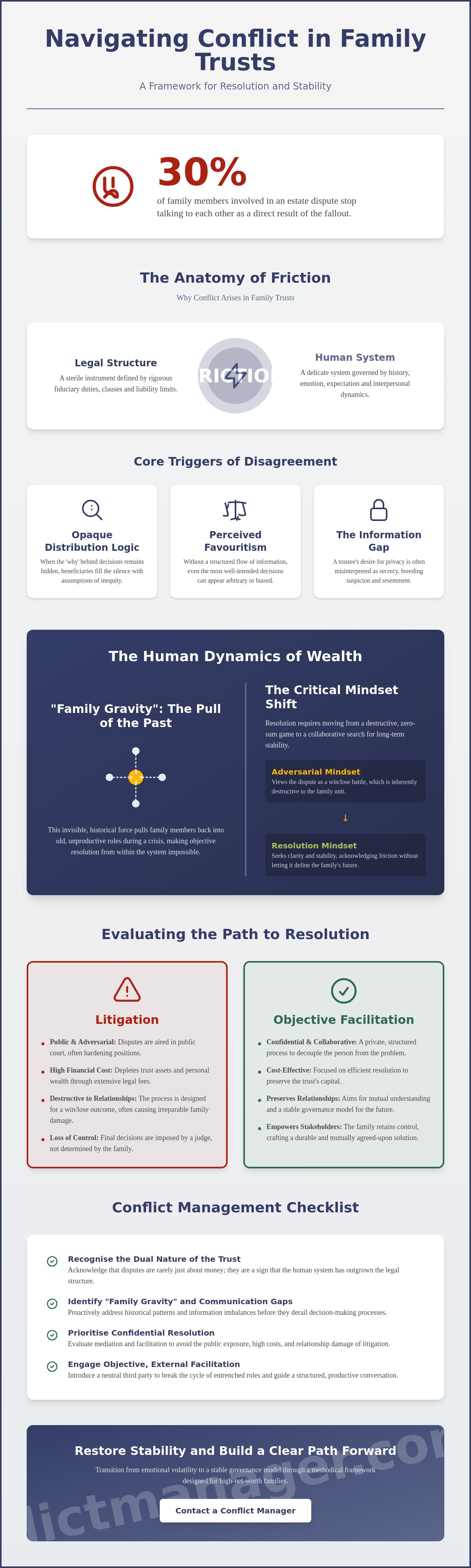
The Family Trust Conflict Management Checklist
Structure. Order. Clarity. These are the essential tools for de-escalating tension within a high-stakes environment. Managing conflict in family trusts is most effective when stakeholders move from a reactive stance to a methodical, proactive assessment. Early intervention is the key to preventing permanent estrangement. Instead of viewing the Trust Deed as a weapon to be wielded in court, it should be treated as a foundational document that provides the baseline for a new, more robust governance agreement. This checklist provides a logical sequence to move from disruption toward a vision of resolution.
Step 1: The Governance Audit
Begin by examining the structural integrity of your current communication channels. How frequently are beneficiaries updated? Is the distribution policy clearly articulated, or does it remain opaque? A thorough audit often reveals that the Trust Deed, while legally sound, fails to address modern family dynamics. It may lack specific provisions for the unique needs of blended families or the philanthropic aspirations of the third generation. Identifying these gaps allows the family to update their internal protocols before the friction turns into a formal dispute. This audit serves as a diagnostic tool, highlighting exactly where the legal structure no longer supports the human system.
Step 2: Engaging the Neutral Third Party
Objectivity is the most valuable asset in any resolution process. When selecting a facilitator, look for a professional who possesses a composed presence and extensive experience with complex wealth structures. It's vital to avoid engaging an advisor who has a pre-existing, deep relationship with only one side of the family. A truly neutral facilitator remains unruffled by the emotional charge of the situation and provides the steady hand needed to guide stakeholders through difficult transitions. If your family is currently experiencing significant friction, engaging a professional for stakeholder facilitation can provide the neutral ground required for a stable resolution.
Step 3: Facilitated Stakeholder Dialogue
Once the audit is complete and a facilitator is in place, the next step is to organise a structured forum for dialogue. This is not a casual family gathering. It is a controlled, objective environment where all beneficiaries have the opportunity to voice their concerns without the pull of "Family Gravity." The focus should remain on establishing a shared vision for the family legacy. By discussing expectations openly, stakeholders can move away from old, unproductive roles and toward a future defined by clear communication and mutual respect. This process ensures that the trust remains a source of stability rather than a catalyst for fracture.
Restoring Stability: The Conflict Manager Approach
Order. Stability. Legacy. These are not merely aspirations; they are the tangible results of a methodical approach to managing conflict in family trusts. At Conflict Manager, we act as the steady hand for families navigating the friction of transition. Our philosophy is rooted in the principle of "Composed Authority." This involves providing a sense of order during periods of high organisational and emotional friction, ensuring that decisions are made based on objective logic rather than temporary volatility. We focus on sustainable outcomes that protect both the trust's capital and the family's human relationships.
Internal efforts to resolve deep-seated disputes often struggle because the participants are too close to the flame. When managing conflict in family trusts, the presence of a neutral advisor changes the chemistry of the room. We don't enter the process to take sides or to litigate the past. Instead, we provide the structural framework necessary to move the conversation forward. This progression is designed to be inevitable and calming, moving stakeholders from a state of complexity toward a vision of structured resolution.
Bespoke Resolution for Private Families
Every family office and private trust possesses a unique structural DNA. We tailor the facilitation process to the specific needs of your family, ensuring that the resolution is as bespoke as the trust itself. Navigating high-stakes environments requires total objectivity. We remain unruffled by the interpersonal dynamics that often entangle internal advisors; this allows us to view the situation with complete clarity. By maintaining this distance, we can address the structural roots of the friction without becoming emotionally entangled in the family's historical patterns. This external perspective is often the only way to break the cycle of "Family Gravity" and establish a new path forward.
Securing the Future Legacy
Professional facilitation does more than resolve a current dispute; it builds the infrastructure for future stability. By establishing clearer succession paths and robust governance protocols, we ensure the family's wealth remains a source of opportunity rather than a catalyst for discord. These new structures provide the transparency that beneficiaries often crave, reducing the likelihood of future misunderstandings. The goal is to provide clarity where there was once only clouded complexity. When the path forward is clearly defined, the anxiety of asset depletion and the fear of estrangement begin to recede. If you're ready to restore order to your family's governance, enquire about professional family trust mediation with Conflict Manager.
Establishing a Path to Lasting Resolution
Conflict is a signal for evolution. We've explored how the Information Gap and the pull of Family Gravity can disrupt even the most robust wealth structures. Successfully managing conflict in family trusts requires more than a simple legal fix; it demands a shift toward structured, objective governance. By choosing facilitation over the adversarial path, you protect both the trust's structural integrity and the family's human bonds. This transition from friction to order ensures that assets remain a source of opportunity rather than a catalyst for estrangement.
Conflict Manager provides the steady hand needed in these high-stakes environments. With specialised expertise in high-net-worth family office mediation and national coverage across Australia, we bring total neutrality to clouded situations. Our focus remains on sustainable outcomes that provide clarity for the future. You don't have to navigate this friction alone. Secure your family legacy through expert-led mediation. Restoring order is possible. With the right framework, your trust can return to its original purpose: providing a stable foundation for generations to come.
Frequently Asked Questions
What is the most common cause of conflict in an Australian family trust?
Disputes over land and property represent the most frequent catalyst for friction, accounting for 51 per cent of estate-related cases. Disagreements regarding liquid money and personal possessions follow at 32 per cent and 21 per cent respectively. These structural tensions are often exacerbated by historical communication patterns that pull stakeholders into unproductive roles during a crisis, making it difficult to reach an objective consensus without external help.
Can a beneficiary sue a trustee for lack of transparency?
Beneficiaries have the legal standing to challenge a trustee for a breach of fiduciary duty if they feel information is being withheld. While a trustee has a duty to inform, this often clashes with a desire for financial privacy. When managing conflict in family trusts, addressing this "Information Gap" through objective facilitation is frequently more effective than litigation, which often results in permanent family estrangement and significant asset depletion.
How does mediation differ from legal representation in a trust dispute?
Mediation involves a neutral third party who facilitates dialogue between all stakeholders to reach a consensual, bespoke agreement. Legal representation is an adversarial process where each party engages an advocate to argue their specific position within a rigid legal framework. While lawyers focus on legal rights, a facilitator focuses on the structural and human dynamics required for long-term stability and the preservation of the family's collective reputation.
Is a family trust dispute a public matter if it goes to court?
Court proceedings are generally a matter of public record, meaning sensitive financial structures and private family communications may become accessible to the public. This lack of confidentiality is a significant risk for high-net-worth families who value discretion. Mediation remains a private process, allowing families to resolve disputes without the "Public Cost" of litigation or the risk of exposing their private affairs to external scrutiny.
How long does the mediation process typically take for complex trusts?
The duration of the mediation process depends on the number of stakeholders, but it's significantly faster than the court system. While litigation can stretch over several years, a structured mediation process typically reaches a resolution within weeks or months. This speed allows families to restore order and move toward a vision of resolution before positions become permanently entrenched and legal fees escalate beyond control.
What happens if one party refuses to participate in mediation?
Mediation is a voluntary process that requires the consent of all parties to be effective. However, Australian courts are increasingly mandating mediation or arbitration before a case can proceed to a trial. If one party is resistant, a neutral facilitator can help them understand the strategic benefits of a private resolution compared to the financial and emotional toll of a public, adversarial legal battle.
Can a neutral third party help with trust succession planning?
A neutral third party is instrumental in succession planning, acting as a steady hand during the transition of control from the Founder to the next generation. They help reconcile traditional family values with modern aspirations, ensuring the "succession shock" doesn't lead to systemic failure. This objective facilitation provides a clear path for managing conflict in family trusts before a leadership vacuum creates an opening for dispute.
What are the benefits of a Family Council in managing trust conflict?
A Family Council provides a formal governance structure that separates family dynamics from the technical management of the trust. It creates a controlled forum for structured dialogue, allowing beneficiaries to voice concerns and establish a shared vision for the family legacy. This proactive approach builds the infrastructure for future stability, ensuring that decision-making processes are transparent and that the family's human capital remains protected from future friction.


