

Legacy. Identity. Control. A commercial dispute is rarely just a disagreement over a contract; it's a visceral struggle over the very elements that define your professional life. When you're managing high emotion business disputes, the line between personal history and commercial assets often blurs until the path forward feels entirely obscured. Internal efforts to resolve these frictions often fail because the parties involved are too close to the heat of the fire, making objectivity nearly impossible to maintain.
You probably recognise the exhaustion that comes from losing control over a hard-won asset or the constant anxiety of a potential public fallout. This guide provides the structural clarity required to move from reactive volatility toward a state of composed resolution. We'll examine how to restore order to your organisation by creating clear boundaries between personal emotion and commercial objectives, ensuring a result that doesn't require years of draining litigation. By the end, you'll understand how to navigate these high-stakes environments with the steady hand of a seasoned professional.
Key Takeaways
- Understand why commercial friction escalates when personal identity and legacy are at stake, particularly within family offices and long-standing partnerships.
- Recognise the hidden drain on executive bandwidth and the risks of reputational erosion when internal disputes lack professional composure.
- Learn practical de-escalation techniques, such as implementing strategic cooling-off periods, to break cycles of reactivity and restore order to the boardroom.
- Discover how a neutral third party provides the objectivity needed for managing high emotion business disputes, bypassing the common traps of historical bias and perceived favouritism.
- Transition from a state of volatile disruption toward a vision of structured resolution, establishing clear boundaries that protect both assets and professional relationships.
What defines a high-emotion business dispute?
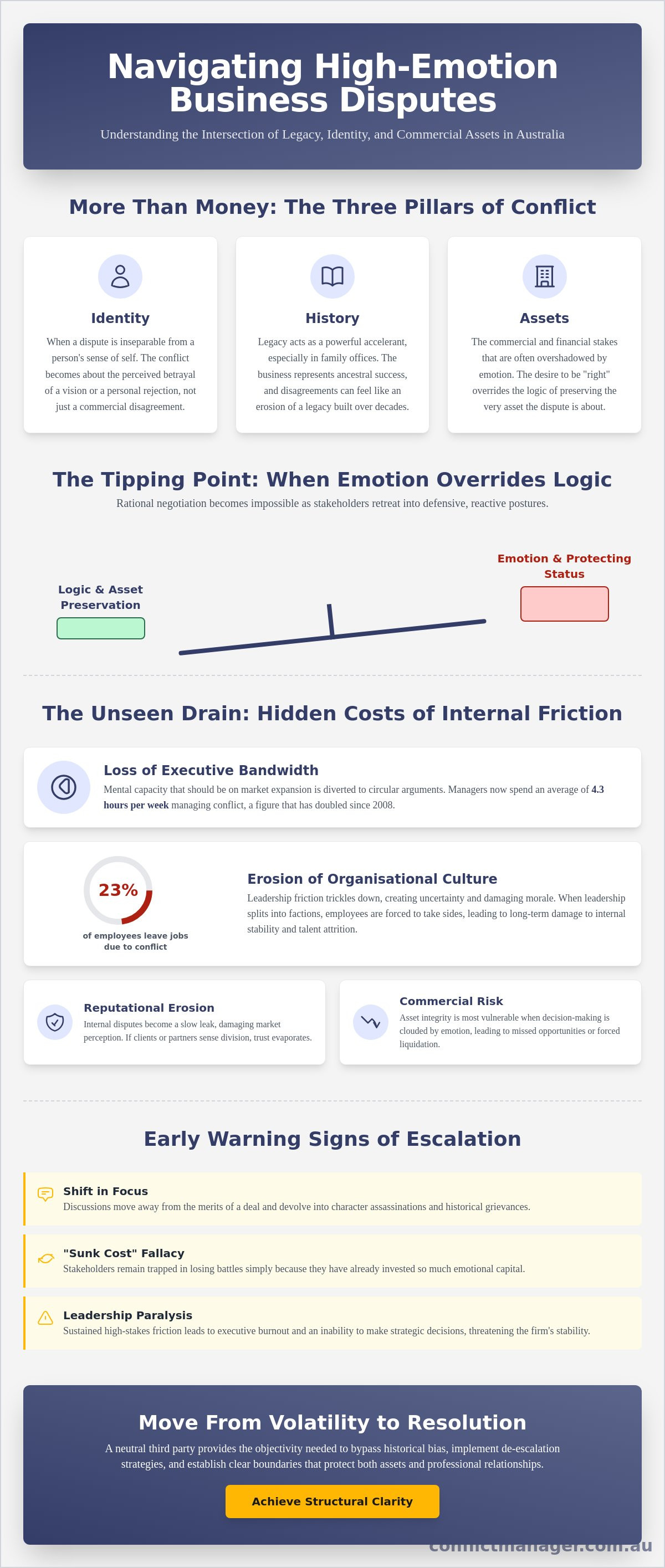
Identity. History. Assets. These are the three pillars of a high-emotion business dispute. While traditional dispute resolution methods often treat conflicts as purely transactional, high-emotion friction occurs when the commercial outcome is inseparable from a person's sense of self. A high-emotion business dispute is a conflict where the psychological stakes exceed the financial ones. In these scenarios, the dispute isn't just about a breach of contract; it's about the perceived betrayal of a shared vision or the erosion of a legacy built over decades.
Legacy acts as a powerful accelerant. For family offices and private wealth structures, the business isn't merely an income stream; it's a testament to ancestral success and future security. When managing high emotion business disputes, one must recognise that the tipping point occurs when the desire to be "right" or to protect one's status overrides the logic of preserving the asset itself. At this stage, rational negotiation becomes impossible as stakeholders retreat into defensive, reactive postures.
The intersection of family and commerce
Intergenerational dynamics introduce layers of complexity that standard mediation rarely accounts for. Within Australian family trusts and private wealth structures, the friction often stems from misaligned values between the founding generation and their successors. These structures are often designed for tax efficiency and asset protection, yet they can become cages when interpersonal relationships sour. The "founder's shadow" can loom large, creating a burden of expectation that makes any commercial disagreement feel like a personal rejection. Success in these environments requires more than just legal expertise; it demands an understanding of the deep-seated emotional currents that drive decision-making.
Recognising the signs of emotional escalation
The transition from objective problem-solving to personal friction is often subtle but devastating. You'll notice a shift where discussions move away from the merits of a deal toward character assassination and historical grievances. The "sunk cost fallacy" often takes hold, keeping stakeholders trapped in losing battles simply because they've already invested so much emotional capital. Recognising these signs is the first step in managing high emotion business disputes before they reach a point of total structural collapse. This sustained high-stakes friction takes a significant organisational toll, leading to executive burnout and a paralysis of leadership that can threaten the very stability of the firm.
The hidden costs of emotional volatility in business
Bandwidth. Focus. Momentum. These are the primary casualties of internal friction. While legal fees are easily tracked on a balance sheet, the unseen drain on executive mental energy is far more corrosive. When leadership is consumed by managing high emotion business disputes, the strategic vision of the firm begins to blur. Mental capacity that should be directed toward market expansion or innovation is instead diverted into preparing for the next circular argument or defensive meeting. Research indicates that managers now spend an average of 4.3 hours each week managing conflict, a figure that has doubled since 2008.
Reputational erosion is rarely a sudden event; it is a slow leak. Internal disputes eventually permeate the organisational perimeter, influencing how clients, partners, and the broader market perceive your stability. If the market senses that a family office or board is divided, trust evaporates. The true cost of a dispute is often the opportunity cost of the growth that never happened.
Erosion of organisational culture
Leadership friction never stays at the top. It trickles down, creating an environment of uncertainty that damages staff morale and triggers talent attrition. When a leadership team or family board splits into factions, employees are forced into the dangerous position of taking sides. This toxicity leads to long-term damage to the brand's internal stability and trust. Statistics show that 23% of employees state workplace conflict has led them to leave a job, a figure that highlights the severe risk to your human capital during periods of volatility.
Commercial risk and asset preservation
Asset integrity is most vulnerable when decision-making is clouded by resentment. In the fast-moving Australian market, delayed decisions can result in missed investment windows or the forced liquidation of assets under suboptimal conditions. Family offices are particularly at risk, as emotional volatility can lead to poor investment choices made out of spite rather than strategy. Managing high emotion business disputes effectively is the only way to ensure commercial logic remains the primary driver of your portfolio's future. Establishing organisational conflict management structures provides the necessary framework to maintain this stability and protect your legacy.
De-escalation strategies: Restoring composure to the boardroom
Order. Clarity. Restraint. When managing high emotion business disputes, the immediate priority is rarely the final settlement; it is the restoration of composure. Without a stable environment, even the most logical resolution will be rejected by stakeholders who feel their identity or legacy is under threat. The most effective tool in these high-pressure moments is the strategic pause. Implementing a formal cooling-off period allows the physiological heat of the conflict to dissipate, breaking the cycle of reactivity that often leads to regrettable decisions or permanent reputational damage.
A fundamental shift in perspective is required to move from friction to functionality. This involves separating the person from the problem, treating the dispute as a structural misalignment rather than a character flaw. When stakeholders stop viewing each other as adversaries and start viewing the conflict as a shared obstacle, the path to resolution becomes visible. The investment mindset is the ability to view a dispute as a capital allocation problem rather than a personal affront. By reframing the situation in this way, you remove the emotional weight from the negotiation table, allowing for a more objective assessment of the commercial stakes involved.
Active listening and emotional intelligence
Effective de-escalation requires moving beyond simply hearing words to understanding the core grievance driving the emotion. Often, a dispute over a specific asset is actually a proxy for a deeper need for recognition or a fear of being sidelined. Reframing the objective from "winning" to "achieving a sustainable outcome" changes the energy of the conversation. Using a measured, rhythmic pace in communication can also help lower the collective pulse of the room. By speaking with a steady, objective tone and avoiding inflammatory language, you provide a grounded centre that others can eventually mirror.
Establishing structural boundaries
Friction often thrives in ambiguity. Defining clear roles and responsibilities reduces the overlap that leads to territory wars, especially in complex family office structures. Utilising formal agendas for every meeting ensures that high-emotion discussions remain on track and focused on objective facts rather than historical grievances. When managing high emotion business disputes, external frameworks and neutral third-party facilitators act as a buffer. These structures depersonalise the decision-making process, ensuring that the final resolution is based on commercial logic and the long-term integrity of the organisation rather than the loudest voice in the room.
The logic of the neutral third party
Perspective. Distance. Objectivity. These are the qualities an internal stakeholder cannot possess during a period of intense friction. When managing high emotion business disputes, the very history that built the organisation often becomes the primary barrier to its survival. Internal attempts at resolution frequently fail because every proposal is viewed through the prism of historical bias or perceived favouritism. This is particularly evident when you consider that 49% of managers are rated as ineffective at conflict resolution; a statistic that suggests the skill set required to lead is distinct from the one required to mediate.
A neutral facilitator acts as a vital circuit breaker. By entering the environment without emotional baggage, they provide a "Steady Hand" effect that naturally lowers the collective pulse of the room. This creates a safe harbour where stakeholders can engage in difficult, high-stakes conversations that would be impossible to have in-house without triggering defensive reactions. While legal mediation often focuses strictly on contractual rights and obligations, strategic conflict facilitation addresses the underlying human dynamics. It seeks to resolve the friction at its source rather than just managing the symptoms of the disagreement.
Objectivity as a premium service
An external counsellor views structural problems without being entangled in the interpersonal web of the firm. They possess the unique license to ask the unaskable question, the one that breaks a deadlock by exposing a hidden truth everyone else is too polite or too frightened to mention. The facilitator isn't a judge handing down a verdict. Instead, they act as a guide leading the parties toward a state of structural clarity. This process allows leaders to step back from the heat of the moment and view the dispute as a challenge to be solved rather than a battle to be won.
Alternatives to the courtroom
Litigation is a blunt and often destructive instrument. In the context of family offices or long-standing partnerships, it frequently exacerbates emotional trauma rather than providing a path to healing. For high-net-worth families in Australia, private and confidential mediation offers a way to resolve disputes without the reputational damage and public scrutiny of a court battle. The focus remains on ensuring sustainable outcomes that preserve the integrity of the assets and the professional relationships for the next generation. If your leadership team is struggling to find a path forward, engaging in professional stakeholder facilitation can provide the necessary distance to restore order and protect your legacy.
Achieving structural clarity with Conflict Manager
Stability. Resolution. Peace. These are not merely desired outcomes; they are the necessary foundations for any enduring commercial legacy. At Conflict Manager, we approach the task of managing high emotion business disputes with a sense of composed authority. We acknowledge that behind every volatile disagreement lies a complex web of human dynamics and structural friction. Our role is to move your organisation from a state of reactive disruption toward a vision of structured resolution, ensuring that the final outcome provides both immediate relief and long-term stability.
We specialise in the unique pressures associated with family offices and multi-generational wealth. In these environments, the stakes involve more than just liquid assets. They involve the preservation of a family's history and future standing. We provide the guidance required to achieve clarity, acting as a neutral anchor when internal efforts have reached a stalemate. Our promise is a process that achieves sustainable peace without sacrificing the integrity of the organisation.
Bespoke resolution for high-stakes environments
Every dispute has its own architecture. We tailor our facilitation process to the specific structural needs of your firm or family trust, avoiding the generic approaches often found in traditional mediation. Our presence is grounded and reassuring. It's designed to lower the collective pulse of the room so that logic can prevail over reactivity. By focusing on structural facilitation, we help you navigate transitions such as succession or divestment with total objectivity. We have successfully guided numerous Australian organisations through periods of profound change, restoring the order required for continued growth.
Your path to a composed resolution
The journey toward a resolution begins with a single, deliberate step. We offer a confidential consultation to assess the specific nature of your structural friction and determine the most effective path forward. When you engage a professional conflict resolution consultant, you can expect a methodical process that prioritises dignity, discretion, and commercial logic. We act as your external counsel, viewing the situation with total objectivity to find the leverage points for a sustainable peace. If your organisation is currently facing internal friction, enquire about our dispute facilitation services today to begin the process of restoring order.
Restoring order to your commercial future
The journey from volatility to structural clarity is built on a foundation of objectivity. Resolving these frictions requires you to look beyond the immediate heat of the argument to the long-term integrity of the organisation. When you focus on separating the person from the problem and implementing clear communication boundaries, the solution often reveals itself. Managing high emotion business disputes isn't about winning a battle; it's about preserving a legacy that could otherwise be consumed by years of draining litigation.
Conflict Manager provides national service coverage across Australia for both private and corporate stakeholders. Our neutral, third-party approach prioritises your structural integrity, offering specialised expertise in high-net-worth family office mediation. We act as the steady hand that guides you through the most complex interpersonal dynamics, ensuring your commercial objectives remain the priority. You don't have to navigate this friction alone.
Secure a composed path to resolution with Conflict Manager. Stability is within reach when you choose a methodical, expert approach to resolution.
Frequently Asked Questions
What is the difference between mediation and litigation in a business dispute?
Mediation is a collaborative, private process where a neutral facilitator helps parties reach a voluntary agreement; litigation is a public, adversarial process where a judge imposes a binding decision. Mediation prioritises the preservation of professional relationships and commercial assets. Litigation often results in high financial costs and permanent reputational damage, making it a less desirable path for those seeking a composed resolution.
How do I manage a business dispute when family members are involved?
Managing business disputes involving family requires a clear separation of personal history from commercial objectives. It's essential to establish formal communication protocols that treat family members as professional stakeholders rather than relatives. This structural distance helps prevent emotional grievances from clouding strategic decision-making, ensuring the family's legacy remains protected while the organisation continues to function with order and clarity.
Can a high-emotion dispute be resolved without going to court?
Most high-emotion disputes can be resolved through professional facilitation or mediation before they ever reach the courtroom. These methods allow for flexible, bespoke solutions that a court simply cannot provide. By addressing the psychological friction early, you can reach a settlement that protects the long-term integrity of the organisation without the trauma and expense of a public trial.
How long does the professional conflict resolution process usually take?
The timeline varies depending on the complexity of the friction, but many facilitated resolutions are achieved within a few weeks or months. This is significantly faster than the Australian court system, where litigation can often drag on for several years. The focus of a facilitator is on achieving a sustainable outcome with efficiency, helping you return to normal operations as quickly as possible.
What should I do if the other party refuses to engage in mediation?
If a party is hesitant, it's often helpful to highlight the risks of alternative paths, such as the extreme cost and public nature of litigation. You might suggest a preliminary, low-pressure consultation with a neutral facilitator to discuss the process. Often, resistance stems from a fear of being unheard, and a professional facilitator can help lower the collective pulse and build trust.
Is business mediation confidential in Australia?
Business mediation in Australia is typically a confidential process, governed by agreements that prevent discussions from being used in future court proceedings. This privacy is a significant benefit for family offices and high-profile firms. It allows for honest, high-stakes dialogue without the risk of public or market fallout, ensuring that sensitive commercial information remains within the boardroom.
How can I tell if our dispute requires an external facilitator?
You likely need an external facilitator when internal discussions have become circular or personal attacks have replaced objective problem-solving. If stakeholders are taking sides or the same arguments repeat without any progress, the situation has reached a tipping point. Managing high emotion business disputes often requires a neutral third party to restore order and view the situation with total objectivity.
What are the benefits of using a neutral third party for family office conflict?
A neutral third party provides the distance necessary to view structural problems without being entangled in complex family dynamics. They bring total objectivity to volatile situations, acting as a buffer that naturally lowers the pulse of the room. This ensures that final decisions are based on commercial logic and the preservation of wealth rather than historical resentment or perceived favouritism.


