

Grief. Friction. Complexity. These forces often converge after a loss, creating a volatile environment where rational discussion feels nearly impossible. Research indicates that 35 per cent of adults have already witnessed estate disputes firsthand, yet few are prepared for the sheer weight of the emotional and financial toll. When internal tensions rise, family estate dispute mediation offers a composed alternative to the destructive path of open litigation. It's a methodical transition that moves the conversation away from the public eye and into a private, neutral space where the focus remains on resolution rather than retribution.
You likely understand that the true cost of a legal battle isn't just measured in solicitor fees; it's found in the permanent fracture of lifelong relationships. This article explores how professional mediation provides a structured environment to resolve complex inheritance friction while protecting your family's integrity and assets. We'll examine the logic of external intervention, the benefits of avoiding a public courtroom, and the specific steps required to reach a sustainable, out-of-court settlement that honours the legacy you've worked so hard to build.
Key Takeaways
- Clarity. Identity. Integrity. Recognise that estate friction is rarely just about financial assets, as it involves deep-seated family history that requires a nuanced approach.
- Discover how family estate dispute mediation provides a neutral, private space to reach bespoke agreements that a court simply cannot order.
- Resolution. Stability. Order. Shift the focus from winning a legal argument to resolving human conflict, ensuring your family's long-term legacy remains intact.
- Learn the importance of setting clear objectives, such as asset preservation or relationship repair, before entering the facilitation process.
- Authority. Objectivity. Support. Understand the value of an objective, external voice in bringing order to high-stress transitions and protecting your family's enduring structural integrity.
Navigating the Complexity of Family Estate Disputes
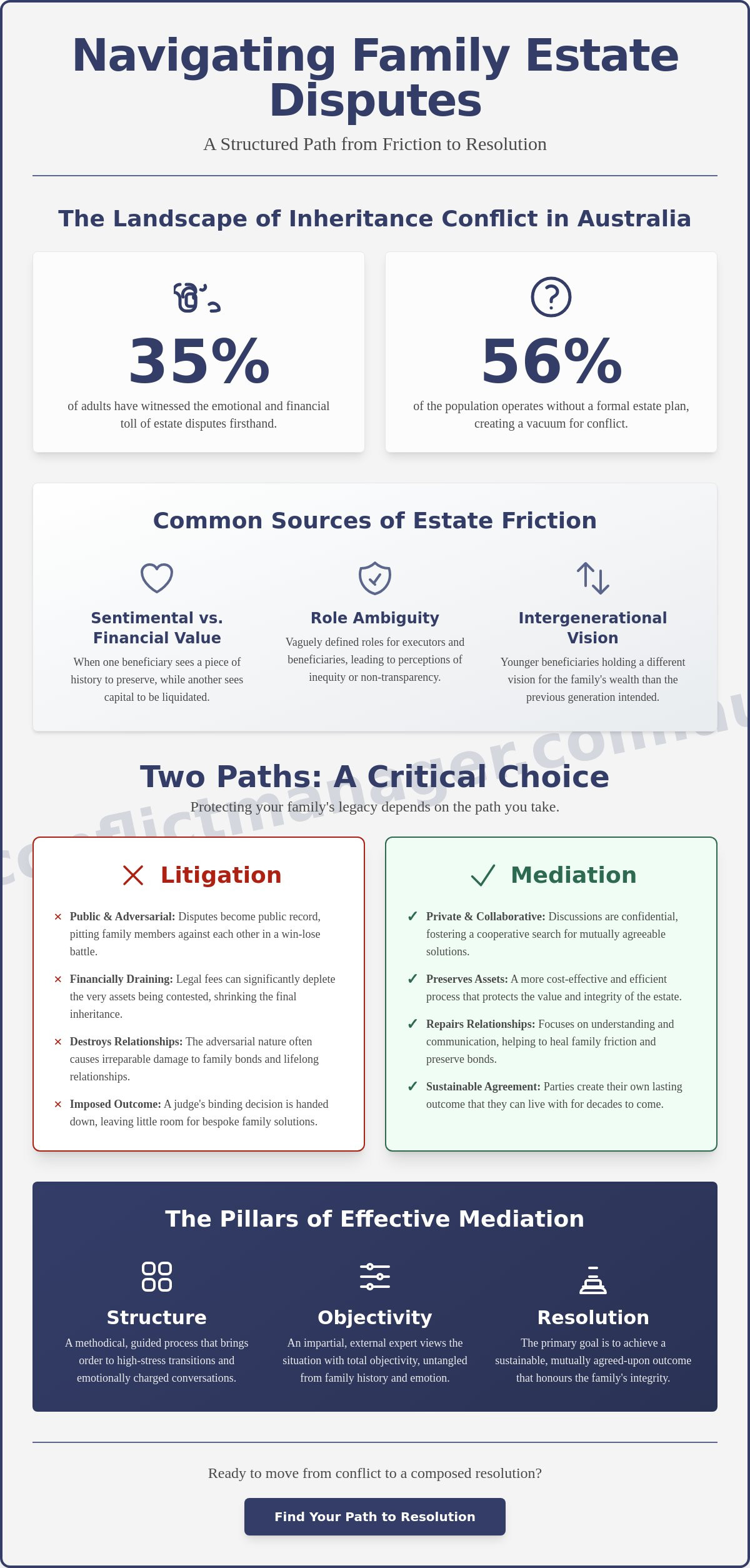
Legacy. Identity. Continuity. These are the silent stakeholders in every estate. When a patriarch or matriarch passes, the distribution of assets often acts as a catalyst for long-dormant grievances. It isn't merely about the family home or a share portfolio; it's about the perceived value of one's place within the family unit. Research from June 2026 indicates that 35 per cent of adults have already experienced or witnessed such friction, yet 56 per cent of the population still operates without a formal estate plan. This lack of a roadmap creates a vacuum, often filled by confusion and deep-seated resentment.
Unresolved conflict doesn't just hurt feelings; it creates structural instability that can threaten the very integrity of a family trust or office. When beneficiaries stop communicating, the movement of assets stalls and the legacy begins to erode. Engaging in family estate dispute mediation offers a way to halt this decline. It provides a neutral, private space where an external expert can view volatile situations with total objectivity. Understanding What is Mediation? is the first step toward reclaiming order from chaos. It's about moving from a state of disruption toward a vision of structured resolution.
The High Cost of Silence and Litigation
Litigation is a blunt, public, and exhausting instrument. It often depletes the very assets it seeks to divide. Legal fees in 2026 can be substantial, with standard probate matters often costing thousands, while contested cases can spiral into much higher figures. Beyond the financial drain, the risk of public exposure is high. Court proceedings can make private family matters a matter of public record, potentially damaging a family's standing or business reputation. Silence is equally dangerous. It often masks growing resentment that eventually erupts during the probate process, turning a manageable disagreement into a permanent fracture.
Identifying Common Friction Points in Inheritance
Disputes rarely happen in a vacuum. They typically centre on a few recurring themes that require a steady hand to navigate. Only 28 per cent of families expect a smooth wealth transfer, while 53 per cent anticipate problems such as delays and conflict. These issues often include:
- Sentimental vs Financial Value: Conflict arises when one beneficiary views an asset as a piece of history to be preserved, while another sees it as capital to be liquidated.
- Role Ambiguity: Tension often flares when the roles of executors and beneficiaries aren't clearly defined, leading to perceptions of inequity or a lack of transparency.
- Intergenerational Vision: With 60 per cent of families expecting a wealth transfer within the next decade, younger beneficiaries often hold a different vision for the future of the family’s wealth than the previous generation intended.
What is Family Estate Dispute Mediation?
Structure. Clarity. Resolution. These are the pillars of the mediation process. Unlike the binary nature of a courtroom, where one party must lose for another to win, family estate dispute mediation is a collaborative facilitation. It is a methodical progression where all stakeholders are invited to contribute to a shared solution. The mediator doesn't act as a judge or an arbitrator. They don't hand down mandates or issue binding orders. Instead, they guide the conversation toward a logical sequence that reflects the group's collective interests. This approach highlights the Advantages of Mediation in Estate Planning, particularly when dealing with complex assets or blended family dynamics. It moves the focus away from legal technicalities and back toward the structural integrity of the family unit.
The goal is to reach a sustainable outcome. In the context of inheritance, sustainability means more than just a signed agreement; it means a resolution that the family can live with for decades to come. By removing the adversarial "us versus them" mentality, mediation allows beneficiaries to speak openly about their needs and concerns. This transparency often reveals that the friction is less about the assets themselves and more about the desire for recognition or fairness. When these underlying human dynamics are addressed, the path to a financial settlement becomes much clearer.
The Role of the Neutral Third Party
High stakes. Volatile emotions. Complex history. These elements can easily overwhelm internal attempts at resolution. A mediator brings a sense of composed authority to the room. They remain unruffled by the friction, acting as a steady hand that ensures the process remains objective. Their role is to ensure all voices are heard without becoming emotionally entangled in the family's past. By lowering the pulse of the discussion, they allow participants to move past reactive emotions and toward a vision of sustainable order. For families seeking this level of objective guidance, engaging in professional conflict resolution can be the difference between a legacy preserved and one lost to litigation.
Confidentiality and Privacy in Mediation
Privacy is a cornerstone of this method. Unlike public court records, which anyone can access, what happens in mediation stays within the room. This confidentiality allows for more candid discussions and creative problem-solving that a court simply cannot provide. Under Australian law, communications made during a mediation session are generally protected by statutory confidentiality and cannot be used as evidence in subsequent court proceedings. This legal safeguard ensures that sensitive family matters remain a private concern, protecting the reputation and standing of the family in the wider community.
Mediation vs. Litigation: Protecting Your Family Legacy
Binary outcomes. Winners and losers. Adversarial combat. These are the hallmarks of the courtroom, where litigation focuses on the narrow interpretation of legal text rather than the preservation of human relationships. In contrast, family estate dispute mediation prioritises the resolution of conflict through dialogue and mutual understanding. While a solicitor in a trial setting seeks to "win" an argument, a mediator seeks to "resolve" a situation. This distinction is vital for families who wish to keep their private matters away from the public record and maintain the structural integrity of their family office or trust.
The flexibility of mediation allows for bespoke solutions that a court simply cannot order. A judge is bound by strict legal precedents and statutory frameworks, often resulting in the forced sale of assets or a rigid division of funds. Mediation enables stakeholders to craft creative asset management rules. For instance, a family might agree to keep a holiday home in a trust with specific usage rights, or allocate shares in a family business based on active participation rather than equal percentages. These nuanced arrangements are the foundation of a lasting legacy. It's about moving from a state of disruption toward a vision of structured resolution.
Maintaining Control over the Outcome
In the quiet environment of a mediation room, the family retains the power. You aren't handing your future over to a stranger in a wig who has never met your children or understood your parents' values. A judge’s ruling is often a blunt instrument that leaves everyone feeling unheard. By focusing on Preventing a Probate Fight, mediation encourages "win-win" scenarios. It moves the conversation from "what I am owed" to "what we need to move forward," ensuring the decision-making power remains exactly where it belongs: with the family.
The Financial and Emotional ROI of Resolution
Efficiency is a form of preservation. Litigation often spans years, during which time the estate's value is eroded by mounting legal costs. Verified data for 2026 shows that probate attorney fees typically range between $250 and $500 per hour, meaning a prolonged battle can easily consume tens of thousands of dollars. Mediation, however, is usually measured in weeks. By reducing billable hours, you preserve more of the estate for future generations. The emotional return on investment is even greater. The stress of a public court battle can cause irreparable psychological damage. Choosing a composed path leads to less friction in the years following the settlement, allowing for a more stable transition of wealth.
Preparing for a Successful Estate Mediation Process
Preparation. Order. Foundation. These are the elements that transform a chaotic disagreement into a manageable process. While previous sections explored the mechanics of the room, the success of family estate dispute mediation begins long before the first meeting. It requires a deliberate shift from a reactive state to a proactive one. Before stakeholders gather, they must step back from the immediate friction to assess their true intent. Is the primary goal financial gain, the preservation of family harmony, or the structural integrity of specific assets? Clarity on these objectives acts as a compass, moving the group from a state of disruption toward a vision of structured resolution.
Data is the bedrock of objectivity. Gathering all relevant documentation, including current wills, trust deeds, and independent asset valuations, is a non-negotiable step. When stakeholders enter the room with a shared set of facts, the opportunity for ambiguity diminishes. This transparency ensures that the conversation remains grounded in reality rather than assumption, allowing the mediator to guide the group through a methodical and logical progression. It's about ensuring that everyone is willing to engage with the process in good faith, acknowledging that the path forward requires a commitment to order over ego.
Defining Your Non-Negotiables and Flexible Points
Stakeholders should arrive with a clear understanding of their primary needs. It's essential to distinguish between sentimental attachments, such as a family heirloom, and financial requirements, like a specific cash distribution. Recognising where you can be flexible isn't a sign of weakness; it's a strategic move toward long-term stability. By identifying these points early, you create space for the creative problem-solving that defines successful mediation. This internal clarity prevents the session from stalling on minor points and keeps the focus on the broader legacy.
Engaging the Right Facilitator
High-net-worth family dynamics require a specific type of guidance. You need a facilitator who remains unruffled by high-stakes environments and understands the weight of intergenerational responsibility. The right expert projects an image of stability, acting as the wise, external counsellor who can view volatile situations with total objectivity. Knowing When to Engage a Neutral Third-Party Mediator is critical to preventing further erosion of the estate's value and the family's integrity. If your family is navigating a complex transition, you may benefit from a steady hand to lead the way. To begin your journey toward a composed resolution, explore our Family Conflict Resolution services today.
Composed Resolution: The Conflict Manager Approach
Order. Clarity. Integrity. These are the markers of a successful transition. Conflict Manager acts as the steady, objective voice required to guide families through their most difficult periods of friction. We understand that the management of sizable family assets carries a heavy weight of responsibility, often stretching across multiple generations and complex legal structures. Our approach purposefully avoids the sensationalism and artificial urgency often found in litigation. Instead, we focus on the movement toward structural integrity. We ensure the legacy remains intact while the human dynamics are handled with quiet discernment and professional expertise.
By engaging in family estate dispute mediation through our facilitation, stakeholders gain access to a wise, external counsellor. We remain unruffled by high-stakes environments, providing the necessary distance to view volatile situations with total objectivity. This perspective is vital when internal efforts have stalled under the pressure of emotional history and complex inheritance friction. We act as a neutral third party that brings clarity to clouded situations, allowing families to see the path forward when they're too close to the conflict to find it themselves. When families choose family estate dispute mediation with a professional facilitator, they're investing in the longevity of their relationships and the preservation of their wealth.
Tailored Facilitation for High Net Worth Families
Our services are bespoke. They're designed to handle the friction of interpersonal dynamics without becoming emotionally entangled in them. We specialise in family office mediation, a critical service for families navigating the complexities of leadership changes or intergenerational wealth transfers. We recognise that these transitions often create structural instability; therefore, our role is to provide a grounded, reassuring presence that suggests a deep understanding of these human and structural dynamics. The goal is always a sustainable outcome that honours the family’s long-term vision, ensuring that the transition of assets doesn't come at the cost of family unity.
Achieving Clarity and Stability
The communication flow we employ is methodical and logical. We move participants from a state of complexity toward a vision of structured resolution. This progression feels inevitable. It's designed to lower the pulse of the room and build trust through a logical sequence of discovery and agreement. Our methodical flow ensures that every stakeholder feels the process is both thorough and efficient, leaving no stone unturned in the pursuit of a lasting settlement. If you're ready to move beyond the disruption of inheritance friction, you can experience a composed approach to family dispute resolution that prioritises your family's future and legacy through professional facilitation.
Securing the Future of Your Family Legacy
Legacy. Continuity. Resolution. Choosing a path that prioritises these values is the most significant decision a family can make during a period of disruption. We've examined how the adversarial nature of the courtroom often erodes both financial capital and family character. In contrast, family estate dispute mediation offers a private, structured alternative that allows for creative solutions a judge simply cannot provide. By focusing on bespoke outcomes rather than binary legal victories, you can ensure that your family office remains stable and the inheritance process remains respectful of those who came before you.
Conflict Manager brings a deep understanding of high-net-worth family dynamics to every facilitation. We provide independent and objective third-party guidance with national service coverage across Australia, acting as a steady hand when internal tensions are at their highest. If your family is navigating the friction of an inheritance disagreement, it's time to move toward a vision of structured resolution. You can consult with a neutral expert to resolve your family estate dispute and begin the methodical process of reclaiming order. A composed path to legacy preservation is within reach, ensuring your family's integrity remains as enduring as the assets you protect.
Frequently Asked Questions
Is family estate dispute mediation legally binding in Australia?
The outcome of family estate dispute mediation becomes legally binding once all parties sign a written settlement agreement. While the discussion itself is confidential and non-binding, the resulting document serves as a contract that can be formalised through court consent orders. This ensures the resolution carries the same weight as a judicial decision without the public friction of a trial.
How long does the estate mediation process typically take?
The timeframe for mediation is typically measured in weeks rather than the years often required for litigation. Most disputes reach a resolution within one or two full-day sessions following a brief period of intake and preparation. This efficiency allows families to move from a state of disruption toward structural stability much faster than the traditional court system permits.
What happens if one family member refuses to participate in mediation?
Participation in private mediation is voluntary, but a refusal can lead to a court-mandated session if litigation has already commenced. Judges in Australian probate matters frequently order parties to attempt mediation before a trial date is set. If a stakeholder remains unwilling, the process cannot proceed privately, often leaving the family with no choice but the more expensive path of a court hearing.
Can we use mediation if we have already started legal proceedings?
You can engage in family estate dispute mediation at any stage of the legal process, even if a court date has been scheduled. Many families find that the pressure of looming litigation provides the necessary impetus to seek a composed, out-of-court settlement. Transitioning to a neutral facilitation often halts the erosion of estate assets and prevents further damage to family relationships.
Who should attend the estate mediation session?
All primary beneficiaries and the executors of the estate should attend to ensure any agreement is comprehensive and final. In cases involving complex family offices, legal advisors or financial experts may also participate to provide technical clarity. The goal is to have all decision-makers in the room so the resolution remains stable and durable for the long term.
How is the cost of a private mediator usually shared among beneficiaries?
The costs are typically split equally between the parties involved or paid directly from the estate assets by mutual agreement. Sharing the financial responsibility reinforces the neutral nature of the process and ensures all stakeholders have an equal investment in the outcome. This arrangement avoids the perception of bias and supports the structural integrity of the final settlement.
What is the difference between a mediator and a family lawyer?
A mediator acts as a neutral third party to facilitate a shared resolution, whereas a family lawyer advocates specifically for the interests of one individual. While a lawyer's role is to ensure their client "wins" under the law, a mediator focuses on resolving the human and structural friction for everyone involved. Both roles are important, but the mediator provides the objective steady hand required for collective clarity.
Is mediation suitable for complex trusts and offshore assets?
Mediation is exceptionally well-suited for resolving disputes involving intricate trust structures and international holdings. These complex environments often require bespoke solutions that a standard court order is too rigid to provide. A neutral facilitator can help stakeholders navigate the technical and emotional nuances of offshore assets, moving the family toward a vision of global structural order.


