

The true cost of internal friction isn't found on a balance sheet; it's measured in the slow erosion of a legacy you've spent decades building. When disputes are left to fester, they don't just damage relationships. They paralyse decision-making, invite reputational risk, and eventually threaten the very core of your asset integrity. Recognising the professional conflict resolution benefits is the first step toward moving from a state of volatility to one of structured order. It's about more than just stopping an argument. It's a strategic investment in your future stability.
You probably recognise that internal attempts to settle deep-seated grievances often fail because the people involved are simply too close to the fire. It's difficult to remain objective when your own history is part of the problem. This article will show you how expert-led facilitation acts as a critical safeguard for your wealth and organisational health. We'll explore the methodical logic of external intervention and how it delivers sustainable, clear outcomes that protect your multi-generational legacy for years to come.
Key Takeaways
- Recognise why resolving deep-seated friction is a strategic imperative for maintaining organisational order and ensuring clear, decisive leadership.
- Learn how a neutral third party untangles complex interpersonal dynamics that often paralyse even the most seasoned internal teams.
- Discover the primary professional conflict resolution benefits that act as a safeguard for your family legacy and prevent the erosion of substantial assets.
- Understand the limitations of internal mediation and how external facilitation bypasses the biases that frequently stall progress in high-stakes disputes.
- Identify the methodical steps required to move from a period of disruption toward a state of long-term structural stability and stakeholder harmony.
Beyond the Surface: The Strategic Imperative of Conflict Resolution
Disruption. Stagnation. Decay. In high-stakes environments, conflict is rarely a simple disagreement over policy or procedure. It's often a fundamental misalignment of values or a breakdown in the structural integrity of the organisation itself. Professional conflict resolution is a methodical, disciplined process designed to restore order where there is chaos and clarity where there is confusion. One of the most significant professional conflict resolution benefits is the ability to transform volatile friction into a stable foundation for future growth. It's the difference between a temporary truce and a permanent solution.
Defining Resolution in High-Stakes Environments
Clarity. Stability. Discernment. In the context of family offices or corporate boards, achieving resolution requires a level of sophistication that goes far beyond basic communication skills. It's not about merely 'settling' a dispute to keep the peace for another week; it's about reaching a sustainable, clear outcome that respects the long-term legacy of the institution. For those seeking a comprehensive overview of conflict resolution, the field is understood as a rigorous academic and professional discipline that prioritises objective analysis over emotional reaction. In the Australian professional context, this demands a steady hand and a neutral perspective that internal parties simply cannot provide.
The Hidden Costs of Unresolved Friction
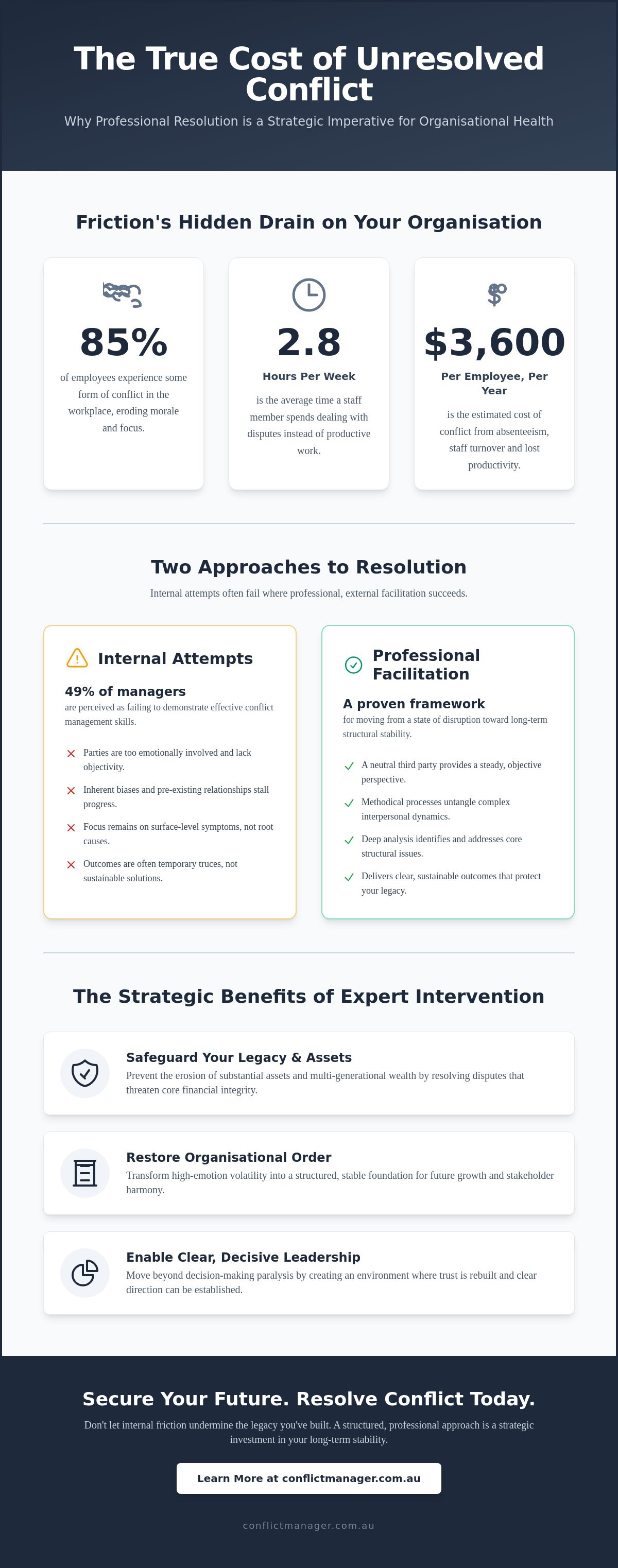
Avoidance is a costly strategy. When friction remains unaddressed, it acts as a catalyst for catastrophic structural failure. Research indicates that 85% of employees experience some form of conflict at work, with the average staff member spending 2.8 hours per week dealing with these disputes. For a business, this equates to billions in lost productivity. In fact, workplace conflict costs employers approximately $3,600 per employee each year when factoring in absenteeism and "presenteeism," where employees are physically present but mentally disengaged.
Beyond the financial metrics, the psychological toll on stakeholders is profound. Decision-making paralysis becomes the norm. Trust erodes. The slow decay of trust within a family office or board can lead to the fracturing of multi-generational wealth. By moving from reactive firefighting to a proactive, strategic framework, leaders can secure their legacy and ensure that internal friction doesn't become a permanent barrier to progress. Professional conflict resolution benefits the entire ecosystem by replacing high-emotion volatility with a structured path forward that protects both assets and relationships.
The Architecture of Resolution: How Expert Mediation Restores Order
Restoring order requires a blueprint. It isn't enough to simply talk through a grievance; one must construct a framework where complex dynamics can be untangled without causing further damage to the organisation. One of the primary professional conflict resolution benefits is the introduction of a steady, objective voice into a volatile environment. This external counsellor acts as a neutral party, viewing the situation with total objectivity to address root causes rather than just the visible symptoms of friction. By focusing on structural integrity, the process moves the group from a state of disruption toward a vision of calm, methodical progress.
The Psychology of the Neutral Third Party
Objectivity is often the first casualty of internal disputes. When stakeholders are emotionally entangled in a family office or a corporate board, they lose the ability to see the structural reality of the situation. This lack of distance is why internal efforts often struggle. Research suggests that 49% of managers are perceived as failing to demonstrate effective conflict management skills, often because they are too close to the participants. A neutral third party provides a "steady hand" effect, where a composed presence naturally lowers the pulse of the room. This environment allows for the importance of conflict resolution skills to manifest through active listening and strategic facilitation. The goal is to guide the conversation without becoming a participant in the grievance itself.
Frameworks for Sustainable Outcomes
Sustainable outcomes require more than a simple split-the-difference compromise. True resolution aligns with long-term strategic goals and the preservation of legacy. It involves drafting agreements with precision and nuance, ensuring every stakeholder feels heard while maintaining a vision of structured order. To achieve this, the process must move beyond reactive firefighting. It requires a deliberate pace. For those navigating these difficult transitions, engaging in professional Stakeholder Facilitation can provide the necessary clarity to move forward. By untangling these threads, we ensure the outcome holds under pressure, protecting the organisation's future. The focus remains on the movement from complexity to clarity, ensuring that the resolution is not just reached, but maintained through subsequent generations of leadership.
Internal Friction vs External Objectivity: A Comparison of Approaches
Proximity. History. Blindness. Internal leaders often believe that their deep, intimate knowledge of a business or family dynamic is their greatest asset during a dispute. However, this very proximity often acts as a veil, obscuring the root causes of friction behind years of historical baggage and unspoken power imbalances. One of the primary professional conflict resolution benefits is the ability to bypass these cognitive biases entirely, allowing for a perspective that is unburdened by the past. While keeping it in-house may feel safer, it frequently results in a cycle of temporary truces rather than a permanent restoration of order. Internal HR or family leaders rarely manage to be truly neutral. Even with the best intentions, they fall into the trap of self-serving fairness, where their proposed solutions subconsciously favour their own perspective or the existing power structure.
The most common objection to external intervention is the belief that an outsider couldn't possibly understand the nuances of a specific family or board; in reality, it's that very lack of familiarity that provides the necessary clarity. An external expert doesn't need to know every detail of a twenty-year-old grievance to identify the structural breakdown occurring today. They bring the efficiency of expertise, often reaching a resolution in days that would take months of circular, internal debate to even begin addressing. This speed is essential for maintaining momentum and preventing the dispute from further damaging the organisation's reputation or bottom line.
The Limits of Internal Mediation
Power imbalances are the invisible barriers to internal resolution. When a senior stakeholder or a family leader attempts to mediate, their authority creates an inherent pressure that stifles honest dialogue. Subordinates or younger family members may feel unable to speak freely for fear of future repercussions, leading to a superficial agreement that lacks genuine buy-in. This perceived bias is often insurmountable, as every suggestion from the internal mediator is scrutinised for hidden agendas. Investing in professional intervention highlights the benefits of resolving conflict at work by ensuring the process is led by someone with no personal stake in the outcome.
Why Professional Expertise Outperforms Intuition
Discernment. Objectivity. Composure. A seasoned professional remains unruffled by the high-stakes environments and emotional outbursts that typically derail internal discussions. They use an elevated corporate register and precise, impactful terminology to navigate difficult transitions, ensuring the conversation remains focused on structural integrity rather than personal character. This methodical, logical progression moves stakeholders from a state of disruption toward a vision of structured resolution. One of the most valued professional conflict resolution benefits is this sense of inevitable progress, where a proven framework provides the stability that intuition alone cannot replicate. By applying a methodical approach, the expert provides a sense of order that transforms a volatile situation into a manageable transition.
Quantifiable Gains: Asset Integrity and the Preservation of Legacy
Wealth. Continuity. Purpose. The preservation of a multi-generational legacy requires more than sound financial advice; it demands a stable interpersonal structure. One of the most critical professional conflict resolution benefits is its role as a safeguard for asset integrity. When internal friction goes unaddressed, it often leads to the fracturing of sizeable assets as stakeholders seek to exit or liquidate their interests. Maintaining stability during intergenerational succession or structural change isn't just a matter of harmony. It's a financial necessity. Effectively managed disputes prevent the erosion of wealth that occurs when decision-making becomes paralysed by internal friction.
Legacy as a Structural Foundation
Multi-generational family offices must remain functional to survive the transition of power. Internal disputes can quickly lead to the mismanagement of trusts or the liquidation of family businesses to satisfy departing stakeholders. Professional mediation provides the neutral space needed to untangle these complex dynamics before they reach a point of no return. Legacy preservation is the deliberate act of maintaining structural harmony to ensure that wealth and purpose endure across generations. By addressing the root cause of friction, families can protect the integrity of their shared assets and ensure that the core mission of the office remains intact.
Organisational Stability during Change
Structural changes such as mergers or leadership successions are naturally high-emotion events. These transitions often surface deep-seated grievances that can derail even the most sound business strategy. The cost of failing to address these issues is staggering. In the UK alone, the annual cost of workplace conflict is estimated at £28.5 billion. When you consider that 62% of professionals have considered leaving their roles due to ongoing friction, the risk to your organisational stability is clear. External facilitation removes interpersonal roadblocks, allowing leadership teams to regain a clarity of purpose. It also serves as a critical buffer against litigation, which is the most expensive and damaging way to resolve any dispute. To secure your organisation's future, consider the advantages of professional Family Conflict Resolution to ensure your legacy remains untarnished by internal discord.
Securing the Future: The Logic of Expert Intervention
Transition. Clarity. Resolution. Moving from a state of entrenched friction toward a sustainable agreement is not an overnight event; it's a methodical journey. When stakeholders understand the professional conflict resolution benefits, the prospect of external intervention shifts from a perceived intrusion to a necessary safeguard. The logic of expert intervention lies in its ability to strip away emotional noise, revealing the structural adjustments required to restore organisational health. For many Australian families and boards, this transition provides the first moment of genuine clarity they've experienced in years.
A Reassuring Path Forward
The process begins with a structured onboarding designed to lower the temperature of the room. This initial phase involves acknowledging the reality of the disruption without assigning blame. To engage skeptical stakeholders, it's often helpful to frame mediation not as a sign of internal failure, but as a sophisticated tool for asset protection. Acting before friction causes permanent structural damage is vital. Once the integrity of a trust or a corporate reputation is publicly compromised, the path to restoration becomes significantly more complex and costly. A proactive approach ensures that the resolution is reached on your own terms rather than being dictated by external pressures.
The Conflict Manager Approach
Every situation is unique. High-net-worth families and complex Australian organisations require bespoke strategies that respect their specific histories while prioritising their future stability. This approach reflects a deep understanding of human dynamics and the weight of responsibility that comes with managing significant assets. By acting as a neutral third party, we provide the objective discernment needed to untangle even the most volatile circumstances. It's about providing a steady hand when the stakes are highest. Our methodology ensures that all parties move from a state of complexity toward a vision of structured order. If you are ready to move beyond the cycle of internal friction, discover how our composed authority can restore order to your situation.
Restoring Order and Preserving Your Legacy
The transition from disruption to stability requires a steady hand and a methodical framework. By now, you recognise how professional conflict resolution benefits your organisation by untangling complex interpersonal dynamics that internal teams simply cannot bypass. It's about protecting the structural integrity of your legacy and ensuring that decision-making remains clear even under significant pressure.
Whether you are navigating the intricate dynamics of a family office or the volatility of a major corporate restructure, the value of external objectivity is undeniable. Our team brings composed authority to high-stakes environments, backed by expertise in high-net-worth family office dynamics and a proven track record in national Australian stakeholder facilitation. This measured approach ensures every stakeholder is heard while the focus remains firmly on a sustainable, clear outcome. The future of your organisation depends on the actions you take today. Secure your legacy with our expert-led conflict resolution services. You don't have to navigate these transitions alone. Clarity and order are well within your reach.
Frequently Asked Questions
What are the primary benefits of professional conflict resolution for family offices?
The primary professional conflict resolution benefits for family offices include the restoration of structural order and the long-term preservation of multi-generational wealth. By untangling interpersonal friction, expert facilitation ensures that decision-making remains objective and focused on the office's core mission. This process prevents the slow decay of trust that often leads to the fracturing of assets or the total collapse of shared family goals.
How does external mediation differ from internal dispute management in an Australian context?
External mediation provides a level of objectivity that internal managers simply cannot achieve because they are too close to the historical baggage of the dispute. In an Australian corporate or family context, this external perspective bypasses the 'self-serving fairness' trap where internal leaders subconsciously favour their own interests. It transforms a circular argument into a methodical, logical progression toward a clear and sustainable outcome for all stakeholders.
Can professional conflict resolution prevent the need for legal representation?
Engaging an expert early acts as a critical safeguard that frequently prevents the need for costly and public legal representation. While legal processes are adversarial by design, professional mediation focuses on untangling root causes to reach a mutual agreement before litigation becomes inevitable. This proactive approach protects your reputation and ensures that sensitive family or business matters remain private rather than being settled in a courtroom.
How long does a typical professional mediation process take for a complex dispute?
A professional mediation process is designed for efficiency, often achieving in days what internal efforts fail to resolve over many months. For complex disputes, the process typically involves a structured onboarding followed by intensive facilitation sessions, which may range from half-day to multi-day engagements depending on the number of stakeholders involved. This methodical pace ensures that the resolution is thorough without dragging the organisation through a state of prolonged disruption.
Is it possible to resolve high-emotion family disputes without causing further friction?
It is entirely possible to navigate high-emotion disputes without increasing friction by introducing a composed, external authority into the room. This 'steady hand' effect naturally lowers the pulse of the participants, allowing for a more logical discussion of structural issues. By focusing on objective outcomes rather than personal grievances, professional facilitation provides a reassuring path forward that respects the emotional weight of the situation without becoming entangled in it.
What should we look for when engaging a neutral third-party mediator for a board-level conflict?
Stakeholders should prioritise a mediator who demonstrates total objectivity and a deep understanding of complex organisational dynamics. Look for a professional who uses an elevated corporate register and has a proven track record of remaining unruffled in high-stakes environments. The right facilitator acts as a wise, external counsellor who can bring clarity to clouded situations while maintaining the absolute discretion required at the board level.
How does professional facilitation protect the financial integrity of a family business?
Professional facilitation protects financial integrity by preventing the impulsive liquidation of assets that often occurs when stakeholders reach a point of decision-making paralysis. By maintaining organisational stability during periods of high stress, these services ensure that the family business continues to operate efficiently. One of the key professional conflict resolution benefits is this ability to safeguard the structural foundation of a legacy against the costs of internal discord.
What happens if one stakeholder is resistant to the resolution process?
If a stakeholder is resistant, the process begins with a methodical onboarding phase that frames the resolution as a strategic safeguard rather than a personal confrontation. The facilitator works to acknowledge the individual's concerns within a logical framework, helping them see how a structured outcome serves their own long-term interests. This approach often lowers resistance by providing a sense of order and fairness that internal efforts frequently lack.


