

What if the greatest threat to your family's hard-earned prosperity isn't a volatile market or a shifting tax landscape, but the quiet friction sitting right across the dinner table? It's a sobering reality that many high-net-worth families face. When personal history and professional interests collide, navigating a preserving family legacy dispute often becomes a battleground of high stakes and deep emotions. You've likely spent decades building a foundation of stability, yet you understand that internal discord can dismantle even the most robust structures if left unaddressed.
It's natural to feel a sense of unease when the threat of public litigation or permanent estrangement looms over your achievements. You'll learn how to reconcile this interpersonal friction with sophisticated structural governance to protect your heritage for future generations. This guide provides a clear framework for navigating these transitions, moving from the deadlock of disagreement toward a sustainable resolution. We'll explore how a neutral, steady hand can help restore communication, maintain asset integrity, and establish the organisational clarity needed for a peaceful future.
Key Takeaways
- Bridge the narrative gap between generations to ensure that wealth remains a shared mission rather than a source of interpersonal friction.
- Identify the critical intersection of emotional history and asset governance to address a preserving family legacy dispute with professional discernment.
- Protect your family's public reputation by understanding the risks of the Australian court system and the strategic advantages of private stakeholder facilitation.
- Apply a methodical framework for discovery to uncover the underlying psychological drivers that often complicate seemingly straightforward financial disagreements.
- Establish a robust governance structure that reconciles family dynamics with long-term asset integrity, providing a sense of order for future transitions.
The Fragility of Legacy: Why Family Disputes Emerge
Success. Momentum. Vision. These are the engines of wealth creation. Yet, as a family moves from the rapid accumulation of assets toward the quiet stewardship of a legacy, the internal dynamics shift. The transition from wealth creation to wealth preservation is a primary friction point. Founders are often driven by a singular purpose, but subsequent generations may find themselves adrift in a narrative gap. They inherit the capital, but they don't always inherit the clarity of mission that built it.
A preserving family legacy dispute rarely emerges from a single event. It's usually the result of years of avoided conversations and strategic silence. When stakeholders choose to ignore misaligned expectations, those grievances don't dissipate. They compound. Eventually, they manifest as structural deadlocks that paralyse the family office or the family business. The cost of this inaction is steep. Beyond the obvious erosion of financial capital, there's the devastating loss of relational integrity and public standing.
The Intersection of Emotion and Assets
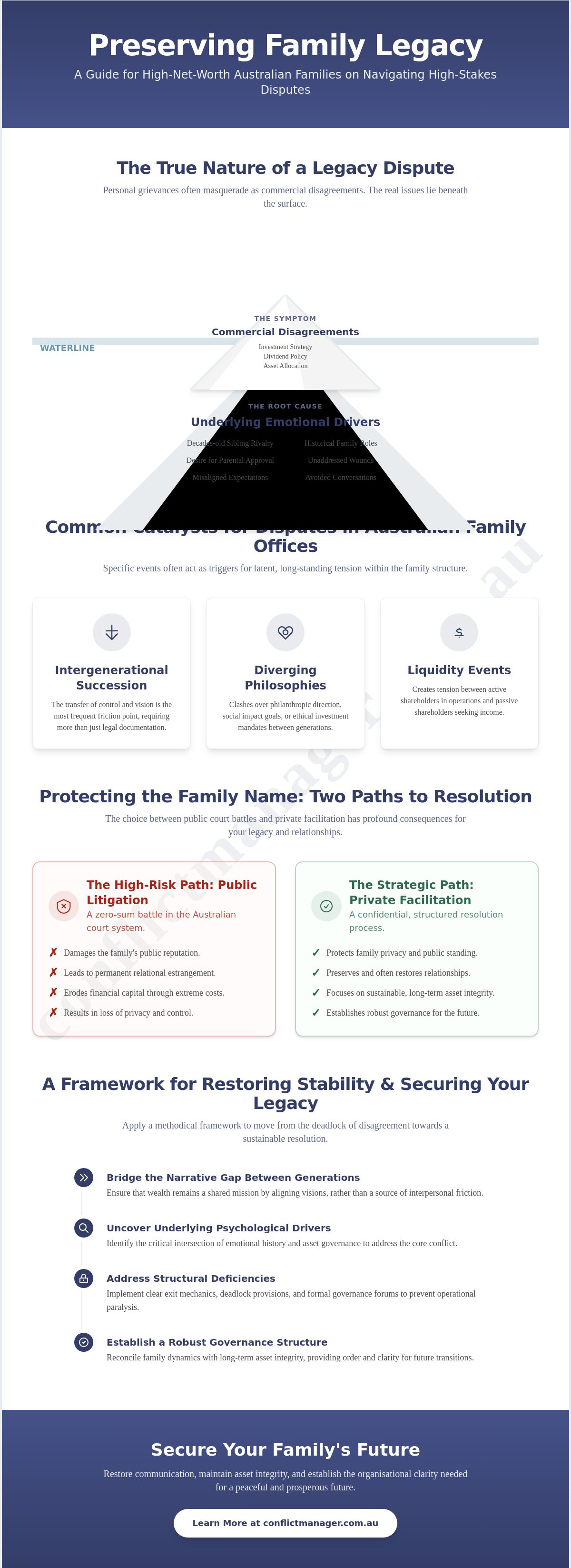
Personal grievances frequently masquerade as commercial disagreements. It's common to see a dispute over a specific investment or a dividend policy that's actually rooted in decades-old sibling rivalry or parental approval. In many Australian family boardrooms, decisions are haunted by family "ghosts". These are the historical roles and unaddressed wounds that stakeholders carry into professional environments. Traditional wealth management, while expert at navigating the rules of inheritance and tax structures, often lacks the psychological discernment to address these core conflict drivers. It treats the symptoms, while the underlying friction remains untouched.
Common Triggers in Australian Family Offices
Specific events often act as catalysts for latent tension. In the Australian context, intergenerational succession is the most frequent trigger. The transfer of control is a delicate movement that requires more than just legal documentation. We also observe growing friction regarding philanthropic direction or ethical investment mandates. Younger generations often advocate for social impact, which can clash with the more traditional, return-focused perspectives of senior members. Additionally, liquidity events create significant tension between active shareholders involved in daily operations and passive shareholders who view the family assets purely as a source of income. Without a clear governance framework, these triggers can lead to a total breakdown in communication.
Structural Gaps vs. Emotional Friction: Defining the Dispute
Clarity. Order. Resolution. These are the objectives of any formal governance structure. However, a preserving family legacy dispute is rarely a simple matter of technical interpretation. It is a unique category of conflict where emotional history and asset governance collide. While a standard commercial disagreement might focus on a specific contract, a legacy dispute involves the weight of the past and the uncertainty of the future. It's the point where the boardroom table becomes an extension of the family home.
Distinguishing between healthy friction and destructive conflict is essential for any family office. Healthy friction involves a robust debate over investment strategy or risk appetite; it is focused on the objective and the external. Destructive conflict is personal, circular, and rooted in the subjective. It often persists because trust deeds and constitutions, while legally sound, are fundamentally limited. They can govern the distribution of funds, but they cannot resolve interpersonal animosity. When a preserving family legacy dispute reaches this level of complexity, external objectivity becomes a necessity. It's the only way to decouple deep-seated emotion from long-term strategy.
Identifying Structural Deficiencies
Many disputes are exacerbated by a lack of clear exit mechanics. When a dissenting family member feels trapped within a structure, their frustration often manifests as obstruction. Inadequate deadlock provisions in shareholder agreements can lead to total operational paralysis. Without a formal family council or a dedicated governance forum, there is no pressure valve for these tensions. In these moments, stakeholder facilitation provides a structured environment to address these gaps before they trigger a permanent breakdown.
The Psychology of Family Wealth Friction
Perceived injustice is a powerful driver of conflict. This often stems from unequal contributions to the business or perceived favouritism in distributions. The "rising generation" also carries a significant burden of expectation, often feeling they must honour a legacy they didn't help create. This pressure can lead to resentment, especially during the transition of a patriarch or matriarch from active leadership. As noted in the analysis of Navigating Family Business Conflicts, even the most established dynasties can falter when governance fails to evolve alongside family dynamics. Restoring order requires acknowledging these psychological realities as part of the structural solution.
Litigation vs. Private Mediation: Protecting the Family Name
Privacy. Discretion. Control. For many Australian families, these aren't merely preferences; they're the pillars of their public and private existence. When a preserving family legacy dispute reaches a point where internal dialogue fails, the forum chosen for resolution dictates more than just the financial outcome. Litigation is an adversarial instrument. It's designed to identify a winner and a loser through the rigid application of law. Mediation, specifically when guided by professional stakeholder facilitation, is a restorative process. It seeks to align structural governance with the human reality of the family.
The inherent risk of the public record in Australian court systems can't be overstated. Our legal tradition prizes "open justice", which means that once a matter is filed, the intimate details of family wealth, internal friction, and private agreements often become accessible to the public and the press. While it's possible to seek suppression orders, they're rarely granted just to protect a family's reputation. Adversarial litigation forces a family to air their grievances in a way that often makes relational repair impossible. You lose the ability to manage your own narrative the moment you step into a courtroom.
A cost-benefit analysis of these paths reveals a stark contrast. The financial expense of high-stakes litigation is significant, but it's the erosion of the "family brand" that carries the true weight. A court-ordered resolution is binary. It provides a legal answer but often leaves the family in a state of relational deadlock. Elite families increasingly favour discreet, neutral facilitation because it allows for a "sustainable-agreement" outcome. This approach treats the dispute not as a case to be won, but as a structural misalignment to be corrected. It's a movement toward order rather than an escalation of conflict.
The Hidden Costs of Public Disputes
Reputational damage is often permanent. When internal family friction becomes public knowledge, it can destabilise business interests, spook investors, and alienate key staff within the family office. There's also the profound emotional toll of seeing personal history dissected in a public forum. Beyond the immediate crisis, litigation risks setting legal precedents that could limit the family's future flexibility in managing assets or succession. It creates a rigid framework that doesn't account for the evolving needs of future generations.
Mediation: A Path to Reassurance and Order
Private facilitation offers total confidentiality. It creates a secure environment where stakeholders can speak candidly without fear of the public record. This allows for the crafting of bespoke outcomes that a court simply doesn't have the jurisdiction to order. By focusing on restored communication and structural clarity, families preserve their ability to work together on future ventures. It's about moving from volatility toward a vision of composed authority. This path ensures that the family legacy remains an asset, not a liability.
A Framework for Legacy Resolution: Restoring Stability
Structure. Logic. Precision. Moving from the friction of a preserving family legacy dispute toward a state of order requires a methodical, step-by-step progression. This isn't a process that can be rushed or handled with haphazard internal attempts. It requires a disciplined framework that addresses both the structural deficiencies of the family office and the psychological nuances of the stakeholders involved. By following a logical sequence, families can transition from a state of reactive conflict to one of proactive governance.
The process begins with initial engagement. We establish a safe, neutral space that's physically and emotionally removed from the usual sites of family tension. This environment allows for discovery, where we look beyond the immediate financial disagreement to identify the underlying drivers of the friction. Facilitation then follows, where high-emotion conversations are navigated with composed authority. Once a path forward is identified, resolution is achieved by codifying the agreement into sustainable governance structures. Finally, a period of follow-up ensures that these new frameworks are respected and operationalised across the entire family ecosystem.
The Role of the Neutral Third Party
Internal attempts at resolution often exacerbate the friction because the participants are too emotionally entangled to remain objective. A neutral third party brings a steady hand to the table, capable of viewing volatile situations without becoming a part of them. It's essential to engage a facilitator who understands the complex intersection of corporate strategy and family dynamics. Their presence lowers the pulse of the room, allowing for a level of discernment that's impossible when stakeholders are in a state of high stress. If you're currently facing a deadlock, our family conflict resolution services provide the external objectivity needed to restore stability.
Sustainable Outcomes for Multi-Generational Wealth
The ultimate goal is to create a framework that survives the current generation. This often involves updating family constitutions to reflect modern realities, such as digital legacy planning or ethical investment mandates. We focus on implementing formal communication protocols that prevent silence from compounding into future disputes. By designing conflict management systems today, families ensure that future generations have a clear roadmap for navigating their own transitions. This structural clarity is the most effective way to protect asset integrity while maintaining the human relationships that define a family's heritage.
Securing the Future: How Conflict Manager Preserves Family Integrity
Stability. Integrity. Continuity. These are the foundations of a heritage that survives the test of time. When a preserving family legacy dispute threatens to derail decades of achievement, the solution must be as sophisticated as the assets involved. Our methodology at Conflict Manager combines professional discernment with grounded, empathetic guidance. We specialise in managing high-stakes, high-emotion environments across Australia, providing a steady hand when internal dynamics become volatile. We recognise that the Australian landscape presents unique challenges, from specific regulatory requirements to the cultural nuances of local family dynasties.
We focus on two parallel objectives: the absolute integrity of your assets and the preservation of your family relationships. These aren't mutually exclusive goals. By applying a methodical lens to complex human and structural friction, we move families from a state of disruption toward a vision of structured resolution. This process isn't about compromise for the sake of peace; it's about building a governance framework that functions for all generations. It's the movement from chaos to order. Our expertise in stakeholder facilitation ensures that every voice is considered within a framework of composed authority. We don't just resolve the immediate crisis. We help you build the systems that prevent the next one. This proactive approach is what distinguishes a legacy that fades from one that flourishes.
Professional Mediation for High Net Worth Families
Our services are bespoke. We understand that no two family offices are identical. We provide objective, external counsel that's entirely free from emotional entanglement. This neutrality is our greatest asset. It allows us to view the situation with total objectivity, providing a sense of order during periods of high stress. We ensure that every stakeholder feels heard, creating the clarity needed for long-term stability. Our role is to act as a wise, external counsellor, viewing the situation without the weight of personal history. This distance is what allows us to identify the structural gaps that family members might overlook.
Taking the Next Step Toward Resolution
Deadlock often feels permanent, but it's usually just a sign that your current internal efforts have reached their limit. A confidential consultation provides the initial clarity needed to find a way through the friction. It's a low-pulse environment where you can explore options without the pressure of immediate decision-making. Transitioning from a state of friction to one of sustainable governance is a methodical journey that requires patience and precision. You can Enquire about our Family Office Mediation services to begin the transition from deadlock to a sustainable path forward. By acting now, you ensure that your family legacy remains a source of pride rather than a point of contention.
Securing Your Heritage Through Structural Clarity
The transition from discord to order is a deliberate movement. It requires a shift from the volatility of personal grievance to the stability of formal governance. By choosing a framework that prioritises private facilitation over the risks of public litigation, you protect both your family's public reputation and its internal integrity. A preserving family legacy dispute doesn't have to result in a permanent breakdown of trust. Instead, it can serve as a necessary catalyst for a more robust and transparent future for all stakeholders involved.
Our firm brings a sense of composed authority to high-stakes environments. We provide specialised expertise in high-net-worth family office dynamics through a national Australian service that guarantees total confidentiality. We understand the weight of your responsibility. You can restore order and preserve your legacy with expert mediation. This process allows you to decouple emotion from strategy, ensuring that your heritage remains a firm foundation for future generations. Your legacy is far too valuable to be left to the uncertainty of deadlock.
Frequently Asked Questions
What is the primary cause of family legacy disputes in Australian family offices?
The primary cause is often a misalignment of values during intergenerational succession. While the founding generation focuses on wealth creation, subsequent generations may have different views on philanthropic direction or ethical investment mandates. This narrative gap creates friction that, if left unaddressed by formal governance, eventually manifests as a preserving family legacy dispute.
How can mediation preserve a family legacy better than legal action?
Mediation preserves legacy by prioritising confidentiality and restorative outcomes over adversarial wins. Australian court systems operate on the principle of open justice, meaning sensitive family details often become part of the public record. Private facilitation allows for bespoke agreements that maintain asset integrity and protect the family's public reputation from permanent damage.
Can a dispute be resolved if family members are no longer on speaking terms?
Resolution is entirely possible through structured stakeholder facilitation, even when direct communication has collapsed. A neutral third party can act as a bridge, using shuttle mediation to convey positions and identify common ground without requiring face-to-face contact initially. This methodical approach lowers the emotional pulse and allows logic to resurface over historical grievances.
What is the role of a neutral third party in a family office dispute?
A neutral third party provides a steady hand and total objectivity during periods of high organisational friction. They identify structural gaps and psychological drivers that family members are often too emotionally entangled to see. By viewing the situation as a wise, external counsellor, they help stakeholders decouple personal history from the strategic needs of the legacy.
How long does the family legacy dispute resolution process typically take?
The timeline varies based on complexity, but most families reach a sustainable framework for resolution within several weeks or months. This is significantly more efficient than the Australian court system, where litigation or probate delays can often stretch from 6 to 18 months. Professional facilitation focuses on moving from disruption to order with deliberate speed.
Is mediation confidential for high-profile Australian families?
Yes, confidentiality is a fundamental pillar of private mediation and stakeholder facilitation. Unlike litigation, where suppression orders are rarely granted solely for reputational protection, mediation occurs entirely behind closed doors. This ensures that sensitive financial data and internal family dynamics remain private, protecting the long-term integrity of the family brand.
What happens if we cannot reach an agreement through mediation?
Parties retain all their legal rights and can still pursue other avenues if a consensus isn't reached. However, the discovery phase of mediation often provides valuable clarity on the underlying drivers of the conflict. Even without a total resolution, the process frequently identifies a preserving family legacy dispute as a structural misalignment rather than a permanent deadlock.
How do we prevent future disputes once the current conflict is resolved?
Prevention requires codifying the resolution into robust governance structures, such as updated family constitutions and formal communication protocols. Establishing a regular family council or a dedicated governance forum acts as a pressure valve for future tension. By designing these systems today, you ensure that future generations have a clear roadmap for navigating their own transitions.


