

Stagnation. Friction. Uncertainty. The most dangerous threat to a multi-generational legacy isn't a market downturn or a shifting regulatory landscape. It's the quiet, corrosive friction of an internal stalemate that no one knows how to break. You've likely felt the weight of a boardroom where silence has become a weapon, or perhaps the exhaustion of a family office where every strategic pivot is met with emotional gridlock. When these tensions arise, professional stakeholder conflict facilitation becomes the essential tool for re-establishing order and protecting your organisational reputation.
Internal attempts to resolve these disputes often fail because the parties are too close to the fire to see the exits; the emotional weight of legacy makes objectivity almost impossible. You'll discover how professional facilitation transforms volatile stakeholder disputes into structured, sustainable resolutions that preserve both legacy and organisational integrity. This article examines the logic of external guidance and the methodical steps required to move from complexity toward a vision of restored stability and a clear path forward for your assets and strategy.
Key Takeaways
- Understand how stakeholder conflict facilitation prioritises long-term structural health and interpersonal harmony over the narrow scope of legal settlements.
- Learn to reframe intense friction not as a sign of failure, but as a catalyst for necessary organisational evolution and strategic growth.
- Master the 'Methodical Flow' framework; a sequence of acknowledging, analysing, and intervening to move from complexity toward a vision of restored stability.
- Discover how an external counsellor provides the steady hand and total objectivity required to protect your legacy during complex transitions.
Defining Stakeholder Conflict Facilitation in High-Stakes Environments
Complexity. Friction. Resolution. These three states often define the lifecycle of a high-stakes transition. In these environments, stakeholder conflict facilitation serves as the professional guidance of key parties through periods of profound change. It's a clinical, objective process designed to re-establish structural order when internal dynamics have reached an impasse. While internal leaders often attempt to manage these tensions themselves, the weight of historical bias and emotional entanglement usually makes a neutral outcome impossible.
The catalysts for such friction are rarely simple. They typically emerge during critical junctures such as succession planning, significant structural shifts, or disputes regarding the long-term management of substantial assets. When the stakes involve both financial wealth and personal legacy, the room for error vanishes. Professional facilitation provides a steady hand, ensuring that the organisation's integrity remains intact even when individual relationships are under immense strain.
The Distinction Between Mediation and Strategic Facilitation
It's vital to distinguish this process from traditional legal mediation. Mediation is often a reactive tool used to reach a settlement and avoid the courtroom. It focuses on the transaction. Strategic facilitation, however, is a proactive structural process. It prioritises the health of the relationship and the sustainability of the organisation. By integrating established conflict resolution methods into a bespoke framework, the facilitator maintains the centre during volatile discussions. The goal isn't just a temporary compromise but a structured resolution that protects the asset's future.
Why High-Stakes Environments Amplify Interpersonal Friction
In the Australian context, the intersection of private wealth, family legacy, and corporate governance creates a unique set of pressures. The weight of responsibility felt by principals can easily cloud objective decision-making. They're not merely managing a balance sheet; they're guarding a heritage. This psychological burden often turns strategic disagreements into deeply personal disputes. When communication breaks down, the cost isn't just emotional. It manifests as organisational gridlock, lost momentum, and a genuine threat to the reputation of the entity. External intervention introduces a level of third-party clarity that internal stakeholders simply cannot achieve on their own. It moves the conversation away from historical grievances and toward a logical, methodical path forward.
The Mechanics of Neutral Facilitation: A Structural Approach
Stability. Clarity. Distance. The facilitator enters a high-stakes environment not as a participant, but as a neutral third party. They act as a steady hand during the storm. In volatile disputes, emotions often cloud the underlying structural issues, making it difficult for even the most seasoned leaders to see a way out. Professional stakeholder conflict facilitation begins by lowering the pulse of the room through composed authority. When a leader remains unruffled, others find the space to breathe. This composure isn't just a personality trait; it's a strategic tool that builds immediate trust among parties who may have spent months in gridlock.
Before any resolution is attempted, the conflict must be mapped. This involves a clinical assessment of the competing interests, historical grievances, and structural bottlenecks. It's about seeing the whole board. By identifying the friction points without judgment, the facilitator provides a shared reality for all stakeholders. This objective map serves as the foundation for every subsequent move, ensuring that the process is grounded in facts rather than assumptions.
Maintaining Total Objectivity as an External Guide
The Wise Counselor archetype is essential in these moments. An external guide provides a mirror to the organisation's current state, reflecting truths that internal members are often too entangled to perceive. They must remain unruffled by the high stakes involved, whether those stakes are financial, reputational, or personal. This requires a rigorous process of filtering emotional noise to reach the core structural issue. Whether it's a dispute over a legacy asset or a disagreement on corporate direction, the facilitator identifies the logic beneath the heat. They don't get caught in the crossfire; they redefine the terrain.
The Psychology of the Neutral Third Party
Establishing a safe harbour is the first step in resolving leadership-level disputes. When stakeholders feel that a third party is truly neutral, they're more likely to speak candidly. Internal efforts often stall because any attempt at resolution is viewed as taking a side. A seasoned professional who understands the unique weight of Australian family assets can navigate these waters with precision. This external perspective ensures that the focus remains on the integrity of the asset rather than the ego of the individual. If your leadership team is currently facing such an impasse, engaging in professional stakeholder facilitation can provide the clarity needed to move forward. This neutral intervention prevents the stalemates that occur when internal communication has completely broken down, allowing for a structured return to order.
Reframing Resistance: From Interpersonal Friction to Structural Evolution
Resistance. Evolution. Clarity. In the high-pressure environment of a family office or a corporate board, conflict is often misread as a terminal breakdown of order. It's easy to view a heated dispute as a sign of failure, yet friction is frequently the signal that an organisation's current structure can no longer contain its growing complexity. When we engage in stakeholder conflict facilitation, we aren't just dampening the noise. We're translating it. We reframe these moments of resistance as necessary transitions, moving the group from a state of disruption toward a vision of structured resolution that respects both the past and the future.
Most internal efforts to resolve disputes fail because they focus on the symptoms rather than the systemic shift trying to occur. If a succession plan is stalling, it's rarely just about the percentage of equity. It's about the identity of the founders and the fears of the successors. By acknowledging this difficult reality, the facilitator validates the stakeholder experience. This validation is the first step in de-escalating the heat and allowing for a more clinical, objective analysis of the path forward.
De-escalating High-Emotion Disputes with Composure
Managing 'hot' moments in the boardroom requires a specific kind of quiet authority. When voices rise, the facilitator's response is to slow the tempo. We use deliberate pauses and measured speech to create the space required for reflection. This rhythmic variation in communication lowers the pulse of the room, preventing the reflexive 'fight or flight' responses that stall progress. We don't just ask questions; we employ outcome-focused inquiry to move the dialogue away from blame and toward the nub of the matter. It's about creating a safe harbour where difficult truths can be spoken without sinking the ship.
Identifying Root Causes Beyond the Surface Argument
To reach a sustainable resolution, one must distinguish between stated needs and underlying fears. A stakeholder might argue over a tactical detail, such as a specific asset's management, when they're actually reacting to a perceived loss of influence. Succession and structural change are notorious triggers for deep-seated psychological resistance. Through stakeholder conflict facilitation, we peel back these layers. We look for the root causes that are hidden behind the surface-level financial or tactical arguments. By addressing these core fears directly, we ensure the integrity of the final resolution is robust enough to withstand future pressures.
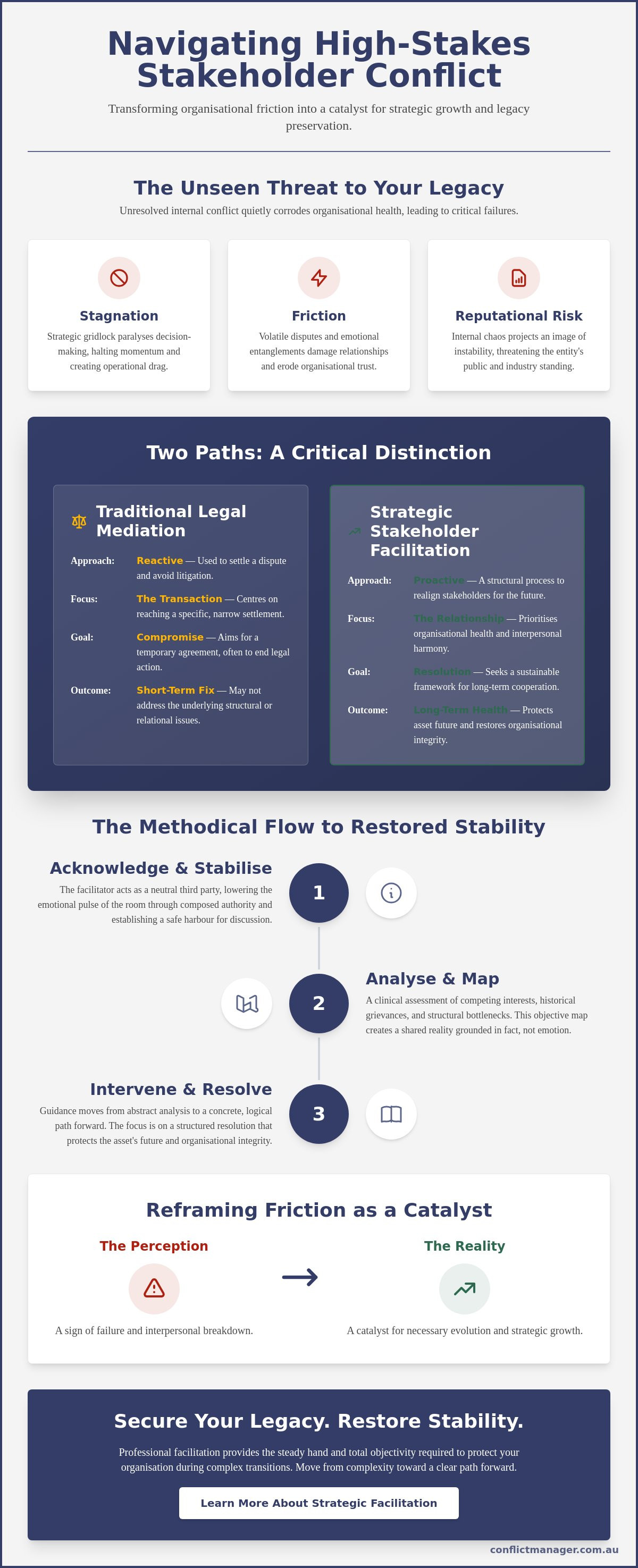
Frameworks for Navigating Complex Stakeholder Dynamics
Structure. Sequence. Resolution. Moving a group of high-level stakeholders from gridlock to action requires more than a simple meeting; it demands a clinical, methodical flow. This process ensures that the transition is not just discussed but actually executed with precision. By following a structured framework, we remove the guesswork and replace it with a predictable path toward stability. Every session must be anchored in the logic of progress rather than the heat of the moment.
The Methodical Flow consists of four distinct phases:
- Acknowledge: Validating the current state of disruption and the reality of the friction.
- Analyse: Moving beyond the surface to map the underlying structural and psychological drivers.
- Intervene: The active phase of facilitation where the centre is held and difficult dialogues are navigated.
- Resolve: The finalisation of a structured, sustainable agreement that protects the asset and the legacy.
Structuring the Conversation for Sustainable Outcomes
Success begins long before the stakeholders enter the room. The discovery phase is essential, involving individual interviews to map the landscape of the dispute without the pressure of the group dynamic. This allows each party to speak candidly about their fears and objectives. Once this map is established, we transition to the facilitated dialogue. This is a controlled environment where collective clarity is achieved through structured inquiry. To ensure the resolution is more than just a momentary truce, we conclude with a resolution roadmap. This document outlines the specific, actionable steps each party will take; it ensures long-term accountability and the preservation of organisational integrity.
Managing Power Imbalances in Multi-Generational Groups
In many Australian family offices and trusts, the 'founder's shadow' can loom large, often stifling the vision of the next generation. These power imbalances are a primary source of friction during wealth transfers. Effective stakeholder conflict facilitation ensures that seniority does not equal silence for others. We create a platform where quiet stakeholders can contribute their insights without fear of reprisal. This balance is critical for the long-term health of the asset. By integrating these discussions into formal governance structures, we provide a permanent mechanism for managing future tensions. If you are navigating a multi-generational transition and find yourself in a stalemate, our professional stakeholder conflict facilitation provides the structured path forward your organisation requires.
Securing the Future: The Logic of Professional Intervention
Integrity. Longevity. Stability. The ultimate objective of stakeholder conflict facilitation is not merely the cessation of an argument. It is the preservation of the entity itself. When high-stakes friction is left to fester, it doesn't just damage interpersonal relationships; it erodes the structural foundation of the organisation. Professional intervention provides the objective distance necessary to protect the integrity of the asset for future generations. It is a strategic investment in the future. It ensures that a legacy built over decades isn't dismantled by a season of unresolved discord.
Engaging a steady hand during periods of organisational restructuring or succession is a hallmark of sophisticated leadership. It signals to all parties that the health of the organisation takes precedence over individual grievances. This methodical approach replaces the noise of internal politics with the quiet authority of an external guide. By the time a resolution is reached, the focus has shifted from the friction of the past to the potential of the future.
Preserving Legacy and Asset Integrity
In the Australian private wealth landscape, unresolved conflict is perhaps the single greatest threat to family assets. When disputes become entrenched, decision-making stalls and market opportunities are lost. Beyond the financial ledger, there is the matter of reputational capital. A principal's standing in the business community is a fragile asset; public or internal fractures can diminish this standing rapidly. Engaging in professional facilitation allows leaders to manage these tensions with composure. It builds a culture where conflict is treated as a manageable variable rather than an avoided catastrophe. By addressing friction through a methodical, third-party lens, the organisation demonstrates a level of sophistication that reassures stakeholders and protects the family legacy.
Transitioning from Disruption to Structured Stability
The path from complexity to clarity is rarely a straight line, yet it is an inevitable one when guided by an expert. We move from the initial state of disruption, where communication has failed and goals have diverged, toward a vision of structured stability. This transition is essential for any organisation undergoing significant restructuring. A single engagement with a neutral facilitator can completely reset the trajectory of a struggling leadership team. It replaces the heat of interpersonal friction with the logic of shared objectives.
The presence of a neutral party provides a unique form of reassurance. It allows stakeholders to step back from their defensive positions and view the situation with total objectivity. This shift in perspective is what enables a sustainable resolution. By the time the process concludes, the organisation has moved beyond the immediate crisis. It has gained a clear path forward and a renewed sense of order. Sophisticated leadership is defined by the ability to recognise when internal efforts are no longer sufficient. Choosing professional stakeholder conflict facilitation is a hallmark of an authoritative leader who understands the weight of their responsibility and the value of a structured resolution.
Restoring Order and Protecting Legacy
Order. Integrity. Resolution. These are the outcomes of a commitment to professional structural health. Conflict doesn't have to be the end of a legacy; it's often the catalyst for a necessary evolution. By choosing a methodical approach, you ensure that the friction of the present doesn't dictate the failure of the future. Professional stakeholder conflict facilitation provides the steady hand required to navigate these high-stakes transitions with composed authority.
A structured path forward is essential for any organisation facing an impasse. Whether you're managing a complex multi-generational wealth transfer or a significant corporate shift, the logic of external intervention is clear. It provides the objectivity and clarity that internal efforts often lack. Our nationwide Australian professional service offers specialised expertise in high-net-worth family office mediation and organisational conflict management. We focus on the preservation of interpersonal relationships and the long-term health of your assets.
Secure a composed resolution with Conflict Manager and return your organisation to a state of structured stability. The path to clarity is open to those willing to seek a neutral, authoritative guide.
Frequently Asked Questions
What is the difference between stakeholder facilitation and traditional mediation?
Facilitation focuses on the long-term structural health of the organisation, whereas mediation is typically a reactive process aimed at reaching a legal settlement. In stakeholder conflict facilitation, the goal is to preserve the relationship and the integrity of the asset rather than simply resolving a single grievance. It's a proactive measure that addresses the underlying dynamics before they escalate into litigation.
When is the right time to engage an external conflict facilitator?
The ideal time to engage an external facilitator is when internal efforts to resolve a dispute have reached a stalemate or before a major transition begins. If you notice that boardroom discussions have become circular or that emotional gridlock is stalling strategic decisions, third-party clarity is required. Early intervention prevents the reputational damage that often follows prolonged internal friction.
How do you handle high-emotion disputes in a family office setting?
High-emotion disputes in family offices are managed by lowering the pulse of the room through composed authority and objective mapping. We move the conversation away from historical blame and toward the shared goal of protecting the family legacy. By creating a safe harbour for difficult truths, we allow stakeholders to express underlying fears without disrupting the organisational momentum.
Can stakeholder facilitation help with succession planning in Australian businesses?
Stakeholder conflict facilitation is highly effective for succession planning in Australian businesses, particularly when navigating the 'founder's shadow'. It provides a structured framework for managing power imbalances and ensuring that all generations are heard. This process protects the integrity of the wealth transfer and ensures the business remains viable through the transition.
What happens if stakeholders refuse to participate in the facilitation process?
If a stakeholder is reluctant to participate, we begin with individual discovery interviews to understand their specific concerns and barriers. Participation is often secured by demonstrating how the process protects their interests and the long-term value of the organisation. Most parties agree to engage once they realise that the alternative is continued gridlock or public reputational damage.
How long does a typical stakeholder conflict facilitation engagement take?
The duration of a facilitation engagement depends on the complexity of the dispute and the number of parties involved. While some specific impasses can be addressed in a series of intensive sessions, more complex multi-generational transitions may unfold over several months. Each engagement is methodical and structured to ensure that the final resolution is both sustainable and actionable.
How do you ensure the confidentiality of private family or board discussions?
Confidentiality is maintained through strict professional ethics and formal non-disclosure agreements that protect all private family or board discussions. As a neutral third party, the facilitator operates outside the internal hierarchy, providing a secure environment where sensitive information can be shared without fear of leaks. This privacy is essential for maintaining the reputational capital of the principal.
What are the hallmarks of a sustainable conflict resolution outcome?
A sustainable resolution is marked by clear, actionable next steps and the restoration of structural order within the group. It isn't just a verbal agreement; it's a documented roadmap that ensures accountability and preserves interpersonal relationships. When stakeholders feel that the outcome is objective and fair, the organisation can move forward with renewed stability.


