

A signed agreement is often mistaken for a final conclusion. In reality, many settlements act as little more than a temporary ceasefire, leaving the underlying friction to smoulder until it inevitably reignites. When disputes recur, they drain vital emotional energy and threaten the very integrity of a family legacy or a corporate board. You likely recognise the exhaustion of watching legal costs climb while genuine peace remains elusive. It's a cycle that feels both inevitable and deeply unsustainable.
Achieving sustainable conflict resolution outcomes requires more than just a simple compromise. It demands a sophisticated structural realignment of both logic and emotion. This framework provides the clarity needed to transform volatile disputes into enduring stability, ensuring agreements survive the pressure of time. We'll explore how to build foundations that preserve relationships and protect your most valuable assets. This guide outlines a path toward a quiet, composed resolution that allows your organisation or family to move forward with renewed order and purpose.
Key Takeaways
- Identify the critical distinction between a temporary legal settlement and sustainable conflict resolution outcomes that provide long-term peace.
- Master the two essential pillars of durable agreements, ensuring your organisational structure and emotional landscape are both fully aligned.
- Recognise why the adversarial nature of court proceedings often won't preserve family relationships and how to avoid public exposure of private matters.
- Shift from reactive dispute management to proactive conflict prevention systems that maintain stability before friction escalates.
- Learn how expert facilitation preserves the integrity of your legacy while providing a clear, methodical path through high-stakes transitions.
Beyond the Settlement: Defining Sustainable Conflict Resolution Outcomes
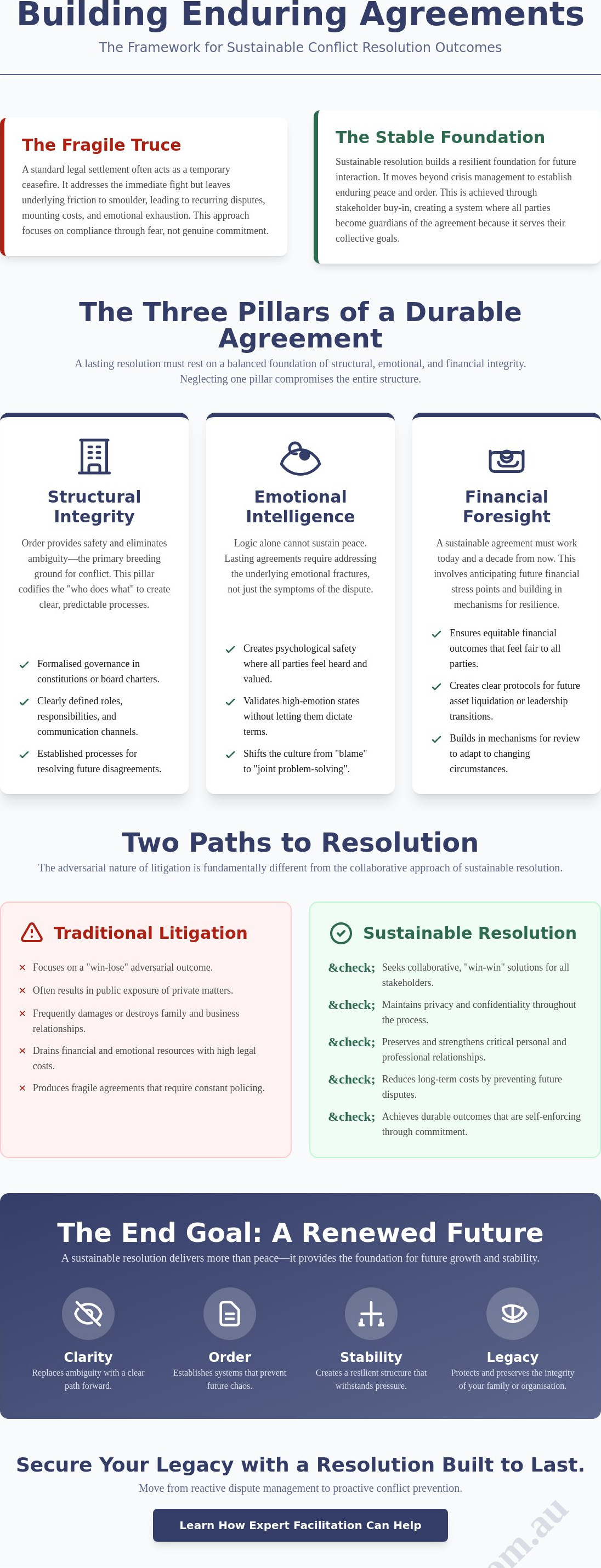
Clarity. Order. Stability. These are the markers of a resolution that actually lasts. A standard legal settlement often focuses on the cessation of hostilities, effectively ending the fight on paper without addressing the friction beneath the surface. In contrast, sustainable conflict resolution outcomes are designed to remain robust even when future pressures mount. They move beyond the immediate crisis to establish a framework for enduring peace. This approach views the resolution not as a static end point, but as a resilient foundation for future interaction.
The desire to "win" a dispute is a natural impulse, yet it's frequently the primary driver of fragility. When one party feels coerced into an agreement, the resolution becomes a ticking clock. True durability is powered by stakeholder buy-in. This is the engine of any successful conflict resolution process; it ensures every participant sees their own interests reflected in the final arrangement. Without this alignment, the agreement is merely a fragile truce waiting for the next point of stress to shatter it. A sustainable outcome prioritises the health of the system over the triumph of an individual side.
The Distinction Between Compliance and Commitment
Compliance is a hollow victory. It occurs when parties follow an agreement because they fear legal repercussions or lack the resources to continue the struggle. While it provides temporary quiet, it requires constant policing and external oversight. Commitment is a vastly different state. It's the active choice to uphold an agreement because it aligns with personal and collective goals. When commitment is the foundation, the need for future external intervention diminishes. The parties themselves become the guardians of the peace, reducing the drain on emotional and financial resources.
The Time Horizon of a Sustainable Agreement
A resolution that works today must also work in a decade. For family offices and complex boards, the goal is often intergenerational stability rather than a quick fix for the current financial year. Achieving this requires identifying potential stress points, such as leadership transitions or asset liquidations, that could derail the agreement years later. Building in mechanisms for periodic review ensures the resolution evolves alongside the organisation. This foresight transforms a static document into a living framework that preserves legacy and business integrity over the long term. It's about creating a structure that can weather the inevitable shifts in the business and personal landscape.
The Three Pillars of a Durable and Lasting Agreement
A resolution is a living structure. For it to remain standing under the weight of time and future pressure, it must rest upon a stable tripod of structural, emotional, and financial foundations. If any single pillar is neglected, the agreement becomes lopsided and prone to collapse. Achieving sustainable conflict resolution outcomes requires a methodical balancing act that ensures the needs of the organisation and the individuals within it are addressed with equal rigour. This holistic approach prevents the recurrence of old grievances and provides a clear map for the journey ahead.
Structural Integrity and Governance
Order provides safety. When roles and responsibilities are left ambiguous, friction is the inevitable result. Structural integrity involves codifying the terms of an agreement into formal documents such as family constitutions, board charters, or revised shareholder agreements. These frameworks define "who does what" and establish clear communication channels for future disagreements. By removing the guesswork from daily operations, you eliminate the primary breeding ground for conflict. A well-structured governance model acts as a pressure valve, allowing tensions to be resolved through established processes rather than personal attacks.
Emotional Intelligence in Resolution
Logic alone cannot sustain a peace. Many agreements fail because they address the symptoms of a dispute while ignoring the underlying emotional fractures. Emotional alignment requires validating high-emotion states without allowing them to dictate the final terms. It's about creating a sense of psychological safety where participants feel heard and understood. This cultural shift from "blame" to "joint problem-solving" is essential for long-term stability. While 65% of mediated disputes result in a voluntary agreement according to the American Bar Association, those that endure are almost always those where the parties have achieved genuine relational clarity. Engaging in expert stakeholder facilitation can help bridge these emotional gaps, ensuring the "aftercare" of a resolution is as robust as the initial settlement.
Economic Viability and Asset Integrity
Financial feasibility is the final safeguard. A resolution that compromises the long-term health of a family office or a business is not a resolution; it's a delayed crisis. Settlements must balance individual liquidity needs with the preservation of the core legacy. There's a significant danger in "buying peace" by over-leveraging assets or fragmenting a portfolio to satisfy immediate demands. Sustainable outcomes ensure the organisation remains economically viable, protecting the interests of both current stakeholders and future generations. The focus remains on the movement and growth of assets rather than their dissolution under the strain of infighting.
Achieving this balance is a complex task that benefits from a steady, objective hand. When these three pillars are aligned, the resulting stability allows leaders to return their focus to innovation and growth, confident that the foundations of their organisation are secure.
Why Traditional Litigation Struggles to Deliver Sustainability
The law provides finality; it does not provide peace. When friction becomes intolerable, the courtroom often appears as a logical destination because it offers a definitive end point. Yet, for those seeking sustainable conflict resolution outcomes, litigation is a blunt instrument that frequently leaves the underlying system more fragile than before. The adversarial process is built on a foundation of binary results. There is a winner and a loser. This mentality ensures that the party who feels defeated leaves the process with a sense of injustice, often biding their time until they can reopen the dispute through other channels. It's a cycle of temporary suppression rather than genuine resolution.
Publicity is another significant deterrent. Court proceedings are generally a matter of public record. For high-net-worth families or sensitive corporate boards, the exposure of private grievances creates a secondary layer of conflict that is difficult to manage. This external pressure often hardens positions and makes the quiet, nuanced compromise required for longevity nearly impossible to achieve. While the World Bank notes that mediation can reduce dispute resolution time by 50-70% compared to court proceedings, the real value lies in the privacy and control that traditional litigation simply cannot offer.
The Cost of Relational Erosion
Relational equity is the silent engine of any family business or close-knit board. Litigation burns through this social capital at an alarming rate. When family members or long-term partners face each other as legal adversaries, the damage to trust is frequently permanent. Rebuilding a shared vision after an aggressive legal fight is a task few organisations survive intact. In these scenarios, a court-ordered victory feels like a hollow loss. You might secure the asset, but you've irreparably tarnished the legacy you were fighting to protect.
The Limitation of Legal Remedies
Judges possess the power to divide assets, but they lack the mandate to heal a multi-generational rift. Their rulings are strictly bound by statute and precedent. These frameworks often ignore the complex emotional subtext that fuels the dispute in the first place. A court can dictate a financial payout, but it cannot foster the empathy needed for future collaboration. External facilitators offer more bespoke and creative solutions. They address the human element, ensuring the agreement is supported by both logic and emotion. This tailored approach is what allows a resolution to move from a forced compliance to a lasting commitment.
Strategic Frameworks for Maintaining Resolution in Complex Organisations
Prevention. Foresight. Strategy. These are the tools that shift an organisation from a reactive stance to one of proactive stability. While many entities focus on resolution services only after a crisis has erupted, the most resilient boards and family offices implement conflict prevention systems as a core operational standard. This shift is fundamental to achieving sustainable conflict resolution outcomes. It acknowledges that while friction is inevitable in high-stakes environments, its escalation into a destructive force is not. By developing internal dispute management protocols, leadership teams can address minor grievances before they calcify into structural threats.
Designing a Bespoke Governance Framework
A robust governance framework acts as a map for navigating the complexities of shared wealth and power. For many, the Family Office serves as a vital hub for mediating internal friction, providing a structured space where interests can be debated without compromising the core business. Effective systems include the identification of early warning signs, such as a breakdown in formal communication or the repeated avoidance of specific agenda items. Integrating conflict management into the annual strategic planning cycle ensures that relational health is treated with the same rigour as financial performance. It transforms the resolution process from an emergency intervention into a routine check-up.
The Power of Neutral Facilitation
Objectivity. Composure. Perspective. A neutral third party provides an essential centre during volatile debates, acting as a steady hand that lowers the collective pulse of the room. This external presence is particularly vital when discussing sensitive transitions or asset distributions where internal biases are most pronounced. The psychology of facilitation is grounded in ensuring all voices are heard, preventing the conversation from devolving into chaos or being dominated by a single perspective. By maintaining a methodical and logical flow, a facilitator helps the group move from a state of complexity toward a vision of structured resolution. If your board or family office is facing an impasse, engaging in professional stakeholder facilitation can provide the clarity needed to protect your legacy and restore order.
Training leadership teams in the art of facilitating difficult conversations further strengthens this foundation. When executives and family members possess the skills to navigate disagreement with empathy and discernment, the organisation becomes more adaptable. They learn to view friction not as a failure, but as an opportunity for structural refinement. This proactive approach ensures that the agreements made today don't just settle a dispute, but actually build a more resilient future for everyone involved.
Partnering for Long-Term Clarity: The Conflict Manager Approach
Stability. Integrity. Resolution. Our methodology is defined by a sense of composed authority and a deep understanding of the human dynamics that drive organisational friction. We recognise that for family offices and boards, the primary objective is the preservation of legacy. This requires a facilitator who remains unruffled by high-stakes environments and can navigate difficult transitions with total objectivity. By focusing on the structural and emotional foundations of a dispute, we help stakeholders achieve sustainable conflict resolution outcomes that endure long after the initial facilitation concludes.
Internal efforts to resolve conflict often struggle under the weight of history and interpersonal friction. It's difficult to remain objective when you're emotionally entangled in the result. An external counsellor provides the necessary distance to view the situation with clarity. They act as a neutral third party that brings order to clouded situations. This methodical progression moves the conversation away from disruption and toward a vision of structured stability. It's an inevitable transition from complexity to a state of composed agreement.
A Reassuring Path Through High-Emotion Disputes
Navigating a transition in leadership or an asset division is a significant responsibility. These periods of change are often fraught with high-emotion states that can cloud judgment and lead to fragile agreements. We manage this weight by providing a grounded and reassuring presence. Our role is to act as a steady hand, lowering the collective pulse and ensuring that the logic of the resolution remains the priority. This objective oversight allows all parties to find a sense of quiet confidence, knowing their concerns have been heard within a professional and empathetic framework. It ensures the integrity of the organisation remains the central focus throughout the process.
Next Steps Toward Stability
The path to lasting peace begins with an honest assessment of your current conflict landscape. Whether you are managing a recurring board dispute or seeking to protect a family legacy, professional mediation offers a clear way forward. Engaging an external facilitator provides the structural clarity needed to prevent future friction. To begin this transition from complexity toward order, you can organise a confidential consultation with Conflict Manager. We will work with you to develop a bespoke framework for sustainable conflict resolution outcomes, ensuring your organisation remains robust and unified for the years ahead. This is the first step toward achieving the composed resolution your stakeholders deserve.
Restoring Order and Securing Your Legacy
Disruption is temporary; stability is a choice. We've explored how moving beyond a simple legal settlement allows for the creation of robust, intergenerational frameworks. By balancing structural governance with emotional alignment, you ensure that agreements don't just exist on paper but survive the pressure of time. Traditional litigation often burns through the social capital of a family or board, yet a methodical, neutral approach preserves the relationships that underpin your success.
Achieving sustainable conflict resolution outcomes requires a shift from reactive firefighting to proactive system design. It's a process that demands a facilitator who remains unruffled by high-stakes environments. Our national facilitation services provide the composed, objective oversight necessary to navigate even the most volatile transitions. We specialise in supporting HNW family offices and complex organisations to find a sense of order amid friction. You can secure your legacy with expert conflict resolution today. Reclaiming your focus starts with a single, steady step toward resolution.
Frequently Asked Questions
What makes a conflict resolution outcome truly "sustainable"?
A truly sustainable outcome is an agreement that maintains its integrity long after the initial friction has subsided. It moves beyond a simple cessation of hostilities to address the underlying structural and emotional fractures that caused the dispute. Achieving sustainable conflict resolution outcomes requires a framework that all stakeholders are committed to upholding, ensuring the resolution remains robust under the pressure of future transitions.
Can high-emotion family disputes really reach a lasting agreement?
Yes, even the most volatile family disputes can reach a lasting agreement when the underlying grievances are validated and addressed with composure. Lasting peace in family dynamics requires moving stakeholders from a state of blame toward joint problem-solving. By creating psychological safety, facilitators allow families to preserve their legacy while resolving the friction that threatens their collective future.
How does professional mediation differ from a legal settlement?
Professional mediation focuses on building peace and relational alignment, whereas a legal settlement often prioritises the cessation of hostilities through forced compliance. While a court can divide assets, mediation addresses the human element to ensure the agreement remains durable. This approach reduces the need for future external intervention by fostering genuine commitment rather than mere legal obedience.
Is it possible to achieve a sustainable outcome without going to court?
It's entirely possible to achieve sustainable conflict resolution outcomes without the public exposure and relational damage associated with court proceedings. Private facilitation allows for a more bespoke and creative approach to dispute management, focusing on the preservation of legacy rather than binary wins. This method provides a quiet, composed environment where complex family or board dynamics can be resolved with total objectivity.
What is the role of a neutral third party in ensuring a resolution sticks?
A neutral third party provides an objective centre that lowers the collective pulse and keeps the discussion methodical. This external presence ensures that no single voice dominates and that the conversation remains focused on logical resolution rather than emotional entanglement. Their role is to act as a steady hand, guiding parties through complexity toward a vision of structured order that everyone can support.
How do we prevent a resolved conflict from resurfacing in the future?
Prevention is achieved by implementing conflict management protocols and clear governance frameworks that define roles and responsibilities. By establishing early warning signs and regular review mechanisms, organisations can address minor friction before it calcifies into a crisis. This proactive stance ensures that the structural integrity of the agreement is maintained and adapted as the organisation evolves.
What should a family office do when internal friction threatens asset integrity?
A family office should engage an external facilitator to provide the objectivity and discernment that internal efforts often lack. When friction threatens assets, the priority must be a structural realignment that protects the core legacy while addressing individual liquidity needs. This intervention brings a sense of order to clouded situations, allowing the organisation to move forward with its assets and relationships intact.
How long does it typically take to reach a sustainable resolution?
While every situation is unique, mediation typically reduces the time required to reach an agreement by 50-70% compared to traditional court proceedings. The focus is on a methodical and logical progression that doesn't sacrifice depth for speed. A sustainable resolution is built to last, meaning the time invested early on prevents the recurring emotional and financial costs of future disputes.


