

Privacy. Discretion. Legacy. The most enduring resolutions for high-net-worth families aren't found in a public courtroom; they're forged in the quiet, controlled environment of private mediation. For families managing sizeable assets or complex family offices, the adversarial nature of the Australian legal system often creates more friction than it resolves. You might feel that litigation is the only way to protect your interests, yet the reality is that resolving family disputes without court offers a level of discretion and structural integrity that a judge simply cannot provide.
It's understandable to fear that a private approach might lack the finality of a court order or fail to address deep-seated emotional grievances. You want to safeguard your family legacy and business continuity without the indignity of public exposure or the exhausting financial drain of a trial. This guide explains how you can achieve a sustainable, private resolution that preserves both your relationships and your wealth. We'll explore the mechanics of sophisticated mediation, the benefits of stakeholder facilitation, and the specific ways you can maintain composure while navigating even the most volatile transitions.
Key Takeaways
- Safeguard your family legacy and asset integrity by avoiding the public exposure and adversarial nature of the Australian court system.
- Discover how resolving family disputes without court provides the privacy and composure necessary to manage complex trust and corporate structures.
- Shift the decision-making power from a judge to the family, allowing for bespoke resolutions that prioritise long-term business stability and relationship preservation.
- Evaluate the differences between mediation and stakeholder facilitation to identify the most effective, structured path for your unique family dynamics.
- Understand why an external, neutral third party is essential for providing clarity and order during periods of high emotional stress and structural transition.
Beyond the Bench: Why Australian Families Seek Alternatives to Court
The Australian legal system is built for finality, yet it often lacks the precision required for the preservation of delicate human systems. In the context of high-net-worth families, the adversarial process frequently acts as a catalyst for further disruption rather than a path to peace. Litigation forces parties into opposing camps; it demands a winner and a loser. This binary outcome rarely accounts for the nuances of multi-generational wealth or the shared business interests that define a family's legacy.
For many, Alternative dispute resolution (ADR) represents a more sophisticated choice. It moves the conversation from a public arena into a private, managed space. Resolving family disputes without court isn't simply about avoiding a judge; it's about maintaining the structural integrity of the family unit. It allows for a steady, objective exploration of the friction points that threaten to derail a family's future, providing a framework where composure can be restored.
The Hidden Costs of Family Litigation
The financial impact of a court battle is often the most visible drain, but it's rarely the most damaging. While filing fees are fixed, the attrition of legal fees over months or years can erode the very assets being contested. In Australia, with the Federal Circuit and Family Court (FCFCOA) handling approximately 20,000 new applications annually, the system is under immense pressure. Disputes may linger for over a year before reaching a final hearing. Such delays create a state of suspended animation for family businesses. They stall decision-making. They breed long-term resentment. When wealth is tied to the operational success of an enterprise, these prolonged periods of uncertainty can lead to missed market opportunities and internal staff friction that far outweighs any financial gain achieved through a court-imposed judgment.
Privacy as a Strategic Asset
Discretion. Confidentiality. Security. For families with significant public profiles or complex trust structures, privacy is a non-negotiable requirement. Court proceedings are, by default, a matter of public record. Even with pseudonym orders, the risk of sensitive financial data or private disagreements entering the public consciousness remains a constant threat to a family's reputation. Private mediation offers a closed-door advantage. It ensures that the specific mechanics of a family office or the details of a succession plan remain within the room. By resolving family disputes without court, stakeholders can speak openly without the fear that their words will be used against them in a subsequent cross-examination. This safety allows for a level of honesty that is impossible in a courtroom, facilitating a resolution that is both legally sound and personally sustainable.
The Spectrum of Private Resolution: Mediation, Facilitation, and Collaborative Practice
High-stakes environments require a bespoke approach to conflict. Resolving family disputes without court is not a singular event but a choice of methodologies tailored to specific human and structural needs. For high-net-worth families, the path chosen often depends on the complexity of the assets and the desired level of ongoing interaction. While some families require a definitive settlement, others need a framework for continuous communication and governance.
Conciliation provides a more directive experience where a neutral party might suggest options for settlement. Collaborative practice involves a team of specialists working toward a collective solution. These methods ensure that the unique architecture of a family's wealth is considered at every stage. By moving away from the rigid constraints of the legal system, stakeholders can adopt a more flexible, interest-based strategy that prioritises the health of the family unit.
Expert-Led Mediation for Complex Estates
Mediation is a voluntary process where a neutral third party facilitates a mutually acceptable agreement. In the context of Family Dispute Resolution, the focus shifts from adversarial posturing to underlying interests. For estates involving diverse portfolios or multi-generational trusts, a mediator acts as a steadying influence. They balance the high-emotion dynamics that often cloud objective decision-making. By stripping away the legal friction, families can find common ground that a court-imposed order might overlook. This process allows for a sophisticated exploration of needs, ensuring that the final agreement is both durable and respectful of each party's perspective.
Stakeholder Facilitation for Family Offices
Leadership transitions. Wealth transfers. Structural shifts. These are the moments where friction is most likely to occur within a family office. Facilitation is less about settling a specific legal argument and more about managing the flow of communication. It provides a structured framework for multi-generational stakeholders to navigate transitions with clarity and composure. A facilitator remains unruffled by internal politics. They ensure that the family legacy remains the priority during periods of organisational change, acting as a neutral third party to bring order to clouded situations. Choosing the right methodology is the first step toward a structured resolution. If you are navigating a complex transition, seeking professional stakeholder facilitation can provide the objective perspective needed to maintain family unity and business continuity.
Comparing Litigation and Private Dispute Management
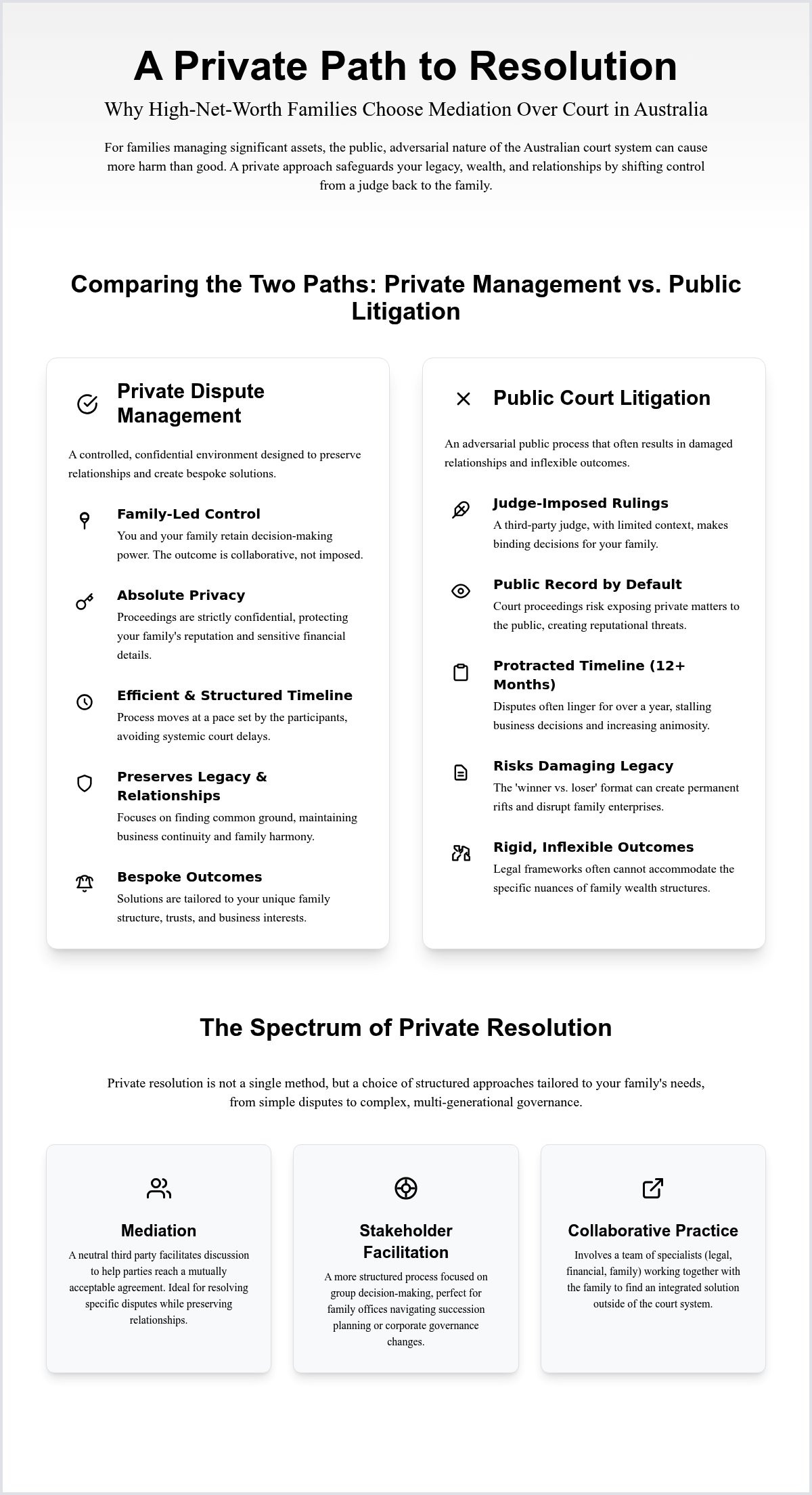
Control. Agency. Autonomy. These are the primary elements families forfeit when they enter the Australian court system. In litigation, a judge who is a stranger to the family's history and values makes binding decisions about their future. Resolving family disputes without court restores this agency to the stakeholders. It replaces a rigid, one-size-fits-all legal framework with a bespoke process designed around the specific needs of the family office or estate. This shift from a hierarchical decision-making model to a collaborative one is essential for families who prioritise discretion and structural integrity.
The formality of the court is designed for administrative efficiency, not for the delicate handling of a family business. Public hearings can trigger market instability or internal staff anxiety, creating ripple effects that damage the enterprise. Private dispute management operates with a level of composure that protects asset integrity. It allows for a steady, methodical examination of the issues without the artificial pressure of court-imposed deadlines or the threat of an unpredictable judgment. By maintaining order within a private setting, families can address the friction points that threaten their legacy without exposing their internal dynamics to the public record.
Control and Self-Determination
Families often find that the most effective solutions are those they craft themselves. A judge is limited by the Family Law Act 1975 and established case law; they cannot order the creative, multi-layered governance arrangements that a high-net-worth family might actually require. Private resolution allows for a tailored timeline that respects the complexity of the assets involved. It empowers participants to reach a voluntary consensus, which carries a psychological weight that a court order lacks. When parties feel they've been heard and have actively shaped the outcome, the resulting agreement is far more likely to be respected over the long term.
Sustainable Outcomes vs. Binary Judgments
Winning a legal battle often comes at the expense of the family bond. Litigation is inherently binary; for one side to succeed, the other must typically fail. This dynamic is often toxic for multi-generational relationships where ongoing cooperation is required. Achieving Sustainable Conflict Resolution Outcomes requires a move away from short-term legal wins toward long-term stability. While a court order might resolve a property split, it rarely addresses the underlying friction that caused the dispute. Private resolution seeks to repair the structural foundations of the family, ensuring that the resolution is durable enough to withstand future leadership transitions or wealth transfers.
Navigating the Choice: Which Path Suits Your Family’s Circumstances?
Discernment. Strategy. Alignment. Determining the most effective method for resolving family disputes without court requires a high degree of professional objectivity. It's not merely a matter of choosing a meeting room; it's about aligning the resolution process with the specific structural complexities of your family wealth. For families managing multi-generational trusts or intricate corporate holdings, the primary objective often oscillates between asset protection and relationship repair. A dispute involving a family office requires a different level of facilitation than a singular inheritance disagreement. Recognising these nuances early ensures that the chosen path provides the necessary stability for all stakeholders.
The role of trusts and corporate structures cannot be understated when choosing a path. These entities often have their own internal governance rules that must be respected during any mediation. When assets are significant, the risk of a misstep is high. Involving a neutral third-party mediator early in the process prevents the hardening of positions. It allows for a steady, methodical exploration of options before the friction becomes an insurmountable barrier to progress. Resolving family disputes without court is most successful when the process is treated as a strategic transition rather than a reactive crisis.
Evaluating the Friction
Friction is rarely static. It either dissipates through intervention or hardens into systemic dysfunction. When assessing your circumstances, consider whether the dispute is an isolated event or a symptom of deeper organisational friction. High-emotion situations, if left unaddressed, can rapidly escalate into adversarial legal battles that threaten the family legacy. Identifying these triggers before they become entrenched is critical. Knowing When to Engage a Neutral Third-Party Mediator can be the difference between a controlled transition and a public crisis.
Preparing for Private Resolution
Preparation breeds composure. A successful resolution relies on a shared, objective understanding of the facts. This begins with the methodical organisation of documentation, including trust deeds, shareholder agreements, and financial statements. Ensuring that all key stakeholders are genuinely willing to engage in the process is equally vital. Without this collective commitment, even the most sophisticated mediation will struggle to find traction. By setting the stage for a respectful dialogue, you create a space where complex transitions can be navigated with quiet confidence. If you are ready to move toward a structured resolution, you can arrange a confidential consultation for stakeholder facilitation to begin the process.
Composed Resolution: The Conflict Manager Approach to Private Disputes
Clarity. Order. Composure. When internal dynamics reach a point of friction, the view from within often becomes clouded. Resolving family disputes without court requires more than just a willingness to talk; it requires a structured environment where composure is the priority. Conflict Manager acts as that steady hand. We provide the order and clarity necessary to navigate transitions that might otherwise feel insurmountable. Our focus is specifically on high-net-worth families and family offices across Australia, where the stakes involve not just assets, but legacies.
The logic of external intervention is simple. It brings objectivity to a volatile space. Internal efforts to resolve conflict often struggle because the participants are emotionally entangled in the outcome. A neutral third party views these human and structural dynamics with total objectivity. We don't just facilitate a conversation. We manage the movement from disruption toward a state of structural integrity. This methodical approach ensures that the resolution is durable enough to withstand the complexities of sizeable estates and multi-generational wealth.
A Wise, External Counsellor
Objectivity. Discernment. Composure. These are the foundations of our premium conflict management service. We understand the weight of responsibility that comes with managing sizeable Australian assets and complex family structures. Our approach is bespoke, tailored to the unique friction points of your family office. We operate as a compassionate guide who remains unruffled by high-stakes environments. This service is available nationally, ensuring that families across Australia can access a sophisticated level of mediation without the need for public legal battles. We remain a neutral party, viewing volatile situations with the total objectivity required to bring order to organisational friction.
Next Steps to Resolution
Moving from complexity toward a vision of structured resolution begins with a single, private step. It's about deciding that the public, adversarial nature of the court system isn't the right fit for your family's future. Initiating a private consultation allows for an initial assessment of the conflict without any immediate pressure. We help you organise the chaos. We bring a methodical flow to the resolution process, ensuring that every stakeholder feels heard and every asset is protected. This progression feels inevitable and calming, moving the reader from a state of complexity toward a vision of structured resolution. The rhythm of our process is slow and deliberate, designed to lower the pulse and build trust through logical sequence.
The path to peace isn't found in a courtroom. It's forged through a deliberate, logical sequence of facilitated discussions. If your family is facing a period of high stress or organisational friction, it's time to seek a steady hand. Contact Conflict Manager to discuss your family’s path to resolution.
Securing the Integrity of Your Family Legacy
Integrity. Stability. Continuity. The choice to move away from the adversarial nature of the Australian legal system is a strategic decision to protect both your wealth and your relationships. By resolving family disputes without court, you ensure that the complex architecture of your family office remains private and that your decisions are made with composure rather than under the pressure of a public hearing. You have the power to transition from a state of disruption toward a vision of structured, long-term resolution.
Conflict Manager provides a steady, objective hand for high-stakes disputes. With specialised expertise in family office dynamics and a national reach across Australia, we act as a wise, external counsellor to guide you through volatile transitions. Our methodical approach ensures that even the most complex human and structural frictions are addressed with total objectivity, allowing you to focus on the preservation of your multi-generational success.
Begin your journey toward a composed resolution with Conflict Manager. It's possible to find clarity and order even in the most challenging times; you don't have to navigate these transitions alone.
Frequently Asked Questions
What are the main alternatives to court for family disputes in Australia?
The primary alternatives in Australia include private mediation, stakeholder facilitation, and collaborative practice. For families with complex wealth, facilitation often focuses on governance and structural change rather than just a single settlement. Resolving family disputes without court through these methods allows for a bespoke timeline. These processes prioritise the family's specific needs over the rigid, adversarial procedures of the Federal Circuit and Family Court of Australia.
Is mediation legally binding for family disputes?
A mediation agreement is not automatically binding until it's formalised through legal channels, such as a Consent Order or a Binding Financial Agreement. During the process, parties reach a "Heads of Agreement" which outlines the consensus. To ensure these outcomes have the force of law, participants should engage independent legal practitioners to draft the necessary documentation. This structural step provides the finality needed to protect sizeable assets and ensure long-term stability.
How long does the mediation process typically take compared to court?
Mediation typically resolves within weeks or months, whereas the Australian court system often involves delays of a year or more. A private session can be organised as soon as all stakeholders are ready to engage. This efficiency is critical for business continuity, as it prevents the prolonged uncertainty that can stall corporate decision-making. By choosing a private path, families regain control over their schedule rather than being subject to the court's administrative backlog.
Can we use mediation for disputes involving family trusts and businesses?
Yes, private resolution is highly effective for disputes involving multi-generational trusts and family businesses. Standard legal processes often struggle with the technical nuances of these entities, but stakeholder facilitation is designed to manage such structural complexity. It allows for a steady, objective exploration of governance and succession issues. Resolving family disputes without court in this context ensures that the operational integrity of the family office remains protected from public scrutiny.
What happens if we cannot reach an agreement through mediation?
If an agreement isn't reached, the parties may choose to attempt further sessions or proceed to arbitration or litigation. In parenting matters, a practitioner may issue a Section 60I certificate, which is usually required before filing a court application. However, many high-net-worth families find that even a partial agreement provides a framework for future discussions. An external counsellor can help identify the specific friction points that prevented a full resolution during the session.
How do we choose a neutral third-party mediator for a high-net-worth dispute?
Selecting a mediator for high-net-worth disputes requires looking for specialised expertise in complex asset structures and a composed, authoritative presence. The practitioner must be capable of viewing volatile situations with total objectivity. They should act as a neutral third party who understands the weight of responsibility inherent in family office dynamics. It's essential to choose someone who prioritises sustainable outcomes and maintains a steady hand during periods of high emotional stress.
Do we still need solicitors if we choose an alternative to court?
While Conflict Manager provides expert facilitation, we don't provide legal representation. It's often advisable to have solicitors provide independent legal advice before and after the mediation process. Lawyers play a vital role in ensuring that any reached agreement is legally sound and accurately reflects the family's intentions. This combination of professional facilitation and legal oversight creates a robust framework for resolving complex disputes without the need for adversarial litigation.
Is private dispute resolution confidential in Australia?
Private dispute resolution is generally confidential in Australia, with protections enshrined in the Family Law Act 1975. Discussions held during mediation sessions are "without prejudice," meaning they cannot be used as evidence in court later. This confidentiality is a primary driver for families who fear the public exposure of their assets or private matters. It creates a safe environment where stakeholders can speak with total honesty to reach a durable and respectful resolution.


