

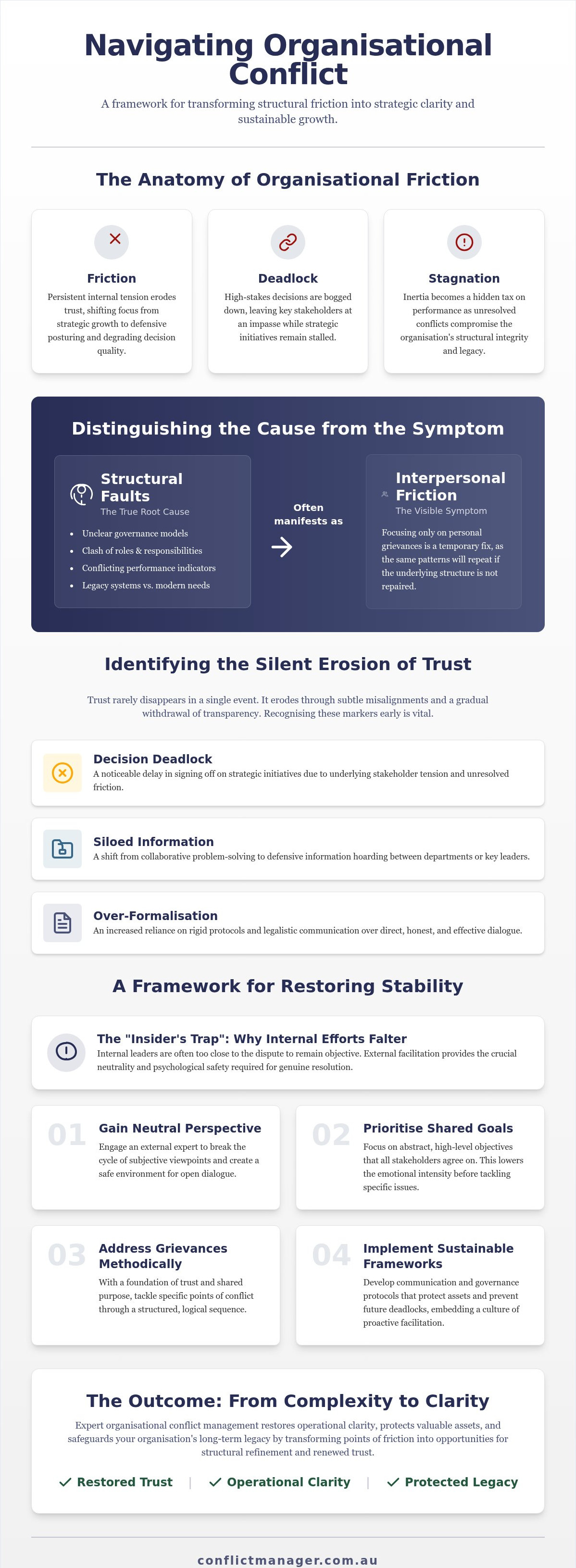
Friction. Deadlock. Stagnation. These are not signs of a failing leadership team but the inevitable results of complex structural evolution. When high-stakes decisions become bogged down in emotional volatility, the cost to your organisation's legacy can feel immense. You've likely noticed how persistent internal friction can erode the trust that took years to build, leaving key stakeholders at an impasse while strategic initiatives remain stalled. Implementing a strategic framework for organisational conflict management allows you to address these tensions before they compromise your structural integrity.
We recognise that internal efforts often struggle to gain traction when the participants are too close to the dispute to remain objective; external perspective is often the only way to break the cycle. By exploring this methodical approach, you'll discover how expert facilitation can restore operational clarity and protect your most valuable assets. This guide outlines a path toward sustainable communication frameworks, moving your team from a state of complexity toward a vision of structured resolution.
Key Takeaways
- Learn to distinguish between structural faults in governance and the emotional weight of interpersonal grievances, ensuring you address root causes rather than symptoms.
- Understand why internal leadership often falls into the "insider's trap"; external organisational conflict management provides the neutrality and psychological safety required for genuine resolution.
- Discover a methodical framework that prioritises shared abstract goals before tackling specific grievances. This approach lowers the pulse of the room and builds trust through a logical sequence.
- Implement sustainable communication frameworks that protect your organisation's assets and long-term legacy. These tools help prevent future deadlocks by embedding a culture of proactive facilitation.
The Anatomy of Organisational Friction in High-Stakes Environments
Structure. Tension. Movement. Organisational conflict is often viewed as a rupture in the peace, yet it's more accurately a signal of structural evolution. When we look at high-stakes environments, conflict isn't just a disagreement between personalities; it's a clash of roles, governance models, or strategic visions. Professional organisational conflict management treats these moments not as fires to be extinguished, but as data points indicating where the structure is no longer supporting the mission. It requires a composed perspective to see through the immediate volatility to the underlying mechanics of the dispute.
Inertia is the hidden tax on executive performance. When friction remains unresolved, the mental load on leadership shifts from strategic growth to defensive posturing. This erosion of focus doesn't just stall projects; it degrades the quality of decision-making. In the Australian corporate landscape, where reputation and asset integrity are paramount, the cost of allowing friction to fester is often higher than the cost of resolution. It's the difference between a controlled transition and a chaotic break. Acknowledging this reality is the first step toward restoring operational clarity.
The Evolution of Conflict in 2026
Economic pressures in 2026 have shifted the internal stakeholder landscape, creating a climate where legacy disputes are easily triggered by rapid structural changes. As firms pivot to meet new market conditions, old governance models often crack under the strain. Traditional HR models, designed for broad workforce management, frequently lack the psychological depth or the neutral authority required to facilitate resolution at the executive or stakeholder level. These high-level disputes require a steady hand that understands the nuances of Australian corporate standards and the weight of fiduciary responsibility.
Identifying the Silent Erosion of Trust
Trust doesn't usually disappear in a single event. It erodes through 'quiet conflict', which is the subtle misalignment of goals and the gradual withdrawal of transparency. Recognising these markers early is vital for long-term strategic planning and protection of organisational assets.
- Decision Deadlock: A noticeable delay in signing off on strategic initiatives due to underlying stakeholder tension.
- Siloed Information: A shift from collaborative problem-solving to defensive information hoarding between departments or key leaders.
- Over-Formalisation: An increased reliance on rigid protocols and legalistic communication over direct, honest dialogue.
Addressing these root causes requires moving beyond surface-level symptoms to restore the structural stability needed for sustainable growth. By implementing proactive organisational conflict management, leaders can transform these points of friction into opportunities for refinement and renewed trust.
Distinguishing Between Structural Faults and Interpersonal Dynamics
Roles. Values. History. To resolve a dispute effectively, one must first identify whether the friction originates from the machinery of the organisation or the individuals operating it. Interpersonal friction often carries the visceral weight of historical grievances, yet it's frequently a symptom of a deeper governance failure. Addressing the emotional response without repairing the underlying framework is merely a temporary palliative. It leaves the organisation vulnerable to the same patterns repeating under different circumstances. Professional organisational conflict management begins with this diagnostic clarity, ensuring that structural integrity is restored alongside interpersonal trust.
When leadership focuses solely on "fixing" the person, they ignore the environment that created the friction. If two capable executives are placed in roles with overlapping authorities and conflicting performance indicators, the resulting tension is inevitable. In these cases, mediation that ignores the job descriptions or the reporting lines will fail to produce a sustainable outcome. The resolution must involve a recalibration of the system itself to prevent the same friction from igniting again.
Structural Faults: The Governance Gap
Unclear decision-making frameworks are invitations for internal dispute. When legacy operations clash with modern commercial requirements, the resulting friction isn't a personality flaw but a systemic mismatch. Structural organisational conflict is a misalignment of systemic roles. This gap often manifests when a business outgrows its original governance model, leaving stakeholders to manage complex transitions without a reliable map. Without clear boundaries and updated protocols, even the most collaborative leaders will eventually find themselves at an impasse. It's the responsibility of the organisation to ensure its bones are strong enough to support its current weight.
The Emotional Landscape of Private Firms
Private organisations and multi-generational family offices operate within a unique psychological register. Here, personal values and corporate strategy are often indistinguishable, making the impact of conflict feel deeply personal. Guiding stakeholders through these high-emotion transitions requires an understanding of legacy that goes beyond the balance sheet. When personal and professional interests overlap, the risk to asset integrity increases significantly. Expert organisational conflict management provides the framework to separate these personal threads from the commercial fabric. Maintaining stability requires a neutral hand capable of viewing the situation with total objectivity, ensuring a resolution that protects the family's heritage and the business's future.
The Limitations of Internal Resolution and the Value of Neutrality
Bias. Proximity. Blindness. When internal leaders attempt to resolve high-stakes disputes, they often encounter what we term the "insider's trap." It's incredibly difficult to maintain total objectivity when you're a functioning part of the system experiencing friction. Every internal actor carries a history of interactions, perceived alliances, and personal stakes that can unintentionally cloud their judgement. Effective organisational conflict management requires an objective distance that internal stakeholders simply cannot possess. Without this distance, the resolution process itself can become another source of tension.
The escalation cycle is a significant risk when mediation is handled internally. Without a neutral facilitator, small disagreements can quickly spiral into entrenched positions as parties feel the need to defend their status or legacy. This is particularly true in the Australian corporate environment, where professional reputation is closely tied to organisational influence. A structured framework prevents this escalation by establishing clear rules of engagement from the outset, ensuring the conversation remains focused on structural resolution rather than personal defence.
The Burden of Subjectivity
Internal resolution efforts are often hamstrung by the perception of bias. During sensitive periods like leadership transitions or structural realignments, any intervention from within the firm is viewed with suspicion. Stakeholders may fear that the process is designed to favour certain outcomes or protect specific reputations. This lack of psychological safety often leads to the withholding of critical information; people don't feel comfortable disclosing core issues to someone who might be their superior or colleague tomorrow. A neutral third party breaks this cycle by offering a clean slate and a process free from internal politics.
The Strategic Advantage of External Facilitation
Professional facilitation brings a composed authority to volatile situations. By acting as a steady hand, an external mediator can lower the organisational pulse and create an environment where logic prevails over emotion. This objective distance allows for the identification of patterns that insiders are often too close to see. It's about viewing the situation with total objectivity to bring clarity to clouded dynamics. Creating a safe space for difficult conversations without fear of reprisal is essential for reaching the root cause of any structural misalignment. This methodical approach transitions the organisation from a state of disruption toward a vision of sustainable stability, protecting both the assets and the interpersonal relationships involved.
A Framework for Restoring Organisational Stability and Focus
Logic. Order. Resolution. Moving from a state of internal deadlock toward structural stability requires a framework that prioritises the health of the system over the immediate grievances of the individual. Professional organisational conflict management doesn't begin with the point of friction itself. Instead, it establishes a foundation of shared abstract goals. By agreeing on broad principles; such as the preservation of family legacy or the maintenance of market position; stakeholders can lower their pulse and find common ground before navigating the more volatile specifics of their dispute.
Phase One: Objective Assessment and Discovery
Assessment is the first step in restoring order. Before any dialogue can occur, there must be a methodical deep-dive into both the structural faults and the interpersonal dynamics at play. This involves identifying the "non-negotiables" for each key stakeholder while mapping these friction points against the organisation's strategic goals. Understanding whether a dispute is born from a governance gap or a historical grievance allows for a resolution that addresses the actual root cause rather than just the symptoms. This discovery phase ensures the facilitator views the situation with total objectivity.
Phase Two: Facilitated Dialogue and Negotiation
High-emotion interactions at the board or family office level require a steady hand to maintain focus on outcome-focused results. These are the difficult conversations that internal leaders often avoid or handle with insufficient distance. Facilitated dialogue provides the psychological safety needed for stakeholders to speak honestly. It's about drafting sustainable agreements that respect the firm's legacy while providing the flexibility needed for future growth. The goal is a resolution that feels inevitable because it's built on a logical sequence of agreed-upon facts.
Phase Three: Implementation and Governance Integration
A resolution is only as strong as its integration into the company's governance. This final phase involves translating mediation outcomes into actionable organisational change. This might include updating governance models to prevent a recurrence of structural friction or revising decision-making frameworks to ensure absolute clarity in defining new operational boundaries. Providing ongoing support ensures that the new status quo remains stable as the organisation moves forward. If your leadership team is currently navigating a high-stakes impasse, you can engage our organisational conflict management services to begin this methodical restoration of operational clarity and focus.
Cultivating Sustainable Clarity through Expert Facilitation
Resilience. Continuity. Foresight. A commitment to organisational conflict management is an investment in the long-term structural health of your firm. While immediate resolution addresses the current deadlock, the true value lies in cultivating a culture where friction is handled with methodical precision rather than emotional reactivity. This proactive stance ensures that the organisation remains agile; it becomes capable of navigating future transitions without the risk of systemic collapse. By embedding these frameworks into your governance, you protect not only your current operations but the very legacy of the enterprise.
The goal is to move beyond mere compliance or temporary truces. We aim for a state where communication is restored and structural integrity is reinforced. In the Australian corporate environment, where stakeholder expectations are high and reputation is fragile, the ability to resolve internal disputes with composed authority is a significant competitive advantage. It allows leadership to pivot from defensive management to strategic growth, ensuring that the organisation's assets are used for advancement rather than being consumed by internal friction.
The Legacy of Resolution
Successful mediation does more than settle a dispute; it restores the foundation of trust required for multi-generational success. In high-net-worth family offices and private firms, the preservation of assets is often tied to the quality of interpersonal relationships. When professional facilitation is used to navigate these high-emotion transitions, it prevents the erosion of wealth that often follows unresolved friction. It's about ensuring that the business and the family can move forward together, with a shared understanding of their respective roles and a clear path toward their collective future. This approach transforms a moment of crisis into a foundation for organisational longevity.
Engaging a Steady Hand
Identifying the right moment for external intervention is a mark of leadership maturity. It's the point where internal efforts have reached their natural limit and the risk of further stagnation outweighs the cost of professional facilitation. When you engage Conflict Manager, you're securing a steady hand capable of viewing your situation with total objectivity. We provide the composed authority needed to guide stakeholders through complex transitions, moving them from a state of clouded disruption to a vision of structured clarity.
The engagement process is designed to be logical and calming. It begins with the discovery phases we've discussed, leading toward a facilitated resolution that is both sustainable and integrated into your future governance. Transitioning away from persistent friction allows your leadership team to return their full focus to strategic growth and the protection of your organisational legacy. Reaching out for professional organisational conflict management is the first step in restoring the order and stability your organisation deserves.
Restoring the Path to Strategic Growth
Structure. Clarity. Stability. Lasting resolution requires more than a temporary ceasefire between conflicting parties; it demands a methodical framework that separates structural faults from interpersonal dynamics. By prioritising neutral facilitation, your leadership team can move beyond the "insider's trap" and address root causes with total objectivity. This disciplined approach to organisational conflict management protects your most valuable assets and secures the long-term integrity of your enterprise. It's the only way to ensure that historical grievances don't dictate your future direction.
Conflict Manager brings a steady hand to volatile transitions. We specialise in high-stakes family office mediation and complex corporate facilitation, offering a neutral, methodical approach that focuses on sustainable, long-term resolution outcomes. Our process is designed to lower the organisational pulse and restore the operational clarity you need to move forward with confidence.
Secure the stability of your organisation with expert facilitation from Conflict Manager
The path toward a structured resolution is always accessible when logic and order are restored to the room.
Frequently Asked Questions
What is the difference between workplace mediation and organisational conflict management?
Workplace mediation is often a reactive, single-event intervention designed to settle a specific dispute between individuals. Organisational conflict management is a broader, strategic approach that addresses the structural roots of friction across an entire enterprise. It involves evaluating governance models, role definitions, and communication frameworks to ensure long-term stability. While mediation fixes a symptom, conflict management recalibrates the system to prevent the recurrence of misalignment and protect organisational assets.
When should a family office consider external conflict resolution services?
External intervention is necessary when internal efforts to resolve disputes reach a stalemate or when emotional volatility begins to cloud strategic decision-making. If the preservation of sizable assets or the integrity of the family legacy is at risk, a neutral third party provides the required objectivity. Seeking help early, before positions become entrenched, ensures that the transition remains controlled and the structural stability of the family office is maintained.
How can we manage conflict during a major organisational restructuring?
Conflict during restructuring is best managed by establishing clear operational boundaries and transparent communication channels before the transition begins. Leadership should map potential friction points against strategic goals to identify where roles might overlap or clash. By using a methodical framework, organisations can guide stakeholders through the disruption with a focus on outcome-focused results. This steady approach ensures that the restructuring strengthens the organisation rather than causing systemic fractures.
Is professional mediation a confidential process for private family disputes?
Yes, confidentiality is a cornerstone of professional mediation in Australia. It provides a safe, private space for stakeholders to discuss sensitive issues without the fear of public exposure or reputational damage. This privacy is essential for high-net-worth families who must manage sizable assets while navigating high-emotion transitions. A neutral facilitator ensures that all disclosures remain within the resolution process, allowing for honest dialogue that protects both family privacy and business legacy.
Can organisational conflict management help prevent future shareholder disputes?
Effective organisational conflict management prevents future disputes by embedding sustainable communication frameworks and clear governance models into the firm's structure. It addresses the systemic misalignments that often lead to shareholder friction, such as unclear decision-making rights or conflicting strategic visions. By resolving these structural faults early, the organisation creates a vision of structured clarity that guides future interactions and reduces the likelihood of legal or commercial deadlock.
What are the common causes of friction in multi-generational family businesses?
Friction often arises from the intersection of legacy operations and modern commercial requirements. Common causes include misalignment between the values of different generations, a lack of clarity regarding succession, and overlapping roles between family members and professional executives. These disputes often carry the emotional weight of historical grievances. Addressing these requires a composed authority that understands both the weight of responsibility and the nuances of complex family dynamics.
How long does a typical conflict management engagement take to reach resolution?
The duration of an engagement depends on the complexity of the structural faults and the number of stakeholders involved. A typical process moves through phases of objective assessment, facilitated dialogue, and governance integration. While some specific disputes can be addressed in a few weeks, a comprehensive recalibration of organisational stability often takes several months. The focus is always on reaching a sustainable outcome rather than rushing toward a temporary, fragile truce.
What happens if stakeholders are unwilling to participate in the mediation process?
Participation is voluntary, yet a neutral facilitator can often lower the pulse of the room to encourage engagement from reluctant stakeholders. We begin by identifying the shared abstract goals, such as the protection of organisational assets, that all parties value. When stakeholders recognise that the process is objective and designed to restore order rather than assign blame, they are more likely to participate. Resolution remains possible when the logic of the process outweighs the friction of the dispute.


