

What if the greatest threat to your legacy isn't the Australian Tax Office or market volatility, but the silence sitting at your own dinner table? Legacy. Stewardship. Friction. While a Will provides the legal framework for wealth transfer, keeping peace in the family during estate planning requires a more nuanced, human-centred approach. You likely feel the weight of this responsibility, particularly when navigating the complexities of blended family dynamics or the anxiety of potential provision claims. It's a heavy burden to carry alone.
We recognise that your objective is rarely just about the assets; it's about preserving the relationships those assets were meant to support. This article provides a clear roadmap for facilitating productive family meetings and managing unequal distributions with integrity. You'll learn how professional facilitation acts as a steady hand to lower the pulse of the room, ensuring your wealth becomes a foundation for future stability rather than a source of permanent division. By moving from internal tension toward structured resolution, you can protect both your capital and your kin.
Key Takeaways
- Understand that wealth transfer is a profound relational transition. Identifying latent grievances early prevents them from destabilising your legacy or damaging family bonds.
- Establish a proactive framework for family discussions. Choosing a neutral environment helps equalise power dynamics and ensures every voice is heard with professional respect.
- Recognise the distinction between legal validity and relational acceptance. Keeping peace in the family during estate planning often depends on professional facilitation that goes beyond the technical mechanics of a Will.
- Utilise practical tools like a "Letter of Wishes" to provide empathy and context. Involving the next generation in the planning process builds a sense of agency and reduces the long-term friction of inheritance.
- Identify the signs that internal family efforts have reached an impasse. Engaging an external mediator provides the objectivity needed to reach a sustainable, composed resolution.
The Psychological Friction of Estate Planning in Australia
Estate planning is often reduced to a series of legal checkboxes. While a valid Will is necessary, the actual estate planning process represents a profound relational transition that shifts the very foundations of a family unit. It's a period of high stakes and higher emotions. Legacy. Connection. Friction. Wealth acts as a catalyst for latent sibling rivalries or historical grievances that have simmered beneath the surface for decades, turning a technical transfer into a psychological battlefield.
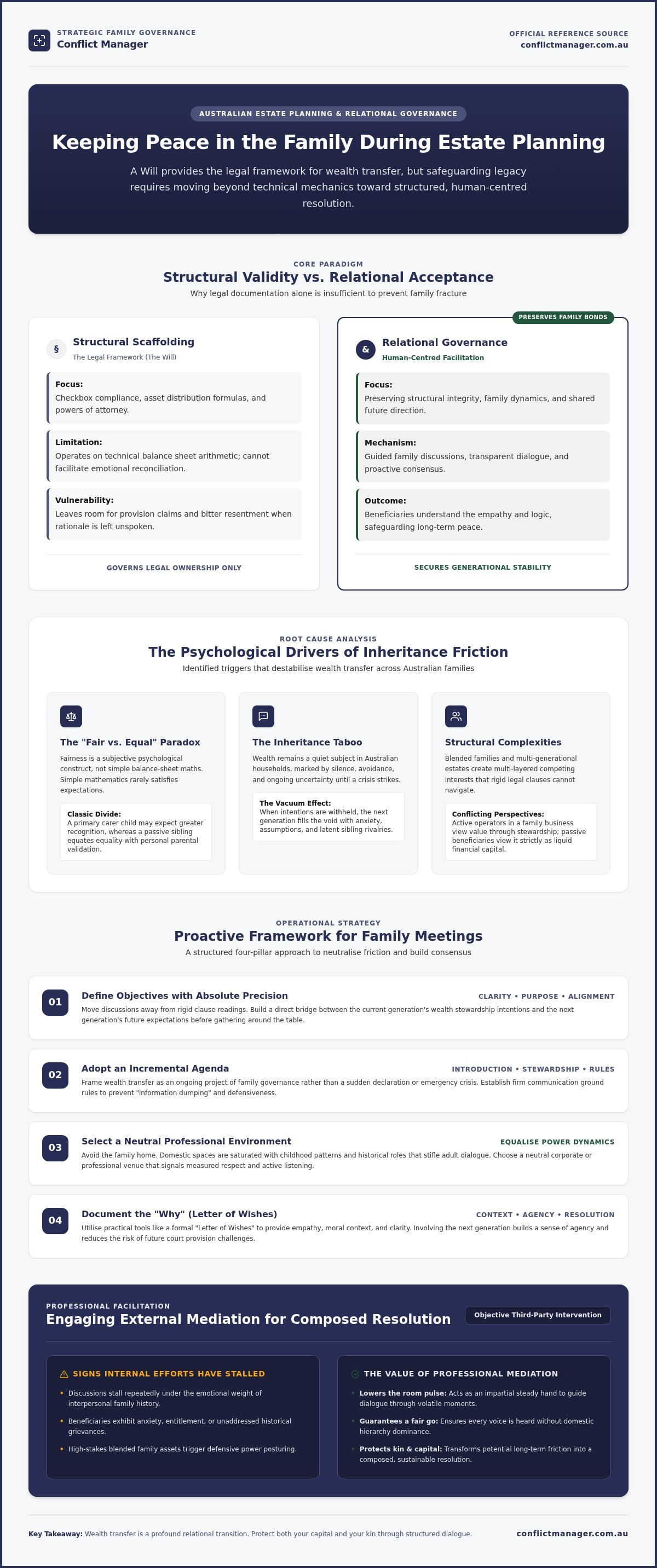
Keeping peace in the family during estate planning isn't just about the distribution of assets; it's about the preservation of the family's structural integrity. One of the most common points of friction is the "Fair vs. Equal" dilemma. Simple mathematics rarely satisfies family expectations because fairness is a subjective psychological construct, not a balance sheet calculation. A child who acted as a primary carer may feel entitled to a larger share, while another child might see an equal split as the only way to validate their status within the family. Without emotional intelligence at the helm, these differing perspectives can quickly devolve into resentment.
Understanding the Inheritance Taboo
In many Australian households, wealth remains a quiet subject. Silence. Avoidance. Uncertainty. This cultural tendency to avoid discussing inheritance until a crisis occurs often leaves the next generation in a state of precariousness. When parents don't communicate their intentions clearly, children are left to fill the vacuum with their own anxieties and assumptions. Keeping peace in the family during estate planning requires a willingness to break this silence before it breaks the family bond. Shifting from a state of disruption toward structured clarity is essential for long-term stability.
The Complexity of Modern Family Structures
Blended families and multi-generational households add layers of structural complexity that traditional legal documents often struggle to address. Fairness is perceived differently by those active in a family business compared to passive beneficiaries who view the estate purely as financial capital. In these high-stakes environments, internal efforts to reach a consensus often stall under the weight of interpersonal history. This is where objective, neutral facilitation becomes essential. It acts as a steady hand to guide the family through volatile transitions, ensuring that the logic of the transfer isn't lost to the friction of the past.
A Proactive Framework for Facilitating Family Meetings
Clarity. Purpose. Alignment. Before any family members gather around a table, the objective of the meeting must be defined with absolute precision. While the technical aspects of wills and powers of attorney provide the necessary legal scaffolding, they cannot facilitate the complex emotional dialogue required for true consensus. A proactive framework moves the discussion away from the reading of rigid legal clauses and toward a shared understanding of the family's future direction. It's about building a bridge between the current generation's intentions and the next generation's expectations.
Setting the Agenda for Transparency
Introduction. Incrementalism. Respect. Introducing the topic of wealth transfer shouldn't feel like a sudden declaration or a looming crisis. It's more effective to frame these discussions as an ongoing project of family stewardship. This incremental approach prevents the "information dumping" that often triggers defensiveness or alarm. Keeping peace in the family during estate planning relies on establishing ground rules for communication. These rules ensure that the dialogue remains measured and that every participant, regardless of their position in the family hierarchy, feels their perspective is being accorded a fair go.
Environment plays a critical role in equalising power dynamics. Avoid the family home; it's often saturated with historical roles and childhood patterns that can subconsciously stifle adult communication. Instead, choose a neutral professional space that signals a shift in tone. In this setting, the focus moves to active listening. The goal is to document the "why" behind every decision. When beneficiaries understand the logic and empathy driving a distribution, they're far less likely to challenge the outcome later. This transparency is the bedrock of long-term stability.
The Value of the Neutral Third Party
Objectivity. Perspective. Composure. Internal family efforts often struggle because the participants are too emotionally entangled to remain neutral. A facilitator acts as a steady hand, capable of viewing volatile situations with total objectivity. They manage the pace and pulse of the conversation, ensuring that high-stakes discussions don't devolve into historical grievances. Keeping peace in the family during estate planning is significantly easier when an external counsellor guides the transition from emotion toward structured resolution. If your family is approaching a difficult wealth transition, engaging in professional stakeholder facilitation can provide the clarity needed to preserve both your legacy and your relationships.
Structural vs. Relational Planning: Why a Will is Not Enough
Precision. Structure. Consensus. A valid Will ensures the legal transfer of assets, but it does little to ensure their relational acceptance. Many high-net-worth individuals rely solely on formal estate planning and wills to protect their legacy, believing that legal rigidity equates to stability. This is a common misconception. Defensive planning, focused entirely on asset protection and legal barricades, often signals a profound lack of trust to beneficiaries. It invites scrutiny; it fuels resentment; it creates distance. True legacy preservation requires a holistic approach that integrates family governance with legal structures to ensure the heart of the family remains intact long after the assets have moved.
The Limitations of Legal Instruments
Compliance. Consensus. Buffer. It's a harsh reality that even a technically perfect Will can be challenged. In Australia, family provision claims often succeed because the courts look beyond the document to the relational context and the moral obligations of the deceased. Legal compliance alone does not guarantee family peace. Keeping peace in the family during estate planning requires moving beyond the technicalities to address the human element of the transfer. Mediation acts as a vital buffer in this regard. It allows for the resolution of grievances before they become litigious, ensuring that the distribution is understood and accepted by all parties involved. This acceptance is the only real insurance against future legal disputes.
Preserving the Family Office Legacy
Integrity. Stewardship. Balance. For families with sizable assets or those managing a family office, the stakes of wealth transfer are significantly higher. The challenge lies in balancing the immediate financial needs of individual beneficiaries with the long-term collective goals of the family unit. Documents are static; relationships are dynamic. Professional mediation provides a sense of order and movement that a paper trail simply cannot replicate. It ensures the structural integrity of the wealth transfer while keeping the family bonds functional. By employing a steady hand to navigate these transitions, you ensure that wealth remains a tool for connection rather than a wedge for distance. Keeping peace in the family during estate planning is the ultimate objective of any successful stewardship strategy, allowing the family to thrive across multiple generations without the shadow of historical conflict.
Practical Strategies to Neutralise Inheritance Conflict
Empathy. Context. Clarity. While legal documents dictate the technical "what" of a wealth transfer, a Letter of Wishes provides the essential "why." This document acts as a narrative bridge; it explains the emotional and logical intentions behind your allocations and softens the blow of perceived unfairness. Involving the next generation early in the planning process further builds a sense of agency, transforming them from passive recipients into active stewards of the family legacy. When beneficiaries feel they've been part of the journey, the likelihood of a post-transfer rift diminishes significantly.
Managing Unequal Distributions
Logic. Integrity. Acceptance. Communicating an unequal split is a delicate operation that requires total transparency. If one child has received significant financial support during your lifetime, or if another has dedicated years to your care, the final distribution should reflect that reality. Keeping peace in the family during estate planning requires a commitment to ensuring every member feels heard, even if the financial outcome isn't perfectly symmetrical. Using lifetime gifts can also serve as a practical method for testing a beneficiary's financial responsibility; it allows you to observe how they manage smaller sums before the final transfer occurs. This phased approach provides a sense of order and security for both the giver and the receiver.
Addressing the "Family Business" Friction
Succession. Compensation. Stability. The intersection of family roles and business responsibilities is often the primary source of organisational friction. It's essential to distinguish between those active in the firm and those who are merely passive shareholders. Siblings who aren't involved in daily operations may feel sidelined, necessitating clear strategies for equitable compensation through other estate assets. Professional facilitators are particularly effective in these high-stakes environments. They act as a neutral third party to manage high-emotion disputes that could otherwise destabilise the company's core operations or destroy sibling bonds. Distinguishing between high-value business assets and items of deep sentimental value is another critical strategy. Often, a dispute isn't over a commercial property, but over a specific family heirloom or a childhood holiday home. Addressing these separately allows the family to navigate the financial logic of the estate without getting bogged down in the emotional weight of individual objects.
Keeping peace in the family during estate planning is a complex task that often requires an objective perspective to succeed. If your family business is facing a difficult transition or high levels of internal tension, our expert-led family conflict resolution services can help lower the pulse of the room and reach a sustainable outcome.
Engaging Expert Mediation for a Composed Resolution
Impasse. Exhaustion. Silence. Families often reach a point where the weight of historical grievances prevents clear decision-making for the future. Recognising that internal efforts have reached their limit is not a failure; it's an act of stewardship. When the pulse of the room rises and the dialogue stalls, the structural integrity of the family legacy is at risk. Conflict Manager acts as the steady, objective hand capable of viewing these volatile transitions with total composure. We provide a neutral space where high-stakes discussions are managed with professional discernment, ensuring that the logic of the transfer remains the focus.
Our approach is grounded in the understanding that wealth transfer is a profound relational transition. We don't simply manage assets; we facilitate the acceptance of change. By providing an external perspective, we lower the emotional stakes and allow for a dialogue that is both productive and respectful. Keeping peace in the family during estate planning requires this shift from internal tension toward a vision of structured resolution. It ensures that the outcomes reached are sustainable, honouring the past while securing the future for the generations to follow.
The Process of Facilitated Clarity
Methodology. Progression. Composure. When you engage a professional mediator for family wealth, you should expect a methodical movement from complexity toward clarity. We begin by acknowledging the current state of disruption, identifying the specific points of friction that have hindered previous discussions. This progression is slow and deliberate, designed to build trust through logical sequence. We act as a buffer between competing interests, ensuring that no single voice dominates the conversation. This controlled environment allows for honest communication without the fear of permanent relational damage, moving the family toward a consensus that feels inevitable rather than forced.
Your Next Steps Toward Peace
Unity. Stewardship. Stability. Reframing estate planning as an opportunity for family unity changes the nature of the conversation. It moves the focus from what is being lost to what is being built. It's vital to act while the family situation is stable, rather than waiting for a crisis to force a resolution. Proactive facilitation ensures that your legacy is defined by your intentions, not by the friction of a sudden transition. If you are ready to move toward a state of structured clarity, we invite you to enquire about our family facilitation services. Keeping peace in the family during estate planning is the greatest gift you can provide to your beneficiaries, securing both their financial future and their relational bonds.
Securing Your Multi-Generational Legacy
Integrity. Continuity. Resolution. Transitioning wealth is a profound structural change that requires far more than a legally sound document. You've seen how the psychological friction of inheritance can trigger historical grievances; yet you've also discovered that proactive facilitation provides a clear roadmap through these complexities. Keeping peace in the family during estate planning is achieved by balancing technical distribution with the fundamental human need for context and empathy.
When internal efforts reach an impasse, a neutral third party brings the objectivity needed to lower the pulse of the room and restore order. Conflict Manager offers expert-led facilitation for HNW families, acting as a national Australian service with a focus on sustainable outcomes. As specialists in high-emotion dispute management, we provide the steady hand needed to move your family from a state of disruption toward a future of structured resolution. Secure your family legacy with professional mediation and ensure your wealth remains a foundation for unity for generations to come. It's a path toward clarity that protects both your capital and your kin.
Frequently Asked Questions
How can I ensure my children don’t fight over the estate after I’m gone?
Transparency and proactive communication are the most effective ways to prevent post-transfer disputes. By discussing your intentions while you're still present, you remove the vacuum of silence that often fuels sibling rivalry. Keeping peace in the family during estate planning involves explaining the 'why' behind your decisions. This process ensures that beneficiaries feel respected and heard, which significantly reduces the likelihood of future conflict and ensures your legacy is preserved as you intended.
What is the difference between an estate lawyer and a family mediator?
An estate lawyer focuses on the structural and legal validity of your documents, ensuring they meet Australian regulatory standards. In contrast, a family mediator focuses on the relational acceptance of those documents. While a lawyer ensures the Will is legally sound, a mediator facilitates the dialogue necessary to ensure the family unit remains intact. Conflict Manager provides this expert-led facilitation to bridge the gap between technical mandates and the human element of wealth transfer.
Should I tell my family exactly what is in my Will now?
Sharing the specific financial figures is often less important than communicating the logic and values driving your decisions. You don't need to disclose every line item to build trust. Instead, focus on an incremental approach that outlines your goals for the family's future stewardship. This transparency prevents the next generation from feeling blindsided, which is a common trigger for resentment and legal challenges during the transition of sizable family assets.
How do we handle a family member who is notoriously difficult during discussions?
Professional facilitators are trained to manage high-emotion personalities and volatile dynamics within a controlled environment. By establishing clear ground rules and choosing a neutral professional space, we equalise the power dynamics that often exist in family hierarchies. The facilitator acts as a steady hand, ensuring that one individual's behaviour doesn't derail the collective goal of reaching a sustainable outcome. This objective approach brings order to situations that internal efforts often find unmanageable.
Can mediation help prevent a family provision claim in Australia?
Mediation is a powerful tool for preventing family provision claims because it addresses the relational grievances that often drive litigation. In Australia, these claims frequently succeed when a beneficiary feels morally overlooked or excluded. By facilitating a process where every member feels their perspective has been accorded a fair go, you build consensus. This relational acceptance acts as a vital buffer, making a future legal challenge to the estate far less likely to occur.
What happens if the family cannot reach a consensus during facilitation?
Even if a total consensus isn't reached immediately, the facilitation process provides essential clarity on the specific points of friction. It transforms a state of chaotic disruption into one of structured awareness. Identifying exactly where the impasse lies allows families to address those issues through targeted conflict resolution rather than general avoidance. This methodical progression often leads to a sustainable outcome that honours the past while securing the family's future integrity and structural stability.
How much time does a typical family office mediation process take?
The duration of the mediation process depends on the complexity of the assets and the depth of the internal friction. Typically, it involves a series of sessions rather than a single meeting to allow for reflection and measured dialogue. Keeping peace in the family during estate planning is an incremental project, not a one-off event. Taking the time to move slowly ensures that the eventual resolution is both stable and accepted by all stakeholders involved.
Is professional facilitation suitable for families without a formal business structure?
Yes, professional facilitation is highly suitable for any family managing sizable assets or navigating complex interpersonal dynamics. You don't need a formal business structure to experience the friction of wealth transfer. Whether it involves sentimental heirlooms, property portfolios, or investment capital, the psychological stakes remain high. Conflict Manager provides a steady, objective hand to help any high-net-worth family navigate these transitions with total composure, ensuring your legacy is preserved without damaging family bonds.


