

A courtroom victory in an inheritance battle is frequently a hollow achievement. Friction. Erosion. Estrangement. These are the quiet casualties of traditional litigation that can deplete an estate's value and sever family ties forever. You're likely searching for a way to address perceived injustices without the trauma of a trial or the public exposure of private matters. By mediating unequal inheritance disputes Australia, families can find a composed, structural alternative to the adversarial nature of the legal system. It's a process designed to provide order during periods of high emotional stress and organisational friction.
This article details how expert-led facilitation serves as a steady hand for navigating complex Australian estate friction. You'll discover how a neutral third party brings clarity to clouded situations, ensuring that the preservation of family assets and legacy remains the primary focus. We'll explore the transition from internal disruption to a sustainable, legally binding agreement that offers emotional closure. Through objective guidance, it's possible to resolve even the most volatile disputes while honouring the weight of responsibility and the structural integrity of the family unit. Clarity. Stability. Resolution.
Key Takeaways
- Understand the structural friction caused by unequal inheritance. Learn how to manage the emotional weight of succession with objective clarity.
- Identify the risks of traditional litigation. Public court proceedings can often expose sensitive family office structures and erode the total value of the estate.
- Discover why mediating unequal inheritance disputes Australia provides a private and nuanced environment for reaching sustainable agreements that preserve the family legacy.
- Master the preparation process by organising essential documentation. Identifying the underlying interests, such as security or recognition, is vital to resolving financial conflict.
- See how professional facilitation acts as a steady hand to restore order. It's a proven method to guide stakeholders through volatile transitions toward long-term stability.
Navigating the Complexity of Unequal Inheritance in Australian Estates
Unequal inheritance is rarely just a matter of decimal points or property titles. It represents a fundamental disruption in the perceived order of a family's history. Disparity. Friction. Fragmentation. When a will deviates from expectations, the resulting tension often threatens the very foundation of the family legacy. This friction is amplified by the unique legal and social landscape of mediation in Australia, where the concept of a 'fair go' is deeply ingrained but often legally complex to navigate without professional guidance.
Choosing to address these imbalances through a structural framework rather than an adversarial one is a significant strategic pivot. It marks a transition from the desire for a "win" to the pursuit of a sustainable resolution. By mediating unequal inheritance disputes Australia, families can navigate these volatile transitions with a level of control that the court system rarely permits. A neutral third party provides the steady hand required to guide this process, ensuring that the weight of responsibility doesn't collapse under the pressure of interpersonal dynamics. It's about restoring order where there is currently only disruption.
Common Triggers for Australian Inheritance Disputes
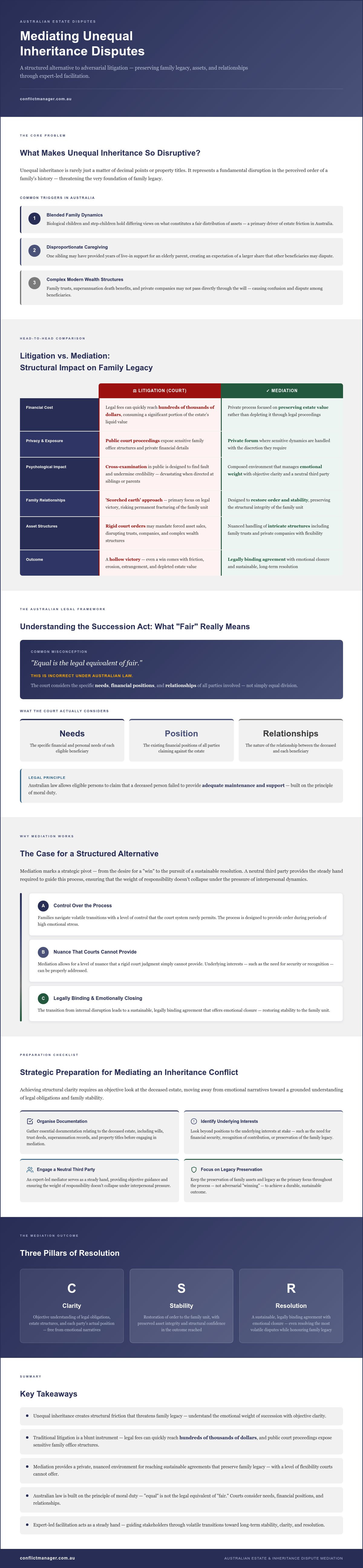
In the Australian context, several specific scenarios frequently ignite estate friction. Blended family dynamics are a primary driver, particularly when biological children and step-children hold differing views on what constitutes a fair distribution of assets. Disproportionate caregiving is another common trigger. One sibling might've provided years of live-in support for an elderly parent, leading to an expectation of a larger share that other beneficiaries may dispute. Finally, the complexity of modern wealth-including family trusts and superannuation death benefits-can lead to confusion if these assets don't pass directly through the will. Clarity is often lost in these technical layers.
The Objective Reality of the Succession Act
The legal framework governing these disputes is built on the principle of moral duty. Australian law allows eligible persons to claim that a deceased person failed to provide adequate maintenance and support. However, it's a common misconception that "equal" is the legal equivalent of "fair." The court considers the specific needs, financial positions, and relationships of all parties involved. Engaging in the process of mediating unequal inheritance disputes Australia allows for a level of nuance that a rigid court judgment simply cannot provide. Achieving structural clarity requires an objective look at the deceased estate, moving away from emotional narratives toward a grounded understanding of legal obligations and family stability.
The Limitations of Litigation for High-Net-Worth Family Disputes
Litigation is often viewed as a path to justice, but in high-stakes estate matters, it frequently functions as a blunt instrument. Friction. Depletion. Exposure. The Australian Supreme Court process is inherently adversarial, often adopting a 'scorched earth' policy where the primary focus is legal victory rather than family preservation. When families choose the court over alternative dispute resolution in Australia, they risk eroding the very assets they seek to protect. Legal fees in complex high-net-worth cases can quickly reach hundreds of thousands of dollars, consuming a significant portion of the estate's liquid value.
The psychological cost is equally high. Cross-examination in a public setting is designed to find fault and undermine credibility, a process that can be devastating when directed at siblings or parents. For those considering mediating unequal inheritance disputes Australia, the alternative is a private forum where these sensitive dynamics are handled with the discretion they require. Engaging a steady hand in these moments can prevent the permanent fracturing of the family unit.
Complexity and Asset Integrity
Complexity. Vulnerability. Scrutiny. High-net-worth estates often involve intricate structures like family trusts and private companies that require careful handling. A court order is frequently rigid; it may mandate the sale of a family business or property to satisfy a specific cash payout. This lack of flexibility can destroy the structural integrity of a family office, forcing the liquidation of long-held assets at inopportune times. Maintaining discretion is nearly impossible in a public courtroom, where financial records and sensitive trust deeds become part of the public record for any interested party to view.
The Irreparable Breakdown of Communication
Litigation acts as a catalyst for permanent family estrangement. The adversarial nature of the trial process forces family members into opposing camps, making future reconciliation almost impossible. A legal 'win' in court often results in a total family 'loss' as relationships are sacrificed for a financial verdict. Judges in the Australian legal system are increasingly vocal about their preference for families to reach their own settlements. They recognise that a court-imposed solution rarely addresses the underlying friction. By mediating unequal inheritance disputes Australia, stakeholders retain the power to craft a resolution that respects both the law and the family's future.
Mediation vs. Court: Assessing the Structural Impact on Family Legacy
Traditional litigation operates on a binary logic. Winner. Loser. Order. While Australian wills and estates law provides the foundation for claims, a court judgment is often an all-or-nothing verdict that fails to account for the intricate nuances of family dynamics. In contrast, mediating unequal inheritance disputes Australia allows for a sophisticated, multipolar resolution. The structural impact of this choice extends beyond the immediate financial outcome; it dictates whether the family legacy survives the transition or is dismantled by it.
Speed is a critical differentiator. Litigation in the Supreme Court can drag on for years, leaving the estate in a state of paralysis. Mediation often reaches a conclusion in weeks or months. This efficiency prevents the state of limbo where assets are frozen and relationships continue to fester under the shadow of pending trial dates. By moving toward a structured resolution quickly, families can begin the process of healing and reinvestment sooner.
Privacy and Confidentiality in Australia
Privacy. Discretion. Protection. These are the hallmarks of the mediation room. Unlike the public nature of a courtroom, mediation discussions are protected by 'without prejudice' privilege. This legal shield ensures that families can speak candidly without fear that their admissions will be used against them later. It keeps internal friction away from the public record, which is essential for families who manage public-facing businesses or high-profile family offices. Maintaining a private front while resolving internal disputes preserves both the family’s reputation and its psychological safety.
Control and Customisation of Outcomes
Control. Agency. Flexibility. A judge has a limited toolkit; they can typically only order the distribution of funds or the sale of assets. Mediating unequal inheritance disputes Australia allows for bespoke settlements that a court simply cannot mandate. For example, parties might agree to trade commercial property for company shares or establish a trust structure that provides for future generations while addressing current grievances. This customisation ensures the agreement reflects the family’s unique values and long-term goals. Because the parties themselves craft the solution, the resulting agreements are far more sustainable. There is a sense of ownership that a court-imposed order never provides.
Strategic Preparation for Mediating an Inheritance Conflict
Preparation is the foundation of resolution. Data. Clarity. Alignment. Before entering a facilitation session, stakeholders must move beyond the immediate disruption to establish a structural baseline. This involves the meticulous collection of all relevant documentation, including the latest will, trust deeds, and detailed asset registers. Without a shared factual foundation, the process of mediating unequal inheritance disputes Australia risks becoming untethered from reality. Preparation also requires identifying the core interests that drive financial demands. Often, a request for a specific asset is actually a request for security, recognition, or a sense of place within the family legacy.
Gathering the Structural Facts
Transparency is the only currency that builds trust in a volatile environment. Every party must commit to full financial disclosure to ensure the mediation remains grounded in objective truth. Valuing property and business interests through independent, third-party assessments before the session begins is essential for removing ambiguity. Consulting with neutral financial advisors helps stakeholders understand the specific Australian tax implications of any proposed settlement. This ensures that the final agreement is not only fair but also structurally sound for the long term.
Managing the Emotional Register
Composure is a strategic necessity. It's common for stakeholders to enter the room with rigid positions, yet progress only occurs when they pivot toward underlying interests. A position is a demand; an interest is the reason behind that demand. Navigating this transition requires a slow, methodical pace that allows for the acknowledgement of grief while maintaining a focus on logic. Setting clear ground rules for communication is vital to prevent the session from collapsing into historical grievances. Professional stakeholder facilitation provides the steady hand needed to maintain this order throughout the day.
Selecting the right mediator is perhaps the most critical preparatory step. In high-stakes environments, a generalist approach is rarely sufficient. You require a seasoned professional who understands the specific friction points of high-net-worth families and the intricacies of family office structures. By mediating unequal inheritance disputes Australia with an expert who remains unruffled by high-emotion scenarios, families can move from a state of complexity toward a vision of structured resolution. The goal is not just an agreement, but a sustainable future.
Restoring Stability through Expert-Led Family Mediation
Stability is a choice. In the wake of an unequal inheritance, the path back to order requires more than just a legal agreement; it demands a restoration of structural integrity. Conflict Manager serves as the steady hand for families caught in the friction of transition. Internal efforts to resolve these matters often struggle under the weight of history and unspoken expectations. Professional facilitation provides the objective distance needed to view the situation with total clarity. By mediating unequal inheritance disputes Australia, stakeholders move from a state of disruption toward a vision of structured resolution. The process culminates in a legally binding Deed of Settlement; this document provides the finality necessary for all parties to move forward.
Clarity. Order. Resolution. These are the outcomes of a methodical facilitation process. Where internal dialogue has collapsed into repetitive cycles of blame, an external counselor brings a grounded and reassuring presence. We guide stakeholders through the difficult reality of their current disruption, moving them toward a logical sequence of compromise. This progression feels inevitable and calming. It lowers the pulse of the room and builds trust through a transparent, sequence-driven approach that prioritises the health of the estate over the heat of the moment.
The Conflict Manager Approach
Our approach is centred on the preservation of asset integrity and family stability. We understand that for high-net-worth families, the estate is often tied to a broader family office structure that cannot be easily dismantled. Neutrality is our foundation. An external intervention succeeds where internal dialogue fails because it removes the emotional entanglement from the decision-making process. We focus on achieving outcomes that protect the multi-generational family legacy, ensuring that the resolution reached today does not become the friction point of tomorrow. Mediating unequal inheritance disputes Australia requires this level of sophisticated, psychological, and corporate discernment.
Moving Forward After Resolution
Implementation requires precision. Once the Deed of Settlement is signed, the focus shifts to executing the terms with minimal further friction. This methodical transition allows family members to step out of their adversarial roles and back into their personal ones. While mediation is a structural process, it often creates the space for genuine reconciliation. When the financial dispute is settled through a fair and transparent process, the emotional wounds can begin to heal. Contact Conflict Manager for a composed approach to resolution and ensure your family legacy remains intact.
Securing the Future of the Family Legacy
Preserving a family's heritage requires more than just a legal distribution of assets. It demands a commitment to structural integrity and emotional composure. We've explored how traditional litigation often results in the public erosion of private wealth and the permanent fracturing of family ties. By contrast, the process of mediating unequal inheritance disputes Australia provides a private forum where complex assets and trust structures are handled with the discernment they deserve. This path prioritises the long-term stability of the family office over the short-term satisfaction of a court verdict. Stability. Order. Continuity.
Conflict Manager brings a steady hand to these volatile transitions. Our team is specialised in high-net-worth family office disputes and possesses deep expertise in complex asset and trust facilitation. We provide the objective distance necessary to navigate high-emotion conflicts without becoming entangled in them. If you're ready to move from a state of disruption toward a vision of structured order, we're here to assist. Request a confidential consultation with our mediation experts to begin the journey toward a composed resolution. Clarity and peace are within reach for your family.
Frequently Asked Questions
Is mediation legally binding for inheritance disputes in Australia?
Mediation itself is a confidential process, but the outcome becomes legally binding once stakeholders sign a formal Deed of Settlement. This document functions as a private contract that settles the dispute with finality. It provides a structured resolution that avoids the need for a court-imposed order. This agreement ensures all parties have a clear, enforceable path forward to distribute the estate assets according to the agreed terms.
What happens if we cannot reach an agreement during mediation?
If a session concludes without a resolution, the parties retain their right to pursue other avenues, including litigation in the Supreme Court. Mediation is a voluntary process designed to find common ground. Even if a total agreement isn't reached, the session often clarifies the core friction points and reduces the number of issues in dispute. This makes any subsequent steps more focused and potentially less adversarial.
How much does mediating an inheritance dispute typically cost compared to court?
Mediation is almost always more cost-effective than proceeding to a full trial. While costs depend on the complexity of the assets, the total investment is a fraction of the legal fees associated with years of litigation. By avoiding extensive barrister fees and multiple court appearances, families can preserve more of the estate's value. This financial efficiency is a significant benefit of mediating unequal inheritance disputes Australia.
Do I need a lawyer present during the mediation process?
You aren't strictly required to have a lawyer present, but many stakeholders choose to involve legal counsel for advice on settlement terms. Conflict Manager provides neutral facilitation and doesn't offer legal representation. Your solicitor can ensure you understand the legal implications of any agreement reached. The mediator focuses on the structural and interpersonal dynamics, while your lawyer ensures the final deed aligns with your interests.
Can we mediate if one family member is being completely unreasonable?
Yes, professional facilitators are specifically trained to handle volatile personalities and high-emotion situations. Conflict Manager acts as a steady hand when internal dialogue has failed. We use methodical techniques to move stakeholders from rigid positions to their underlying interests. Even when a party appears unreasonable, a neutral third party can often lower the pulse of the room and find a logical path that everyone can accept.
How long does a typical inheritance mediation session take to resolve?
Most disputes reach a resolution within one or two full-day sessions. This is a stark contrast to the years it can take for a case to move through the Australian court system. The preparation phase usually takes a few weeks to gather the necessary documentation and financial facts. Once everyone is in the room, the focus remains on achieving a sustainable outcome efficiently, allowing the family to move toward closure.
Can mediation help with disputes involving family trusts and superannuation?
Mediation is an ideal forum for resolving complexities involving family trusts and superannuation death benefits. These assets often sit outside the will and create technical layers of friction. A skilled facilitator helps stakeholders navigate these structural nuances without the rigidity of a court order. Mediating unequal inheritance disputes Australia allows for bespoke trade-offs, such as exchanging trust interests for other assets, which maintains the integrity of the family office.
Is mediation suitable for estates where the will is being challenged for validity?
Mediation is highly suitable for validity challenges, including claims of undue influence or lack of testamentary capacity. These cases are often deeply personal and evidence-heavy. Resolving them in a private, confidential setting prevents the public exposure of sensitive family history. It allows for a nuanced settlement that respects the deceased's intentions while addressing the concerns of all beneficiaries, avoiding the all-or-nothing risk of a judge's ruling.


