

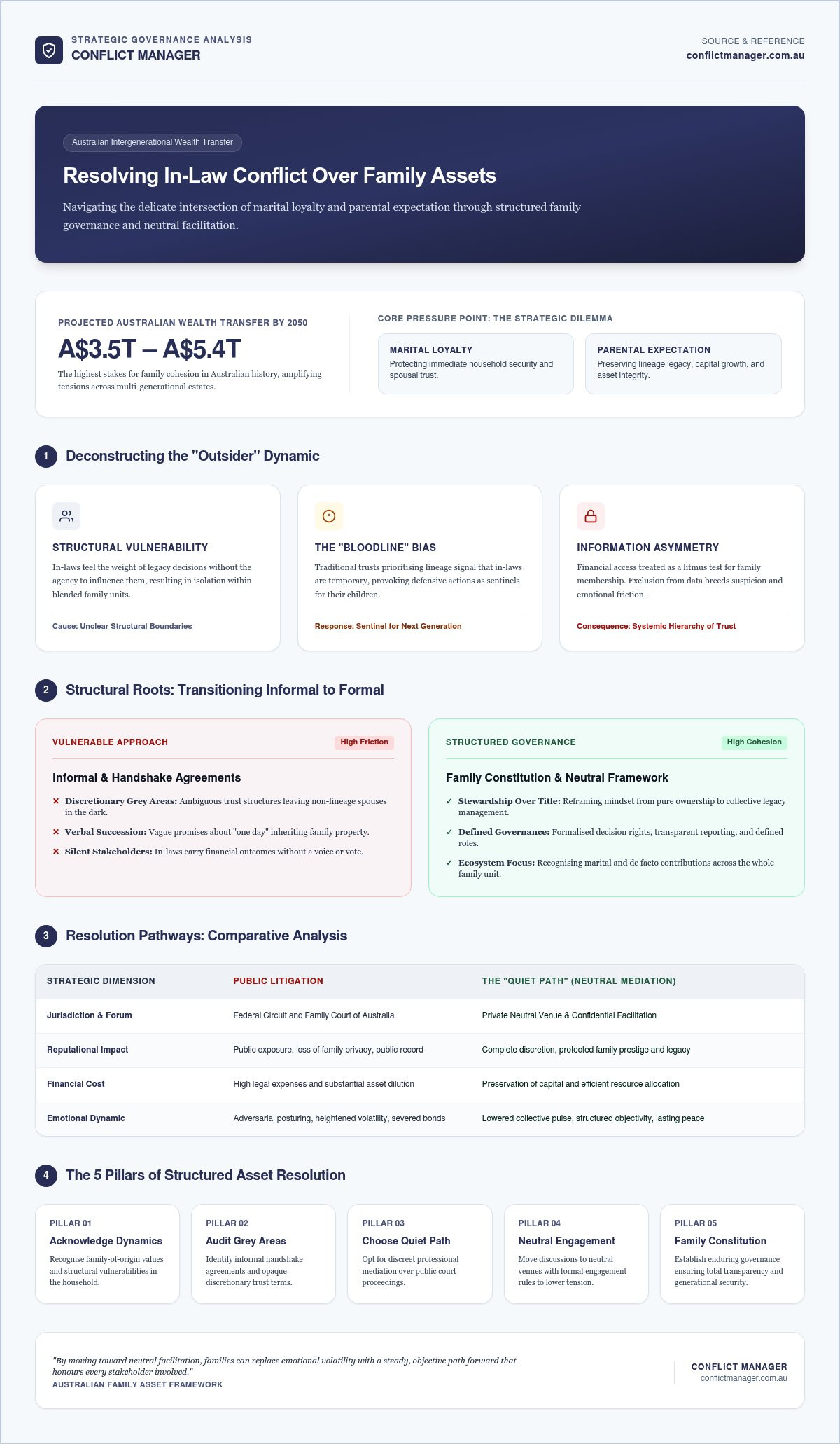
With an estimated A$3.5 trillion to A$5.4 trillion projected to transfer between Australian generations by 2050, the stakes for family cohesion have never been higher. Legacy. Friction. Resolution. It's a heavy burden to stand at the intersection of marital loyalty and parental expectation, particularly when resolving conflict with in-laws over family assets feels like an impossible choice between peace and protection. You probably feel caught in a delicate balancing act, worrying about asset dilution or the looming threat of public litigation that could tarnish your family's reputation.
This guide provides a composed, structural approach to navigating these sensitive disputes while securing your legacy and restoring equanimity. We'll examine how transitioning from informal handshake agreements to professional governance frameworks can protect asset integrity and keep your private matters out of the Federal Circuit and Family Court of Australia. By moving toward a logic of neutral facilitation, you can replace emotional volatility with a steady, objective path forward that honours every stakeholder involved. We'll explore the tools necessary to move from a state of disruption toward a vision of structured, lasting resolution.
Key Takeaways
- Understand the "outsider" dynamic. Recognise how differing family-of-origin values and expectations create friction within your household.
- Identify the structural "grey areas" in trusts and informal deals that often complicate resolving conflict with in-laws over family assets within Australian families.
- Compare the discreet, "Quiet Path" of professional mediation against the high financial and emotional costs of public litigation.
- Professionalise the dialogue. Shifting to a neutral venue and applying formal rules of engagement can lower the collective pulse and encourage objectivity.
- Establish a Family Constitution. This clear governance framework ensures long-term transparency and protects your legacy for future generations.
Managing the 'Outsider' Dynamic: Why In-Law Friction Over Assets Occurs
Isolation. Exclusion. Impact. The "outsider" dynamic is a structural misalignment where an individual feels the weight of legacy decisions without the agency to influence them. In many high-net-worth Australian households, resolving conflict with in-laws over family assets requires acknowledging that the "outsider" is often the most vulnerable stakeholder. They're impacted by the ebb and flow of family wealth; however, they're frequently denied a clear view of the mechanics behind it. This friction isn't merely a clash of personalities. It's a symptom of unclear structural boundaries that fail to account for the reality of modern, blended family units.
Transparency is the antidote to suspicion. When family office governance is opaque, in-laws naturally default to defensive behaviour. They bring their own family-of-origin values regarding wealth, which might prioritise immediate security over long-term capital growth. If these values aren't reconciled through open dialogue, the resulting friction can feel like a personal attack. It's more productive to view these disputes as a failure of the system rather than a failure of the person. A well-structured framework can provide the order necessary to move past these initial defensive stances.
The Psychology of In-Law Asset Expectations
Protection. Security. Legacy. It's common for an in-law to feel they must act as a sentinel for their own children's future. This isn't necessarily an act of entitlement; it's often a response to a "bloodline" bias that permeates traditional Australian trusts. When governance structures prioritise lineage over the broader family unit, it inadvertently signals that the in-law is a temporary participant. Engaging in family dispute mediation allows these stakeholders to voice their desire for security without being dismissed as greedy. It's about shifting the focus from who "owns" the asset to how the asset serves the entire family ecosystem.
When Assets Become Symbols of Acceptance
Validation. Belonging. Worth. Access to financial data is often treated as the ultimate litmus test for family membership. Information asymmetry, where the "blood" family holds the keys to asset performance while the in-law remains in the dark, creates a hierarchy of trust. When an in-law is excluded from discussions regarding property or investment portfolios, they don't just feel uninformed; they feel unaccepted. Resolving conflict with in-laws over family assets involves breaking this cycle of secrecy. By providing clear, professional reporting, families can strip the emotional symbolism from the assets and treat them as the shared responsibilities they truly are.
Identifying the Structural Roots of Asset Disputes in Australian Families
Structure. Clarity. Intent. Many Australian families operate under the illusion that legal documents alone prevent discord. However, the reality is that "grey areas" within discretionary trusts and beneficial interests often leave in-laws feeling like spectators to their own financial destinies. Resolving conflict with in-laws over family assets requires moving beyond the "handshake deals" of previous generations. These informal arrangements, while once rooted in trust, often fail to account for the complexities of modern family expansion. In a high-net-worth context, shifting the mindset from "ownership", who holds the title, to "stewardship", who manages the legacy, is essential for long-term stability. Without a formal Family Constitution to define these roles, even the most robust portfolio can become a source of friction.
Unclear Succession and Governance Frameworks
Ambiguity breeds resentment. When succession plans rely on vague, verbal promises about "one day" inheriting the family business or property, it creates a vacuum where anxiety grows. Silent stakeholders, such as a daughter-in-law or son-in-law, may have no formal vote in the family office, yet their lives are inextricably linked to its success. This absence of clear governance is frequently the primary driver of disputes that eventually find their way into the legal system. Understanding the Federal Circuit and Family Court property guidelines can highlight just how much weight the law gives to financial contributions and de facto relationships, making proactive clarity even more vital for protecting the family's core interests.
The Impact of Informal Communication Channels
Disruption. Friction. Resolution. Informal settings invite informal outcomes. "Kitchen table" discussions about multi-million dollar assets might feel comfortable to the bloodline, but they effectively alienate in-laws who are kept on the periphery. Using one family member as a "messenger" to relay decisions to their spouse is equally hazardous; it filters complex financial strategies through an emotional lens. This information asymmetry creates a "them vs. us" mentality that erodes trust over time. Breaking this cycle involves establishing formal, professional channels where expectations are documented and shared. Families often find that engaging a neutral facilitator helps dismantle these structural barriers before they escalate into irreparable fractures.
Comparing Paths to Resolution: Mediation vs. Litigation for Family Wealth
Choice. Consequence. Legacy. When a family reaches a financial crossroads, the path chosen dictates more than just the distribution of a property portfolio or a share entitlement. It determines whether the family unit survives the process. The "Public Path" of the Australian court system is often a blunt instrument, designed to settle legal ownership but indifferent to the relational wreckage left behind. Resolving conflict with in-laws over family assets often requires a venue that prioritises confidentiality over public victory. For high-profile Australian families, the "Quiet Path" of private mediation is a strategic necessity, preventing sensitive financial details from becoming part of the public record.
Litigation is an expensive endeavour, both in fiscal and emotional terms. While a court order might provide a final number, it often results in split assets and broken families. Resolving conflict with in-laws over family assets via the adversarial system tends to entrench "us versus them" mentalities, as each party is encouraged to view the other as an opponent to be defeated. Professional mediation seeks a different outcome. It aims to preserve the structural integrity of the legacy while ensuring each stakeholder feels their contribution is recognised. Effective strategies for managing in-law dynamics around family assets focus on building bridges rather than burning them, ensuring the wealth remains a resource rather than a weapon.
The Limitations of the Adversarial Legal Model
Winning. Defeating. Ending. The legal model is inherently binary; one party wins while the other loses. Lawyers are trained to advocate for their client's specific rights, not to heal the subtle fractures in a family's foundation. During the discovery process, family secrets and sensitive internal communications can be aired in a forum that lacks the nuance required for complex interpersonal dynamics. This exposure often creates a level of resentment that no amount of A$100,000 settlements can ever repair. It's a high-stakes gamble that frequently costs more in reputational damage than the assets themselves are worth.
The Benefits of Neutral Third-Party Facilitation
Objectivity. Composure. Order. A neutral facilitator acts as a steady hand, viewing volatile situations without emotional entanglement. They create a safe space where in-laws can express genuine concerns about their children's security or their own role in the family office without fear of retribution. This environment encourages stakeholders to move away from defensive postures and toward collaborative solutions. By stripping away the artificial urgency of litigation, families can find the clarity needed to reach sustainable, non-litigious outcomes that protect both the balance sheet and the dinner table.
How to Facilitate Calm Discussions Regarding Shared Assets
Structure. Order. Composure. Moving from a state of emotional friction toward a vision of structured resolution requires a departure from the informal. When families attempt to settle high-stakes financial matters over dinner, the environment itself often sabotages the outcome. Resolving conflict with in-laws over family assets starts with a deliberate shift in setting. By moving the discussion from the family home to a neutral, professional boardroom, you signal that the conversation is a matter of governance rather than a personal grievance. This physical boundary helps stakeholders leave their domestic roles at the door and enter the room as partners in a shared legacy.
A methodical approach ensures that the process remains objective. Follow this five-step sequence to maintain order:
- Step 1: Venue Neutrality. Select a professional environment that carries no emotional history for any participant.
- Step 2: Define Rules of Engagement. Prioritise composure. Agree to let each speaker finish without interruption and focus on objective data rather than subjective feelings.
- Step 3: Separate the People from the Problem. Focus on the asset structure, such as the trust deed or the property valuation, rather than the perceived flaws of an individual.
- Step 4: Engage a Neutral Third Party. Use a professional facilitator to manage the dialogue and neutralise high-emotion spikes.
- Step 5: Document Agreement. Record every point of consensus immediately. This creates a psychological sense of forward movement and prevents "memory creep" later on.
Setting the Professional Tone
Language matters. Shifting the vocabulary from "inheritance" to "stewardship" fundamentally changes the dynamic. Inheritance implies a passive receipt of wealth, which can fuel entitlement or resentment. Stewardship, however, implies an active responsibility to protect and grow an asset for the next generation. This framing allows you to invite in-laws into the conversation as co-protectors of the family legacy without ceding control of core assets. It transforms the in-law from a potential threat into a valued guardian of the family's future integrity.
Managing High-Emotion Moments with Equanimity
Disruption. Friction. Resolution. Even in the most professional settings, financial topics can trigger deep-seated anxieties. When a family member becomes overwhelmed, don't attempt to push through the tension. Instead, use scheduled breaks to allow for reflection and cooling off. A facilitator provides a steady hand during these moments, identifying when the group's pulse has risen too high and gently steering the conversation back to the agreed rules of engagement. If your family is currently navigating these complexities, professional stakeholder facilitation can provide the objective perspective necessary to reach a sustainable outcome while resolving conflict with in-laws over family assets.
Establishing Long-Term Stability Through Formal Family Governance
Stability. Governance. Continuity. Resolving conflict with in-laws over family assets isn't merely about surviving a single dispute; it's about building a framework that prevents the next one from occurring. While trusts and legal agreements provide the shell of an asset pool, they rarely manage the human behaviour within it. A formal governance structure acts as the connective tissue between legal rights and relational harmony. By establishing clear protocols for how family members, including those joined by marriage, interact with the family wealth, you move from a reactive state of crisis management to a proactive state of stewardship. This shift ensures that the family's collective pulse remains steady even during periods of transition.
Building a Family Constitution
Buy-in. Values. Participation. A Family Constitution is a living document that outlines the family's mission, core values, and specific rules for asset participation. To ensure this document is effective, in-laws should be included in the drafting process. When an individual feels their voice has been heard and their role defined, the "outsider" suspicion often found in HNW structures begins to dissipate. A robust constitution typically clarifies:
- Criteria for family employment and fair compensation.
- Policies regarding the distribution of income versus capital.
- Expectations for participation in family councils and voting rights.
- Protocols for resolving internal disagreements before they reach a legal stage.
By documenting these standards, you remove the ambiguity that fuels resentment. It transforms the family's assets from a source of friction into a shared project that everyone has a stake in protecting.
The Ongoing Value of External Facilitation
Order. Integrity. Growth. As a family office expands and adds new members through marriage and birth, the complexity of its internal dynamics increases. Maintaining the structural integrity of the legacy requires more than just internal effort. Having a neutral facilitator on call ensures that small frictions are addressed before they escalate into major legal battles. Regular "Family Assemblies" provide a transparent forum where financial performance and future strategies are shared openly, reducing the information asymmetry that often alienates in-laws. This transparency is the foundation of trust.
Conflict Manager serves as the steady hand for HNW families across Australia, guiding stakeholders from a state of disruption toward a vision of structured resolution. Through expert-led stakeholder facilitation, families can navigate high-emotion transitions with total objectivity. This professional intervention doesn't just fix a current problem; it builds a foundation for multi-generational success. Ultimately, resolving conflict with in-laws over family assets becomes an opportunity to strengthen the family's bond and secure its integrity for the generations to come.
Securing Your Family Legacy Through Professional Governance
Legacy. Integrity. Continuity. The transition from internal friction to structural order is a mark of a resilient family office. You've explored how moving discussions to neutral professional environments and establishing a formal Family Constitution can dismantle the "outsider" dynamic that so often fuels resentment. By prioritising transparency and objective rules of engagement, you protect the family's balance sheet while honouring the human relationships that underpin it. Resolving conflict with in-laws over family assets doesn't have to lead to the public wreckage of litigation. Instead, it can be the catalyst for a more robust, multi-generational framework built on trust and shared stewardship.
If your family is standing at a crossroads, professional facilitation offers a steady hand to guide you through the complexity. Achieve clarity and stability in your family office with expert mediation. Our seasoned professional guidance provides sustainable outcomes for high-net-worth families, bringing a sense of composed authority to even the most high-stakes disputes. You have the power to transform disruption into a vision of lasting resolution. It's time to secure your legacy with confidence and peace of mind.
Frequently Asked Questions
What is the best way to start a conversation about assets with an in-law?
The most effective approach is to transition the dialogue from the kitchen table to a professional, neutral environment. You should frame the discussion around the concept of stewardship rather than personal entitlement. This shift in tone helps lower emotional barriers. By using a neutral facilitator, you ensure the conversation remains objective. It's about creating a safe space where every stakeholder feels heard without the pressure of domestic roles or historical family grievances.
Can we resolve an asset dispute without involving lawyers?
You can certainly reach a resolution without litigation by using professional stakeholder facilitation. While lawyers are trained to advocate for specific legal rights, facilitators focus on the structural integrity of the family and the long-term health of the relationships. This non-litigious path prioritises sustainable outcomes and confidentiality. It allows the family to maintain total control over the decision-making process rather than handing that power to an Australian court system.
How does family office mediation differ from regular divorce mediation?
Family office mediation is a proactive governance tool designed for ongoing continuity rather than a final severance. Unlike divorce mediation, which often aims to split assets and end a relationship, family office facilitation focuses on maintaining asset integrity across multiple generations. It addresses the unique complexities of trusts and beneficial interests. The goal is to build a foundation for future collaboration and shared responsibility within the existing family structure.
Is a Family Constitution legally binding in Australia?
A Family Constitution is primarily a governing framework and a statement of intent rather than a strictly enforceable legal contract. It serves as a "living document" that defines roles, values, and rules for participation. While it isn't a replacement for legal documents like Trust Deeds, it can be cross-referenced to provide clarity on the family's mission. It manages the human behaviour and expectations that legal shells alone cannot address.
What happens if an in-law refuses to participate in mediation?
If an in-law declines to participate, the core family should move forward with establishing their own clear governance and communication protocols. Demonstrating a commitment to transparency and fairness often builds trust over time. This professionalised approach can eventually lower the "outsider" suspicion that caused the initial refusal. A steady hand and a consistent process often encourage reluctant stakeholders to engage once they see the benefits of a structured, objective resolution.
How do we protect family assets from being diluted by marriage?
Protecting assets involves moving from informal handshake deals to documented governance frameworks. Resolving conflict with in-laws over family assets is far more manageable when you have a Family Constitution that clearly defines participation rights and distribution policies. By establishing these rules early, you reduce the ambiguity that leads to suspicion. Professional facilitation ensures that these boundaries are respected while maintaining a sense of belonging for all family members.
How much does professional family mediation cost in Australia?
Fees for private mediation in Australia are generally determined by the complexity of the family office and the duration of the engagement. Standard accredited mediation for property disputes often ranges from A$1,500 to A$2,500 per person. For high-net-worth families with intricate asset structures, costs can exceed A$10,000 per party. This remains a cost-effective alternative to full-scale litigation, which can easily cost each party upwards of A$150,000 in legal fees.


