

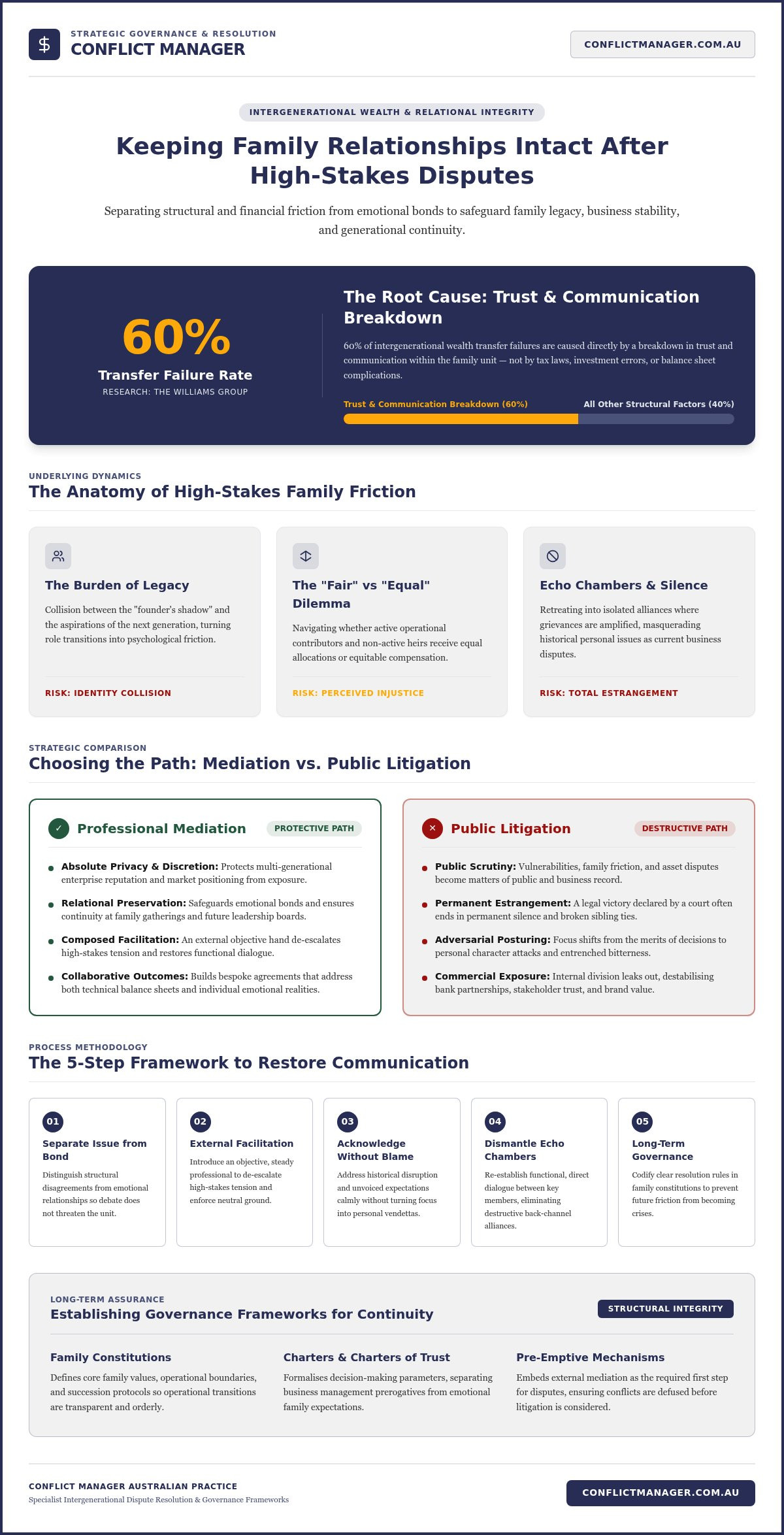
Trust. Communication. Continuity. Research indicates that 60% of intergenerational wealth transfer failures are caused by a breakdown in trust and communication within the family. When friction surfaces, the weight of shared history often makes objective resolution feel out of reach. You aren't just debating a balance sheet; you're managing decades of complex dynamics while seeking a way of keeping family relationships intact after a dispute. It's an exhausting reality that places your peace of mind and your family legacy under immense pressure.
We agree that the risk of permanent estrangement is a heavy price to pay for unresolved conflict. This article provides a structured path toward resolution, showing you how to safeguard emotional bonds through professional mediation. You'll learn how an external, objective hand can help de-escalate high-stakes tension and restore functional communication across generations. We'll examine the transition from internal disruption to a calm, methodical framework that protects both your assets and your most vital relationships.
Key Takeaways
- Integrity. Continuity. Legacy. Learn how to separate structural disputes from relational bonds to ensure your family's history and assets remain secure for future generations.
- Clarity. Equity. Succession. Understand the common triggers of inheritance friction and how to navigate the complex debate between what's fair and what's equal.
- Privacy. Discretion. Resolution. Contrast the exposure of public litigation with the absolute privacy of professional mediation, a critical distinction for keeping family relationships intact after a dispute.
- Follow a methodical process to acknowledge disruption without blame, using a neutral facilitator to restore functional communication.
- Governance. Stability. Order. Establish robust frameworks through family constitutions and charters to resolve future friction before it escalates into a crisis.
Beyond the Row: Why Relationships Matter Post-Dispute
Disruption. Friction. Rupture. In the context of high-net-worth Australian families, a disagreement over an asset or a succession plan is rarely just a business matter. It's an emotional event that threatens the very foundation of the family unit. While a court might declare a winner, the resulting relational damage often leads to a total loss for the family's long-term stability. Prioritising the preservation of bonds isn't a sign of weakness; it's a strategic necessity for keeping family relationships intact after a dispute. When the dust settles, a legal victory feels hollow if it's accompanied by silence at the dinner table or a permanent rift between siblings.
The Distinction Between Dispute and Relationship
Relational integrity in family wealth is the structural capacity to sustain shared purpose and mutual trust despite differing viewpoints on specific fiscal or operational outcomes. It's the glue that holds the legacy together across generations. You can identify when a professional disagreement has shifted into a personal vendetta when the focus moves from the merits of a decision to the perceived flaws of a family member. This shift carries immense psychological weight. Individuals often feel the crushing pressure of multi-generational expectations, fearing that a single "wrong" move will dismantle what their ancestors worked to build. This fear often manifests as aggression or withdrawal, both of which serve to deepen the rift rather than bridge it.
The Strategic Value of Family Unity
Unity is the prerequisite for effective family office governance. Without it, structural integrity collapses. Internal friction doesn't stay internal; it leaks out to impact external stakeholders, bank relationships, and business stability. When a family is seen as a house divided, its market position weakens and its reputation in the Australian business community can suffer. This is where a steady, objective perspective becomes invaluable. By engaging in a structured family mediation process, families can move from a state of volatility toward a vision of resolution. An external counsellor provides the composed authority needed to de-escalate high-stakes environments. They ensure that the focus remains on the family bond rather than the immediate row. This approach is essential for keeping family relationships intact after a dispute, allowing the legacy to transition safely to the next generation. It's about building a framework where disagreement is allowed, but the relationship remains sacred.
The Anatomy of High-Stakes Family Friction
Friction. Heritage. Volatility. High-stakes family disputes rarely arise from a single isolated event. They are typically the culmination of structural shifts and deeply embedded emotional patterns. When a family office or enterprise faces transition, the intersection of wealth and identity creates a uniquely combustible environment. Research from The Williams Group indicates that 60% of intergenerational wealth transfer failures stem from trust and communication breakdowns. This highlights the immense difficulty of keeping family relationships intact after a dispute when the stakes involve both financial survival and personal history. High-emotion situations often cloud objective judgement, leading to choices that prioritise immediate emotional relief over the long-term integrity of the family assets.
Succession and the Burden of Legacy
Power. Transition. Identity. The transfer of leadership is often the most volatile period for a family unit. It forces a collision between the "founder’s shadow" and the aspirations of the next generation. Succession isn't merely a legal hand-off; it's a psychological renegotiation of individual roles. In the Australian context, the debate between "fair" and "equal" often paralyses decision-making. Should a sibling who has worked in the business for twenty years receive the same stake as one who has pursued a different path? These questions are rarely settled by balance sheets alone. They require a deep understanding of strategies for navigating family conflict to ensure the legacy remains a source of pride rather than a catalyst for resentment. Without a clear path forward, the burden of legacy can become a weight that pulls the family apart.
Communication Breakdowns in High-Pressure Environments
Silence. Avoidance. Escalation. When pressure mounts, families often retreat into "echo chambers" where grievances are shared only with those who already agree. This isolation prevents objective problem-solving and allows historical grievances to masquerade as modern business concerns. Silence is not peace. It's often a precursor to a more significant rupture. By the time legal threats are made, internal efforts at resolution have usually become counter-productive. Identifying the point where a neutral party is required is a mark of leadership. Engaging a professional for family conflict resolution can break the cycle of avoidance and provide the structural integrity needed to move forward. This external intervention brings clarity to clouded situations, providing a steady hand when internal dynamics have become too entangled to self-correct.
Choosing the Path to Resolution: Mediation vs. Litigation
Privacy. Discretion. Reputation. In the Australian legal landscape, the choice of forum often determines the future of the family unit. Litigation is inherently adversarial. It is a public process that demands a winner and a loser. When family members are forced into a courtroom, the resulting exposure often leads to permanent relational rupture. This public record can damage the family brand and reveal sensitive business valuations to competitors. Choosing a private path is a strategic decision. It is the most effective way of keeping family relationships intact after a dispute while ensuring that internal friction remains confidential.
The financial disparity between these paths is stark. Contested family or estate litigation in Australia frequently exceeds A$50,000 per party. Professional resolution through mediation is significantly more efficient. However, the true value lies in the preservation of the bond. A legal victory is hollow if it results in the total destruction of the family legacy. When choosing between mediation and litigation, families must consider the long-term impact on their internal trust. A neutral third party provides the objective hand required to navigate these transitions. They bring a sense of order that a courtroom, focused on rigid legal precedents, cannot replicate.
The Privacy and Discretion of Mediation
Protecting the family name is paramount. Mediation happens behind closed doors, allowing for a level of honesty and vulnerability that is impossible in a courtroom. This private facilitation enables nuanced, bespoke outcomes that a judge cannot provide. An external counsellor maintains total objectivity, ensuring that the process remains focused on resolution rather than retribution. This discretion allows the family to address the "fair vs equal" debate without external interference, safeguarding both the asset integrity and the emotional well-being of all stakeholders.
Sustainable Outcomes vs. Temporary Settlements
Court orders are often temporary fixes for deep-seated structural problems. They rarely address the underlying friction that caused the row. Sustainable stability requires stakeholder buy-in. Mediation fosters a sense of order and mutual respect, which is essential for keeping family relationships intact after a dispute. By reaching a consensual agreement, family members are more likely to adhere to the terms and maintain functional communication. This collaborative approach ensures that the family office remains a cohesive unit, capable of managing wealth across generations without the threat of recurring legal battles.
Five Steps to Rebuilding Trust and Intimacy
Structure. Method. Recovery. Moving past a significant row requires more than a simple desire for peace. It demands a deliberate, staged approach to restore what has been fractured. For those focused on keeping family relationships intact after a dispute, the path forward is rarely linear. It begins with acknowledging the disruption without the reflex to assign blame. This shift in perspective allows the family to view the conflict as a structural challenge rather than a personal failure. By focusing on the health of the system, individual stakeholders can lower their guard and engage with the resolution process more authentically.
- Step 1: Acknowledge the Disruption. Validate the tension without revisiting the specific grievances. This creates a baseline of honesty from which the family can begin to rebuild.
- Step 2: Engage a Neutral Facilitator. Internal attempts at resolution often fail because of existing power dynamics. A professional brings the composure needed to maintain structural integrity during difficult dialogues.
- Step 3: Separate Business from Personal. Clearly delineate fiscal disagreements from relational bonds. This prevents financial friction from poisoning the family’s emotional core.
- Step 4: Define New Boundaries. As roles evolve, so must the rules of engagement. Establishing clear expectations for individual roles within the family office reduces future overlap and friction.
- Step 5: Establish a Governance Framework. Formalise how decisions are made. A robust framework provides a sense of order and predictability, acting as a buffer against future volatility.
Facilitating Difficult Conversations with Composure
Dialogue requires a controlled environment. When emotions are high, the setting must be neutral to prevent old patterns from resurfacing. Techniques such as timed contributions and focused agendas help manage emotional volatility during mediation sessions. Active listening in a living room is often defensive and reactive; however, in a professional boardroom setting, it transforms into a strategic tool for objective comprehension and de-escalation. This shift allows participants to hear the intent behind the words rather than just the sting of the argument. It's about creating a space where keeping family relationships intact after a dispute becomes the primary objective for everyone in the room.
Creating a Roadmap for Reconciliation
Trust is built through consistency. It's important to set realistic timelines, as relational integrity cannot be restored overnight. Small, consistent actions, such as regular facilitated meetings or transparent communication regarding asset management, serve as the building blocks for a renewed bond. By moving from a state of complexity toward a vision of resolution, families can secure their legacy while protecting their most vital connections. If your family is ready to begin this process, you can book a stakeholder facilitation session to establish a professional foundation for your recovery.
Establishing Governance for Long-Term Stability
Order. Continuity. Resilience. Long-term stability is not an accident of good intentions; it's the result of robust structural governance. Family constitutions and charters serve as the foundational documents for this stability, providing a clear roadmap for decision-making and conflict resolution. While these documents are often moral contracts rather than purely legal ones, they establish a shared culture of accountability. This framework is essential for keeping family relationships intact after a dispute, as it provides a neutral reference point when personal emotions threaten to override collective interests.
Regularity is key. Implementing scheduled facilitation allows families to address minor friction before it reaches a point of escalation. A professional conflict management approach builds a more resilient family office by socialising the idea that disagreement is a natural part of any complex organisation. An external counsellor acts as a steady hand, offering an objective view that family members, regardless of their expertise, cannot maintain when they're personally involved. This neutral presence ensures that discussions remain focused on structural outcomes rather than historical grievances.
The Family Office as a Resilient Structure
Clarity. Responsibility. Alignment. Integrating conflict resolution into standard operating procedures transforms the family office into a resilient structure. When roles and responsibilities are clearly defined, the ambiguity that often leads to friction is removed. Governance protects the integrity of the assets by ensuring that business decisions are insulated from relational volatility. It creates a boundary that allows the family to function as a professional enterprise while maintaining the warmth of their personal bonds.
Next Steps: Securing Your Family’s Future
Proactivity is the most effective strategy for wealth preservation. You should initiate a review of your current dispute management strategies well before a major transition, such as a leadership change or a significant wealth transfer, occurs. Proactive mediation allows for the quiet resolution of underlying issues, ensuring that the family unit remains cohesive during periods of high stress. To begin building a more secure framework for your legacy, you can organise a confidential consultation with Conflict Manager. This professional step ensures that your focus remains on keeping family relationships intact after a dispute while securing the structural future of your family office.
Securing Your Legacy through Structural Resolution
Preservation. Continuity. Order. Resolving high-stakes friction isn't just about settling a balance sheet; it's about safeguarding the emotional bonds that define your family. We've explored how separating business disputes from personal grievances and opting for the privacy of mediation over the exposure of litigation are critical steps for keeping family relationships intact after a dispute. By implementing robust governance frameworks, you can ensure that future transitions are managed with clarity rather than volatility.
Conflict Manager provides a composed, objective approach to high-emotion situations. Specialised in high-net-worth family office mediation, we offer national Australian expertise in complex dispute management to help you navigate these difficult transitions. You don't have to manage the weight of responsibility alone. Achieve a structured resolution with Conflict Manager and move toward a state of lasting stability. With the right guidance, your family's future can be one of shared purpose and renewed trust.
Frequently Asked Questions
How do I start a conversation about mediation without offending my family?
Frame the suggestion as a commitment to the family's continuity rather than an indictment of the current situation. Focus on the structural integrity of the family office and the desire to protect long-term bonds. This objective approach reduces personal friction. You're suggesting a tool for keeping family relationships intact after a dispute. By positioning mediation as a standard professional safeguard, you remove the stigma of failure and replace it with a vision of collective resilience.
Can a dispute really be resolved if the emotions are extremely high?
Emotional volatility is a standard component of high-stakes disputes and does not preclude a successful resolution. Professional facilitators use structured de-escalation techniques to move parties from reactive states to objective problem-solving. This methodical process ensures that even when tensions are high, the focus remains on the structural outcomes. A neutral hand provides the stability needed to navigate these transitions without the family becoming further entangled in historical grievances.
What happens if one family member refuses to participate in mediation?
Mediation is fundamentally voluntary, but a refusal by one member doesn't necessarily end the path to resolution. Initial individual sessions can often address the specific fears or misconceptions preventing participation. If a member remains resistant, the facilitator can work with the remaining stakeholders to establish new boundaries. This proactive management prevents the entire family office from being held hostage by a single point of friction, maintaining asset integrity and operational flow.
Is professional mediation more effective than traditional family counselling?
These services serve different purposes. Family counselling typically focuses on therapeutic healing and psychological dynamics. Professional mediation is a structural intervention aimed at reaching specific, sustainable agreements regarding assets, roles, and governance. While Conflict Manager provides an empathetic environment, we focus on resolution and facilitation rather than clinical psychotherapy. This distinction is vital for families seeking clear, actionable outcomes in high-pressure environments where wealth and legacy are at stake.
How long does the family mediation process typically take in Australia?
The duration varies based on the complexity of the assets and the number of stakeholders involved. Most professional mediations reach a resolution in significantly less time than the years often required for Australian court proceedings. Many families achieve a binding settlement within several sessions. This efficiency is a primary benefit for those focused on keeping family relationships intact after a dispute, as it limits the period of active friction and reduces the emotional toll.
Will mediation help protect our family assets from a legal battle?
Mediation is a primary tool for protecting assets because it prevents the public exposure and high costs of litigation. By reaching a private, consensual agreement, families avoid the risk of a court-imposed decision that may not align with their long-term strategic goals. This process ensures that asset integrity remains a priority. It safeguards the family brand from the reputational damage that often accompanies public legal battles within the Australian business community.
What is the role of a neutral third party in a family office dispute?
A neutral third party acts as a steady hand capable of viewing volatile situations with total objectivity. They manage the flow of communication, ensuring that power imbalances don't stifle productive dialogue. By remaining unruffled by internal family dynamics, the facilitator brings clarity to clouded situations. They provide the structural framework necessary to separate personal grievances from the professional requirements of the family office, allowing for logical and balanced decision-making.
How can we ensure the resolution is sustainable for the next generation?
Sustainability is achieved by integrating the resolution into a formal governance framework. This often involves the creation of family constitutions or charters that define how future friction will be managed. Regular facilitation sessions can help address minor issues before they escalate into significant rows. By establishing these clear rules of engagement, the family provides the next generation with a stable foundation and a proven method for maintaining relational unity and asset security.


