

Proposing an independent mediator isn't an admission of defeat; it's often the most deliberate act of relationship protection a family can undertake. Yet, when conversations stall over estate distribution or generational change, knowing how to convince family to use a mediator without triggering immediate defensiveness can feel daunting.
Friction. Impasse. Exhaustion. You're likely weary of circular discussions and rightly worried that suggesting external facilitation will be misconstrued as an intent to litigate. When pride runs deep, even well-intentioned suggestions can provoke defensiveness from relatives who value privacy and control above all else.
This guide provides a measured framework to introduce mediation dispassionately, address common anxieties around neutrality and confidentiality, and preserve your shared relationships. Ahead, you'll discover practical conversational strategies to lower the emotional temperature, dismantle misconceptions, and secure voluntary participation across the entire family.
Key Takeaways
- Understand the systemic fears behind resistance, identifying why relatives often view external intervention as an existential threat to personal autonomy.
- Dismantle misconceptions by framing mediation as an entirely voluntary, private dialogue rather than a precursor to formal litigation.
- Master strategic timing to initiate the conversation during calm, neutral intervals rather than emotionally charged family gatherings.
- Apply structured language scripts that show how to convince family to use a mediator by centring on mutual exhaustion, privacy, and shared control.
- Select accredited practitioners across Australia with demonstrated acumen in multi-generational dynamics, family trusts, and complex estate continuity.
Understanding Family Resistance to Mediation in Australia
Dread. Skepticism. Entrenchment. When high-stakes decisions emerge around estate allocations, family discretionary trusts, or multi-generational succession, discussions frequently freeze. Resistance to third-party facilitation is rarely a rejection of fairness itself. Rather, it represents systemic defensiveness rooted in a profound fear of losing personal autonomy.
Within Australia, family disputes often bypass standard commercial logic. Unaddressed emotional friction, vulnerability, and long-standing relational hierarchies lead relatives to interpret any outside intervention as an existential threat. When considering how to convince family to use a mediator, one must first recognize that unassisted kitchen-table negotiations routinely collapse under the weight of historical grievances. Professional mediation acts as a confidential safeguard, keeping private estate structures and enterprise governance out of public dispute forums.
The Psychology of Reluctance: Pride, Control, and Vulnerability
Reluctance usually stems from perceived vulnerability rather than obstinacy. Understanding these dynamics is essential when learning how to convince family to use a mediator effectively:
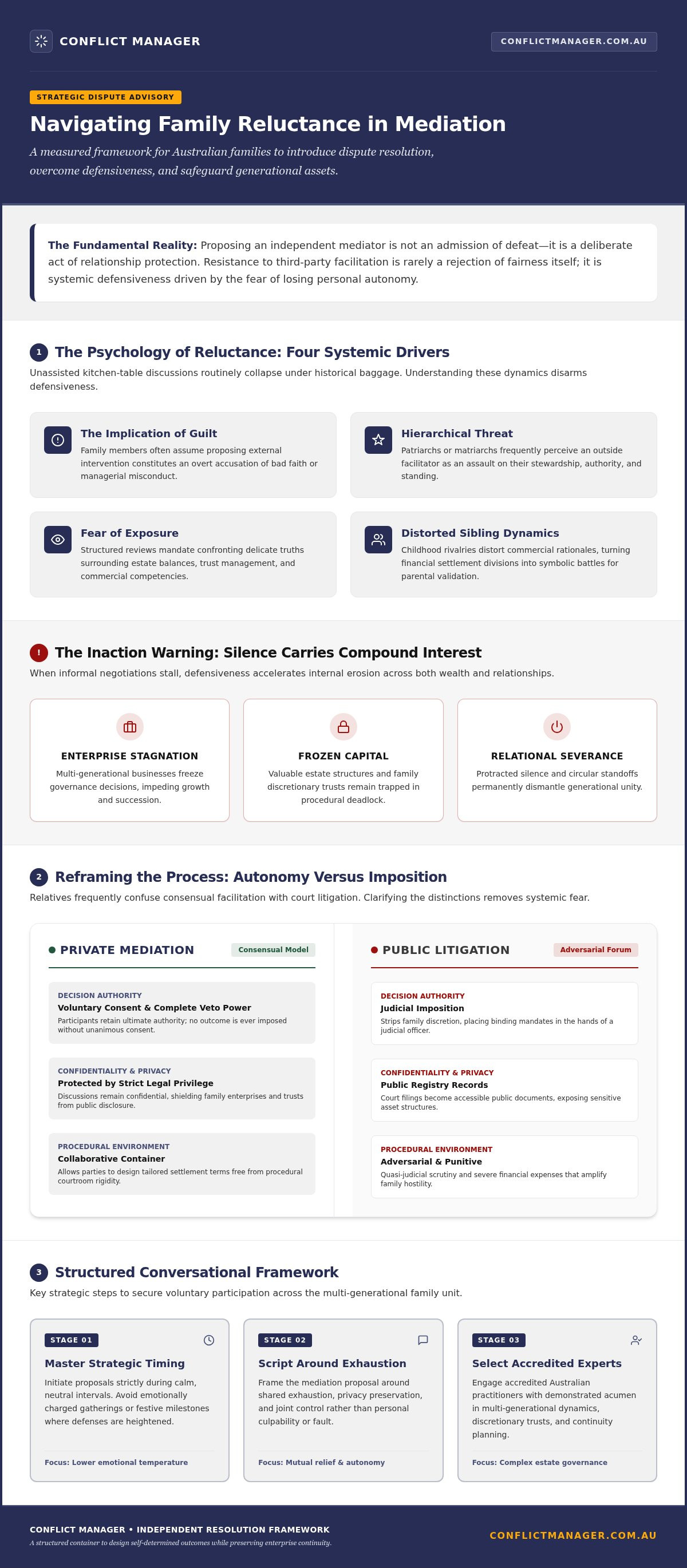
- The Implication of Guilt: Relatives frequently assume that proposing external assistance signals an overt accusation of wrongdoing or bad faith.
- Hierarchical Threat: Senior matriarchs or patriarchs may view third-party involvement as an assault on their established authority and stewardship.
- Fear of Exposure: Structured forums require confronting uncomfortable realities regarding asset distribution, trust management, or private commercial competencies.
- Distorted Sibling Dynamics: Childhood rivalries and lingering resentments often skew rational settlement offers, turning practical financial divisions into symbolic battles for validation.
Appreciating the broad scope of the family mediation process helps demystify these sessions, reframing them as collaborative discussions rather than interrogations.
The Hidden Toll of Unresolved Internal Disputes
Silence carries compound interest. When family members retreat behind defensive walls, unaddressed hostility quietly erodes both personal wellbeing and shared capital. Multi-generational enterprises can stall, valuable family assets remain frozen in indecision, and protracted silence eventually fractures generational unity beyond repair. Where informal standoffs amplify defensiveness and drain emotional resources, structured conflict resolution introduces steady, objective boundaries that allow complex conversations to proceed safely.
Reframing Mediation: How to Disarm Common Misconceptions
Control. Discretion. Agency. The sharpest resistance to external intervention almost always comes from a fundamental confusion: mistaking private mediation for adversarial litigation. Relatives assume that welcoming a third party involves stepping into a quasi-judicial arena where an outsider will pass judgment, scrutinise personal conduct, or dictate settlement terms. In truth, mediation is entirely consensual. The participants retain ultimate control over the terms, retaining complete veto power throughout.
Clearing up this distinction is pivotal when working through how to convince family to use a mediator. Independent dispute resolution does not impose decrees. Instead, it provides a structured container where parties design their own outcomes. While parenting disputes carry specific statutory frameworks under Family Dispute Resolution requirements in Australia, voluntary facilitation for estates, trusts, and commercial arrangements operates without procedural rigidities or forced outcomes, shielding the family from the punitive costs and publicity of public court registries.
Mediation vs Litigation: Autonomy Versus Imposition
Public litigation strips families of their discretion, placing binding choices in the hands of a judicial officer. Contrast this with the private dispute resolution room:
- Decision-Making Authority: Litigation hands power over to a judge; mediation guarantees that no arrangement is finalised without unanimous, voluntary consent.
- Total Privacy: Court filings become public record, exposing sensitive trust structures, whilst private mediation is protected by strict legal privilege and confidentiality.
- Expedited Resolution: Formal legal disputes frequently consume twelve to twenty-four months in trial queues, whereas facilitated agreements are routinely settled across a handful of focused sessions.
Neutrality and Confidentiality: Why the Mediator Takes No Sides
Impartiality forms the cornerstone of professional standards in Australia. An accredited practitioner holds no stake in the final distribution; their sole obligation is procedural equity. They manage relational dynamics so forceful personalities cannot hijack discussions or silence quieter stakeholders. Individual caucus sessions allow each relative to disclose priorities in absolute confidence, testing commercial options without committing publicly.
Framing the process around dignity rather than legal confrontation helps relatives view independent intervention as an act of family stewardship. Exploring options with an objective provider of family conflict resolution offers a measured starting point for households seeking sustainable consensus while protecting their generational assets.
Timing the Conversation: When and How to Raise the Subject
Precision matters. Proposing mediation at the wrong instant can convert mild unease into entrenched opposition. When family dynamics involve multi-generational businesses, estates, or discretionary trusts, the setting in which you introduce external help shapes how the invitation is received. If introduced during an argument, relatives hear an ultimatum; introduced during a period of steady calm, they see a pragmatic path forward.
Understanding how to convince family to use a mediator requires acute situational awareness. The objective is to present facilitated dialogue before positions harden into irreconcilable legal claims. As outlined in the Harvard Law School Program on Negotiation's guide to dispute resolution, interest-based mediation succeeds best when parties still have the latitude to explore mutual gains rather than defending entrenched rights under duress.
Selecting the Optimal Moment and Setting
Context dictates outcome. Initiating this dialogue demands an environment stripped of historical baggage and commercial urgency:
- Avoid Acute Stress Triggers: Never raise mediation during holiday gatherings, memorial services, or formal board meetings where corporate governance pressures run high.
- Select Neutral Ground: Choose quiet, low-stakes environments away from the family home or corporate headquarters, removing territory-based defensiveness.
- Ensure Adequate Bandwidth: Confirm that relatives are not grappling with unrelated professional crises, ensuring they have the mental space to absorb your proposal calmly.
- Target Inflection Points: The most receptive windows emerge when informal talks have stalled, but before anyone consults an adversarial litigator.
Managing Your Own Composure Before the Discussion
Your internal posture sets the room's temperature. When mastering how to convince family to use a mediator, separate the relational bond from the mechanical deadlock at hand. Enter the exchange with no intention of litigating historical conduct, cataloguing past grievances, or demanding concessions. If met with reflexive skepticism, resist the urge to debate. Respond instead with steady validation: acknowledge their apprehension, reassert that any mediation remains entirely voluntary, and give them the space to consider the framework without pressure.
Practical Conversational Scripts: Proposing Mediation Calmly
Words carry weight. When tensions simmer over an estate or trust distribution, casual phrases often sound like calculated threats. The secret to how to convince family to use a mediator lies in reframing the intervention entirely: position it not as an admission of dysfunction, but as an investment in family preservation. Framing mediation around mutual fatigue and shared control disarms defensive reactions before they solidify into permanent resistance.
Step-by-Step Framing for High-Stakes Family Disputes
Introduce the subject methodically, preserving emotional safety at each stage:
- Step 1: Validate collective exhaustion. Open by naming the shared toll: "None of us are enjoying these circular talks, and I know everyone is feeling completely drained by this process."
- Step 2: Propose neutral structure over personal agendas. Present the practitioner as a facilitator of productive conversation: "Rather than continuing to rehash this alone, an independent professional could simply help keep our conversations orderly and constructive."
- Step 3: Reinforce voluntary control and confidentiality. Remove the fear of imposed outcomes: "This isn't court. A mediator can't make decisions for us or force an outcome, and everything discussed stays strictly private."
- Step 4: Grant full agency in selection. Invite joint vetting from the outset: "I want you to be completely confident in the person we choose. Let's review credentials together, and if you don't feel entirely comfortable with someone, we won't engage them."
Navigating Common Objections with Measured Responses
Anticipate instinctive pushback and meet it with calm, non-combative answers:
When they say: "We don't need a stranger meddling in our private business."
"I completely respect that our family affairs should remain private. That's precisely why a confidential dispute professional makes sense. They keep our matters off public records and give us an objective sounding board so we can resolve this behind closed doors."
When they say: "You're just trying to build a legal case against me."
"Not at all. In fact, choosing voluntary mediation is how we avoid lawyers and legal proceedings altogether. The process is entirely confidential and off-the-record, so nothing said can be used in an adversarial way."
When they say: "This will cost too much and achieve nothing."
"Unresolved conflict carries the heaviest price tag of all, both in relationship damage and frozen assets. A structured facilitation gives us a focused, contained timeframe to reach consensus on our own terms."
Mastering how to convince family to use a mediator means meeting friction with steady neutrality. If your household is navigating multi-generational assets or governance transitions, you can engage professional stakeholder facilitation to establish safe boundaries and guide everyone toward a lasting settlement.
Taking the Next Step: Selecting the Right Professional Mediator
Diligence. Competence. Alignment. Once relatives agree in principle to explore structured facilitation, selecting the right practitioner becomes the critical variable. An ill-fitted mediator can inadvertently exacerbate relational friction or struggle with intricate commercial realities. Conversely, a seasoned facilitator provides an immediate sense of order, steadying volatile discussions from the very first meeting.
When considering how to convince family to use a mediator, offering qualified practitioner options directly addresses lingering reservations. Family members managing high-value assets need confidence that the chosen professional commands both psychological discernment and commercial literacy. In Australia, practitioners should be vetted under recognized national standards, such as the Australian Mediator and Dispute Resolution Accreditation Standards (AMDRAS), ensuring they adhere to rigorous training and mandatory professional development.
Key Attributes of an Effective Family Dispute Facilitator
Prioritise specific expertise tailored to multi-generational dynamics and private wealth structures:
- Commercial and Structural Literacy: The practitioner must comfortably interpret discretionary trust arrangements, company constitutions, and complex estate distribution frameworks.
- Absolute Independence: Avoid using existing family accountants or corporate legal counsel. True neutrality requires an outside party with no historical ties or professional allegiances to any faction.
- Composed Psychological Command: Look for a steady presence capable of defusing elevated emotions without becoming entangled in the family's internal history.
Transitioning from Agreement to the First Session
Moving from reluctant consent to active participation requires a predictable, step-by-step pathway. Preliminary intake interviews should always be conducted individually. These separate, confidential discussions give each relative an opportunity to express concerns, establish safety parameters, and clarify expectations away from opposing viewpoints.
Setting transparent ground rules around documentation, agreed timelines, and meeting formats ensures there are no procedural surprises. Lasting resolutions for multi-generational matters rarely occur in a single afternoon. Establishing this expectation early reinforces that external facilitation is a measured, dignified process designed to safeguard family relationships and protect shared assets over the long term.
Preserving Relationships and Protecting Family Continuity
Clarity. Composure. Continuity. Navigating deadlock within a family is rarely about winning an argument; it's about protecting shared bonds and securing generational assets. Knowing how to convince family to use a mediator transforms a volatile conversation into a deliberate act of stewardship. By timing discussions carefully, dispelling misconceptions around legal imposition, and involving relatives directly in selecting an accredited practitioner, you replace chronic apprehension with mutual confidence.
When informal talks stall, structured external facilitation provides the steady framework needed to break the stalemate. Bringing decades of combined expertise guiding complex trusts, multi-generational estates, and enterprise transitions across Australia, objective dispute management ensures sensitive matters are resolved without courtroom escalation. Speak with Conflict Manager to explore composed, independent mediation tailored to your family, and establish a clear, dignified path forward together.
Frequently Asked Questions
What if a family member flatly refuses to attend mediation?
If a relative flatly refuses, respect their boundary rather than escalating pressure. Mediation requires voluntary engagement to produce lasting results. Often, resistance softens when you suggest an initial, non-committal briefing with the facilitator alone, or offer shuttle mediation where parties remain in separate rooms. Understanding how to convince family to use a mediator involves giving resistant members time to process the structure without feeling cornered or coerced.
How is family mediation different from traditional therapy or legal proceedings?
Mediation focuses strictly on practical structural consensus rather than clinical diagnosis or legal advocacy. It isn't clinical psychotherapy, which explores past pathology or emotional repair, nor is it legal representation, which argues rights in an adversarial setting. Instead, neutral facilitators guide structured negotiations to resolve discrete governance, estate, or relational deadlocks with complete confidentiality and procedural balance.
Who covers the costs of private family dispute resolution in Australia?
Costs in private dispute resolution are traditionally shared equally among participating parties, though flexible arrangements exist. Splitting the financial commitment evenly reinforces mutual neutrality and collective ownership of the process. In complex family trusts or estate administration, funding is sometimes drawn directly from the shared enterprise or estate asset pool by mutual consent, provided all beneficiaries agree that resolving the impasse serves the common good.
Can mediation agreements be made legally binding across Australia?
Mediation agreements aren't inherently binding, but they can be formalised into legally enforceable contracts. Once consensus is reached in session, participants take the agreed term sheet to their respective independent legal advisors. Across Australia, these terms can be drafted into formal deeds of settlement, consent orders, or binding financial agreements, providing legal certainty and enduring structural integrity while keeping sensitive matters out of open court.
How do we choose a neutral mediator when family trust is deeply fractured?
Choosing an impartial facilitator requires establishing transparent, joint selection criteria from the outset. When relational trust is damaged, one party should never select the practitioner unilaterally. Collate credentials for several accredited professionals with demonstrated experience in multi-generational wealth and dispute management. Allow hesitant relatives to review profiles, conduct vetting calls, and exercise an absolute veto. This shared vetting demonstrates how to convince family to use a mediator through mutual agency.
What happens during the initial private intake session?
The private intake session is an individual, confidential assessment designed to establish psychological safety and process scope. Each participant meets separately with the practitioner before any joint discussion takes place. The mediator assesses the complexity of the dispute, identifies personal priorities, and screens for power imbalances. It provides a discreet space to ask procedural questions, clarify expectations, and ensure the format is genuinely appropriate for all involved.
Is private family mediation legally confidential in Australia?
Yes, private dispute resolution in Australia operates under strict statutory and contractual confidentiality protections. Discussions held during mediation cannot be disclosed to third parties or tendered as evidence in court proceedings should talks dissolve. Practitioners and participants execute formal confidentiality agreements before sessions commence. This legal privilege ensures every family member can speak candidly, explore compromises, and propose structural solutions without fear of compromising their position later.


