

Relying on a judge to grant a suppression order is often the quickest path to unwanted exposure. When high-stakes disagreements emerge, protecting family privacy during a dispute becomes an immediate operational priority; yet the open nature of the court system means private financial ledgers, commercial agreements, and personal correspondence can quickly enter the public domain. You likely already dread the prospect of these sensitive details being examined in an adversarial forum, where internal friction becomes vulnerable to commercial rivals, estranged connections, or media attention.
Reputation. Continuity. Discretion. You don't have to surrender control of your family's narrative to a public legal process. In this guide, you will discover how to resolve sensitive family disputes privately, establishing an orderly framework that safeguards commercial holdings, asset integrity, and personal dignity without public exposure. We examine the structured facilitation methods, binding confidentiality agreements, and communication protocols required to resolve friction and protect intergenerational trust entirely outside the courtroom.
Key Takeaways
- Understand the systemic exposure created by open court proceedings, where standard discovery processes can place sensitive financial structures on public record.
- Discover why proactive mediation protocols succeed in protecting family privacy during a dispute by establishing binding confidentiality deeds before substantive dialogue begins.
- Implement rigorous information governance across extended family branches, aligning legal, financial, and tax advisors under a unified communication hierarchy.
- Learn how neutral stakeholder facilitation de-escalates complex internal tension with composure, preserving both intergenerational trust and commercial continuity.
The Hidden Risks: Why Traditional Litigation Threatens Family Privacy
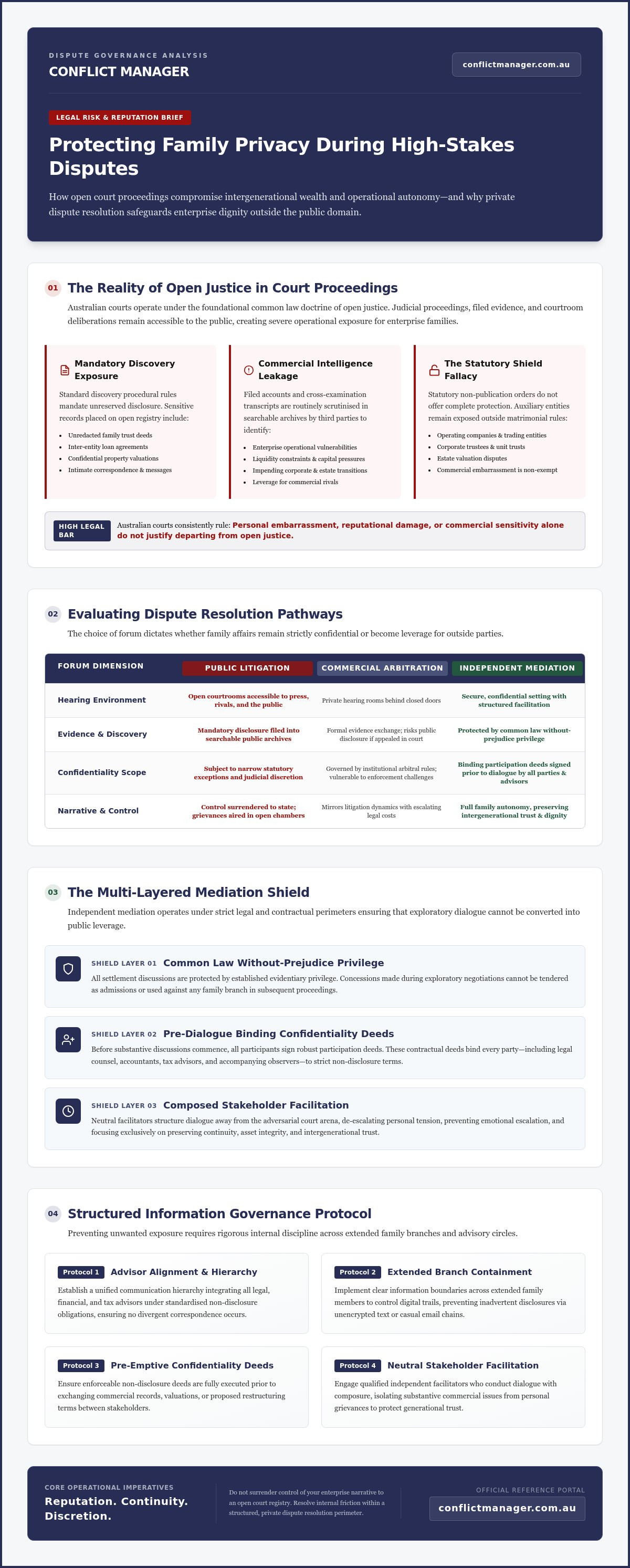
Exposure. Scrutiny. Vulnerability. Initiating formal litigation immediately surrenders control over who observes, records, and analyses your family's internal affairs. Australian courts operate firmly under the common law doctrine of open justice, a foundational principle requiring judicial proceedings, filed evidence, and courtroom deliberations to remain accessible to the public. While intended to ensure judicial transparency, this operational reality presents an existential hazard for complex families; every sworn affidavit, corporate ledger, and personal correspondence submitted into evidence risks becoming part of an indelible public record.
During the discovery phase of an adversarial dispute, procedural rules mandate comprehensive disclosure of private assets. The vulnerability here is absolute. Unredacted trust deeds, inter-entity loan structures, property valuations, and intimate text messages are routinely produced. When family friction plays out before a judge, the emotional toll escalates as private grievances are read aloud in open chambers. For enterprise families, protecting family privacy during a dispute is impossible once sensitive operational data enters a registry where third parties can inspect it.
The Reality of Open Justice in Commercial and Estate Disputes
Civil courtrooms offer minimal shelter for commercial discretion. Commercial rivals, disgruntled associates, and industry analysts routinely scrutinise filed accounts and cross-examination transcripts to identify operational vulnerabilities, liquidity constraints, or impending corporate transitions. These records persist indefinitely in searchable archives, permanently affecting generational reputations long after the underlying conflict concludes. Recognising these systemic exposures, many families transition toward alternative dispute resolution (ADR) mechanisms to resolve structural friction away from public registries.
Statutory Safeguards and Their Practical Vulnerabilities
Many individuals assume statutory non-publication provisions provide an impermeable shield. They don't. While specific legislation restricts public reporting of individual names in matrimonial or children's matters, these protections rarely extend to auxiliary entities. Operating companies, corporate trustees, unit trusts, and estate valuation disputes frequently sit outside mandatory anonymisation rules. Securing bespoke suppression or pseudonym orders requires meeting an extraordinarily high legal standard; Australian courts consistently rule that personal embarrassment, reputational damage, or commercial sensitivity alone do not justify departing from open justice.
Relying on judicial discretion for confidentiality remains a perilous strategy. When protecting family privacy during a dispute is paramount, true security requires resolving matters within private, non-adversarial frameworks where statutory loopholes never apply.
Evaluating Resolution Pathways: Court Action versus Private Dispute Resolution
Autonomy. Discretion. Control. Selecting the forum for resolving conflict dictates whether your family affairs remain private or become leverage for outside parties. While litigation surrenders control to the state, private dispute resolution provides a structured perimeter around commercial assets, personal histories, and leadership succession. The choice between adversarial litigation, private arbitration, and independent mediation represents the difference between managing public fallout and executing a quiet, strategic realignment.
A Comparative Framework: Privacy, Discretion, and Enforceability
Commercial arbitration offers private hearing rooms, but it mirrors litigation through formal evidence exchange, escalating costs, and vulnerability if an award is challenged in court. Independent mediation, by contrast, operates under a multi-layered shield. Settlement discussions are insulated by common law without-prejudice privilege, ensuring that exploratory concessions cannot be used in future proceedings. Well-drafted participation deeds reinforce this statutory protection, binding all participants, including advisors and observers, to strict non-disclosure terms. Established statutory protections worldwide, such as formal mediation confidentiality laws, illustrate the global legal consensus that settlement dialogue must remain strictly confidential to be effective. When a consensus is reached, the terms are codified within private deeds of release, achieving finality without public registration.
Preserving the Family Legacy and Business Stability
Adversarial legal proceedings quickly destabilise commercial enterprises. When family principals trade hostile allegations through solicitor letters, the operational business suffers. Key executives grow anxious, lenders reconsider terms, and market competitors sense vulnerability. Litigated outcomes frequently destroy the goodwill built over generations because courts deal exclusively in narrow legal rights, ignoring the underlying emotional dynamics that drive interpersonal conflict.
In contrast, engaging experienced stakeholder facilitation allows families to address commercial structure, estate distributions, and personal grievances simultaneously. A neutral facilitator guides the room away from posturing and towards practical solutions, maintaining complete decision-making autonomy among family members. Structured mediation is therefore not merely a procedural step; it serves as a critical risk mitigation tool. For family offices and enterprise founders, protecting family privacy during a dispute is fundamentally about insulating commercial holdings and intergenerational trust from external volatility.
How to Implement a Privacy-First Dispute Resolution Protocol
Discipline. Structure. Containment. Establishing an orderly framework before addressing contentious financial or succession issues ensures that internal friction never spills into the public sphere. Unstructured negotiations invariably create security gaps; informal telephone calls, reactive text exchanges, and fragmented email trails frequently end up shared with outside confidantes. Successfully protecting family privacy during a dispute requires replacing emotional reactivity with a sequential, privacy-first protocol that binds every participant to absolute discretion from the outset.
Implementing this protocol involves five deliberate stages:
- Phase 1: Pre-engagement standstill. The parties sign an interim covenant pausing legal notices, asset transfers, and external communications while terms of engagement are arranged.
- Phase 2: Execution of multi-party deeds. All principals, family branches, and participating entities execute comprehensive non-disclosure agreements.
- Phase 3: Neutral mediator selection. The family appoints an experienced, independent facilitator specialised in complex asset structures and multi-generational dynamics.
- Phase 4: Channeled substantive dialogue. Discussions proceed via structured caucuses and joint sessions governed by strict operational rules.
- Phase 5: Private settlement execution. Consensual agreements are codified in confidential deeds of settlement, resolving all matters without contentious public filings.
Executing Enforceable Confidentiality and Non-Disclosure Deeds
Substantive discussions must never proceed on verbal assurances of goodwill. Comprehensive non-disclosure deeds establish binding contractual perimeters around the process. These agreements must define "confidential information" broadly, explicitly encompassing entity valuations, tax strategies, trust instruments, and the existence of the dispute itself. Critically, these covenants must extend beyond direct family principals to bind independent accountants, wealth managers, and family office staff. Clear liquidated-damages provisions and immediate injunctive relief clauses should be established upfront, neutralising any temptation to use media leaks or commercial exposure as tactical leverage.
Structuring the Mediation Environment for Discretion
Physical and digital logistics require rigorous containment. Neutral, secure meeting spaces ensure family branches avoid unexpected encounters in prominent professional offices where commercial peers might observe them. Virtual proceedings must deploy encrypted platforms with restricted participant access, disabled recording functions, and controlled document-sharing rooms. During heightened emotional friction, structured private caucuses allow the facilitator to shuttle between parties, de-escalating volatile grievances without direct confrontation.
Strict operational boundaries govern the sessions. Personal digital devices are checked, unauthorised recording is strictly prohibited, and draft settlement iterations are distributed through watermarked, secure channels. By removing operational chaos, this disciplined structure ensures that protecting family privacy during a dispute remains an unbreakable operating standard, clearing a pathway toward lasting consensus.
Information Governance: Managing Advisors, Family Members, and Digital Trails
Vigilance. Alignment. Discretion. Even the most robust confidentiality deed fails if daily communication practices remain undisciplined. During heightened interpersonal strain, information leaks rarely originate from calculated malice; instead, they stem from emotional exhaustion, casual disclosures to confidantes, or uncoordinated external advisors acting in silos. True containment demands an orderly information architecture that governs how news travels across branches, generations, and professional advisory teams.
Establishing Advisor Coordination and Communication Tiers
Unchecked advisory teams can inadvertently escalate friction. When independent tax agents, corporate solicitors, and private wealth managers communicate without centralised oversight, professional posturing often replaces conciliation. Families should appoint a designated communication lead to direct all external dialogue. This individual filters inbound queries and ensures every professional operates from an identical factual baseline. When professional counsel is aligned under a quiet strategy, advisors support peaceful realignment rather than expanding structural conflict. For enterprise families, protecting family privacy during a dispute requires enforcing this single hierarchy, preventing external professionals from becoming conduits for inadvertent disclosure.
Digital Hygiene and Communication Containment
Informal messaging channels represent an immediate operational hazard. Group messaging apps, unencrypted emails, and reactive SMS threads leave permanent digital footprints that outside parties can capture. Substantive dialogue regarding estate apportionments or balance sheet adjustments must move exclusively to secure, access-controlled document portals. Family members should observe absolute silence regarding dispute mechanics around social circles, spouses, and commercial associates; offhand remarks at dinner tables or industry gatherings quickly transform into market rumours that compromise negotiation leverage.
When internal networks become overwhelmed by mistrust or leaks, attempting to manage containment alone often deepens fractures. To establish an uncompromised, privacy-first perimeter around sensitive commercial and domestic affairs, engage professional family conflict resolution to restore order before reputational capital is lost.
Navigating Next Steps: Engaging Neutral Facilitation with Composure
Deadlock. Bitterness. Inertia. When substantive communication collapses within an enterprise family, the natural impulse is often defensive posturing. Formal legal notices begin replacing conversation, board meetings devolve into operational gridlock, and informal side-channel complaints proliferate. These behaviours serve as immediate warning signals that internal resolution capacity has reached its limit. Left unaddressed, this stagnation inevitably forces someone's hand toward public litigation. Introducing external facilitation at this critical juncture is not an admission of weakness; it represents an active intervention designed to stabilise relationships, protect commercial holdings, and prevent irreparable reputational harm.
Choosing the right neutral partner requires looking beyond basic accreditation. Complex wealth transfers and multi-entity enterprises demand facilitators who possess deep commercial literacy, an appreciation of multi-generational family office governance, and an unyielding commitment to operational discretion. A seasoned practitioner acts as an objective ballast, viewing volatile interpersonal friction without judgment while guiding parties through deliberate, structured dialogue.
Introducing an External Mediator to Hesitant Family Members
Reluctant participants often fear losing control. Skeptical relatives frequently worry that engaging an external practitioner means inviting outside interference, or worse, succumbing to an uneven playing field. Positioning the process effectively requires demystifying the methodology. Reassure family members that mediation is entirely voluntary, structurally neutral, and insulated from public scrutiny. Unlike a trial judge or commercial arbitrator, an independent facilitator holds no power to impose decisions. Autonomy remains entirely in the hands of the principals, ensuring that protecting family privacy during a dispute aligns directly with retaining ultimate decision-making power.
Achieving Sustainable, Enforceable, and Private Closures
Reaching an in-principle agreement is only an intermediate milestone; the true test lies in durable execution. Once alignment emerges, the facilitator assists the parties' legal and financial advisors in translating consensus into comprehensive, private settlement deeds and revised governance frameworks. These instruments should establish clear operational protocols, balanced dividend arrangements, and modernised family charters equipped with preemptive dispute escalations for future generations. Across the country, Conflict Manager facilitates calm, confidential resolutions for complex families and family offices, converting turbulent transitions into stable, enduring alignments. Taking control of the process early remains the only reliable pathway to protecting family privacy during a dispute, securing both commercial legacy and personal dignity for decades to come.
Securing Intergenerational Trust Outside the Courtroom
Clarity. Discretion. Continuity. Relying on traditional litigation to resolve complex internal disagreements is an unnecessary gamble. True success in protecting family privacy during a dispute is never achieved through reactive courtroom suppression orders; it is secured proactively through binding non-disclosure deeds, disciplined information governance, and private mediation. Establishing this orderly perimeter insulates commercial holdings while preserving personal dignity.
With proven national experience facilitating high-stakes disputes for family offices, multi-generational businesses, and high-net-worth families across Australia, Conflict Manager provides a calm, objective approach that de-escalates acute emotion while keeping personal and financial matters private. Resolving friction quietly remains entirely within your control. If your family is navigating sensitive friction, speak with Conflict Manager to explore confidential, structured resolution and safeguard your generational legacy with lasting composure.
Frequently Asked Questions
Can family court proceedings in Australia be kept entirely confidential?
No, Australian family court proceedings cannot be guaranteed complete confidentiality due to the principle of open justice. While statutory rules restrict publishing identifying details in media reports, courtrooms remain open to public observers and filed affidavits can be inspected under specific circumstances. Related commercial entities, operating companies, and unit trusts often fall outside statutory protections entirely. Complete confidentiality is only achievable by handling the disagreement outside the court registry through private resolution frameworks.
What is the difference between a statutory non-publication order and private mediation?
A statutory order is a narrow judicial restriction on external reporting, whereas private mediation is a completely closed, contractually protected negotiation forum. Court-ordered restrictions only limit media publication; they don't seal courtrooms or prevent commercial associates from observing the litigation process. Private mediation keeps all evidence, financial disclosures, and personal testimony entirely off the public record, shielding sensitive matters behind signed non-disclosure agreements and without-prejudice privilege from day one.
How does an independent mediator maintain confidentiality during a family dispute?
An independent mediator maintains confidentiality by establishing binding participation deeds and controlled communication protocols before substantive discussions begin. They conduct separate caucus sessions where sensitive details shared by one party are never disclosed to another without explicit consent. When protecting family privacy during a dispute, the mediator enforces strict digital security standards, disallows unauthorised recording, and ensures all preliminary working papers and settlement drafts are securely contained.
Can an NDA prevent a disgruntled family member from speaking to the media?
Yes, a properly drafted non-disclosure deed creates an enforceable legal restraint against public or media commentary. Comprehensive deeds include wide definitions of confidential information, explicit liquidated damages for breaches, and clauses permitting immediate injunctive relief to prevent imminent disclosures. When backed by a calm, structured mediation process, the deed aligns personal accountability with significant consequences, lowering the incentive for any participant to use public exposure as tactical leverage.
What happens if confidential financial documents are leaked during a family disagreement?
Leaked financial documents can be exploited by competitors, destabilise commercial banking covenants, and compromise negotiation leverage. If litigation has commenced, leaked materials entered into evidence often become impossible to claw back from public view. In private mediation, however, non-disclosure deeds provide immediate recourse, allowing affected parties to seek urgent legal injunctions against further dissemination while enforcing contractual penalties against the breaching party, preventing ongoing operational damage.
Why is private mediation preferable to litigation for family businesses and family offices?
Private mediation insulates commercial operations, preserves market reputation, and leaves final decision-making power with the family principals. Litigation imposes rigid judicial outcomes while publicly exposing private trust structures, equity valuations, and balance sheets. Mediation offers an orderly, confidential alternative that protects employee morale and external stakeholder trust. It's the most effective strategic method for protecting family privacy during a dispute while keeping commercial holdings intact across successive generations.
How can we convince an estranged family member to enter private mediation instead of hiring lawyers?
You can convince them by highlighting that mediation preserves their personal control, saves immense time, and prevents unwanted public exposure. Frame the process as a voluntary, neutral setting rather than a hostile confrontation. Assure them that mediation doesn't force a settlement and that an external facilitator ensures their voice is heard without legal intimidation. Presenting an independent mediator as an objective guide helps lower emotional defensiveness and rebuilds procedural trust.


