

The most contentious family disputes rarely stem from the property, the estate, or the commercial asset under review. Friction, silence, fatigue; the true impasse is almost always the unspoken personal history brought to the boardroom or dining table. When confronting high-stakes generational transitions, getting family members to agree on a major decision often feels like an exhausting exercise in circular debate. You already recognise the quiet dread of watching practical planning stall, accompanied by the persistent fear that deadlock might fracture lifelong relationships or invite bitter formal disputes.
Sustainable agreement doesn't require perfect harmony or the sudden erasure of old rivalries. Instead, it requires a disciplined process that cleanly separates objective decision criteria from deeply felt personal positions. In this guide, you'll discover a structured methodology to guide complex family choices toward genuine consensus, protecting both generational wealth and cohesion while clarifying exactly when neutral facilitation becomes essential.
Key Takeaways
- Understand why historic sibling dynamics and childhood roles unconsciously disrupt modern high-stakes negotiations.
- Discover a proven five-step framework for getting family members to agree on a major decision by establishing shared operational criteria.
- Learn practical communication tactics designed to de-escalate defensive reactions and keep discussions focused on collaborative problem-solving.
- Navigate complex asset, succession, and care transitions with clarity while safeguarding generational wealth and personal dignity.
- Identify the critical structural thresholds where engaging professional stakeholder facilitation protects relationships far better than self-managed talks.
Why Major Family Decisions Frequently Reach an Impasse
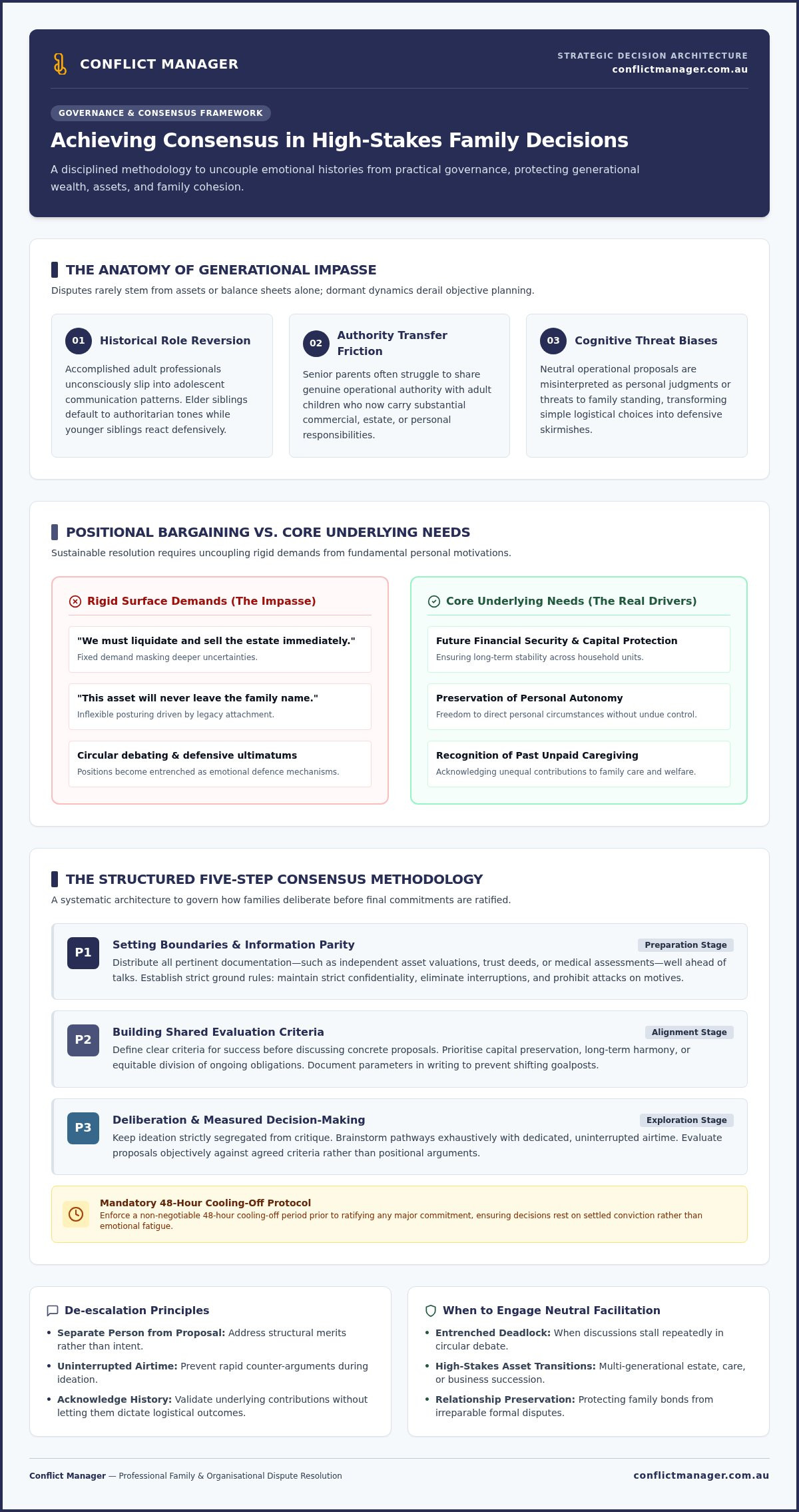
Decisions concerning property, succession, or care arrangements are never solely about balance sheets. Power, legacy, identity; high-stakes choices inevitably revive dormant generational hierarchies. When an urgent matter requires collective commitment, getting family members to agree on a major decision often collapses because practical proposals are mistaken for personal judgments. Cognitive biases cause participants to interpret neutral operational ideas as threats to their standing, transforming straightforward logistical choices into defensive skirmishes. Without an agreed, systematic process, conversations quickly drift away from constructive problem-solving toward entrenched posturing.
The Interplay of Historical Roles and Current Stakes
Family systems carry enduring memories. In critical family summits, accomplished adult professionals frequently slip back into adolescent communication patterns. An elder sibling might instinctively adopt an authoritarian tone, while a younger sibling resists out of long-standing reflex rather than reasoned analysis. At the same time, senior parents often find it difficult to share genuine authority with adult children who now carry substantial financial or personal responsibilities. The presence of partners and in-laws brings fresh perspectives that can intensify existing tribal lines. Committing to a structured consensus decision-making process helps depersonalise these interactions, replacing outdated childhood habits with adult governance standards.
Positional Bargaining Versus Core Underlying Needs
When family discussions stall, participants usually dig into unyielding positions: "We must sell the estate immediately," or "This property will never leave the family name." These rigid demands are rarely the real issue. Beneath an entrenched position lies a fundamental fear regarding future financial security, loss of personal autonomy, or a desire for recognition after years of unpaid caregiving. Demanding a single, narrow outcome is almost always an attempt to safeguard self-worth. Achieving lasting progress in getting family members to agree on a major decision requires uncoupling emotional needs from practical realities. Acknowledging that personal validation and structural execution are two distinct issues allows genuine common ground to finally emerge.
A Structured Five-Step Framework for Achieving Family Consensus
Discipline, cadence, neutrality; casual kitchen-table conversations rarely survive the weight of multi-generational choices. Successfully getting family members to agree on a major decision demands an orderly process that governs how the group engages before tackling what must be decided. Without a clear architecture, high-stakes deliberations quickly deteriorate into emotional attrition and defensive standoffs.
Phase 1: Setting Boundaries and Information Parity
Suspicion thrives in information vacuums. Distribute all pertinent documentation; whether independent asset valuations, trust deeds, or medical assessments; well ahead of the initial gathering. When every participant reviews the exact same baseline, you eliminate anxieties rooted in perceived secrecy. Establish conversational boundaries early: discussions remain confidential within the core group, interruptions are paused, and attacks on motive are ruled out of order.
Phase 2: Building Shared Evaluation Criteria
Define what a successful outcome looks like before floating concrete proposals. Does the family prioritise capital preservation, long-term harmony, or an equitable distribution of ongoing obligations? Clarifying collective benchmarks first strips subjectivity out of the review phase. Documenting these parameters in writing prevents participants from shifting goalposts when proposals challenge personal preferences. As academic guidance on practical family decision-making tips emphasises, securing consensus on guiding principles first keeps the room focused on joint problem-solving rather than individual ultimatums.
Phase 3: Deliberation and Measured Decision-Making
Keep ideation strictly segregated from critique. Brainstorm potential pathways exhaustively without permitting immediate dismissals, giving each stakeholder dedicated, uninterrupted airtime. Evaluating proposals against your agreed criteria reveals workable compromises that positional arguing conceals. Once an optimal path emerges, enforce a mandatory forty-eight-hour cooling-off period before ratifying any commitment, ensuring agreements rest on settled conviction rather than fatigue. When generational tensions threaten this sequence, engaging external family conflict resolution provides the neutral boundary control necessary to guide delicate talks to finality.
Navigating High-Stakes Scenarios: Estates, Care, and Assets
Context dictates friction. Estate settlements, residential aged care transitions, and multi-generational family enterprises each generate distinct structural pressures. Successfully getting family members to agree on a major decision across these complex landscapes requires diagnosing the specific operational challenge rather than treating the deadlock as a generic personal dispute.
Ageing Parents and Long-Term Care Arrangements
Care transitions force families to balance physical safety against personal dignity. Tensions frequently erupt when a primary local caregiver shoulders the physical and administrative burden, while geographically distant relatives critique decisions from afar. This division breeds resentment and mutual guilt. Clear medical assessments anchor choices in clinical reality rather than family speculation. Establishing documented care plans transparently keeps the focus on the parent's expressed wishes, preventing suspicions of unilateral control or neglect.
Inheritance, Property Divestment, and Estate Governance
Generational asset transfers bring financial expectations into direct collision with sentimentality. Sibling disputes account for 44% of estate conflicts, with disagreements over property and land driving 51% of these disputes according to research by Lesser Lutrey Pasquesi & Howe. Family homes hold deep emotional equity that resists cold balance-sheet calculations, which explains why an equal division of capital rarely feels genuinely equitable to every child. Independent property appraisals eliminate subjective guesswork. Integrating validated family decision-making tips allows siblings to navigate probate and divestment without turning property valuations into proxies for affection.
Family Enterprise and Shared Financial Assets
Shared commercial assets demand rigorous separation between domestic family dynamics and fiduciary responsibilities. Family members who work inside a family business often hold radically different financial goals from passive shareholders who simply depend on dividend distributions. Confusing a casual family gathering with a formal shareholders' meeting invites chaos. Clear voting thresholds and formalized family constitutions establish clear boundaries. When getting family members to agree on a major decision involving succession or business divestment, disciplined governance preserves both commercial solvency and personal ties.
Practical Communication Strategies to De-Escalate Defensive Behaviour
Tone, cadence, restraint; interpersonal delivery determines whether an objective proposal is weighed carefully or rejected out of hand. In fraught conversations, participants often process administrative suggestions as indictments of their loyalty or capability. Defensiveness follows instantly. Successfully getting family members to agree on a major decision requires transforming hostile exchanges into collaborative inquiries. By deliberately slowing conversational momentum, you prevent adrenaline surges from derailing rational assessment.
Shifting from Accusation to Inquiry
Interrogation provokes resistance. Asking "Why didn't you sort this earlier?" instantly triggers protective counterattacks. In contrast, framing queries around execution creates room for alignment: "What criteria should we use to assess this option?" or "How do we balance Mum's immediate comfort with the financial obligations?" Validating emotional tension is equally crucial. Acknowledging that an estate transfer or care shift feels overwhelming does not mean conceding to unworkable demands. Demonstrating genuine comprehension neutralises the urge for repetitive posturing, allowing participants to abandon performative venting in favour of pragmatic planning.
Managing Emotional Flooding and Resistance
Cognitive capacity drops sharply when physiological flooding takes over. Flushed skin, rapid speech, abrupt silence; these symptoms indicate a nervous system under siege. Forcing a vote in this state guarantees future sabotage. Protect the process by deploying deliberate circuit breakers:
- Institute tactical recesses: Call a pre-agreed ten-minute recess whenever voices rise or non-verbal distress signals appear.
- Restate core alignment: Anchor every restart by reciting the shared principles established during your early planning stages.
- Separate people from problems: Address the logistical issue on paper rather than debating individual temperament across the table.
De-escalation requires relentless discipline. When personal histories continually overwhelm internal attempts at structured discourse, engaging professional stakeholder facilitation provides the steady, external authority needed to guide participants through volatile dynamics and secure sustainable outcomes.
Recognising When to Engage Professional Family Facilitation
Deadlock, silence, attrition; internal attempts to resolve structural dilemmas inevitably meet natural boundaries. When self-guided discussions stall, prolonged friction threatens both family cohesion and generational capital. Seeking external intervention isn't an admission of personal failure. Instead, it serves as a protective governance measure that shields relationships from enduring damage. In complex environments, getting family members to agree on a major decision demands independent procedural oversight that internal members cannot realistically provide.
Key Indicators That Self-Facilitation Has Reached Its Limit
Recognising when private discussions have turned unproductive is vital to preventing irreversible estrangement. According to estate dispute research by Lesser Lutrey Pasquesi & Howe, 30% of disputing parties report that family members ceased speaking entirely following unresolved conflicts. Consider stepping back from self-managed talks when these diagnostic signals emerge:
- Information triangulation: Direct dialogue collapses into hostile text exchanges, unaddressed emails, or manipulative back-channel lobbying through uninvolved relatives.
- Severe leverage imbalances: Dominant figures dictate terms through financial superiority or emotional guilt, forcing quieter stakeholders into silent resentment or passive non-compliance.
- Compounding relational costs: The prolonged exhaustion, lost commercial opportunity, and relational damage of ongoing stalemate begin to exceed the effort required to follow a structured dispute management process.
The Role of Independent Stakeholder Facilitation
An independent facilitator alters the room's conversational physics. Rather than taking sides, an external expert enforces structured ground rules, neutralises historical power imbalances, and ensures every voice receives equitable, dignified airtime. This neutral structure depersonalises proposals, transforming combative positional claims into objective assessments against shared criteria. By creating a composed, highly regulated environment, third-party oversight allows participants to address contentious commercial realities without damaging long-standing personal bonds. Discover how Conflict Manager facilitates high-stakes family consensus with composed authority, preserving asset integrity and generational harmony across Australia.
Moving from Impasse to Enduring Consensus
Clarity, structure, restraint; navigating significant estate milestones or care transitions doesn't require erasing complex personal histories. Instead, it relies on establishing an objective architecture that protects both relationships and long-term assets. Successfully getting family members to agree on a major decision comes down to defining shared evaluation benchmarks early, regulating conversational pacing, and separating practical logistical hurdles from emotional defensiveness.
When discussions encounter persistent deadlock, introducing experienced external facilitation isn't a sign of surrender. It is a prudent governance choice that depersonalises contentious friction, rebalances dialogue, and preserves generational cohesion. You don't have to shoulder the burden of resolving high-stakes family friction alone. Speak with Conflict Manager about navigating your family's major decision to establish a composed, structured pathway forward that honours every stakeholder while securing decisive progress.
Frequently Asked Questions
How do you handle a family member who refuses to compromise on a major decision?
Shift the focus immediately away from their rigid position and examine their underlying exposure. Uncompromising stances usually mask unaddressed anxieties about financial stability or personal autonomy. Invite them to articulate the practical criteria required for them to feel secure, rather than debating their specific demand. When a member stonewalls entirely, engaging an independent facilitator helps depersonalise the deadlock and re-establishes productive dialogue.
What should we do if siblings have completely conflicting views on elder care?
Ground every care discussion in third-party objective assessments rather than subjective opinions. Rely on reports from treating geriatricians, occupational therapists, and independent care assessors to establish clinical necessity. When getting family members to agree on a major decision around ageing parents, separating logistical care requirements from emotional rivalries ensures the elder parent's safety and autonomy remain the focal point of all planning.
Is it better to discuss contentious family decisions in person or via video?
In-person meetings foster relational empathy, but video conferences offer useful emotional containment for volatile dynamics. Virtual sessions allow participants to regulate their physical environment, take structured breaks, and mitigate intimidation tactics driven by physical proximity. Hybrid arrangements can also work effectively, provided every participant agrees to identical conversational rules and shares identical documentation beforehand.
How can we keep family discussions focused without dredging up past grievances?
Establish strict, written agendas that define the boundary between historic complaints and present operational choices. Appoint a neutral timekeeper or external chair empowered to halt irrelevant historical detours. Acknowledge old grievances briefly outside the meeting room, but maintain a firm boundary: the current session exists solely to evaluate agreed options for the future.
Can a family reach an enduring agreement without total unanimous consent?
Yes, robust consensus requires broad consent and commitment rather than identical enthusiasm from every individual. Sustainable alignment means all stakeholders agree the process was fair, their concerns were formally recorded, and they will support the final path forward. Reaching this threshold in getting family members to agree on a major decision depends on procedural equity rather than forced unanimity.
What is the difference between family therapy and professional dispute facilitation?
Family therapy focuses on clinical healing, interpersonal attachment styles, and past psychological wounds. Professional dispute facilitation focuses strictly on governance, practical problem-solving, and establishing binding operational agreements between stakeholders. Facilitators do not provide clinical psychotherapy; they provide structured, neutral oversight to negotiate tangible transitions concerning estates, succession, or care arrangements.
When should a family establish formal governance rules for decision-making?
Families should establish formal governance before significant assets, operating businesses, or succession timelines create acute pressure. Waiting until a crisis erupts leaves conversations vulnerable to emotional hijacking. Developing a family charter or voting protocol during stable periods ensures clear procedural mechanisms are already in place when high-stakes choices inevitably arise.


