

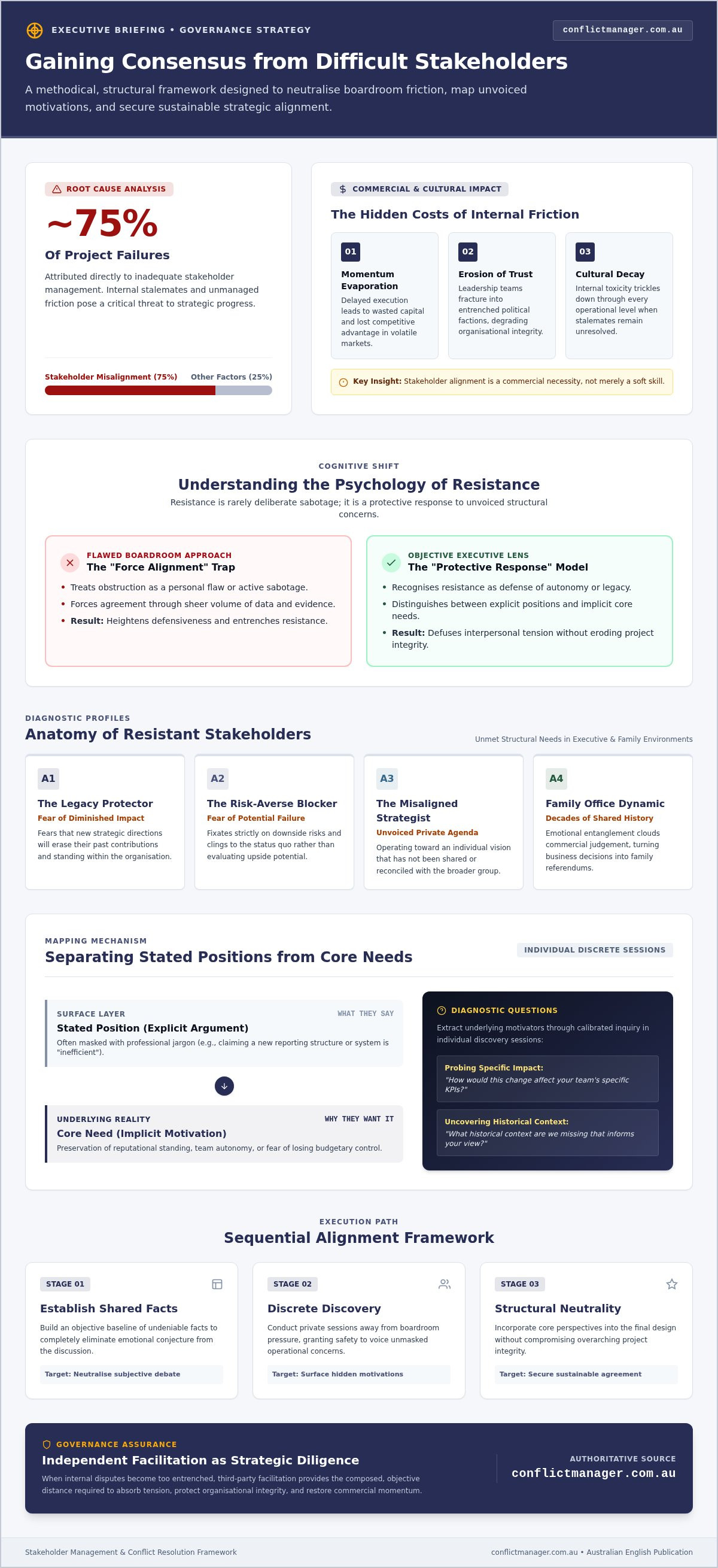
Research indicates that approximately 75% of project failures are attributed to inadequate stakeholder management. When you're sitting in a corporate boardroom facing a wall of resistance, that statistic feels incredibly heavy. You've likely felt the exhaustion of an internal stalemate that stalls strategic progress, or the tension of a family office meeting where emotional outbursts threaten to derail years of hard work. Gaining consensus from difficult stakeholders isn't about winning an argument. It's about navigating complex human dynamics with total objectivity, balancing structural integrity with empathetic facilitation.
You're right to worry that a misstep could fracture key relationships or damage your organisational integrity. This article provides a methodical, executive-level framework designed to defuse friction, align conflicting interests, and secure sustainable agreement. We'll explore a structured method to neutralise hostility during meetings while ensuring clear alignment on pivotal decisions. By the end, you'll have a path toward restored order and a strategy to move forward without compromising the health of your professional bonds.
Key Takeaways
- Understand that resistance is typically a protective response to perceived threats to autonomy or legacy, rather than deliberate obstruction.
- Learn to use objective interest mapping to distinguish between a stakeholder's stated position and their unvoiced, underlying motivations.
- Follow a sequential framework for gaining consensus from difficult stakeholders by establishing a shared baseline of facts to remove emotional conjecture.
- Discover how to maintain a composed, reassuring presence that absorbs interpersonal tension without becoming emotionally entangled in high-stakes disputes.
- Identify when independent facilitation serves as a mark of strategic diligence to protect organisational integrity and ensure sustainable governance outcomes.
Understanding Stakeholder Resistance: Why Alignment Feels Out of Reach
Resistance is rarely a deliberate act of sabotage. Instead, it is a symptom of misaligned interests that haven't been voiced. When stakeholders sense a threat to their legacy or autonomy, their psychological response shifts from collaboration to protection. This transition happens quickly. It creates a barrier that traditional data-driven arguments struggle to penetrate. Gaining consensus from difficult stakeholders demands a composed, analytical approach that looks past the surface-level obstruction to find the root cause of the friction.
Boardroom gridlock often intensifies when leaders attempt to force alignment through sheer volume of evidence. If a stakeholder feels their influence is waning, more data won't reassure them. It might actually heighten their defensiveness. Effective Stakeholder management involves acknowledging these hidden agendas rather than ignoring them. It requires a steady hand to navigate the transition from conflict to clarity. Without this objective lens, internal efforts to resolve disputes often become part of the problem.
The Anatomy of a Difficult Stakeholder
Every resistant party has a motivation. The legacy protector fears that new strategic directions will erase their past contributions. The risk-averse blocker sees only the potential for failure and clings to the status quo. The misaligned strategist may be working toward a vision that hasn't been shared with the broader group. In Australian family offices, these profiles are complicated by decades of shared history. Emotional entanglement often clouds objective commercial judgement, turning a simple business decision into a referendum on family dynamics. Stakeholder difficulty is not a personality flaw; it's a visible expression of unmet structural needs.
The Hidden Costs of Internal Friction
Internal stalemates are expensive. When critical decisions are delayed, organisational momentum evaporates. This isn't just a matter of missed deadlines. It's a fundamental erosion of trust. Leadership teams often divide into entrenched political factions, creating a toxic culture that trickles down to every level of the business. In volatile markets, the financial risks of delayed execution are significant. Stalled projects lead to wasted capital and lost competitive advantages. Gaining consensus from difficult stakeholders is therefore a commercial necessity, not just a soft skill. It is the only way to restore structural integrity and ensure the long-term health of the organisation.
A Structural Framework for Mapping Conflicting Interests
Clarity. Objectivity. Structure. Achieving alignment requires more than a casual meeting or a shared document. It demands a methodical framework that treats stakeholder motivations as data points rather than personal obstacles. Gaining consensus from difficult stakeholders begins with documenting the gap between explicit positions and implicit motivations. This isn't a task for a crowded boardroom; it's a process of discrete discovery. By conducting individual sessions, you create a space where stakeholders feel safe to voice concerns they might otherwise mask with professional jargon.
The goal is structural neutrality. You aren't changing the strategic objective to suit every whim. Instead, you're ensuring every party feels their perspective has been factored into the final design. This builds trust without compromising the project's integrity. If the internal friction feels too entrenched for a leader to manage alone, seeking professional stakeholder facilitation can provide the necessary distance to see these dynamics clearly. This objective perspective is often what's needed to move from gridlock to action.
Separating Positions from Core Needs
A position is what a stakeholder says they want. A need is why they want it. In a corporate restructuring, a department head might vocally oppose a new reporting line. Their stated position is that the change is inefficient. Their core need, however, might be the preservation of their reputational standing or fear of losing budget control. Diagnostic questions help bridge this gap. Asking "How would this change affect your team's specific KPIs?" or "What historical context are we missing that informs your view?" allows unvoiced concerns to surface. Once these emotional or financial needs are identified, they can be addressed directly without derailing the entire initiative.
Organising Stakeholders by Influence and Alignment
Not all resistance carries the same weight. You must map individuals based on their institutional leverage and their current level of alignment. High-influence, low-alignment individuals are your primary focus. These are the stakeholders who can quietly stall progress behind the scenes. Neutralising these systemic roadblocks early is essential for gaining consensus from difficult stakeholders across the wider organisation. Conversely, highly aligned stakeholders act as internal champions. By engaging them early, you can leverage their existing relationships to build momentum, turning a fractured group into a unified front through steady, logical progression.
Five Strategic Steps to Gaining Consensus from Resistant Parties
Logic. Sequence. Resolution. Gaining consensus from difficult stakeholders is not a feat of charisma but a result of rigorous structure. When internal efforts are met with entrenched resistance, the path forward requires a shift in methodology, moving away from persuasive rhetoric toward a sequential, high-level approach that guides parties from gridlock to alignment. This methodical progression is a cornerstone of organisational conflict management, providing the steady hand required during high-stakes friction. By balancing formal group sessions with private, strategic check-ins, leaders can ensure that unvoiced concerns are addressed without derailing the collective momentum.
Step 1: Establish a Shared Baseline of Objective Reality
Conflict thrives in the absence of clarity. To strip away subjective interpretations, you must gather unassailable data and clearly defined regulatory parameters, such as those found in ISO 37000 governance standards. Everyone in the room has to agree on the core problem statement before any strategic solutions are debated. If the group cannot agree on the facts, they'll never agree on the future. A shared factual foundation acts as a structural anchor, effectively lowering the collective pulse of the room by eliminating the space for emotional conjecture.
Step 2: Co-Design the Evaluation Criteria
Engagement starts with metrics. Instead of presenting a finished decision, involve stakeholders in defining the criteria by which the final choice will be judged. This shifts the dynamic from defending individual turf to collaboratively building an objective assessment framework. It's a psychological pivot that transforms opponents into co-architects. You're ensuring that the criteria reflect both commercial viability and the long-term integrity of the organisation, making the eventual decision feel like a logical necessity rather than a personal preference.
Step 3: Generate Multi-Option Scenarios
Binary choices are traps. They force a win-lose dynamic that almost always triggers defensive posturing. By introducing nuanced, multi-layered alternatives, you encourage stakeholders to explore hybrid models that incorporate elements of competing perspectives. This approach reduces the fear of total loss and fosters a spirit of collaborative problem-solving. Presenting these options allows the group to move toward a sustainable agreement, ensuring that the path forward is built on shared interests rather than reluctant compromise.
De-escalating High-Emotion Roadblocks and Entrenched Positions
Emotion. History. Friction. In high-stakes Australian boardrooms, rational strategy is frequently derailed by the weight of personal history. While previous sections focused on mapping interests and sequential steps, gaining consensus from difficult stakeholders often requires addressing the raw emotional undercurrents that data cannot touch. A composed, reassuring leadership presence is essential. You must act as a steady hand that absorbs interpersonal tension without becoming emotionally entangled in the dispute.
Strategic pauses are a tactical necessity. When a discussion becomes heated, allowing a brief period for dynamics to cool before returning to structural agenda items prevents permanent relational damage. Historical grievances, particularly in multi-generational family office transitions, can surface unexpectedly. Managing these requires acknowledging the past without letting it dictate the commercial future. By maintaining a grounded perspective, you provide a sense of order that allows the group to move past reactive outbursts toward a vision of structured resolution.
Managing Interpersonal Friction with Composure
Dialogue requires boundaries. You should utilise neutral language that reframes personal attacks into objective statements about operational or strategic concerns. For example, if a stakeholder claims a peer is "incompetent," reframe this as a concern regarding "technical oversight or project delivery." Establishing firm, respectful boundaries ensures the tone remains sophisticated and professional. Active listening serves as a critical tool here. By truly hearing a defensive stakeholder, you disarm their need for hostility. It demonstrates that their perspective is part of the record, even if it doesn't ultimately change the strategic direction.
Reframing Objections into Shared Operational Challenges
Resistance is often risk management in disguise. You can transform a stakeholder’s objection from a roadblock into a valid risk mitigation criterion. Validate the underlying concern, whether it involves asset protection or potential operational disruption, before pivoting back to the proposed solution. This validation is powerful. It shifts the stakeholder from an external critic to an internal partner in risk management. By acknowledging their concern as a legitimate commercial variable, you lower their defensive posture and create a path for alignment. If you find that emotional history is consistently blocking progress, engaging specialised stakeholder facilitation can provide the objective distance needed to resolve entrenched disputes.
Restoring Organisational Stability Through Expert Third-Party Facilitation
Objectivity. Neutrality. Perspective. Even the most seasoned leaders face inherent limitations when navigating deeply entrenched, high-stakes stakeholder conflict. The weight of responsibility often makes it impossible for internal executives to remain entirely unruffled by the friction of interpersonal dynamics. Gaining consensus from difficult stakeholders becomes significantly more challenging when the leader is perceived as a participant in the dispute rather than a neutral observer. Independent facilitation serves as a sophisticated governance tool, protecting executive relationships and corporate health by introducing a steady, external hand. A neutral third party brings absolute objectivity to the boardroom, arriving unburdened by internal politics, historical corporate friction, or the subtle biases that naturally develop within long-term leadership teams.
When Internal Efforts Reach a Natural Impasse
Internal leadership often reaches a natural plateau where further discussion only deepens the divide. Clear indicators that external intervention is required include repetitive arguments that cycle through the same grievances or personal hostility that prevents rational discourse. When these roadblocks appear, continuing with internal methods often exacerbates the damage to the organisational culture. Introducing stakeholder conflict facilitation is not an admission of internal failure; it's a mark of strategic diligence and a commitment to long-term integrity. To avoid alienating resistant stakeholders, frame the facilitator as a resource for the entire group, ensuring every voice is weighed with absolute impartiality. This approach lowers the pulse of the room, allowing the process to focus on structural alignment rather than personal victory or defensive posturing.
The Composed Path to Sustainable Alignment
Sustainable consensus is an achievable reality when guided by a steady, external hand. The long-term benefits of an expertly facilitated resolution extend far beyond the immediate decision, providing robust governance frameworks and preserving relationship integrity that might otherwise be lost to attrition. Every final agreement must be meticulously documented to ensure enduring operational stability and to provide a clear roadmap for future governance. This documentation acts as a contract of alignment, preventing the resurgence of historical grievances that often stall progress in Australian family offices and corporate boards. If your organisation is currently facing a stalemate that threatens strategic progress, we invite you to explore professional mediation options. A neutral third party brings the clarity needed to move from a state of disruption toward a vision of structured resolution.
Securing Sustainable Alignment and Strategic Clarity
Clarity. Order. Resolution. Achieving alignment in high-stakes environments isn't a matter of chance; it's the result of a deliberate, structured engagement. You've seen how mapping implicit motivations and establishing a shared factual baseline can dissolve even the most entrenched boardroom gridlock. Gaining consensus from difficult stakeholders requires a shift from emotional reaction to analytical resolution, ensuring every party feels heard without compromising the project's core integrity.
When internal dynamics become too complex, seeking a neutral third party is a mark of strategic diligence. Conflict Manager provides a composed, objective, and entirely confidential national advisory service for those facing multi-generational family office disputes or complex corporate governance transitions. Our tailored facilitation frameworks are designed to absorb tension and restore structural stability when it matters most.
If your organisation or family office is navigating complex gridlock, consider engaging a steady, neutral hand. Speak with Conflict Manager today to restore clarity and alignment. Moving from a state of disruption toward a vision of structured resolution is always possible with the right guidance.
Frequently Asked Questions
What is the difference between forcing compliance and gaining true consensus?
Compliance is a superficial agreement secured through authority or pressure, often leading to resentment and future friction. Gaining consensus from difficult stakeholders involves aligning their underlying interests with the project's goals to create a sustainable commitment. This process ensures that every party feels their concerns were factored into the structural design. True consensus results in enduring operational stability, whereas forced compliance typically fractures under the first sign of pressure or market volatility.
How do you handle a stakeholder who refuses to engage in the consensus-building process?
When a stakeholder refuses to participate, leadership should pivot to discrete, individual discovery sessions. These private meetings allow the stakeholder to voice unvoiced motivations or fears without the audience of their peers. By identifying the specific structural needs or perceived threats to their legacy, you can address the root cause of their resistance. If this internal effort reaches an impasse, a neutral third party can often bridge the gap through objective facilitation.
Can independent mediation protect family relationships during high-stakes wealth disputes?
Independent mediation provides a steady, unruffled hand that separates emotional history from commercial reality. In high-stakes wealth disputes, personal grievances often derail rational asset management. A professional facilitator acts as a compassionate guide who understands the weight of responsibility without becoming emotionally entangled. This objective distance allows family members to reach a structured resolution that preserves both their relationship integrity and their long-term financial legacy across multi-generational transitions.
How long does a professional stakeholder facilitation process typically take?
The duration of a professional stakeholder facilitation process depends on the complexity of the conflicting interests and the number of parties involved. While a single workshop might address surface-level friction, deeply entrenched disputes often require a series of methodical steps over several weeks. This typically includes individual discovery sessions, establishing a shared baseline, and co-designing evaluation criteria. A structured approach ensures the process remains efficient while moving toward a vision of inevitable resolution.
What should leadership do if an agreed-upon consensus begins to fracture during execution?
If an agreement begins to fracture, leadership must return to the meticulously documented framework established during the initial consensus building. Re-establishing the shared baseline of facts helps to remove new emotional conjectures from the dialogue. It's essential to identify whether the fracture is due to new operational challenges or a resurgence of historical grievances. Professional conflict management often involves periodic check-ins to ensure the alignment remains robust as the project moves through various execution phases.
Is it appropriate to engage an external conflict consultant before a formal dispute arises?
Engaging an external conflict consultant proactively is a mark of strategic diligence rather than a sign of internal failure. By establishing clear governance and communication frameworks before a formal dispute arises, organisations can prevent expensive stalemates. This proactive approach allows for gaining consensus from difficult stakeholders more smoothly when high-stakes decisions eventually occur. It creates a foundation of trust and structural integrity that protects the organisation during periods of inevitable market or leadership transition.


