

What if the best way to raise mediation is not to argue that it will solve the dispute, but to invite your partner to consider it alongside other options? When trust is strained and business decisions are becoming harder, convincing business partners to try mediation can feel like taking a side. Your partner may hear the suggestion as blame or assume you’ve already decided the relationship cannot be repaired.
That concern is understandable. Mediation isn’t a verdict on who is right, and it doesn’t require either partner to surrender control of the outcome. It offers a structured setting for a focused conversation, with an independent mediator guiding the process rather than imposing a decision. Whether it’s the right next step depends on the issues, the partnership agreement and both partners’ willingness to take part.
This guide explains how to raise mediation calmly, respond to common concerns and compare it with continuing direct discussions or pursuing other options. You’ll also find ways to propose a practical next step without an ultimatum. The aim is to help both partners consider the process clearly, while preserving their choice and agency.
Key Takeaways
- Choose a calm, private moment to discuss the unresolved issue and its effect on the working relationship, rather than raising mediation in the middle of a disagreement.
- When convincing business partners to try mediation, frame it as an option to assess together, not a judgement about fault or a demand to agree.
- Compare direct negotiation, facilitated mediation and formal dispute pathways by considering who guides the discussion, how structured it is and who makes decisions.
- If your partner hesitates, ask what feels unclear, risky or premature before deciding what to do next.
- Turn tentative interest into a small shared step, then consider the mediator’s experience, approach, stakeholder needs and practical arrangements.
Why suggest mediation to a business partner before the disagreement hardens?
A business disagreement can reach beyond the issue itself. Decisions may stall, communication can become guarded, and confidence in the partnership may weaken. Raising mediation at this stage doesn’t mean the business is failing. It can create more structure around a conversation that has become difficult to manage directly.
Mediation is a structured discussion supported by an independent third party, known as a mediator. The mediator helps participants communicate and explore possible options, but doesn’t decide the dispute for them or guarantee agreement. For a neutral overview of the process and the mediator’s role, see Mediation.
Choosing a process is not the same as deciding who is right. Framing the suggestion this way can make convincing business partners to try mediation feel less like taking sides and more like considering a practical method for addressing an unresolved issue. It’s an invitation, not an accusation or an admission of fault.
When is a disagreement ready for a mediation conversation?
There’s no single threshold. A useful signal is when repeated discussions no longer clarify the issue or lead to workable decisions. For example, partners may revisit a staffing or investment decision without resolving it, while responsibilities remain uncertain and day-to-day communication grows more strained.
These signs don’t diagnose either partner or prove the business is headed for failure. They suggest that the current way of discussing the problem may not be helping. A conversation about mediation can help you assess whether a more supported approach would be useful, before delay or frustration makes the issue harder to address.
What mediation can offer without guaranteeing an outcome
Mediation provides a setting where each partner can explain their concerns, hear how the other sees the problem and explore options that may not have emerged in direct discussions. That structure can keep attention on the specific disagreement and its practical effects, rather than letting the conversation become a contest over blame.
Control remains with the participants. They assess any proposed outcome and decide whether it’s acceptable. They can also conclude that further discussion or another pathway is needed. Suitability depends on the nature of the dispute, the participants’ circumstances and any relevant professional advice. If questions involve legal, financial or other specialist matters, partners may need advice from an appropriately qualified professional as they consider their options.
How to raise mediation with your business partner in five considered steps
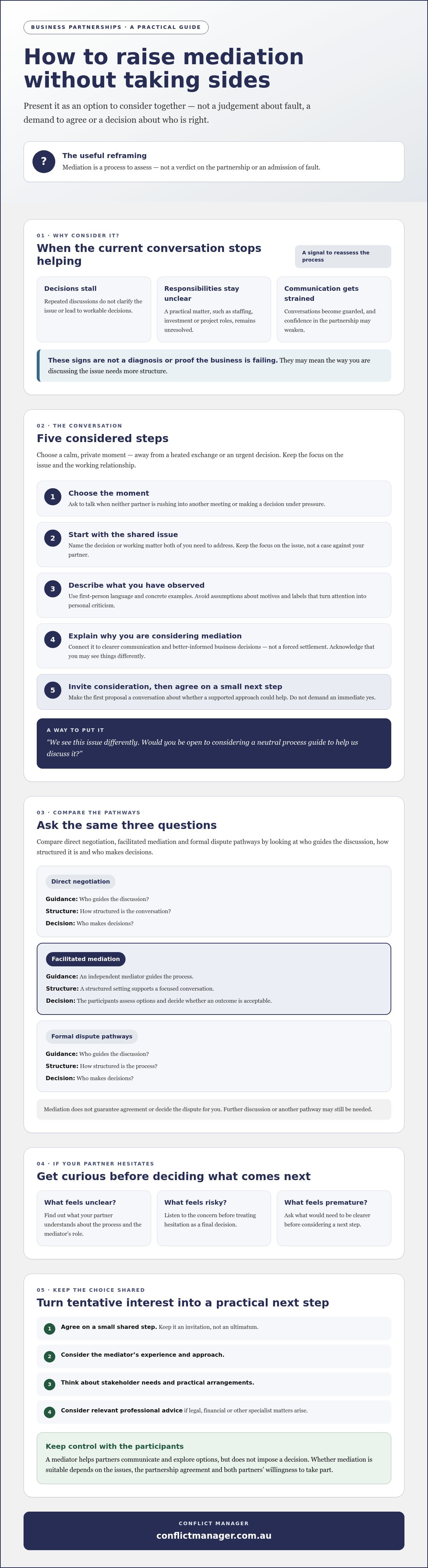
The way you introduce mediation can influence whether it’s heard as a constructive option or a threat. Choose a private, calm moment, away from a heated exchange or urgent decision. Keep the conversation focused on the working relationship and the specific issue that needs attention. These five steps can help you raise the idea without demanding an immediate yes.
- Choose the moment. Ask for time to talk when neither of you is rushing into another meeting or trying to make a decision under pressure. A quiet, private setting gives both partners more room to listen and respond.
- Start with the shared issue. Name the decision or working matter you both need to address. For example: “We still need to agree on how responsibilities for the new project will be divided.” This gives the conversation a clear focus without turning it into a case against your partner.
- Describe what you’ve observed. Use first-person language and concrete examples rather than assumptions about motives. You might say, “I’m concerned that we’ve had several discussions about the project roles, but we haven’t settled who will make the final decisions.” Avoid labels such as “unreasonable” or “impossible”, which can shift attention from the issue to personal criticism.
- Explain why you’re considering mediation. Connect the suggestion to clearer communication and better-informed business decisions, not a forced settlement. Acknowledge that you may see the issue differently, and that a neutral process guide could help you discuss it more constructively.
- Invite consideration, then agree on a small next step. Make the first proposal a conversation about mediation, not a demand to attend. You could say: “I’d like us to consider whether mediation could help us talk through the project decisions and our working relationship. Would you be open to discussing what the process involves? You can ask questions or say if you’re not ready.” If they’re unsure, offer to gather information together or set a time to revisit the question.
Keep the invitation open, not loaded
Convincing business partners to try mediation isn’t about finding the perfect phrase to secure agreement. It’s about making the proposal specific enough to consider and open enough to decline. Listen to your partner’s response without treating hesitation as a final answer. If an external process guide would help you understand possible approaches, you can explore organisational conflict management as one source of professional support.
Mediation, direct negotiation or formal processes: what should partners compare?
Partners don’t have to treat mediation as the automatic next step. Comparing it with continued direct discussion and formal dispute pathways can help you judge which process fits the issue, your readiness to participate and the decisions that need to be made. The appropriate process depends on the dispute and the participants.
| Process | Who guides the discussion? | Structure and decisions |
|---|---|---|
| Direct negotiation | The partners guide the conversation themselves. | Flexible and usually less structured. Partners clarify the issue, discuss priorities and decide whether they can reach a workable way forward. |
| Facilitated mediation | An independent mediator supports the discussion. | More structured, with space for each partner to explain concerns and explore options. The partners assess any proposed outcome and decide what, if anything, they accept. |
| Formal dispute pathway | The process and relevant decision-makers depend on the pathway. | Procedures and potential consequences vary. Partners should seek qualified advice about their circumstances before choosing or proceeding. |
When might direct negotiation be enough?
Direct discussion may be appropriate when you can both communicate constructively and are making progress. Before meeting, write down the precise issue, the decision required and each partner’s priorities. For example, if you’re discussing project responsibilities, separate what must be decided now from preferences that could be adjusted.
If conversations keep circling back without clarifying the issue or producing workable decisions, consider whether additional structure could help. That doesn’t mean direct negotiation has failed. It means the current approach may not be moving the discussion forward.
What distinguishes mediation from a formal dispute pathway?
Mediation supports a conversation. The mediator isn’t a judge and doesn’t decide who is right. A formal pathway may involve different procedures, decision-makers and consequences, depending on the circumstances. Don’t assume how a particular process affects your rights, obligations or options. Check any relevant agreement and seek qualified advice on jurisdiction-specific matters.
If you’re weighing whether convincing business partners to try mediation is the right next conversation, compare the fit of each process rather than treating one route as universal. What structure would help? Are both partners ready to take part? Is specialist advice needed before deciding? These questions can guide a considered choice without pre-judging the outcome.
How to respond when a business partner resists mediation
Hesitation is useful information, not proof that your partner is acting in bad faith or has no interest in resolving the issue. They may be unsure what mediation involves, concerned about being blamed or simply not ready to discuss it. Slow the conversation down. Ask what feels unclear, risky or premature, then listen before trying to answer.
Address common concerns without making promises
Respond to the concern your partner actually raises, rather than offering a rehearsed defence of mediation. Keep your explanation measured and check process details with the proposed mediator.
- “Are you saying this is my fault?” Clarify that you’re suggesting a way to discuss the issue, not asking a third party to decide who is to blame.
- “Will I lose control of the decision?” Explain that mediation supports discussion and exploration of options. Each partner considers what is proposed and decides what they’re willing to accept.
- “Will this stay confidential, or affect my position?” Don’t make assurances. Ask the mediator about the specific arrangements, and seek qualified advice about any legal implications that could affect your circumstances.
A calm answer can include uncertainty: “I don’t know the detail, but we can ask the mediator what applies before either of us decides.” That shows respect for your partner’s concern without overstating what the process can provide.
What if your partner is not ready to say yes?
Don’t turn a no, or a not yet, into a reason to press harder. You could offer neutral information for them to consider, then agree on whether and when to revisit the conversation. If both partners are willing, a brief preliminary discussion with a proposed mediator may help clarify practical questions without committing either of you to proceed.
If your partner declines, respect that choice. Consider what other steps may be available, including advice from an appropriately qualified professional where the dispute raises legal, financial or other specialist issues. The aim is to keep options clear, not to force agreement.
Convincing business partners to try mediation often begins with understanding the reason for their reluctance. If an external guide could help you assess a suitable process, explore Conflict Manager’s conflict resolution services as a possible source of support for internal disputes.
Agree on a practical next step and choose support that fits the dispute
Tentative interest is a chance to make the process more concrete, not a commitment to a particular outcome. Agree on one manageable action together: define the issue you want addressed, identify who needs to be involved or prepare questions for a potential mediator. A clear next step can keep the discussion moving while leaving both partners in control of whether to proceed.
Questions to agree before contacting a mediator
Before making an enquiry, align on what you need to find out. You might use questions such as:
- Who needs to participate? Identify the partners and consider whether other stakeholders need to be involved, or whether their interests can be represented another way.
- What issue should the discussion address? Describe the business matter as specifically as you can, such as an unresolved decision about responsibilities, governance or a change in operations.
- How does the mediator structure the process? Ask how participants are supported to explain their concerns, consider options and raise practical questions.
- What arrangements should we understand first? Confirm the proposed process, fees, scheduling and any confidentiality terms directly with the provider. Don’t assume these details are the same across providers or disputes.
Partners can also compare the mediator’s relevant experience, approach to facilitating discussion and ability to accommodate the stakeholders involved. The right questions depend on the dispute. If you need legal, financial or other specialist advice, consider obtaining it separately before making decisions.
How Conflict Manager can support a structured conversation
For internal disputes, structural change or high-emotion business situations, an external process guide may help bring greater structure to communication. Conflict Manager supports organisations through conflict resolution consulting, mediation and stakeholder facilitation, guiding stakeholders towards clarity and sustainable outcomes. This is support for a process, not a promise that partners will reach agreement.
If both partners are open to exploring support, you can discuss the circumstances and ask whether expert-led assistance may suit the issue and the people involved. Discuss organisational conflict support with Conflict Manager as a measured next step in considering your options.
Take the next step with clarity and choice
Mediation doesn’t need to be presented as the answer to every business disagreement. It can be an option to assess alongside direct discussion and other pathways. A calm invitation, grounded in the specific issue and its effect on the working relationship, helps keep the conversation focused on what both partners need to decide.
When convincing business partners to try mediation, leave room for questions and hesitation. Compare the available processes, clarify what support would involve, and agree on a small next step only if both partners are willing. The aim is not to force a settlement, but to make a considered choice about how to approach the conflict.
Conflict Manager provides professional conflict resolution and organisational conflict management, including mediation and stakeholder facilitation. If an external process guide may help you assess your options, discuss a structured approach to your business conflict with Conflict Manager.
A thoughtful first conversation can create more room for clarity, even before you know which path is right.
Frequently Asked Questions
How do I convince my business partner to try mediation?
Raise mediation as an option for improving the conversation, not as a judgement about fault. Explain the specific business issue and its practical effect, then ask whether your partner would consider learning about the process. Use first-person observations and offer to discuss questions together before deciding whether to proceed. This approach makes convincing business partners to try mediation a shared consideration rather than a demand for immediate agreement.
What if my business partner refuses mediation?
If your partner refuses, respect their choice and avoid turning the suggestion into an ultimatum. You could ask what concerns them, offer neutral information or agree to revisit the question later. If they remain unwilling, consider whether direct discussion or another process is appropriate. Review any relevant partnership agreement and seek qualified professional advice if you’re unsure about your options or the implications of the dispute.
Is mediation suitable for a dispute between business partners?
Mediation may suit a partner dispute when both participants are willing to discuss the issue with support from an independent third party. It can provide structure for explaining concerns and exploring possible options, but it won’t be appropriate in every situation or guarantee agreement. Suitability depends on the dispute, the participants and any relevant professional advice. Partners can ask a proposed mediator about the process before deciding whether to proceed.
Can mediation save a business partnership?
Mediation may help partners communicate more clearly and consider practical ways forward, but it can’t guarantee that a partnership will continue. The process supports discussion; the partners decide whether any proposed outcome is acceptable. A conversation may clarify differences even if it doesn’t resolve them. Consider what each partner needs from the business relationship, and seek appropriate professional advice if decisions involve legal, financial or other specialist matters.
What is the difference between mediation and negotiation?
In negotiation, the partners discuss the issue and explore options themselves. In mediation, an independent third party supports and structures that discussion but doesn’t decide the outcome. Both processes leave participants to assess possible solutions, though mediation adds an external process guide. The right approach depends on whether the partners can communicate constructively, the complexity of the matter and whether additional structure would help.
Is mediation confidential for business partners in Australia?
Don’t assume that every mediation has identical confidentiality arrangements or that particular information is protected in the same way in every circumstance. Ask the proposed mediator to explain the specific terms, how information is handled and any relevant limits before proceeding. If confidentiality or disclosure could affect your business or legal position, seek qualified advice. Confirming the arrangements in advance helps both partners make an informed choice.
What happens if business partners cannot reach an agreement in mediation?
If the partners don’t reach agreement, the mediator doesn’t impose a decision. You can identify which issues remain unresolved and consider whether another discussion or a different pathway may be appropriate. Before taking further steps, review any relevant agreement and seek qualified advice about available options and possible consequences. Mediation may still help clarify the points of disagreement, but it doesn’t require partners to accept an outcome.


