

What if a united leadership team didn’t need to agree on everything? Leaders can hold different views on priorities, timing or risk and still communicate with one voice. The challenge in how to present a united front as business leaders is not to hide those differences. It is to work through them before mixed messages unsettle staff and stakeholders.
Visible alignment matters, especially during organisational change. But avoiding disagreement can leave important risks unresolved, while sharing every internal debate can create uncertainty about direction. A steadier approach is to make room for honest discussion, clarify what the team has decided and communicate that decision consistently without pretending everyone agrees.
This article explains how leaders can handle disagreement constructively, establish shared commitments and communicate transparently when views still differ. You’ll learn how to align on what can be communicated, maintain trust through change and recognise when an impartial facilitator may help the leadership team make progress.
Key Takeaways
- Distinguish shared public communication from private agreement, so dissent can be addressed without giving staff competing instructions.
- Choose a leadership meeting, facilitated discussion or written decision record based on urgency, the intensity of disagreement and likely stakeholder impact.
- Learn how to present a united front as business leaders by moving from defining the issue to confirming the message, responsibilities and next steps.
- Revisit alignment as circumstances and stakeholder responses change, rather than assuming an earlier decision will remain clear to everyone.
- Recognise when internal discussion has stalled and an impartial, structured conversation could help leaders clarify differences and shared commitments.
What presenting a united front means for business leaders
Staff and stakeholders look to senior leaders for direction, particularly when priorities are shifting or a decision affects how work gets done. That pressure can make disagreement feel like a risk to contain. Yet a team that appears aligned without resolving key differences may struggle to give clear answers when questions arise.
A united front means communicating consistently about decisions the leadership team has agreed to, who is responsible for them and what happens next. It does not require every leader to hold identical views or agree on every issue. Private discussion can include challenge and dissent, while communication with staff and stakeholders reflects the decision, its rationale and any acknowledged uncertainty.
Think of alignment as a practical connection between direction and action. The concept of strategic alignment describes how an organisation links its structure and resources to its goals. For leaders, that connection becomes visible when people hear a coherent account of the priority, understand who owns the decision and know what happens next. It is not a performance of unanimity.
What should a united front look like in practice?
Consistency starts with shared facts and agreed language. If leaders announce a change to a reporting process, for example, they should be clear about what has been decided, who is overseeing the transition and when staff can expect further information. They do not need to repeat a script, but they should avoid giving different explanations or shifting responsibility between one another.
Some matters may remain unresolved. Leaders can say so plainly, explain what is still being considered and identify who will provide an update. Predictable communication gives people a reference point during organisational change. It does not require certainty where none exists.
Why does leadership consistency matter to staff and stakeholders?
Conflicting messages create avoidable uncertainty about priorities and accountability. If one executive tells a team to pause a project while another asks them to proceed, staff may be left guessing which instruction takes precedence. They may also question whether the decision is settled or whether leaders are still disputing responsibility for it.
Stakeholders can face similar ambiguity when leaders describe a change differently or imply different commitments. A shared account clarifies what people can rely on and where questions remain. It cannot guarantee trust or a particular outcome, but it gives staff and stakeholders a steadier basis for understanding the organisation’s direction.
How leaders can disagree without undermining a united front
Alignment is not silence. A leadership team that suppresses dissent may appear settled while important risks remain unexamined. The distinction is between challenging a proposal while a decision is being considered and contradicting the agreed direction during communication or implementation.
Consider a planned change to a service or internal process. One leader may see a delivery risk; another may believe delaying will create a different problem. They should be able to test evidence, question assumptions and explore alternatives during the decision-making discussion. If they leave without clarifying what was decided, staff may receive competing instructions and be left to choose which leader to follow.
Constructive internal challenge tests options before a decision. External contradiction creates confusion when leaders give different accounts of a decision that has already been made. The issue is not whether leaders have concerns. It is whether they clarify how those concerns affect the decision, the message and each person’s responsibilities.
How can leaders create room for honest internal debate?
Set a clear process before the discussion begins. Invite leaders to put forward evidence, risks and alternative views, and make space for people who are less likely to speak first. Before closing, summarise the decision, note unresolved questions and record who owns the next step. This gives dissent a place in the process without allowing open questions to be mistaken for settled decisions.
These habits are especially useful during change, when priorities and stakeholder responses may shift. Guidance from York University’s Schulich ExecEd on how to sustain leadership alignment through change offers a relevant perspective on the demands leaders face during conflict and transition.
What if a leader still disagrees with the decision?
First, clarify how the decision was reached and who had authority to make it. Leaders should agree on what can be said accurately. A person can explain the team’s decision and their responsibility for carrying it out without claiming they personally supported every part of the discussion. Honest wording is more credible than a forced performance of unanimity.
Some concerns may be significant enough to warrant further discussion before the team communicates a conclusion. Others can be recorded and monitored while the agreed direction proceeds. Ask whether the concern changes the decision, its risks or the information stakeholders need. If internal conversations keep circling without resolution, impartial organisational conflict management may help leaders clarify differences and shared commitments.
Which approach helps business leaders align on a shared message?
The right process depends on the disagreement, the time available and who will be affected by the decision. A routine operational question may need only a focused leadership meeting. If the same issue keeps resurfacing, or participants cannot speak candidly, a more structured discussion may help. A written decision record can support either approach by making the outcome and responsibilities explicit.
Use these options as a guide, not a guarantee. Choosing how to present a united front as business leaders means matching the process to the circumstances, rather than expecting one method to resolve every disagreement.
| Approach | Suitable when | Benefits | Limitations |
|---|---|---|---|
| Leadership meeting | Leaders can speak openly and those present have decision authority. | Allows direct discussion of facts, interests and options. | May repeat familiar arguments if trust or participation is uneven. |
| Facilitated discussion | Conversations have stalled, or important concerns are not being raised. | A neutral facilitator structures participation and helps clarify differences. | Does not decide for the group or replace the authority of decision-makers. |
| Written decision record | The decision needs to be communicated consistently or revisited later. | Captures the agreed direction, owners, next steps and open questions. | Documents an outcome but cannot resolve underlying disagreement on its own. |
When is an internal leadership meeting enough?
A meeting can be sufficient when participants have the authority to decide and can raise concerns without the discussion becoming personal or circular. Use an agenda that separates facts, interests, options and decisions. The chair should draw out different views and keep the discussion on track without taking over the decision or steering the group towards a preferred answer.
When might impartial stakeholder facilitation help?
Consider facilitation when repeated conversations stall, important issues remain unspoken or the disagreement affects stakeholders beyond the leadership team. An impartial facilitator structures the conversation and supports participants to clarify differences and possible shared commitments. They do not impose the outcome. Before engaging support, agree who will participate, who retains decision authority and what confidentiality can and cannot be expected.
Urgency and impact matter, too. A time-sensitive decision may call for an authorised leader to make a clear call, while recording unresolved concerns for review. Where stakeholder impact is substantial, allow enough time to understand affected perspectives before settling the message. Whichever route is chosen, finish by confirming what is decided, who communicates it, who is responsible for action and what remains open. A written record can help leaders stay consistent without implying that every participant agreed.
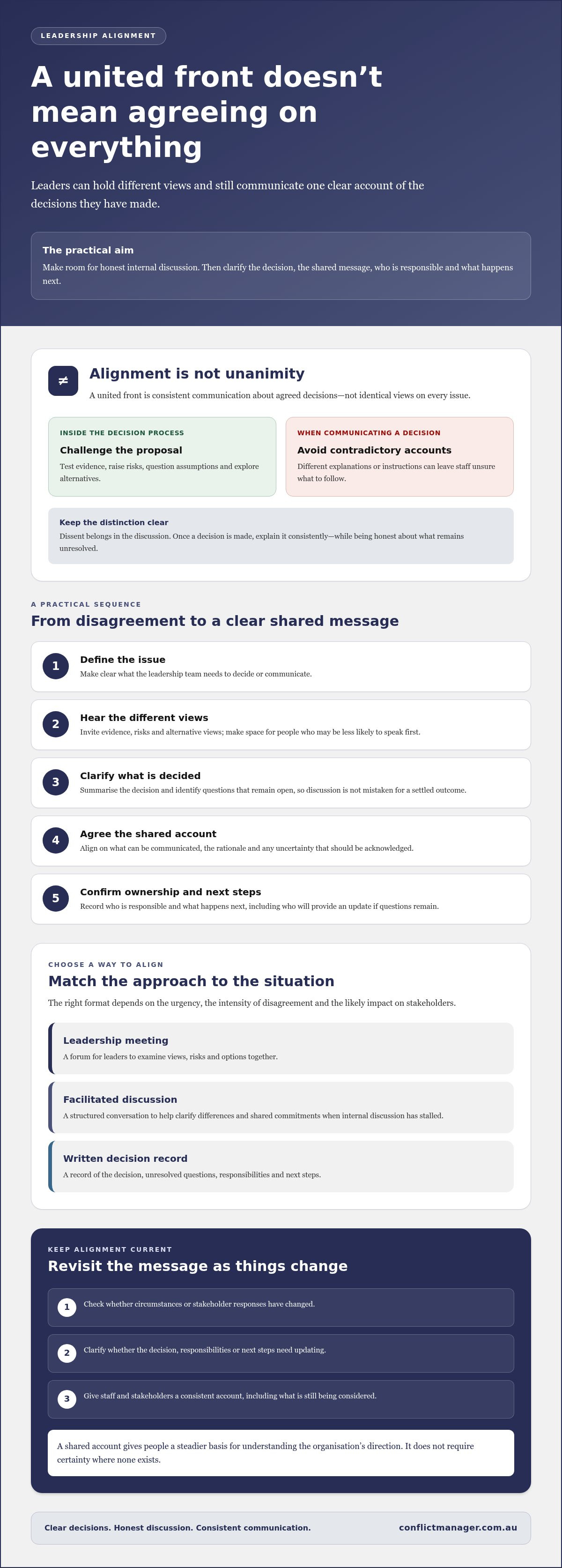
How to present a united front as business leaders: five steps
A shared message is easier to deliver when leaders first clarify what they are deciding and how they will handle disagreement. Use this five-step process in your next leadership discussion to move from competing perspectives to clear communication and accountable action.
- Define the issue. State the decision to be made in neutral language, without building a preferred solution into the description. For example, “How should we manage the transition of this function?” is more open than “How do we implement the restructure?”
- Surface views. Gather relevant facts, then test assumptions. Ask each leader to identify the risks, stakeholders affected and concerns that remain unresolved. Make room for different perspectives before narrowing the options.
- Decide. Clarify who has authority to make the decision and how the group will reach it. Record the outcome and any material concerns that need monitoring. If the implications involve legal, employment or regulatory matters, seek appropriate specialist advice rather than treating the leadership discussion as a substitute.
- Agree the message. Confirm what leaders can accurately say, who will communicate it and what responsibilities follow. Use plain language and acknowledge genuine uncertainty rather than overstating what is known.
- Review. Set a point to revisit the decision or its communication. Feedback, implementation concerns or changed circumstances may affect what staff and stakeholders need to know next.
How should leaders prepare before agreeing on a message?
Preparation keeps the discussion focused on the issue rather than personalities. Share relevant information in advance where practical, distinguish verified facts from assumptions and ask participants to consider who will be affected. Then separate the questions: What do we know? What matters to each leader? What options are available? What needs a decision? This structure helps the team challenge ideas without losing sight of the decision at hand.
How do leaders communicate and review the agreed position?
Capture the outcome in a short written record. A useful message structure is: Decision: what has been agreed. Rationale: why this direction was chosen. Responsibilities: who will do what, and when. Open questions: what remains uncertain and when it will be reviewed. Leaders can adapt the wording for different audiences while preserving the same facts and commitments.
A clear record is only useful if leaders can put it into practice. If internal disagreement is making that difficult, explore organisational conflict management to support a structured discussion and clarify shared commitments.
How to sustain leadership alignment through change and conflict
Alignment is not a one-off achievement. A decision that made sense at the outset may need to be revisited as circumstances change, implementation exposes new issues or stakeholders respond in unexpected ways. Leaders can maintain clarity by checking whether the original rationale still holds, responsibilities remain understood and the message still reflects what the organisation is doing.
Reviewing a decision does not mean reopening it whenever someone raises a concern. It means having a clear way to assess new information, distinguish implementation problems from changed priorities and agree whether an update is needed. This ongoing attention is part of how to present a united front as business leaders without mistaking consistency for rigidity.
What signs suggest the leadership team needs additional support?
Look beyond visible tension to the pattern of discussion and action. The team may need a more structured or impartial process if meetings repeatedly end without a decision, difficult subjects are avoided or stakeholders receive incompatible instructions. These signs can point to different underlying issues: strained working relationships, unclear roles, uncertain decision authority or a process that does not allow concerns to be heard. Identifying the issue helps determine the next step.
If leaders are unsure, they can ask: What decision is stuck? Who has authority to make it? Which concerns remain unresolved, and whose perspective is missing? Clear answers may show that an internal conversation is enough. If not, additional structure can help the group address the issue directly.
What can leaders expect from structured stakeholder facilitation?
Stakeholder facilitation provides a guided setting for participants to express perspectives, examine differences and clarify where shared commitments may be possible. An impartial facilitator supports the process; leaders and other participants retain responsibility for decisions and the commitments they make. Before starting, clarify who needs to take part, what the discussion is intended to address and who holds decision authority.
Conflict Manager provides organisational conflict management and stakeholder facilitation for Australian organisations dealing with internal disputes and structural change. These services may be relevant when leadership discussions have stalled and the group needs support to make progress. You can explore Conflict Manager’s conflict resolution services to understand the available support.
When internal progress has stalled, consider whether a structured, impartial conversation could help clarify the issues and next steps. Discuss stakeholder facilitation with Conflict Manager.
Build alignment through clear, consistent leadership
A united front does not require leaders to think alike. It depends on making space for honest challenge, clarifying how decisions are reached and communicating agreed responsibilities and next steps consistently. That distinction helps leaders address concerns without leaving staff and stakeholders to interpret conflicting directions.
To put how to present a united front as business leaders into practice, define the issue before debating solutions, surface different perspectives, record the decision and agree how it will be explained. Then review the position as circumstances and stakeholder responses evolve. If internal discussions keep stalling, a more structured or impartial process may help clarify what is unresolved and where commitments can be shared.
Conflict Manager provides conflict resolution consulting for organisational disputes and structural change, alongside stakeholder facilitation focused on clarity and sustainable outcomes. Explore Conflict Manager’s conflict resolution services if your leadership team needs support to move a difficult conversation forward.
With a clear process, leaders can acknowledge complexity while giving the organisation a steadier sense of direction.
Frequently Asked Questions
How do business leaders present a united front?
Business leaders present a united front by communicating agreed decisions, responsibilities and next steps consistently. First, clarify the issue and give leaders room to test evidence, risks and options. Then confirm what has been decided, who owns each action and what remains open. Leaders do not need identical views, but staff and stakeholders should receive a coherent account of the decision and know where to direct questions.
Does presenting a united front mean leaders must agree on everything?
No. A united front does not require identical opinions or the suppression of dissent. Leaders can challenge proposals during internal discussion, then communicate the decision accurately once it is made. If a concern is significant enough to affect the decision or its risks, raise it before presenting the position as settled. Where questions remain, acknowledge them clearly rather than suggesting complete agreement or certainty the leadership team does not have.
What should leaders do when they disagree in front of staff?
Pause the disagreement before it turns into competing instructions. A leader can acknowledge that there are different views, clarify what has been decided so far and explain who will resolve any outstanding issue and when staff can expect an update. Avoid asking employees to choose between leaders or act on conflicting directions. After the discussion, the leadership team should align on decision ownership and provide a consistent follow-up.
How can leaders communicate a decision they opposed?
Leaders can explain the team’s decision honestly without claiming they personally supported every part of the discussion. They should understand how the decision was reached, what rationale can be shared and what responsibilities they have accepted. For example, a leader might say, “The team has agreed to this approach. I raised concerns about timing, and we’ll review progress at the agreed point.” Do not misrepresent the decision or your own position.
When should business leaders use an external facilitator?
Consider an external facilitator when repeated internal discussions stall, key concerns remain unspoken or leaders cannot clarify shared commitments. A facilitator can structure the conversation and help participants explore different perspectives. They do not impose the outcome or take decision-making authority away from the leadership team. Before engaging support, clarify who will participate, the discussion’s purpose, decision authority and expectations about confidentiality.
How do leaders maintain a consistent message during organisational change?
Maintain consistency by agreeing on the facts, rationale, responsibilities and next update, then reviewing the message as circumstances evolve. Identify a spokesperson where useful, and make sure leaders know what is settled and what is still being considered. If implementation concerns or stakeholder responses change the picture, reassess the position and explain any update plainly. Consistency means communicating the current decision accurately, not repeating outdated messages as conditions change.


