

A meeting outburst needs a calm boundary before it needs a solution. Managing emotional outbursts in business meetings starts with containing the disruption without dismissing what’s behind it. The chair’s first response can steady the room or leave colleagues feeling unheard and reluctant to speak.
A heated exchange puts the person leading the meeting in a difficult position: intervene and risk embarrassing someone, or stay silent while discussion and decisions stall. The emotion may be real, but the group still needs a respectful, workable way to continue.
This guide explains how to respond calmly in the moment, protect the discussion and agree on a constructive next step. It also covers how to recognise when recurring or high-stakes conflict may benefit from neutral facilitation, so the underlying issue can be addressed through a more structured process.
Key Takeaways
- Managing emotional outbursts in business meetings begins with addressing the disruption without labelling or shaming the person.
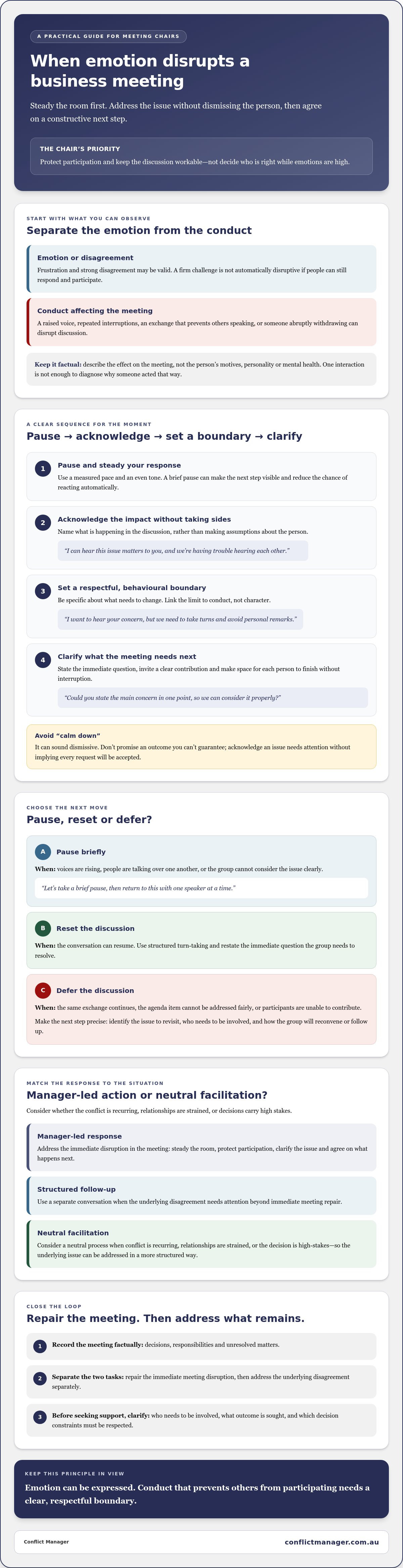
- Use a clear sequence to steady the room: pause, acknowledge the impact, set a respectful boundary and clarify what the meeting needs next.
- Choose between manager-led action, a structured follow-up or neutral facilitation by considering whether conflict is recurring, relationships are strained or decisions carry high stakes.
- Record decisions, responsibilities and unresolved matters factually, then address the underlying disagreement separately from immediate meeting repair.
- Before seeking support, clarify who needs to be involved, what outcome is sought and which decision constraints must be respected.
Managing emotional outbursts in business meetings starts with the immediate situation
An unexpected emotional moment can unsettle the whole room. People may stop contributing, the agenda can lose direction and the chair may feel pressure to act quickly. Managing emotional outbursts in business meetings begins by describing what is happening without turning it into a judgement about the person.
Here, an outburst means a visible escalation that disrupts discussion or participation. Separate the emotion being expressed from the conduct affecting the meeting. Frustration or strong disagreement may be valid; repeated interruptions or personal remarks may still need a boundary. The order matters: steady the room, clarify the issue, then agree on what happens next.
What counts as an emotional outburst in a meeting?
Look for observable behaviour: a raised voice, repeated interruptions, an exchange that prevents others from speaking, or someone abruptly withdrawing from the discussion. These signs describe the effect on the meeting, not why a person acted that way. One interaction isn’t enough to diagnose their motives, personality or mental health.
Strong disagreement alone isn’t necessarily disruptive. A colleague can challenge a proposal firmly while still allowing others to respond. Focus on whether the discussion remains workable and people can participate, not whether everyone sounds calm or agrees.
Why the chair's first response matters
The chair’s pace and tone can either reduce the room’s intensity or add to it. A brief pause, a measured voice and a clear limit make the next step visible. This is a practical form of emotional self-regulation: noticing the pressure in the moment and choosing a response rather than reacting automatically.
Protect participation while keeping the agenda in view. For example: “I can see this is important. Let’s pause the discussion so each person can finish without interruption.” If behaviour needs a firmer limit, name it plainly: “We can continue this conversation, but personal remarks need to stop.” Avoid debating intent while emotions are high. First restore enough structure for people to hear one another.
Emotion can be expressed; conduct that prevents others from participating needs a clear, respectful boundary. Once the room is steadier, clarify what needs attention now, what can wait for a separate conversation and who should be involved in agreeing the next step. This keeps the immediate meeting issue distinct from the underlying disagreement.
Managing emotional outbursts in a business meeting
Once the room has become unsettled, the chair’s next words matter. A simple sequence can help: pause, acknowledge the impact, set a behavioural boundary and clarify what the meeting needs now. Keep your language brief and neutral. The aim isn’t to decide who is right while emotions are high; it’s to make the discussion workable again.
A pause also gives the chair time to steady their own response. Use a measured pace and even tone, and make clear that the issue will be heard without allowing the exchange to escalate. When you resume, state the immediate question the group needs to address so the discussion has a clear focus.
Phrases that acknowledge emotion without taking sides
Name what’s happening in the discussion, not what you assume about the person. For example: “I can hear this issue matters to you, and we’re having trouble hearing each other.” Then invite a clear contribution: “Could you state the main concern in one point, so we can consider it properly?” This acknowledges the impact while giving the speaker a constructive way back into the conversation.
“I want to hear your concern, but we need to take turns and avoid personal remarks.”
That boundary is specific, respectful and linked to conduct rather than character. Avoid “calm down”, which can sound dismissive, and don’t promise an outcome you can’t guarantee. If the person raises a substantive issue, acknowledge that it needs attention without implying that every request will be accepted.
When to pause, reset or end the discussion
Try a short pause when voices are rising, people are talking over one another or the group can no longer consider the issue clearly. You might say, “Let’s take a brief pause, then return to this with one speaker at a time.” If the conversation resumes, use structured turn-taking and restate the immediate question the group needs to resolve.
If the same exchange continues, the agenda item can’t be addressed fairly or participants aren’t able to contribute, defer the discussion. Be precise about what happens next: identify the issue to revisit, who needs to be involved and how the group will reconvene or follow up. Deferral should create a path forward, not leave the disagreement suspended indefinitely.
If conduct suggests someone may be at risk, stop the discussion and prioritise immediate safety. Follow the organisation’s relevant procedures and seek appropriate support. For recurring or high-stakes conflict that’s difficult to manage internally, organisational conflict management or stakeholder facilitation may help restore structure and support productive dialogue.
Internal intervention or neutral facilitation: which approach fits?
Not every difficult meeting calls for outside support. The right response depends on whether the conflict is isolated or recurring, whether key relationships are under strain, how consequential the decision is and whether participants see the person leading the discussion as impartial. Managing emotional outbursts in business meetings includes choosing a process people can trust, not simply returning to the agenda.
Three options may fit, depending on the circumstances:
- Manager-led action: The chair or manager addresses an isolated incident and guides the next meeting or discussion.
- Structured follow-up: Relevant people meet separately from the wider group to clarify the disagreement, expectations and next steps.
- Neutral external facilitation: An impartial third party structures participation when the internal process is no longer seen as fair or effective.
Facilitation supports a process; it doesn’t guarantee agreement or determine who is right. It also doesn’t replace legal advice where that’s needed. Its value is in helping participants communicate with greater structure and work towards clear, sustainable outcomes.
When a manager can manage the next conversation
Internal action may be suitable when the incident is isolated, the chair can remain impartial and participants are willing to re-engage. Set a clear purpose for the next conversation, agree on how people will take part and record the actions to be followed up. If the manager is directly involved in the dispute, their ability to lead the discussion fairly may reasonably be questioned. Consider another process rather than assuming the manager should facilitate.
When a neutral facilitator may be useful
Recurring disruption, entrenched positions or several stakeholders with competing interests can make an internal process difficult to steer. The same applies when a decision carries significant consequences and participants doubt that one person can manage the discussion impartially. A neutral facilitator can establish a clear process, structure participation and keep attention on the issues and decisions that need consideration.
Bringing in an outsider doesn’t signal failure. It can be a deliberate choice to protect working relationships and give a complex discussion the structure it needs, particularly when internal attempts haven’t restored productive dialogue. Before choosing this option, clarify who needs to participate, what the discussion should address and what constraints apply to the decision.
For recurring or high-stakes workplace conflict that’s difficult to manage internally, exploring Conflict Manager’s organisational conflict management and stakeholder facilitation support may help you assess whether a neutral process is appropriate.
How to prepare and follow up after a difficult business meeting
Once the immediate tension has passed, preserve clarity without turning the meeting record into a judgement of anyone involved. Note what was decided, who is responsible for each action and which issues remain unresolved. Describe observable events only where relevant, and avoid characterisations such as “difficult” or “unreasonable”. A neutral record gives participants a shared reference point for what happens next.
Keep immediate meeting repair separate from the underlying disagreement. The group may need to confirm a decision or restore working communication before it is ready to examine the issue that caused the exchange. Before closing, confirm the follow-up time, its purpose and who needs to take part. Clear expectations reduce the risk that people arrive with different assumptions about whether the next conversation is for decision-making, clarification or repair.
A practical follow-up conversation
Choose the format according to the circumstances. A private discussion may suit an isolated concern, while a broader conversation or appropriate facilitator may be more suitable if several people are affected or impartiality is in question. Begin with an open prompt: “What do we need to understand before we can make progress?” Listen for the issue beneath the disagreement, then agree on specific actions, who owns them and a suitable point to review progress.
For example, if a disagreement about responsibilities disrupted a planning meeting, the follow-up might clarify who makes the relevant decision, what information is needed and when the group will revisit it. This keeps the discussion anchored to work that can be addressed, rather than allowing the earlier exchange to define the relationship.
Meeting design that reduces avoidable escalation
Good preparation won’t prevent every difficult moment, but it can reduce confusion about what’s being discussed and how decisions will be made. Share the decision required, relevant information and agenda beforehand. Allow time for disagreement and clarification, and explain how participants can contribute, particularly if seniority or competing interests may affect who feels able to speak.
A clear process doesn’t remove disagreement; it gives people a more structured way to discuss it.
Use the same discipline when managing emotional outbursts in business meetings: document the agreed next step, not assumptions about intent, and return to unresolved matters through a deliberate process. If difficult conversations are recurring or hard to facilitate internally, explore organisational conflict management support.
Building a steadier path forward when meeting conflict persists
A difficult exchange may be an isolated moment. But if the same disagreement resurfaces across meetings, decisions remain stalled or colleagues stop contributing, the incident may point to a broader workplace issue. Consider what keeps recurring: unclear responsibilities, competing priorities, strained stakeholder relationships or a decision that participants don’t believe has been made fairly. The aim isn’t to treat every strong reaction as a pattern, but to notice when the discussion itself can no longer move the work forward.
At that point, managing emotional outbursts in business meetings means looking beyond the moment and deciding what process could support a more constructive conversation. External facilitation isn’t required for every disagreement. It may be worth considering when internal attempts haven’t made progress, positions have become entrenched or the person leading the discussion is closely involved.
What to clarify before engaging a facilitator
Preparation helps make any support purposeful. Before approaching a facilitator, consider:
- Who needs to participate? Identify the people affected by the issue and those needed to clarify or make decisions.
- What remains open? Separate decisions already made from questions that still require discussion.
- What constraints apply? Clarify relevant organisational processes, decision boundaries and any matters that need to be handled through another channel.
- What would be useful? Define a realistic aim, such as clarifying competing perspectives, improving stakeholder communication or identifying practical next steps.
Share relevant context with care, following organisational protocols and respecting confidentiality. A facilitator needs enough information to understand the issue, but not every detail belongs in a shared discussion. Be clear about the process sought and what participants can reasonably expect from it.
How Conflict Manager supports organisational conflict work
Conflict Manager provides expert guidance through internal disputes and organisational structural changes. Its organisational conflict management and stakeholder facilitation work supports clearer communication and structured discussion of complex issues. A facilitator can guide the process, but participants remain responsible for their decisions; no particular agreement or outcome can be assumed.
Seeking outside support can be a considered step towards restoring productive dialogue, not an admission that internal leaders have failed. If recurring conflict is difficult to address within your organisation, consider discussing whether Conflict Manager’s organisational conflict support may suit the situation. Start by clarifying the issue, the people involved and the progress you hope a more structured conversation could support.
Turn a difficult meeting into a constructive next step
Managing emotional outbursts in business meetings is not about suppressing emotion or rushing to resolve every disagreement in the room. It means setting a respectful boundary, protecting people’s ability to contribute and creating a clear process for what happens next.
After a tense exchange, record decisions and unresolved issues neutrally, then separate immediate meeting repair from the deeper conversation. If conflict keeps resurfacing, consider whether internal discussions can still progress fairly and constructively. A neutral facilitator may help bring structure to complex stakeholder discussions, though the process itself can’t guarantee agreement.
Conflict Manager provides expert guidance for internal disputes and organisational change, alongside stakeholder facilitation focused on clear, sustainable outcomes. If your organisation would benefit from a more structured approach, explore Conflict Manager’s organisational conflict support.
A difficult moment need not define the relationship or the decision ahead. With calm boundaries and a considered process, teams can make space for both honest disagreement and forward movement.
Frequently Asked Questions
What should I do when someone has an emotional outburst in a business meeting?
Pause the discussion, acknowledge the impact and set a clear boundary around conduct that prevents others from participating. For example, say, “I want to hear the concern, but we need to take turns speaking.” Then clarify whether the group can continue, needs a brief break or should defer the item. Managing emotional outbursts in business meetings means responding to observable behaviour without assuming what the person intended or diagnosing why they reacted.
Should I ask someone to leave a meeting after an outburst?
Not automatically. First consider whether the meeting can continue safely and whether a pause or clear behavioural boundary is enough to restore participation. If someone’s conduct suggests a person may be at risk, stop the discussion and follow your organisation’s relevant procedures for safety and support. If asking someone to leave is necessary, act consistently with workplace processes and explain how the matter will be followed up.
How can I de-escalate a heated business meeting without taking sides?
Focus on the effect on the discussion rather than deciding who is right. Use neutral observations, such as, “We’re talking over one another, so let’s pause and take turns.” Give each person a fair opportunity to state their concern, and bring the group back to the specific question or decision. Avoid speculating about motives or making promises about the outcome. Your role is to support a workable process, not endorse either position.
Can a manager mediate an emotional dispute between employees?
A manager can guide a follow-up conversation if they can remain impartial and the employees are willing to participate. Set a clear purpose, agree on respectful turn-taking and identify the practical issue to resolve. If the manager is directly involved, has a strong interest in the outcome or is not seen as impartial, another approach may be more appropriate. A neutral facilitator can help structure the discussion, but doesn’t decide the outcome for participants.
When should a business use a neutral meeting facilitator?
Consider neutral facilitation when conflict keeps recurring, positions are entrenched, several stakeholders have competing interests or participants doubt that an internal chair can be impartial. It may also help when a high-stakes discussion repeatedly stalls despite attempts to reset it. A facilitator structures participation and keeps the conversation purposeful. This is a considered process choice, not a guarantee of agreement or a requirement after every tense meeting.
What should happen after an emotional outburst in a meeting?
Record decisions, action owners and unresolved issues in neutral terms, without editorial comments about participants. Before the meeting closes, confirm the purpose and timing of any follow-up and who should attend. Address immediate meeting repair separately from the underlying disagreement, which may need a dedicated conversation. Follow your organisation’s relevant processes, particularly if there are safety concerns or other workplace issues that require a different response.
How can I prevent emotional outbursts in future business meetings?
Make meetings easier to participate in by sharing the decision required, relevant information and agenda in advance. Set expectations for turn-taking and respectful disagreement, and allow time for questions or clarification before a decision is reached. After a difficult exchange, consider whether recurring tensions point to unresolved issues such as unclear responsibilities or competing priorities. Addressing those matters through a structured discussion may reduce avoidable friction, though it can’t prevent every strong reaction.


