

Mediation is a structured way to make decisions, not a promise that everyone will agree. If family discussions have become difficult, not knowing what happens in the room can add to the strain. With the mediation process for family disputes explained step by step, it’s easier to understand what to expect and how to prepare.
You may be wondering how sessions are managed, what happens if one person dominates or refuses to take part, and how mediation differs from legal or court processes. A neutral facilitator can structure the conversation and help each person put forward their perspective, but won’t decide the outcome for them.
This article covers the stages of family mediation, from preparation to discussing issues and possible outcomes. You’ll learn what mediation can and can’t resolve, how to prepare for sessions, and what options may remain if no agreement is reached. The aim is clarity, not pressure: understanding the process can help you decide whether it may suit your family.
Key Takeaways
- Understand how the mediation process for family disputes explained in this guide moves from first contact and preparation to discussion and follow-up.
- Learn how a neutral facilitator can structure conversation so participants can raise concerns and explore options without having decisions imposed on them.
- Consider when mediation may suit your family, and why its fairness, confidentiality and role compared with court processes depend on the circumstances.
- Prepare by clarifying your priorities, questions and relevant information, and identifying what you need to understand before making decisions.
- Explore possible next steps if some issues remain unresolved, including when legal advice or specialist family conflict resolution may be appropriate.
What is family mediation, and what can it help a family resolve?
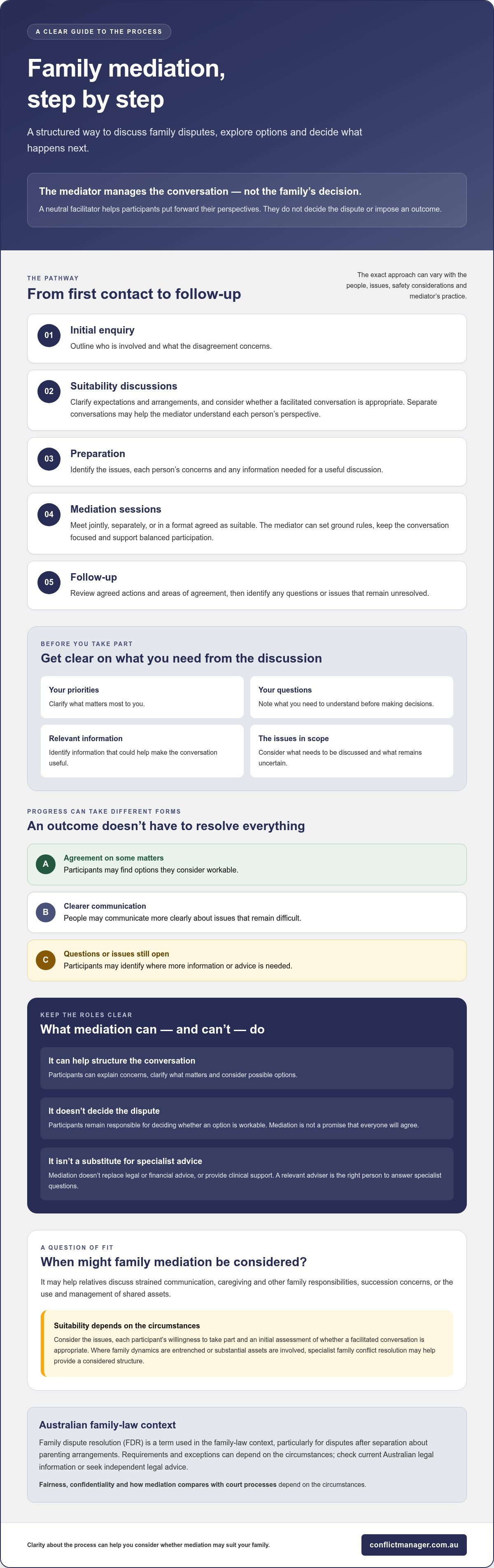
Family disagreements can affect relationships, responsibilities and shared decisions. When direct conversations become circular or difficult to manage, mediation provides a structured way to discuss the issues. A neutral third party facilitates the conversation so participants can explain their concerns, clarify what matters and consider possible options. The mediator guides the discussion, but doesn’t decide the dispute or impose an outcome.
The phrase mediation process for family disputes explained can refer to different contexts. Family mediation may address conflict between relatives, including communication difficulties and disagreements about shared responsibilities or assets. In Australia, family dispute resolution (FDR) is a term used in the family-law context, particularly for disputes after separation about parenting arrangements. Requirements and exceptions can depend on the circumstances, so check current Australian legal information or seek independent legal advice. For a broader overview of family mediation and its different models, see Family mediation.
Which family disputes may be suitable for mediation?
Mediation may help relatives discuss strained communication, caregiving and other family responsibilities, succession concerns, or the use and management of shared assets. For example, family members may need a more constructive way to discuss decisions about an inherited property or responsibilities for an older relative.
Whether mediation is suitable depends on the issues, each participant’s willingness to take part, and an initial assessment of whether a facilitated conversation is appropriate. Mediation isn’t a substitute for legal or financial advice, and it doesn’t provide clinical support. Where family dynamics are entrenched or substantial assets are involved, specialist family conflict resolution may help provide a considered structure for discussion.
What is the mediator’s role in a family dispute?
A mediator sets up a process for discussion and helps participants use it. This may involve setting ground rules, keeping the conversation focused, supporting balanced participation and helping distinguish stated positions from the concerns behind them. The aim isn’t to make everyone agree. It’s to clarify the disagreement and make possible options easier to examine.
The mediator manages the conversation, not the family’s decision. Participants remain responsible for deciding whether an option is workable. If an issue requires legal interpretation, financial analysis or other specialist advice, mediation can help identify the question, but the relevant adviser is the right person to answer it. This keeps the roles clear: the mediator structures the conversation, while the family makes its own decisions.
How does the family mediation process work from first contact to outcome?
Mediation usually happens in stages, giving participants time to understand the format before discussing difficult issues together. If you’re looking for the mediation process for family disputes explained, expect a sequence rather than one decisive meeting. The exact approach can vary according to the people involved, the issues, safety considerations and the mediator’s practice.
- Initial enquiry: Outline who is involved and what the disagreement concerns.
- Suitability discussions: Clarify expectations and process arrangements, and consider whether mediation appears appropriate.
- Preparation: Identify the issues, each person’s concerns and any information needed for a useful discussion.
- Mediation sessions: Meet jointly, separately, or in a format agreed as suitable, to explore concerns and possible options.
- Follow-up: Review agreed actions and areas of agreement, and identify questions or issues that remain unresolved.
Progress doesn’t have to mean resolving every issue. Participants might reach agreement on some matters, communicate more clearly about others, or identify where more information or advice is needed. These are different outcomes, and the mediator can help make the distinction clear.
What happens before the first joint mediation session?
Before a joint discussion, the mediator may speak with participants separately to understand their perspectives and explain how the process works. These conversations can clarify who will take part, which issues are in scope, what each person expects and how sessions will be arranged. They also give the mediator an opportunity to consider suitability and safe participation before a joint meeting proceeds.
What happens during a family mediation session?
A session may begin with the mediator explaining the structure and inviting participants to ask process questions. The group then identifies the issues to discuss. The mediator supports turn-taking, helps distinguish shared concerns from different priorities, and guides participants as they explore options. Participants can ask for clarification, raise a concern about the process or request a pause.
A useful way to picture the discussion is: set expectations, define issues, hear perspectives, explore options, agree next steps. This is a framework, not a guarantee that every issue will be settled. If family dynamics or complex assets make direct discussion difficult, specialist family conflict resolution may offer a structured setting for working through the issues.
Is family mediation fair, confidential, and better than going to court?
Fairness involves more than having a neutral person in the room. Participants need a process that lets them understand the discussion, express concerns and make informed choices. Mediation can support that balance, but it doesn’t guarantee agreement or mean every family dispute is suitable for facilitated discussion.
Taking part doesn’t mean accepting a proposal. The mediator doesn’t impose a decision. However, participation requirements can differ between private mediation, family dispute resolution and court-related processes, so check what applies to your circumstances. A clear explanation of the mediation process for family disputes should cover both the choices available and the limits of the process.
How does mediation differ from a court process?
The key difference is who determines the outcome. In mediation, participants explore options and decide whether they can agree. A court determines matters brought before it, applying the relevant law and procedures. Mediation gives participants more direct control over the discussion, while court proceedings follow a formal decision-making process.
| Aspect | Mediation | Court |
|---|---|---|
| Decision-making | Participants decide whether to accept an option. | A judicial officer makes decisions on matters before the court. |
| Process focus | Facilitated discussion and exploration of possible options. | Formal steps for determining disputed issues. |
| Possible outcome | Full or partial agreement, or unresolved issues. | A court decision, subject to applicable procedures and any available review or appeal rights. |
Neither pathway is automatically better. The nature of the dispute, the participants’ circumstances and the need for a formal determination all matter. Mediation doesn’t prevent you from seeking independent legal advice before, during or after discussions.
What if there is a power imbalance or safety concern?
A neutral facilitator can structure turn-taking, but neutrality alone doesn’t remove a power imbalance. Suitability should be assessed before joint discussions proceed. Depending on the circumstances and the mediator’s assessment, separate conversations or other process adjustments may be considered. These measures don’t guarantee that mediation will be appropriate or safe in every situation.
Confidentiality also depends on the specific process and its applicable rules. Don’t assume that everything said is automatically confidential, inadmissible or protected from disclosure. Ask the mediator to explain the relevant limits and exceptions before sharing sensitive information. If anyone faces immediate danger, prioritise safety and contact emergency services on 000 in Australia, or seek appropriate professional support.
How can family members prepare for mediation and make the discussion useful?
Preparation isn’t about scripting every response or arriving with a fixed answer. It’s about knowing what you need to raise, what needs clarification and where you may be open to options. A little structure can help keep a difficult conversation focused, especially when family members have different views of the same history.
Preparation should fit the issues being discussed. If the matter has legal or financial implications, independent legal or financial advice can help you understand your position. The mediator can structure the discussion, but doesn’t replace specialist advice.
What should you bring or decide before a session?
Make a concise list rather than trying to document every past disagreement. Before the session, consider preparing:
- Key issues: What needs discussion, and what would you like to leave clearer?
- Priorities: Which outcomes feel essential, and where could you explore different options?
- Questions: What do you need clarified before you can consider a proposal?
- Relevant information: Bring documents that relate to the issues, if appropriate. What information is needed depends on the matter and any advice you’ve received.
- Practical arrangements: Confirm who will attend, the session format and any accessibility needs with the mediator beforehand.
It can help to separate a position from the concern behind it. “I won’t agree to that arrangement” is a position; the underlying concern might be uncertainty about responsibilities or future decisions. Naming the concern can create room to explore options without requiring you to give up what matters.
How can participants keep a difficult conversation constructive?
Focus on the specific issue rather than making broad judgements about another person. Listen for the concern behind their position, and ask for clarification when something isn’t clear. Respectful turn-taking gives each participant space to speak and helps the mediator identify where views overlap and where they differ. If the conversation becomes difficult to follow, ask for a pause or a reset.
At the end, record agreed actions and open questions in clear, neutral language. For example, note who will obtain information and what still needs discussion. Treat informal notes as a record of the conversation, not automatically as a formal or legally binding agreement. The effect of any written outcome depends on its form and circumstances, so seek advice if you’re unsure.
If family dynamics or significant assets make preparation and discussion challenging, consider engaging family conflict resolution support to help structure the conversation.
What happens after family mediation, and when may specialist support help?
The end of a mediation session is a chance to take stock, not necessarily a final resolution. Participants may leave with agreed actions, matters resolved, questions to investigate or issues that remain in dispute. Even a partial outcome can clarify what is settled and what needs attention next.
The legal effect of a written agreement depends on its form and circumstances. Don’t assume notes, a summary or a verbal understanding are automatically binding or enforceable. If an outcome has legal or financial consequences, obtain independent advice about how it should be recorded or formalised. This explanation of the mediation process is intended to help you understand the pathway, not replace advice tailored to your situation.
What if family mediation does not resolve every issue?
An incomplete agreement isn’t automatically a failure. Participants can identify what remains unresolved, what information is missing and which questions need specialist input. Independent legal, financial or other professional advice may clarify those points before the family decides whether to continue discussions or consider another appropriate pathway.
For example, family members might agree on immediate practical steps while getting further advice on a complex asset question. Keeping agreed actions separate from open questions can make the next conversation more focused.
When might an external family mediator be useful?
Facilitating a discussion yourselves can be difficult when communication has broken down, family relationships are entrenched or participants have unequal influence. Significant assets or internal family disputes can add further complexity. An experienced external mediator can provide a structured setting, help participants examine concerns and options, and support a more balanced conversation without taking sides or deciding the outcome.
Whether this support fits depends on the family’s circumstances and the issues involved. If you’re considering a structured approach, you can explore Conflict Manager’s family conflict resolution support and consider whether it may suit your situation.
Take a considered next step
Family mediation is a structured way to discuss difficult issues, not a guarantee that everyone will agree. Understanding the process can help you prepare with clearer priorities, relevant questions and a realistic sense of what mediation can and can’t decide.
Consider the key decisions: whether mediation suits your circumstances, what information or independent advice you need, and what could follow if some matters remain unresolved. Even partial progress can distinguish agreed points from questions that still need attention.
Where entrenched family dynamics, significant assets or internal friction make discussion difficult, expert-led family conflict resolution may provide a steady structure. Conflict Manager helps families work towards clarity, stability and sustainable outcomes while leaving decisions with the people involved.
Explore Conflict Manager’s family conflict resolution support to consider whether a structured conversation may suit your situation. A thoughtful next step can help create more clarity, whatever the eventual outcome.
Frequently Asked Questions
What happens at the first family mediation session?
The first session usually establishes how the discussion will work and which issues participants want to address. The mediator may explain the process, invite each person to outline their concerns and help set priorities for the conversation. Depending on the circumstances, suitability or preparation discussions may happen separately before a joint session. Participants can ask about practical arrangements and raise concerns before deciding how to proceed.
Is family mediation confidential in Australia?
Confidentiality depends on the type of mediation and the rules that apply. Don’t assume every discussion is automatically confidential or protected from disclosure, as exceptions may apply. Before sharing sensitive information, ask the mediator to explain the confidentiality arrangements and any limits. If you’re unsure how those rules affect your situation, seek independent legal advice. This is particularly relevant when discussions involve sensitive family, financial or safety matters.
Can family mediation work if one person does not agree?
Mediation can’t produce a shared decision if a participant isn’t willing to engage, and no one has to accept a proposal. A mediator may first explore whether concerns about taking part can be addressed or whether another format is suitable. Requirements can vary depending on the type of process and the circumstances, so check what applies to your situation. Even without agreement, discussion may clarify the issues or identify useful next steps.
Does a family mediator decide who is right?
No. A mediator facilitates the conversation rather than deciding who is right or imposing an outcome. They can help participants explain their perspectives, identify priorities and explore possible options, while each person remains responsible for deciding whether an option is acceptable. If the dispute needs a formal determination, mediation may not resolve it. Independent legal advice can help you understand your rights and options in that situation.
What happens if family mediation does not reach an agreement?
Participants can review what was resolved, what remains open and what information or advice may help with unresolved points. Partial progress can still provide clarity, even without a complete agreement. Possible next steps depend on the dispute and may include further discussion, independent legal or financial advice, or another appropriate process. The legal effect of any written outcome depends on its form and circumstances, so seek advice before relying on it.
Do I need a lawyer for family mediation?
You don’t necessarily need a lawyer present for every mediation, but independent legal advice can help you understand your rights, obligations and the implications of any proposed agreement. Whether you need advice depends on the issues and your circumstances, particularly if the dispute involves parenting arrangements, significant assets or other legal questions. A mediator structures the discussion; they don’t provide legal representation. Ask what participation arrangements are available and seek advice where needed.


