

What helps a difficult workplace conversation stay focused when emotions rise and people see the issue differently? The answer often begins before anyone enters the room. Facilitating difficult conversations at work means creating a fair structure for people to speak honestly, understand the impact of the issue and keep the work in view.
If you’re unsure how to open a sensitive discussion, concerned that frustration will take over, or finding it hard to balance competing perspectives, that uncertainty is understandable. Without a clear purpose or process, a conversation can quickly become a debate about who’s right. Structure gives participants a steadier way to address what happened without becoming personally entrenched.
This guide explains how to prepare, guide and follow up on a difficult workplace conversation. You’ll learn to define the issue, set expectations, make room for each perspective and turn what’s heard into practical next steps. When repeated attempts or power dynamics make an internal process difficult, neutral external facilitation may also be worth considering. The aim is clarity, fairness and a constructive path forward.
Key Takeaways
- Clarify the purpose, participants and examples before the meeting so the discussion has a fair, specific starting point.
- Facilitating difficult conversations at work means guiding the process, not deciding who is right or imposing an outcome.
- When emotions rise, slow the pace, summarise each perspective neutrally and check that everyone understands the issue being discussed.
- Turn areas of agreement into clear actions, responsibilities and review points, while recording unresolved matters separately.
- Consider neutral external facilitation when repeated impasses or perceived partiality make an internal conversation difficult to progress.
Facilitating difficult conversations at work: why the process matters
Raising a sensitive issue with a colleague or team member can feel risky. You may be concerned about how your words will land, whether the other person will become defensive, or whether the discussion will affect your working relationship. A clear process helps contain that uncertainty. It gives people a fair opportunity to explain their perspective while keeping the conversation focused on the work issue that needs attention.
Workplace conversation facilitation is the impartial guidance of a discussion so participants can explain their perspectives, clarify the issue and consider next steps, without the facilitator deciding the outcome. The facilitator manages the process, not the verdict. For a foundational overview of what difficult conversations are, see Wikipedia’s summary of the topic and related conversation models.
Without an agreed purpose, clear roles or shared expectations, participants may arrive with different ideas about what the meeting is for. One person might expect a decision; another may think they’re there simply to be heard. That mismatch can raise frustration before the issue has even been discussed. Facilitating difficult conversations at work means making the purpose and process visible, so the discussion has a steadier foundation.
What makes a workplace conversation difficult?
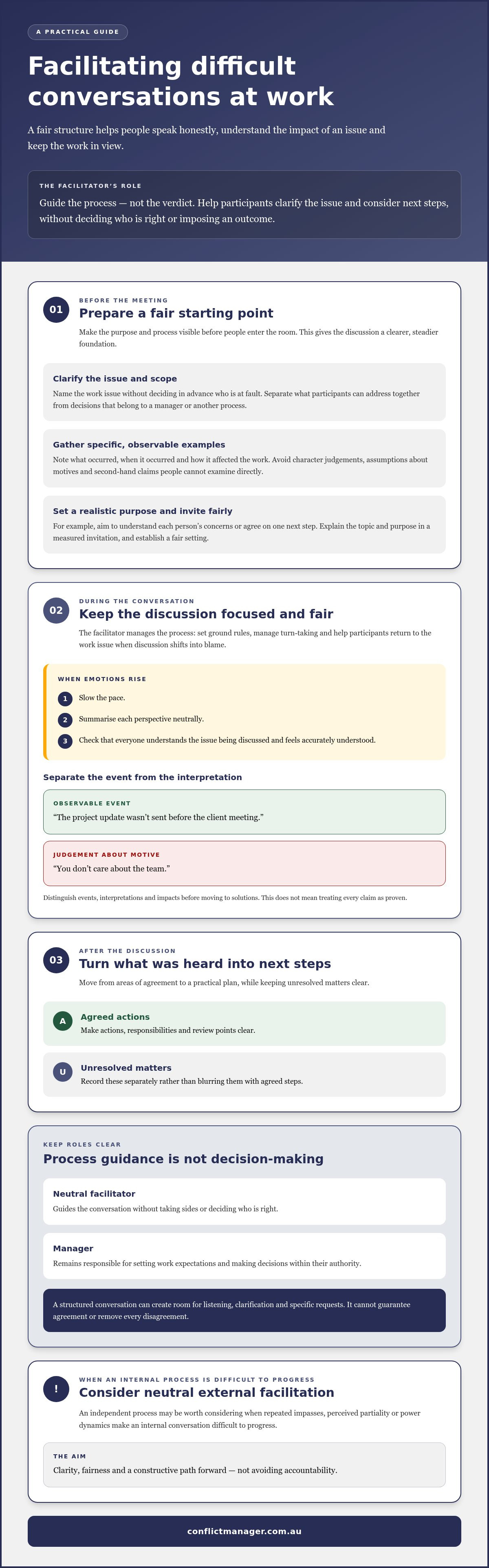
A work issue is easier to examine when it’s described in observable terms rather than as a judgement about someone’s character or motives. For example, “The project update wasn’t sent before the client meeting” identifies an event. “You don’t care about the team” assigns an intention, which the other person may dispute.
Status, past interactions and competing needs also shape what people hear. A manager raising missed deadlines may intend to discuss planning, while an employee hears a judgement about their commitment. Strong feelings can narrow attention in the moment, so a facilitator may need to slow the exchange, summarise each account neutrally and check that participants feel accurately understood. This doesn’t mean treating every claim as proven. It means distinguishing events, interpretations and impacts before moving to solutions.
What facilitation can, and cannot, do
A structured conversation can create room for listening, clarification and specific requests. A facilitator can set ground rules, manage turn-taking and help participants return to the issue when the discussion shifts into blame. These steps can make it easier to consider options, but they can’t guarantee agreement or remove every disagreement.
Roles matter. A manager remains responsible for setting work expectations and making decisions within their authority. A neutral facilitator guides the conversation without taking sides or deciding who is right. If participants perceive the person leading the discussion as partial, or the same impasse keeps returning, an independent process may be worth considering. The aim is not to avoid accountability. It’s to help people address the issue with greater clarity and fairness.
Prepare for tough work conversations before meeting
Preparation creates a useful boundary around a sensitive discussion. Before scheduling it, clarify the issue, who needs to be involved, what examples can be shared and how to invite participants without putting them on the defensive. This is a practical foundation for facilitating difficult conversations at work, particularly when people may have different accounts of what happened.
Set the purpose, scope and desired next step
Name the work issue without deciding in advance who is at fault. For example, identify a handover that has repeatedly left tasks unclear rather than labelling a colleague as careless. Separate what participants can address together from decisions that belong to a manager or another process. Choose a realistic aim, such as understanding each person’s concerns or agreeing on one next step. A clear purpose helps determine who needs to attend and keeps the discussion focused on the issue, rather than every disagreement between participants.
Gather specific, observable examples that are relevant to that purpose. Note what occurred, when it occurred and how it affected the work. Avoid character judgements, assumptions about motives and second-hand claims that participants can’t examine directly. If you’re unsure whether a detail is necessary, ask whether it will clarify the issue or help identify a practical response.
Invite participants and establish a fair setting
Explain the topic and purpose in a measured invitation. Give participants enough context to understand why they’ve been asked to meet, without presenting an accusation as an established fact. Consider who needs to be present, who will guide the conversation and whether each person can speak freely in that setting. If there’s a perceived power imbalance or concern about partiality, think carefully about who is best placed to facilitate.
Agree on practical arrangements before the meeting: a suitable time, a private setting, accessibility needs and any support participants may require. These details don’t resolve the disagreement, but they reduce avoidable uncertainty and help make participation more equitable.
Preparation checklist:
- Define the work issue and the purpose of meeting.
- Identify participants, the facilitator and any relevant decision-maker.
- Gather specific examples, separating observed events from interpretation.
- Decide what is within scope and what may need another process.
- Choose a realistic outcome and plan a neutral invitation.
- Check the time, privacy, accessibility and support arrangements.
Use the checklist as a prompt, not a script. Preparation should make the conversation clearer, not pre-judge what participants will say. Where internal discussions are difficult to structure, organisational conflict management and stakeholder facilitation may be relevant support to explore.
Guide the conversation when emotions or disagreement rise
A well-prepared meeting still needs care in the moment. When people feel misunderstood or challenged, the discussion can shift from the work issue to defending positions. A steady sequence helps: set shared expectations, hear each account, clarify the issue and identify possible next steps. In facilitating difficult conversations at work, fairness comes from applying that process consistently, not from promising that everyone will agree.
Open with purpose and workable conversation agreements
Restate why you’re meeting and what practical outcome you’re working towards, such as understanding the concern or deciding what to address next. Invite participants to agree on a few workable expectations: listen without interrupting, use respectful language and allow each person time to speak. Clarify how confidentiality will be handled, including any limits that apply in the workplace. Avoid promising that everything shared will remain absolutely confidential.
Then hear each person’s account without rushing to test or rebut it. If the conversation starts to accelerate, slow the pace. A short pause, a request to return to one point at a time, or a brief reset can help participants regain focus. If someone can’t continue constructively in that moment, consider pausing the meeting and agreeing how and when to resume.
Respond to strong emotions without taking sides
Acknowledge what you can observe without endorsing an interpretation that’s disputed. For example, “I can see this is frustrating” recognises emotion; “You’re right, they deliberately undermined you” assigns blame before the issue has been examined. Neutrality doesn’t mean ignoring impact. It means giving each account careful attention and using the same standard of respect throughout.
Summarise what you’ve heard in plain, even-handed language, then invite correction: “You’re concerned the change wasn’t communicated in time, and you say you didn’t receive the update. Have I understood both perspectives?” This gives participants a chance to clarify and helps distinguish what they agree happened from what they interpret differently. If participants perceive bias, explain your role and how you’ll manage speaking time and summarise each perspective. Consistency matters more than claiming perfect objectivity.
A facilitator maintains the process; participants remain the owners of their perspectives and decisions. Once the issue is clearer, ask what each person needs to move forward and what options are workable. Keep requests specific and connected to the work. If no shared option emerges, identify the disagreement plainly and consider a practical next step rather than forcing consensus.
A fair process can reduce avoidable escalation by giving people structure, time to be heard and a chance to correct misunderstandings. It can’t remove every tension or settle every underlying disagreement. The aim is a clearer conversation and a more deliberate path forward.
Turn a difficult workplace discussion into clear actions and follow-up
A constructive conversation needs a practical next step. Broad intentions such as “communicate better” or “be more respectful” can sound positive but leave people unsure what to do differently. Translate them into observable actions, named responsibilities and a suitable point to review progress. This helps participants understand what they’ve agreed to and gives them a way to raise difficulties before frustration builds again.
Record agreements without rewriting the conversation
Keep the record concise and factual. Capture what participants agreed to do, who is responsible and any timeframe or review point. For example, “The team lead will circulate the revised handover checklist before the next roster change” is clearer than “Improve handovers”. Check the wording with participants so it reflects the agreement accurately.
Record unresolved matters separately. Note what remains in dispute and identify who will decide how it should be addressed, rather than implying that participants reached consensus. Avoid unnecessary personal detail, and follow relevant workplace processes and policies for handling records. The purpose is to support follow-through, not create a transcript of every difficult moment.
Follow up and adapt when the agreement is not holding
Choose a proportionate review point based on the action and its timeframe. At check-in, ask what has been completed, what is getting in the way and whether the arrangement is working as intended. Make clear how participants can raise implementation concerns between reviews, so small obstacles have a route to be addressed.
An agreement may need adjustment if responsibilities, priorities or circumstances change. Revisit the expectations with the people involved rather than treating the first plan as permanent. If actions repeatedly fall through or the same dispute returns, consider whether the existing approach is still suitable. A different internal process or impartial external support may help when participants can’t move the discussion forward themselves.
Follow-up is part of the resolution, not an administrative extra. In facilitating difficult conversations at work, a clear record and considered review can help turn discussion into action while keeping unresolved issues visible. For more on sustaining progress beyond the meeting, explore guidance on sustainable conflict resolution outcomes. If your workplace needs support to move a difficult discussion towards clear next steps, discuss organisational conflict management.
When to bring in an external facilitator for a workplace conversation
Managers are often the first to notice a workplace disagreement and may be well placed to help colleagues address it. But their role can become difficult if they’re directly involved, hold decision-making authority or are seen as aligned with one person. In these circumstances, participants may question the fairness of the process, even when the manager is trying to be even-handed. An independent facilitator can offer a separate process role, guiding the discussion without deciding who is right.
Outside support isn’t necessary for every disagreement. A manager-led conversation may be appropriate when the issue is defined, participants can speak openly and there’s confidence in the person guiding the discussion. Consider another approach if conversations repeatedly return to the same dispute without clarifying decisions or next steps, or if perceived partiality is preventing people from engaging. Facilitating difficult conversations at work sometimes means recognising when internal efforts have reached their limit.
Signs an internal conversation may need independent support
Look for patterns, not just a single tense exchange. Are participants able to explain their concerns without interruption? Is the person leading the meeting responsible for a decision that affects one party? Have previous discussions clarified what remains unresolved, or have they reinforced the impasse? These questions can help determine whether a neutral external process may make it easier to hear different perspectives and identify a way forward.
Facilitation has limits. If the matter requires a formal workplace response or specialist expertise beyond guiding a conversation, use the relevant workplace policy, formal channel or appropriate adviser. A facilitator should not replace processes designed for issues that need assessment or a decision by someone with the proper authority.
What to clarify before engaging a facilitator
Before proceeding, ask how the facilitator will define the scope, identify participants and structure the process. Clarify how they’ll manage neutrality, handle information shared during the discussion and document any outcomes. It’s also useful to establish what the process can address, what sits outside its scope and who remains responsible for workplace decisions. Clear answers help participants understand what to expect without implying that facilitation guarantees agreement.
Conflict Manager provides organisational conflict management and stakeholder facilitation in Australia, guiding stakeholders through difficult situations towards clarity and sustainable outcomes. If an internal conversation has stalled or perceived bias is making progress difficult, explore Conflict Manager’s facilitation services to discuss whether guided facilitation may fit the situation.
Make the next conversation more constructive
Productive workplace conversations don’t depend on everyone seeing an issue the same way. They need a clear purpose, a fair process and enough room for participants to explain what matters to them. Facilitating difficult conversations at work means keeping that process steady while helping people move from competing accounts towards practical next steps.
Prepare by defining the issue and gathering specific examples. During the discussion, listen carefully, clarify where perspectives differ and avoid forcing agreement. Afterwards, record actions and responsibilities accurately, keep unresolved matters visible and agree when progress will be reviewed.
Sometimes an internal conversation reaches an impasse, or participants question whether the process is impartial. In those situations, external support may help create a clearer path forward. Conflict Manager provides professional conflict resolution and organisational conflict management services, including stakeholder facilitation focused on clarity and sustainable outcomes.
If your workplace is considering a guided process, explore Conflict Manager’s facilitation services. With thoughtful preparation and the right support, a difficult discussion can become a constructive step towards better understanding and workable change.
Frequently Asked Questions
How do you facilitate a difficult conversation at work?
Start by clarifying the work issue and the purpose of the discussion, then explain how participants will take turns and what outcome they’re working towards. Hear each person’s account, distinguish observed events from interpretations, and summarise neutrally to check your understanding. Facilitating difficult conversations at work also means identifying practical next steps without forcing agreement. Record agreed actions and responsibilities, and note unresolved matters separately.
What should I say to start a difficult conversation with a colleague?
Open calmly, name the work issue and invite a discussion rather than assigning blame. For example: “Could we talk about how the recent handover went? I’d like to understand your perspective and work out what would help next time.” Choose a private, appropriate setting and give the other person a clear idea of the topic. Focus on specific events and their impact, not assumptions about motives or character.
Can a manager facilitate a conversation between two employees?
Yes, a manager can guide a conversation if both employees can speak openly and see the process as fair. The manager should clarify the purpose, set expectations for respectful discussion and give each person space to explain their perspective. If the manager is directly involved, holds relevant decision-making power or is perceived as aligned with one employee, a neutral facilitator may be more suitable. Managers remain responsible for decisions within their authority.
What should you do if someone becomes upset during a workplace conversation?
Acknowledge the emotion without confirming a disputed interpretation or assigning blame. You might say, “I can see this is difficult. Would a short pause help?” Slow the pace, summarise what you’ve heard and check that you’ve understood correctly. If someone can’t continue constructively, pause the meeting and agree on how to resume. Don’t treat visible emotion as proof that a person’s account is right or wrong.
How do you remain neutral when facilitating a workplace conflict?
Neutrality comes through consistent actions, not simply claiming to be impartial. Set the same expectations for everyone, manage speaking time fairly and summarise each perspective in balanced language. Separate what participants say happened from their interpretations, and invite corrections to your summaries. If you have a stake in the outcome or participants believe you’re aligned with one side, acknowledge the concern and consider whether another person should facilitate.
When should you use an external facilitator for a workplace conversation?
Consider external facilitation when repeated discussions revisit the same impasse, when a manager’s involvement or perceived partiality makes it hard to speak freely, or when the working relationship is affecting the process. An independent facilitator can guide the discussion without deciding who is right. Outside support isn’t necessary for every disagreement. If the matter needs a formal workplace process, specialist expertise or a decision-maker, use the appropriate channel rather than relying on facilitation alone.
What happens after a facilitated workplace conversation?
Participants should identify practical actions, who is responsible for them and any agreed timeframe or review point. A concise record can help, provided it reflects what was actually agreed. Keep unresolved issues distinct from areas of consensus, and clarify who will decide how those matters are handled. At a suitable check-in, review progress and discuss any obstacles. If the agreement isn’t holding or circumstances change, revisit the plan or consider a different process.


